5 Keys to Managing Merchant Risk in Onboarding & Monitoring
What are the steps that merchant acquirers should follow to ensure they can transform the onboarding process while limiting merchant risk?

The impact of the recent global health crisis has been felt across many sectors and geographies, not least the payments sector that has undergone unprecedented change. Consumer habits have shifted to online shopping for goods and services and the impact for merchant acquirers is the need for faster onboarding of new merchants and effective ongoing monitoring to minimise fraud and compliance risk.
When it comes to onboarding new merchants, automation is key, to ensure a transition from the traditional time-consuming process to a slicker, faster process that limits friction for the new merchant. But what are the steps that merchant acquirers should follow to ensure they can respond to this new challenge of transforming the experience while at the same time limiting risk?
1. Automate as much of the underwriting process as possible
For acquirers, providing a frictionless onboarding experience for their merchant customers is essential. With the pandemic accelerating the general consumer shift to a more online approach, new smaller digital only merchants are regularly appearing, with tight margins and the need to be up and running quickly; for them, a speedy process of onboarding is critical.
The typical merchant onboarding process has a number of different steps that need to be followed before an underwriting decision can be made, as highlighted in the table below, this is typically a 3-5 day process. As already indicated, given the current climate and the different landscape of online only micro-merchants, this process is too long.
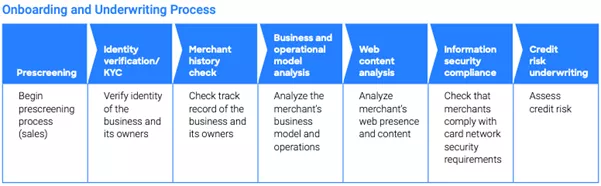
Digital automation can enable a process to underwrite a new merchant in just minutes rather than days. However, this acceleration in decisioning can come at the expense of risk management and can negatively impact profitability for the acquirer if not done correctly.
2. Gather actionable and objective data
Having access to actionable and objective data is key to effective onboarding decisioning. Merchant acquirers should leverage a mix of their own data, third-party data and scoring services to enrich their view of each applicant. The best practice is to leverage both application data and external data from the growing marketplace of data vendors who provide critical insight and scoring of things like bank account validation, email addresses, IP addresses, device IDs and negative hotlists. Ingesting internal data from disparate sources eliminates manual data entry and reduces judgmental underwriting decisioning while creating consistency through automation.
‘Acquirers possess a gold mine of data but the complexity of disparate platforms, unclear data strategy, poor data architecture, and limited buildout capabilities have impaired the ability to effectively monetize this asset.’ (2020 McKinsey Global Payments Report)
3. Leverage analytics and rules
In addition to having accurate and objective data, acquirers should find ways to analyse this data, leveraging analytic models and rules. The tools to do this should allow the acquirer to import models, scorecards, trees and tables, and should be fully configurable from a user perspective. In addition to external data, acquirers often have historical data on applicants but it is inaccessible due to the sprawl of data. Rather than suffering through the pain of trying to centralize all referential data in a single data store, architect the solution to grab data where it resides across many sources and access it at the time of decisioning.
4. Expand the risks you are monitoring, and your rate of learning
Managing risk in the onboarding process should not be the only consideration for merchant acquirers and their merchant customers. Increased digitization and greater demand for new payment solutions have added more risk to merchant acquirers’ portfolios. The barrier to entry into the digital/ecommerce marketplace has added risk as new entities are springing up and entering the system at breakneck speed. Validating these new entities requires more robust solutions that can leverage internal and external data.
Acquirers should sharpen their ability to manage fraud and compliance risk by assessing potentially collusive or fraud-targeted merchant activity, the likelihood of merchant attrition or bankruptcy, and existing and future merchant profitability.
There is a growing need to monitor merchants in real time to detect anomalous behaviours of merchants in time to stem losses. Also, we see great utility in connecting pre-book (onboarding) performance/results with post book (monitoring) outcomes to create faster learning loop and improvement of both areas. In fact, many acquirers are looking at fulfilling both these needs with a single platform/capability for better sharing of insights.
5. Ensure your merchant monitoring approach is comprehensive
An effective merchant monitoring approach will be automated, leverage cutting-edge analytics, real-time urgency and flexible data ingestion, and be able to proactively alert acquirers to potential risks and double as a competitive advantage for attracting new merchants to their network.
To find out more about why an effective strategy for merchant onboarding and monitoring is so important, download the new eBook, Managing Risk with Frictionless Digital Onboarding and Merchant Monitoring.
Learn more about FICO’s solutions for merchant onboarding and monitoring.

Popular Posts

Average U.S. FICO® Score at 716, Indicating Improvement in Consumer Credit Behaviors Despite Pandemic
The FICO Score is a broad-based, independent standard measure of credit risk
Read more
The GSE Data Is Public. Here's What It Shows About Credit Score Modernization.
Independent Milliman analysis of GSE historical data confirms what anyone can now verify directly: FICO® Score 10T is the most predictive score.
Read more
FICO® Score High Achievers: Is Age the Only Factor?
<p>FICO’s latest research on <a href="http://www.fico.com/en/blogs/risk-compliance/us-credit-quality-rising-the-beat-goes-on/" target="_blank">national FICO® Score distribution</a> shows that US credit quality continues to trend upwards, with an increasing number of consumers scoring in the highest scores ranges. Given that, we decided it was time to refresh our study on “<a href="http://www.fico.com/en/blogs/risk-compliance/infographic-what-does-a-high-credit-scorer-look-like/" target="_blank">FICO® Score high achievers</a>,” where we examine the credit behavioural profiles of consumers with higher credit scores.</p> <p>As expected, our latest study showed that older people generally have higher scores, as has been the case in our <a href="http://www.fico.com/en/blogs/risk-compliance/age-before-beauty-credit-worthiness-before-youth/" target="_blank">past research</a>. This is largely because they have trade lines that have been open longer, which leads to higher scores (assuming the trade lines are in good standing and all other things equal). The most credit savvy among you will remember that length of credit history accounts for roughly 15% of the overall <a href="http://www.myfico.com/CreditEducation/WhatsInYourScore.aspx" target="_blank">FICO® Score calculation</a>.</p> <p>But for younger consumers, it isn’t too helpful to say, “just wait until you are 50 years old, and that will fix things!” Thus, I decided to dive deeper with our analysis, including looking at the credit behavioural characteristics of younger consumers with high FICO® Scores.</p> <p>In this analysis, I looked at credit characteristics for the two highest score bands, 750-799 and 800-850, which have about 16% and 23% of the population, respectively. I further broke this down by looking at the characteristics of the youngest 15% in each group, which occurs at age 29 for the 750-799 group and 43 for the 800-850. We used FICO<strong>®</strong> Score 9 for our analysis, and examined typical variables of the categories that go into the make-up of the score.</p> <p><a href="http://www.fico.com/en/blogs/wp-content/uploads/2016/10/FICO-Score-High-Achiever-table.png"><img class="alignnone size-full wp-image-29367" src="http://www.fico.com/en/blogs/wp-content/uploads/2016/10/FICO-Score-High-Achiever-table.png" alt="fico-score-high-achiever-table" width="715" height="747" /></a></p> <p>Since there’s a lot to dissect in this chart, I’ll highlight a few findings that struck me: <ul> <li><strong>Credit history.</strong> Higher scores are undoubtedly associated with a longer time on file. What’s striking is the higher average time on file for the 800+ group, both overall and for revolving accounts (the most common trade line). Clearly, it helps to start credit use early in life – but that’s not the sole determining factor for high scoring. The younger cohorts in both the 800+ and 750-799 groups have time on file medians significantly less than their older counterparts.</li> <li><strong>New credit.</strong> High credit scorers do, in fact, pursue new credit. We see little variation in months since last trade line opening and last inquiry among all groups observed.</li> <li><strong>Pay on time.</strong> As you might expect, the further in the past the delinquency, the higher the score – and that’s <u>if</u> a delinquency ever happened. 95% of the 800+ people and 72% of the 750-799 group have never been delinquent, which is a striking contrast to the 57% for the total population. The percentages for the younger groups are even higher, especially so for the 750-799ers. Collection items are also scarce for these high scorers. While 23% of the national population have collection items greater than $99, the figures are only 0.5% for the 800+ group and 3% for the 750-799 group. It is clear that, in conjunction with starting a credit file early, paying on time is a key trait of the FICO® Score high achiever.</li> <li><strong>Balance and utilization.</strong> Finally, we look at how credit is being used, focusing on revolving product use. (Since most people only have one mortgage or one auto loan, variation in instalment product figures is minimal and driven by payment history, which is near perfect for high scorers, as we’ve seen.) FICO® Score high achievers tend to have more open revolving accounts. While the % active trades and utilization are generally lower, by no means do high scorers avoid the use of credit products. What drives the difference here is the amount of <u>available</u> revolving credit utilized. The 800+ group is roughly 1/4 of the national median, both in total and on their highest utilized card; they also have lower balances and more cards<em>. </em>The 750-799 group is more active and higher utilized, but still only at 2/3 of the national figures. The young 750-799 group compensate with lower revolving balances and, as a result, lower utilization, which is in line with what we see for the 800+ group.</li> <li><strong>Benchmarks.</strong> I’d like to point out that while this study provides good benchmarks of the typical credit traits of the FICO® Score high achiever, individual credit profiles will vary widely. And keep in mind that when we sort groups of consumers as a whole by different behaviours, some results may look superficially odd. For example, the 800+ band has a longer median average open account time (128 months) than average revolving months on file (140 months).</li> </ul> So, what do we conclude? A huge takeaway is that high scorers don’t have too much in the way of serious delinquencies and negative public record data.</p> <p>In most respects, the young 800+ people are like their peer group. They really only differ markedly in their shorter credit history and higher non-mortgage balance, both of which are a function of life stage. Our results show that you don’t have to be a credit product hermit; these high scorers have more credit cards. The takeaway is to start credit activity early and maintain well-managed and moderate usage.</p> <p>In many ways, the young 750-799 people are more interesting because their age profile is much younger. Their credit characteristics differ more from their peer group, particularly in terms of length of credit history. They compensate by having almost pristine credit records and lower balances.</p> <p>Ultimately, 39% of US consumers are FICO® Score high achievers, which they accomplish by following common-sense credit practices. It ain’t rocket science!</p>
Read moreTake the next step
Connect with FICO for answers to all your product and solution questions. Interested in becoming a business partner? Contact us to learn more. We look forward to hearing from you.