5 Steps to Stop Identity Fraud and Improve the Digital Experience
Finding the right balance between security and convenience can be a challenge - here's how to approach it


Identity-based fraud takes many forms: application fraud, bust-out fraud, account takeover, synthetic identities and identity theft. In response, many institutions have deployed layered controls to ensure they are interacting with genuine customers and help stop identity fraud. But, taken too far, having too many controls makes for a frustrating experience that can drive customers away.
How can banks deliver unified experiences across multiple channels, with the right amount of friction, to navigate the fine line between fraud reduction and customer experience? I’ve put together five steps to guide your organization through the process.
Step 1: Decrease the Complexity of Identity Proofing
FICO’s recent Customer Identity Management Survey of 172 banks across the globe, including 59 in North America, found that 51% of respondents push customers who are opening DDA accounts using websites and apps to prove their identity offline. Most commonly, customers are asked to mail in copies of identity documents or visit branches with them.
This arrangement is far from optimal. In a separate FICO survey of 1,000 North American consumers, 55% of respondents said the lack of automation in verifying customers’ identities is problematic; not only is manual intervention overly relied upon, but there is also inconsistency in how well a document is checked. Because humans are involved, the thoroughness of document verification varies based on the person performing this manual process.
To offer customers faster and better originations processes, banks need to automate more – without increasing risk. This means embracing technologies that allow new customers to complete the onboarding process, without asking them to move out of channel to prove who they are.
The solution is already in consumers’ hands. With mobile phones a fixture of daily living, customers can use a ‘selfie’ photo plus their phone’s document scan functionality to convey their identities. Meanwhile, the bank can deploy purpose-built artificial intelligence and machine learning solutions to match the customer’s selfie to their document, perform liveness detection to prove they are there in person, and execute data comparison and hologram detection to verify that the identity document is real and untampered with.
Step 2: Enlist the Digital Banking Team as an Ally
Security controls impact both fraud and customer experience, so it’s important to build organizational consensus to be able to enact them. The goals of a successful, comprehensive identity verification program include:
- Increase legitimate bookings of new accounts by reducing friction during the application through risk management tools.
- Increase mobile app usage, since the majority of consumers use both online and mobile together. Less than 10% of Americans use mobile banking exclusively.
- Confirm the true identity of the consumer to make sure no one is taking over the consumer’s identity.
- Build consumer trust in digital identity verification processes.
- Meet compliance requirements.
- Enable easy, safe access to accounts.
These goals should have key performance indicators, giving the cross-functional team tangible targets for increasing top line revenues while mitigating risk and losses.
Banks also need KPIs around how well they protect the customer and enhance the customer experience with security. For example, in a recently completed FICO survey of 1,000 consumers in North America, 8% of respondents reported they would abandon an account opening process, and 14% said they would go to a competitor, because of untenable identity verification processes. About 70% of the consumers surveyed expected to be able to prove their identity digitally – but as noted above, over half of customers are being sent to a branch, or asked to send in paper verifications for some account types.
The bottom line: The fraud team must work in tandem with its business partners within the bank to reach the common goals of increased revenue, high security and a great customer experience.
Step 3: Manage Identity Across the Customer Lifecycle
Checking a customer’s identity is not a one-and-done process; beyond identity proofing at the point of origination, customer authentication occurs throughout the customer lifecycle. Breaking this down further, a number of processes must be seamlessly integrated:
- Identity validation
- Identity verification
- Enrollment for future authentication
- Binding the identity to the account
- Authentication
- Step-up authentication
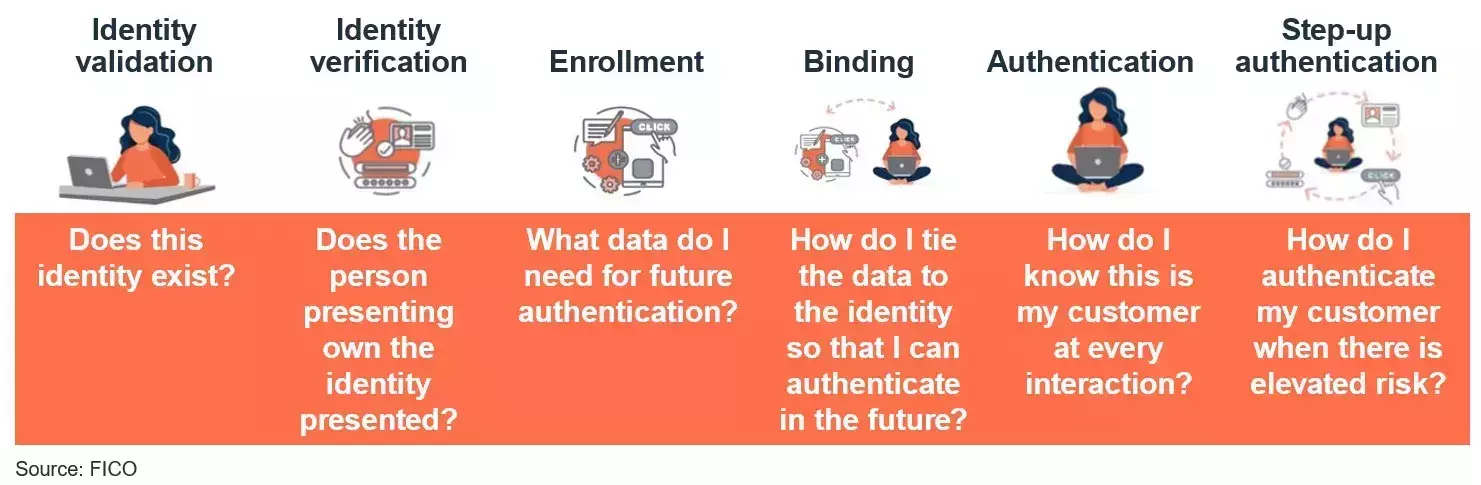
Sorting through the various steps, banks can frame this initiative as having a twofold goal, to:
- Deliver fully digital identity verification that removes duplication and inefficiency.
- Take an integrated approach to identity proofing with authentication across the customer lifecycle.
Step 4: Keep It Simple, but Not Too Simple
How can banks best use automation to stop identity fraud and improve the customer experience? Let’s look at an existing customer account login as an example.
If a bank forces every single customer to do step-up in authentication, it’s going to annoy customers and might drive them away.
This happened to me recently. One of my banks frustrates me every time I try an online login. I’m approved and my account summary page starts loading. But when I click on a specific account, I am taken back to the login screen. Because a double login is necessary every single time I want to see this account, I tend not to go to this bank anymore when I need to make a quick and easy transaction.
It’s all about balance, of course; at the same time, if security is not increased for anyone, your organization becomes more vulnerable to criminals and thus a target.
Step 5: Gain the Power of Contextual, Risk-Based Decisioning
A risk-based approach is critical, requiring contextual decisions that are integrated across decisioning platforms. For example, understanding if the customer is typing their password as normal, using keystroke behavioral biometrics, should help decide automatically whether to initiate a step up at account login. Or understanding whether a new device is being used when a new payee is added.
The consistency of customer experiences across platforms is also important. Not only because customers want to stay in their preferred channel, but also because consistency facilitates mutual authentication. Banks need to remain familiar to customers through coherent, day-to-day engagements, whether the experience is online or mobile.
Solutions to Balance Customer Experience and Risk
While thwarting account takeover is one of today’s most pressing fraud challenges, the solutions to address it can be the foundation for delivering satisfying, loyalty-building experiences throughout the customer lifecycle. Learn more about FICO® Falcon® Identity Proofing and the FICO® Falcon® Authentication Suite, and follow me on Twitter @LizFightsFraud.
Popular Posts

Average U.S. FICO® Score at 716, Indicating Improvement in Consumer Credit Behaviors Despite Pandemic
The FICO Score is a broad-based, independent standard measure of credit risk
Read more
The GSE Data Is Public. Here's What It Shows About Credit Score Modernization.
Independent Milliman analysis of GSE historical data confirms what anyone can now verify directly: FICO® Score 10T is the most predictive score.
Read more
FICO® Score High Achievers: Is Age the Only Factor?
<p>FICO’s latest research on <a href="http://www.fico.com/en/blogs/risk-compliance/us-credit-quality-rising-the-beat-goes-on/" target="_blank">national FICO® Score distribution</a> shows that US credit quality continues to trend upwards, with an increasing number of consumers scoring in the highest scores ranges. Given that, we decided it was time to refresh our study on “<a href="http://www.fico.com/en/blogs/risk-compliance/infographic-what-does-a-high-credit-scorer-look-like/" target="_blank">FICO® Score high achievers</a>,” where we examine the credit behavioural profiles of consumers with higher credit scores.</p> <p>As expected, our latest study showed that older people generally have higher scores, as has been the case in our <a href="http://www.fico.com/en/blogs/risk-compliance/age-before-beauty-credit-worthiness-before-youth/" target="_blank">past research</a>. This is largely because they have trade lines that have been open longer, which leads to higher scores (assuming the trade lines are in good standing and all other things equal). The most credit savvy among you will remember that length of credit history accounts for roughly 15% of the overall <a href="http://www.myfico.com/CreditEducation/WhatsInYourScore.aspx" target="_blank">FICO® Score calculation</a>.</p> <p>But for younger consumers, it isn’t too helpful to say, “just wait until you are 50 years old, and that will fix things!” Thus, I decided to dive deeper with our analysis, including looking at the credit behavioural characteristics of younger consumers with high FICO® Scores.</p> <p>In this analysis, I looked at credit characteristics for the two highest score bands, 750-799 and 800-850, which have about 16% and 23% of the population, respectively. I further broke this down by looking at the characteristics of the youngest 15% in each group, which occurs at age 29 for the 750-799 group and 43 for the 800-850. We used FICO<strong>®</strong> Score 9 for our analysis, and examined typical variables of the categories that go into the make-up of the score.</p> <p><a href="http://www.fico.com/en/blogs/wp-content/uploads/2016/10/FICO-Score-High-Achiever-table.png"><img class="alignnone size-full wp-image-29367" src="http://www.fico.com/en/blogs/wp-content/uploads/2016/10/FICO-Score-High-Achiever-table.png" alt="fico-score-high-achiever-table" width="715" height="747" /></a></p> <p>Since there’s a lot to dissect in this chart, I’ll highlight a few findings that struck me: <ul> <li><strong>Credit history.</strong> Higher scores are undoubtedly associated with a longer time on file. What’s striking is the higher average time on file for the 800+ group, both overall and for revolving accounts (the most common trade line). Clearly, it helps to start credit use early in life – but that’s not the sole determining factor for high scoring. The younger cohorts in both the 800+ and 750-799 groups have time on file medians significantly less than their older counterparts.</li> <li><strong>New credit.</strong> High credit scorers do, in fact, pursue new credit. We see little variation in months since last trade line opening and last inquiry among all groups observed.</li> <li><strong>Pay on time.</strong> As you might expect, the further in the past the delinquency, the higher the score – and that’s <u>if</u> a delinquency ever happened. 95% of the 800+ people and 72% of the 750-799 group have never been delinquent, which is a striking contrast to the 57% for the total population. The percentages for the younger groups are even higher, especially so for the 750-799ers. Collection items are also scarce for these high scorers. While 23% of the national population have collection items greater than $99, the figures are only 0.5% for the 800+ group and 3% for the 750-799 group. It is clear that, in conjunction with starting a credit file early, paying on time is a key trait of the FICO® Score high achiever.</li> <li><strong>Balance and utilization.</strong> Finally, we look at how credit is being used, focusing on revolving product use. (Since most people only have one mortgage or one auto loan, variation in instalment product figures is minimal and driven by payment history, which is near perfect for high scorers, as we’ve seen.) FICO® Score high achievers tend to have more open revolving accounts. While the % active trades and utilization are generally lower, by no means do high scorers avoid the use of credit products. What drives the difference here is the amount of <u>available</u> revolving credit utilized. The 800+ group is roughly 1/4 of the national median, both in total and on their highest utilized card; they also have lower balances and more cards<em>. </em>The 750-799 group is more active and higher utilized, but still only at 2/3 of the national figures. The young 750-799 group compensate with lower revolving balances and, as a result, lower utilization, which is in line with what we see for the 800+ group.</li> <li><strong>Benchmarks.</strong> I’d like to point out that while this study provides good benchmarks of the typical credit traits of the FICO® Score high achiever, individual credit profiles will vary widely. And keep in mind that when we sort groups of consumers as a whole by different behaviours, some results may look superficially odd. For example, the 800+ band has a longer median average open account time (128 months) than average revolving months on file (140 months).</li> </ul> So, what do we conclude? A huge takeaway is that high scorers don’t have too much in the way of serious delinquencies and negative public record data.</p> <p>In most respects, the young 800+ people are like their peer group. They really only differ markedly in their shorter credit history and higher non-mortgage balance, both of which are a function of life stage. Our results show that you don’t have to be a credit product hermit; these high scorers have more credit cards. The takeaway is to start credit activity early and maintain well-managed and moderate usage.</p> <p>In many ways, the young 750-799 people are more interesting because their age profile is much younger. Their credit characteristics differ more from their peer group, particularly in terms of length of credit history. They compensate by having almost pristine credit records and lower balances.</p> <p>Ultimately, 39% of US consumers are FICO® Score high achievers, which they accomplish by following common-sense credit practices. It ain’t rocket science!</p>
Read moreTake the next step
Connect with FICO for answers to all your product and solution questions. Interested in becoming a business partner? Contact us to learn more. We look forward to hearing from you.