Decision Fundamentals: Accelerating Intelligent Solution Creation
This is my second blog in a series of five, recapping the key principles in my talk at FICO World 2016. Those five principles can transform the way organizations can create and dep…

This is my second blog in a series of five, recapping the key principles in my talk at FICO World 2016. Those five principles can transform the way organizations can create and deploy analytically powered applications:
1. Capturing subject matter expertise 2. Accelerating intelligent solution creation 3. Faster insight to execution 4. Building institutional memory 5. Greater analytic accessibility
With this blog I’ll dive into accelerating intelligent solution creation, and how it helps enterprise IT organizations to significantly reduce the complexity of solution creation.
Less Legacy…More Innovation
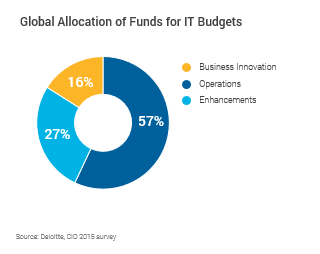
Legacy applications consume an extraordinary amount of IT dollars; only 16% of IT budgets go to innovation.
Today, innovation dollars are getting further reduced and all the new innovative applications built this year will need to be maintained in the following years. Most companies underestimate the complexity and cost of maintaining applications, and find themselves with less and less dollars and personnel to innovate.
That’s where Rapid Application Development (RAD) and Deployment approaches come into play. Not only do they allow enterprise applications to be built much faster, but also decrease application maintenance costs by:
- Making applications that are easier to change
- Making it easier for the operations team to diagnose issues
- Using less staff
- Improving quality because of abstract development and auto generated code
The secret to Rapid Application Development has to do with complexity and collaboration. I know this is true based on my own experience; I used to be Java developer, and before that a C developer, and before that I wrote FORTRAN code. Rapid Application Development presents a sea change in solution creation in three ways:
- By abstracting development to an easy-to-use visual interface, developers can be more productive and new developers can be brought up to speed more quickly.
- By defining a standard extensible way in which integration with enterprise data sources or systems can occur, more systems can be integrated and more code re-used.
- By automatically generating all the necessary code for tracing and logging needed by operations, the collaboration between development and ops is improved.
FICO has taken Rapid Application Development (RAD) capabilities and combined them with Decision Management, allowing our customers to accelerate intelligent solution creation.
We looked at the many FICO Professional Services customer implementations, extracted best practices and common patterns, and transformed them into out-of-the-box services. As with any good technology company we started using these best practices and patterns ourselves.
We re-architected FICO® Origination Manager using our own Decision Management Suite, and these best practices to create a new origination solution that would accelerate and streamline deployment for customers. In the process, we reduced our own developer effort by 75% and were able to deliver the project in just over 6 months.
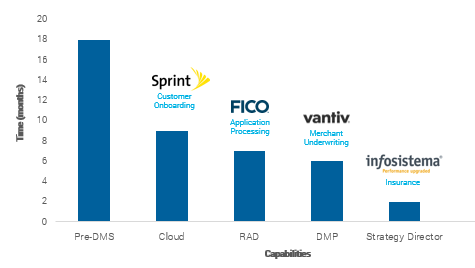
Now let’s take a look at how intelligent solution creation benefits FICO customers. Note that when FICO started this journey, it took us on average 18 months to develop and deliver a solution to a customer. We’ve dramatically shortened that time by integrating RAD with Decision Management.
Watch Video: Sprint leverages FICO to build a customer onboarding system in just nine months
Serving more than 55 million subscribers, Sprint wanted to completely revamp the way it did customer onboarding, and wanted to do it quickly. The wireless company needed to replace its existing credit portal used for new US consumer and business mobility customers. The portal contains multiple originations processes including third party bureau connectivity, risk scoring and custom decisioning rules.
Sprint gets hundreds of thousands of customer applications for service each week. For each customer, Sprint needs to figure out the optimal type of device, how much of the purchase price they are willing to subsidize, what kind of plans will be offered for selection, what kind of deposit will be required, and so on. Sprint optimizes the offer made to each customer to boost customer satisfaction, improve the probability of long-term retention, reduce risk, and increase overall portfolio profitability. Those are very complex factors to juggle.
Using FICO Decision Management Suite, Sprint estimates that by quickly optimizing offers for new customers, they saved millions of dollars in customer acquisition and setup costs. They also they realized these savings quickly; using a cloud-based deployment of DMS, Sprint didn’t have to procure any hardware and rely on their overburdened IT organization. FICO delivered a complete customer onboarding system in just nine months.
Watch Video: Vantiv delivers a new merchant onboarding system in 6 months
Vantiv is one of the largest payment processors in the United States, processing 17 billion transactions a year, with a base of nearly half a million merchants and partnering with over 1400 financial institutions across the country. They have customers ranging from Walmart to mom and pop delis.
Vantiv was growing very rapidly, and it became evident their onboarding process needed to be improved – it was not agile, flexible or scalable enough. Just to give you an idea, they had a manual onboarding process in which it would take an analyst up to 9 days to make a decision on an application. They knew they needed to automate their decisions, not only to speed up the process, but also to make sure they were managing their risk better.
Vantiv worked with FICO on an end-to-end merchant onboarding solution, based on the Decision Management Suite. Today, instead of 9 days it takes minutes for an application to be processed, helping activate a merchant account much faster – which translates directly into revenue growth.
They wanted to run on premise, but didn’t want to wait for their IT organization, so we built the entire project in the cloud and in parallel their IT prepared their infrastructure. Thanks to our rapid application development and deployment capabilities, and their adoption of an agile methodology, we delivered a merchant acquisition solution in less than 6 months.
Infosistema creates an insurance solution in just 2 months
Infosistema is a technology consultancy based in Portugal, with more than 20 years of experience in banking and insurance building web portals, mobile applications, BPM/Workflow, SOA and Analytic solutions.
The insurance industry started facing disruptive change thanks to new technologies like in car analytics, smart homes and wearables. Those technologies are eroding the advantages of scale that large insurers enjoy and are leading to smaller players with new business models. Decision technology plays an important role in the whole cycle of insurance; quoting, underwriting, claims and litigation. Infosistema found a way to help insurers quickly adapt their decision-making to keep up with industry transformations and they were able to build that solution on the Decision Management Suite in just 2 months.
In my next blog I’ll talk about the third decision fundamental, faster insight to execution.

Popular Posts

Average U.S. FICO® Score at 716, Indicating Improvement in Consumer Credit Behaviors Despite Pandemic
The FICO Score is a broad-based, independent standard measure of credit risk
Read more
The GSE Data Is Public. Here's What It Shows About Credit Score Modernization.
Independent Milliman analysis of GSE historical data confirms what anyone can now verify directly: FICO® Score 10T is the most predictive score.
Read more
FICO® Score High Achievers: Is Age the Only Factor?
<p>FICO’s latest research on <a href="http://www.fico.com/en/blogs/risk-compliance/us-credit-quality-rising-the-beat-goes-on/" target="_blank">national FICO® Score distribution</a> shows that US credit quality continues to trend upwards, with an increasing number of consumers scoring in the highest scores ranges. Given that, we decided it was time to refresh our study on “<a href="http://www.fico.com/en/blogs/risk-compliance/infographic-what-does-a-high-credit-scorer-look-like/" target="_blank">FICO® Score high achievers</a>,” where we examine the credit behavioural profiles of consumers with higher credit scores.</p> <p>As expected, our latest study showed that older people generally have higher scores, as has been the case in our <a href="http://www.fico.com/en/blogs/risk-compliance/age-before-beauty-credit-worthiness-before-youth/" target="_blank">past research</a>. This is largely because they have trade lines that have been open longer, which leads to higher scores (assuming the trade lines are in good standing and all other things equal). The most credit savvy among you will remember that length of credit history accounts for roughly 15% of the overall <a href="http://www.myfico.com/CreditEducation/WhatsInYourScore.aspx" target="_blank">FICO® Score calculation</a>.</p> <p>But for younger consumers, it isn’t too helpful to say, “just wait until you are 50 years old, and that will fix things!” Thus, I decided to dive deeper with our analysis, including looking at the credit behavioural characteristics of younger consumers with high FICO® Scores.</p> <p>In this analysis, I looked at credit characteristics for the two highest score bands, 750-799 and 800-850, which have about 16% and 23% of the population, respectively. I further broke this down by looking at the characteristics of the youngest 15% in each group, which occurs at age 29 for the 750-799 group and 43 for the 800-850. We used FICO<strong>®</strong> Score 9 for our analysis, and examined typical variables of the categories that go into the make-up of the score.</p> <p><a href="http://www.fico.com/en/blogs/wp-content/uploads/2016/10/FICO-Score-High-Achiever-table.png"><img class="alignnone size-full wp-image-29367" src="http://www.fico.com/en/blogs/wp-content/uploads/2016/10/FICO-Score-High-Achiever-table.png" alt="fico-score-high-achiever-table" width="715" height="747" /></a></p> <p>Since there’s a lot to dissect in this chart, I’ll highlight a few findings that struck me: <ul> <li><strong>Credit history.</strong> Higher scores are undoubtedly associated with a longer time on file. What’s striking is the higher average time on file for the 800+ group, both overall and for revolving accounts (the most common trade line). Clearly, it helps to start credit use early in life – but that’s not the sole determining factor for high scoring. The younger cohorts in both the 800+ and 750-799 groups have time on file medians significantly less than their older counterparts.</li> <li><strong>New credit.</strong> High credit scorers do, in fact, pursue new credit. We see little variation in months since last trade line opening and last inquiry among all groups observed.</li> <li><strong>Pay on time.</strong> As you might expect, the further in the past the delinquency, the higher the score – and that’s <u>if</u> a delinquency ever happened. 95% of the 800+ people and 72% of the 750-799 group have never been delinquent, which is a striking contrast to the 57% for the total population. The percentages for the younger groups are even higher, especially so for the 750-799ers. Collection items are also scarce for these high scorers. While 23% of the national population have collection items greater than $99, the figures are only 0.5% for the 800+ group and 3% for the 750-799 group. It is clear that, in conjunction with starting a credit file early, paying on time is a key trait of the FICO® Score high achiever.</li> <li><strong>Balance and utilization.</strong> Finally, we look at how credit is being used, focusing on revolving product use. (Since most people only have one mortgage or one auto loan, variation in instalment product figures is minimal and driven by payment history, which is near perfect for high scorers, as we’ve seen.) FICO® Score high achievers tend to have more open revolving accounts. While the % active trades and utilization are generally lower, by no means do high scorers avoid the use of credit products. What drives the difference here is the amount of <u>available</u> revolving credit utilized. The 800+ group is roughly 1/4 of the national median, both in total and on their highest utilized card; they also have lower balances and more cards<em>. </em>The 750-799 group is more active and higher utilized, but still only at 2/3 of the national figures. The young 750-799 group compensate with lower revolving balances and, as a result, lower utilization, which is in line with what we see for the 800+ group.</li> <li><strong>Benchmarks.</strong> I’d like to point out that while this study provides good benchmarks of the typical credit traits of the FICO® Score high achiever, individual credit profiles will vary widely. And keep in mind that when we sort groups of consumers as a whole by different behaviours, some results may look superficially odd. For example, the 800+ band has a longer median average open account time (128 months) than average revolving months on file (140 months).</li> </ul> So, what do we conclude? A huge takeaway is that high scorers don’t have too much in the way of serious delinquencies and negative public record data.</p> <p>In most respects, the young 800+ people are like their peer group. They really only differ markedly in their shorter credit history and higher non-mortgage balance, both of which are a function of life stage. Our results show that you don’t have to be a credit product hermit; these high scorers have more credit cards. The takeaway is to start credit activity early and maintain well-managed and moderate usage.</p> <p>In many ways, the young 750-799 people are more interesting because their age profile is much younger. Their credit characteristics differ more from their peer group, particularly in terms of length of credit history. They compensate by having almost pristine credit records and lower balances.</p> <p>Ultimately, 39% of US consumers are FICO® Score high achievers, which they accomplish by following common-sense credit practices. It ain’t rocket science!</p>
Read moreTake the next step
Connect with FICO for answers to all your product and solution questions. Interested in becoming a business partner? Contact us to learn more. We look forward to hearing from you.