Decision Platform Know-How Makes Winning Customers Personal
Personalisation underpinned by applied intelligence and cloud-hosted platform technology offers a competitive advantage when it comes to winning customers

New IDC research predicts that within the next two years around 30% of global Tier-1 banks will rely on relevant and responsible personalization as a key differentiator to retaining loyal customers.
In fact, as early as next year, it’s predicted at least one in four (25%) will be reliant on applied intelligence, in the shape of AI sentiment analysis, to improve customer experience via decision platforms. A similar number (25%) of well-established banks also expect to be fully reliant on deployment of data warehouses and analytics operations via cloud-hosted decision platforms.
Digital decision platforms have been driving a diverse mix of innovations. The stellar growth of point-of-sale finance, notably in the shape of BNPL (buy-now-pay-later), is a case in point. It’s been around in one form or another for more than 60 years. But with the mass adoption of digital channels, it’s now estimated nearly two-thirds (65%) of online customers will try an instant finance option within the next 12 months.
At the same time payments are also set to become faster and smarter with more than one in three (35%) Tier-1 firms using AI-derived applied intelligence models. A similar number (30%), will also turn to AI-assisted next best action programmes across all channels, driving even greater demand for ever-more complex customer management and customer service solutions delivered via decision platforms. It’s fair to say personalisation underpinned by applied intelligence and cloud-hosted platform technology will continue to offer a competitive advantage when it comes to winning and retaining digital customers.
How Decision Platform Technology Drives Agility
While few of the research findings are genuinely surprising, they are relevant, and they are significant.
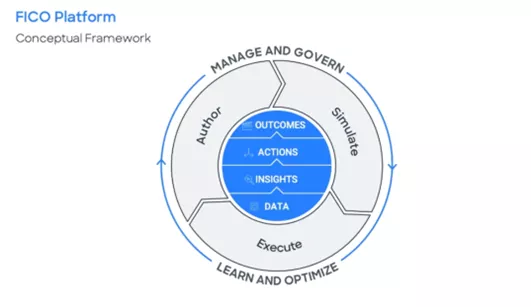
We know that many digital transformation projects fail to deliver what was expected, for many reasons. But success often hinges on agility. For our clients, it’s an ongoing mission. Particularly given the way the lines between industries have blurred with competitive guard rails no longer defined by verticals. Telcos are becoming banks, messaging services are becoming telcos, hyper-scale internet companies are retailers and numerous start-ups have created mass-market payment channels.
Key Steps on the Digital Decision Platform Journey
How ready and willing are Tier-1 banks to transform again and again to simply stay relevant to customers and stay ahead of emerging competition? It's a question continually posed in The 11 Commandments of Digital Banking. It highlights why banks vying for a greater share of digital customers are obliged to focus on humanizing the customer experience, always staying relevant and being personable in impersonal channels.
Agility always poses challenges when it comes to delivering value, managing and measuring success. But driven by a combination of consumer expectation and technological development, firms are re-structuring offerings to be more agile, opportunistic and – as far as possible – near-future proofing to market changes.
Top-Performers Continually Deliver Masterclasses in Best Practice
Volvo Cars turned to FICO Platform to digitize and accelerate the customer onboarding process for its new vehicle subscription service, Care by Volvo. By plugging into a cloud-hosted platform, it now approves most applications in real time, across multiple regions, with credit checks lasting a matter of seconds. It replaced a process that historically could take days to complete.
Care by Volvo is a vehicle subscription service designed to let customers enjoy the benefits of a new Volvo motor, without the challenges of owning one. For a fixed monthly fee, Volvo provides subscribers with a brand-new, while covering all regular service, maintenance costs and breakdown cover. The service was introduced to reflect the shift in consumer preference toward car usage and away from absolute ownership.
Volvo adopted FICO Platform cloud-hosted components to deliver maximum efficiency. The technology connects to various external data providers, provides a workflow for managing referred decisions and is integrated directly into digital sales channels. It is used for both consumer and business subscribers. Care by Volvo quickly achieved its goal of real-time decisions for more than 80% of applications. As a bonus, FICO-powered applied intelligence is also being extended beyond Care by Volvo to all digital sales and new battery electric vehicles as the Volvo Digital journey continues to progress across the globe.
Using Technology to Make Decision-Making Personal
European consumer debt purchaser Hoist Finance is improving management and delivering savings after turning to FICO Platform and rolling out a centralized approach to decision-making. Hoist has now improved the customer experience, streamlined operations and sped up processing. Hoist Finance is now making a million real-time decisions every day across multiple regions. It's now expected to deliver a further €8.5 million (US$9.7 million) in annual staff savings as its lending book grows by 40%.
Hoist Finance now manages 18 million accounts across 10 countries thanks to the decision to centralize decisions via a single platform. Prior to working with FICO, customer decisions were managed using 14 different systems. Hoist unified its decisioning technology across all regions, to deploy new strategies faster and improve results through an ongoing process of testing and simulation. It also wanted to ensure it made better decisions by calling on multiple external data sources and using advanced predictive models and AI.
Hoist Finance is currently live with FICO Platform’s rules management system in Germany and the UK, with five more countries earmarked to go online within the next few months. Every country involves up to 40,000 rules that are all automated on FICO Platform. The automation and personalization of customer engagements and negotiations, enables Hoist to resolve one in five (20%) cases automatically across its entire group, and around one in three (33%) UK cases.
FICO Platform operationalizes predictive models and scores to deliver multiple, simultaneous challenger strategies that consistently deliver more and more efficiencies. But the results speak for themselves. They include a 30% increase in data-driven, digital payment plans. A decrease of nearly 90% in plan breakage rates. There were also critical environmental benefits highlighted by a 97% lower carbon footprint for each digital resolution, resulting in annual savings of 442 tons of carbon for every 10% increase in digital collections – equating to the same amount of carbon that is generated by around 35 UK residents every year.
How FICO Can Help You Develop a Winning Digital Strategy
- Discover the power of FICO Platform to help you design, test and successfully execute strategies.
- Learn more about how FICO Advisors can help you plan your digital strategic direction.
- Read The 11 Commandments of Digital Banking.
- See the Decision Awards winners from FICO World 2022 and their digital transformation success stories.

Popular Posts

Average U.S. FICO® Score at 716, Indicating Improvement in Consumer Credit Behaviors Despite Pandemic
The FICO Score is a broad-based, independent standard measure of credit risk
Read more
The GSE Data Is Public. Here's What It Shows About Credit Score Modernization.
Independent Milliman analysis of GSE historical data confirms what anyone can now verify directly: FICO® Score 10T is the most predictive score.
Read more
FICO® Score High Achievers: Is Age the Only Factor?
<p>FICO’s latest research on <a href="http://www.fico.com/en/blogs/risk-compliance/us-credit-quality-rising-the-beat-goes-on/" target="_blank">national FICO® Score distribution</a> shows that US credit quality continues to trend upwards, with an increasing number of consumers scoring in the highest scores ranges. Given that, we decided it was time to refresh our study on “<a href="http://www.fico.com/en/blogs/risk-compliance/infographic-what-does-a-high-credit-scorer-look-like/" target="_blank">FICO® Score high achievers</a>,” where we examine the credit behavioural profiles of consumers with higher credit scores.</p> <p>As expected, our latest study showed that older people generally have higher scores, as has been the case in our <a href="http://www.fico.com/en/blogs/risk-compliance/age-before-beauty-credit-worthiness-before-youth/" target="_blank">past research</a>. This is largely because they have trade lines that have been open longer, which leads to higher scores (assuming the trade lines are in good standing and all other things equal). The most credit savvy among you will remember that length of credit history accounts for roughly 15% of the overall <a href="http://www.myfico.com/CreditEducation/WhatsInYourScore.aspx" target="_blank">FICO® Score calculation</a>.</p> <p>But for younger consumers, it isn’t too helpful to say, “just wait until you are 50 years old, and that will fix things!” Thus, I decided to dive deeper with our analysis, including looking at the credit behavioural characteristics of younger consumers with high FICO® Scores.</p> <p>In this analysis, I looked at credit characteristics for the two highest score bands, 750-799 and 800-850, which have about 16% and 23% of the population, respectively. I further broke this down by looking at the characteristics of the youngest 15% in each group, which occurs at age 29 for the 750-799 group and 43 for the 800-850. We used FICO<strong>®</strong> Score 9 for our analysis, and examined typical variables of the categories that go into the make-up of the score.</p> <p><a href="http://www.fico.com/en/blogs/wp-content/uploads/2016/10/FICO-Score-High-Achiever-table.png"><img class="alignnone size-full wp-image-29367" src="http://www.fico.com/en/blogs/wp-content/uploads/2016/10/FICO-Score-High-Achiever-table.png" alt="fico-score-high-achiever-table" width="715" height="747" /></a></p> <p>Since there’s a lot to dissect in this chart, I’ll highlight a few findings that struck me: <ul> <li><strong>Credit history.</strong> Higher scores are undoubtedly associated with a longer time on file. What’s striking is the higher average time on file for the 800+ group, both overall and for revolving accounts (the most common trade line). Clearly, it helps to start credit use early in life – but that’s not the sole determining factor for high scoring. The younger cohorts in both the 800+ and 750-799 groups have time on file medians significantly less than their older counterparts.</li> <li><strong>New credit.</strong> High credit scorers do, in fact, pursue new credit. We see little variation in months since last trade line opening and last inquiry among all groups observed.</li> <li><strong>Pay on time.</strong> As you might expect, the further in the past the delinquency, the higher the score – and that’s <u>if</u> a delinquency ever happened. 95% of the 800+ people and 72% of the 750-799 group have never been delinquent, which is a striking contrast to the 57% for the total population. The percentages for the younger groups are even higher, especially so for the 750-799ers. Collection items are also scarce for these high scorers. While 23% of the national population have collection items greater than $99, the figures are only 0.5% for the 800+ group and 3% for the 750-799 group. It is clear that, in conjunction with starting a credit file early, paying on time is a key trait of the FICO® Score high achiever.</li> <li><strong>Balance and utilization.</strong> Finally, we look at how credit is being used, focusing on revolving product use. (Since most people only have one mortgage or one auto loan, variation in instalment product figures is minimal and driven by payment history, which is near perfect for high scorers, as we’ve seen.) FICO® Score high achievers tend to have more open revolving accounts. While the % active trades and utilization are generally lower, by no means do high scorers avoid the use of credit products. What drives the difference here is the amount of <u>available</u> revolving credit utilized. The 800+ group is roughly 1/4 of the national median, both in total and on their highest utilized card; they also have lower balances and more cards<em>. </em>The 750-799 group is more active and higher utilized, but still only at 2/3 of the national figures. The young 750-799 group compensate with lower revolving balances and, as a result, lower utilization, which is in line with what we see for the 800+ group.</li> <li><strong>Benchmarks.</strong> I’d like to point out that while this study provides good benchmarks of the typical credit traits of the FICO® Score high achiever, individual credit profiles will vary widely. And keep in mind that when we sort groups of consumers as a whole by different behaviours, some results may look superficially odd. For example, the 800+ band has a longer median average open account time (128 months) than average revolving months on file (140 months).</li> </ul> So, what do we conclude? A huge takeaway is that high scorers don’t have too much in the way of serious delinquencies and negative public record data.</p> <p>In most respects, the young 800+ people are like their peer group. They really only differ markedly in their shorter credit history and higher non-mortgage balance, both of which are a function of life stage. Our results show that you don’t have to be a credit product hermit; these high scorers have more credit cards. The takeaway is to start credit activity early and maintain well-managed and moderate usage.</p> <p>In many ways, the young 750-799 people are more interesting because their age profile is much younger. Their credit characteristics differ more from their peer group, particularly in terms of length of credit history. They compensate by having almost pristine credit records and lower balances.</p> <p>Ultimately, 39% of US consumers are FICO® Score high achievers, which they accomplish by following common-sense credit practices. It ain’t rocket science!</p>
Read moreTake the next step
Connect with FICO for answers to all your product and solution questions. Interested in becoming a business partner? Contact us to learn more. We look forward to hearing from you.