Falcon Intelligence Network: A Fraud Consortium for Fraud-Fighting Machine Learning Innovation
How FICO uses global payments data to accurately prevent the next fraud event across a wide range of payment types and channels

Rome wasn’t built in a day. And neither was the FICO® Falcon® Intelligence Network, the industry’s richest repository of legitimate and fraudulent payment data. But unlike crumbling ancient Roman ruins, the Falcon Intelligence Network, FICO’s fraud consortium, is stronger and more vital today than ever. Its detailed consortium data is not only one of FICO’s secret weapons for fighting card fraud, but also fraud that proliferates across every payment channel, from mobile, to card not present, to person-to-person (P2P) and more. Consortia data is a key functionality trend for next generation Fraud and AML Machine Learning platforms.*
What Is the FICO Falcon Intelligence Network?
The Falcon Intelligence Network is FICO’s enormous data resource composed of anonymized transactional and non-monetary data regularly contributed by over 9,000 financial institutions worldwide. This fraud consortium is unique to the financial services industry and is at the core of FICO’s ability to innovate and create the most effective analytic and AI techniques and models on the market today. Across all transaction channels, our models achieve their foremost goal: to differentiate non-fraud from fraudulent activity with pinpoint accuracy.
The data riches of the Falcon Intelligence Network are used to protect more than 2.6 billion payment accounts from being hit with fraudulent payments activity. This data also provides the ingredients for the FICO fraud and financial crime solutions, to fight fraud and financial crimes for the enterprise, across all payment channels, and across the customer lifecycle.
Want to gain some insights into our secret sauce? Here are four critical capabilities:
Data-Fueled Analytic and AI Innovation
FICO’s fraud consortium data is never stagnant or outdated; it’s continuously refreshed. From this abundant source, FICO’s data science organization carefully extracts subsets to fuel development in four areas, illustrated below.
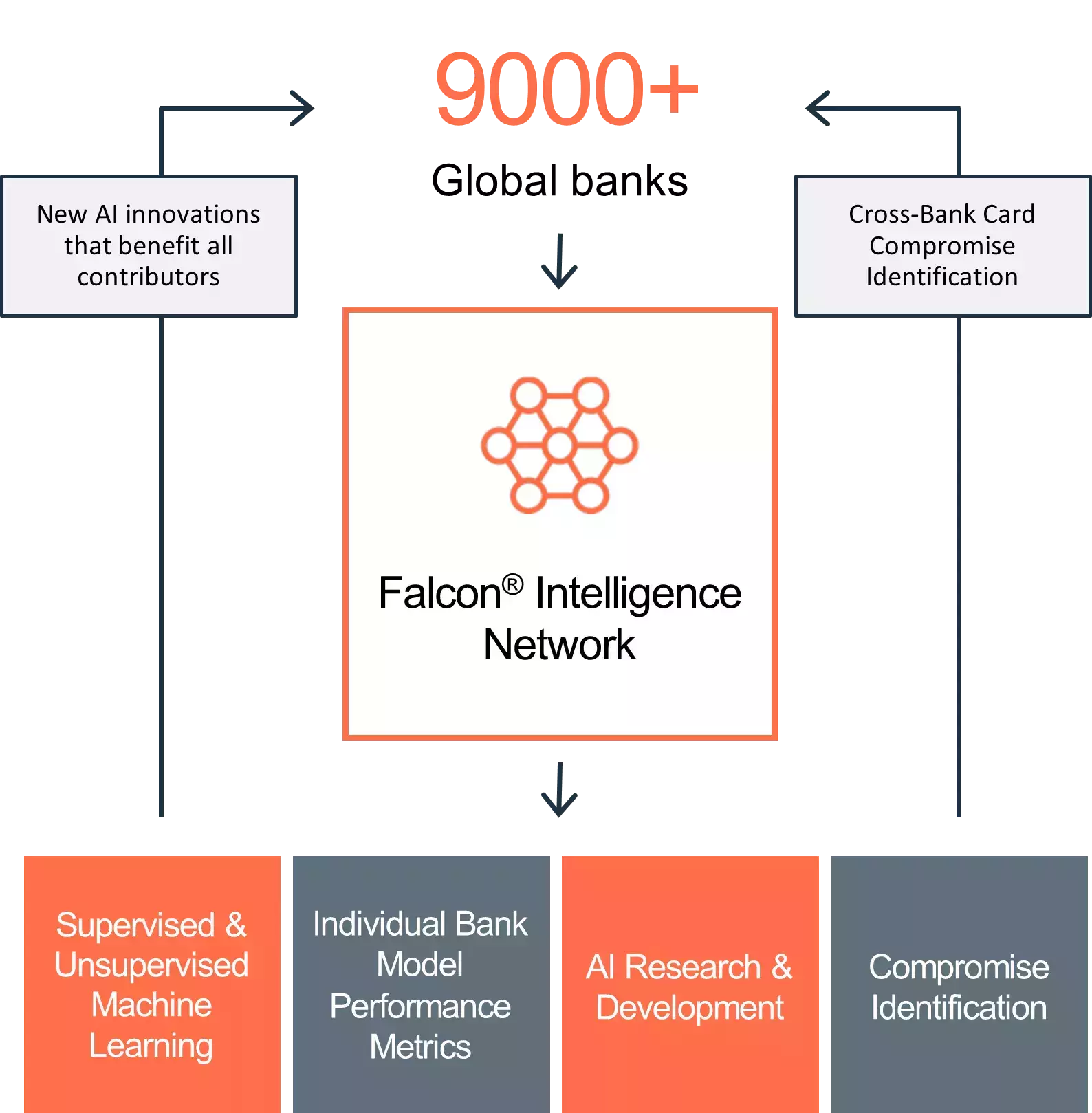
- Machine learning models: FICO uses anonymized transactional and non-monetary data to create machine learning algorithms that inform behavioral analytics, to reduce false positives while interpreting even the most subtle indications of fraud.
The resulting models work with Falcon’s real-time profiling techniques to interpret individual behaviors, while benefitting from macro-level fraud patterns derived from data contributed through the Falcon Intelligence Network. We leverage these approaches in the development of FICO’s supervised fraud models as well as unsupervised and semi-supervised models that are trained on bank-specific data.
FICO’s unsupervised models differ from supervised models because they are not trained on labeled target behavior – i.e., tagged fraudulent card transactions – but instead use techniques that find outlier behavior, that is, potential new fraud behavior in new payment schemes. FICO’s chief analytics officer, Dr. Scott Zoldi, unpacks unsupervised models, which he refers to as “little crystal balls” in this great blog post.
- Performance benchmarking: FICO provides cloud-based model performance benchmarking dashboards that banks and card issuers can use to assess their fraud management strategies. Benchmarking data model performance identifies whether the model is degrading, whether data quality is impacting detection and help identify where you might have room for operational improvements. Benchmarking fraud detection models’ performance is important to verify that a specific model’s performance met, exceeded or did not meet the expected results for your organization’s overall fraud strategy.
- AI research and development: FICO’s data science organization, led by Dr. Zoldi, leads the industry in innovation, having produced more than 100 patented AI and analytic techniques specifically for fraud and financial crime. These innovations are directly applied across our product portfolio, giving FICO a unique understanding of enterprise-level, cross-channel fraud.
We apply this behavioral “lens” on enterprise fraud to quickly spot a wide range of emerging fraud types, which can arise in days, minutes and even seconds. FICO offers industry-leading capabilities for stopping real-time payments fraud, detecting CNP fraud faster in the credit card channel, and stopping mobile payments fraud by gaining a 360-degree view into customer activity, to name just a few.
- Compromise identification: FICO also uses the Falcon Intelligence Network to identify compromised points of purchase (CPP). FICO® Falcon® Compromise Manager harnesses the power of consortium data to proactively detect compromised merchants, ATMs and data breaches, and alert fraud teams. This solution, a companion to the FICO® Falcon® Fraud Manager, mitigates cross-channel fraud exposure by analyzing and detecting likely compromised cards from card present, CNP and ATM transactions.
Bigger Is Better
The examples above clearly show the real-world value of the Falcon Intelligence Network: fraud models that are developed and trained using data from thousands of institutions will be more accurate than models that rely on a relatively thin dataset, such as transaction data from a single bank or issuer. The Falcon Intelligence Network is a fraud consortium unique to FICO, and just one of the many ways we lead performance and innovation in the fraud management industry. Our customers agree.
Follow my news and views on Twitter @dougoclare.

Popular Posts

Average U.S. FICO® Score at 716, Indicating Improvement in Consumer Credit Behaviors Despite Pandemic
The FICO Score is a broad-based, independent standard measure of credit risk
Read more
The GSE Data Is Public. Here's What It Shows About Credit Score Modernization.
Independent Milliman analysis of GSE historical data confirms what anyone can now verify directly: FICO® Score 10T is the most predictive score.
Read more
FICO® Score High Achievers: Is Age the Only Factor?
<p>FICO’s latest research on <a href="http://www.fico.com/en/blogs/risk-compliance/us-credit-quality-rising-the-beat-goes-on/" target="_blank">national FICO® Score distribution</a> shows that US credit quality continues to trend upwards, with an increasing number of consumers scoring in the highest scores ranges. Given that, we decided it was time to refresh our study on “<a href="http://www.fico.com/en/blogs/risk-compliance/infographic-what-does-a-high-credit-scorer-look-like/" target="_blank">FICO® Score high achievers</a>,” where we examine the credit behavioural profiles of consumers with higher credit scores.</p> <p>As expected, our latest study showed that older people generally have higher scores, as has been the case in our <a href="http://www.fico.com/en/blogs/risk-compliance/age-before-beauty-credit-worthiness-before-youth/" target="_blank">past research</a>. This is largely because they have trade lines that have been open longer, which leads to higher scores (assuming the trade lines are in good standing and all other things equal). The most credit savvy among you will remember that length of credit history accounts for roughly 15% of the overall <a href="http://www.myfico.com/CreditEducation/WhatsInYourScore.aspx" target="_blank">FICO® Score calculation</a>.</p> <p>But for younger consumers, it isn’t too helpful to say, “just wait until you are 50 years old, and that will fix things!” Thus, I decided to dive deeper with our analysis, including looking at the credit behavioural characteristics of younger consumers with high FICO® Scores.</p> <p>In this analysis, I looked at credit characteristics for the two highest score bands, 750-799 and 800-850, which have about 16% and 23% of the population, respectively. I further broke this down by looking at the characteristics of the youngest 15% in each group, which occurs at age 29 for the 750-799 group and 43 for the 800-850. We used FICO<strong>®</strong> Score 9 for our analysis, and examined typical variables of the categories that go into the make-up of the score.</p> <p><a href="http://www.fico.com/en/blogs/wp-content/uploads/2016/10/FICO-Score-High-Achiever-table.png"><img class="alignnone size-full wp-image-29367" src="http://www.fico.com/en/blogs/wp-content/uploads/2016/10/FICO-Score-High-Achiever-table.png" alt="fico-score-high-achiever-table" width="715" height="747" /></a></p> <p>Since there’s a lot to dissect in this chart, I’ll highlight a few findings that struck me: <ul> <li><strong>Credit history.</strong> Higher scores are undoubtedly associated with a longer time on file. What’s striking is the higher average time on file for the 800+ group, both overall and for revolving accounts (the most common trade line). Clearly, it helps to start credit use early in life – but that’s not the sole determining factor for high scoring. The younger cohorts in both the 800+ and 750-799 groups have time on file medians significantly less than their older counterparts.</li> <li><strong>New credit.</strong> High credit scorers do, in fact, pursue new credit. We see little variation in months since last trade line opening and last inquiry among all groups observed.</li> <li><strong>Pay on time.</strong> As you might expect, the further in the past the delinquency, the higher the score – and that’s <u>if</u> a delinquency ever happened. 95% of the 800+ people and 72% of the 750-799 group have never been delinquent, which is a striking contrast to the 57% for the total population. The percentages for the younger groups are even higher, especially so for the 750-799ers. Collection items are also scarce for these high scorers. While 23% of the national population have collection items greater than $99, the figures are only 0.5% for the 800+ group and 3% for the 750-799 group. It is clear that, in conjunction with starting a credit file early, paying on time is a key trait of the FICO® Score high achiever.</li> <li><strong>Balance and utilization.</strong> Finally, we look at how credit is being used, focusing on revolving product use. (Since most people only have one mortgage or one auto loan, variation in instalment product figures is minimal and driven by payment history, which is near perfect for high scorers, as we’ve seen.) FICO® Score high achievers tend to have more open revolving accounts. While the % active trades and utilization are generally lower, by no means do high scorers avoid the use of credit products. What drives the difference here is the amount of <u>available</u> revolving credit utilized. The 800+ group is roughly 1/4 of the national median, both in total and on their highest utilized card; they also have lower balances and more cards<em>. </em>The 750-799 group is more active and higher utilized, but still only at 2/3 of the national figures. The young 750-799 group compensate with lower revolving balances and, as a result, lower utilization, which is in line with what we see for the 800+ group.</li> <li><strong>Benchmarks.</strong> I’d like to point out that while this study provides good benchmarks of the typical credit traits of the FICO® Score high achiever, individual credit profiles will vary widely. And keep in mind that when we sort groups of consumers as a whole by different behaviours, some results may look superficially odd. For example, the 800+ band has a longer median average open account time (128 months) than average revolving months on file (140 months).</li> </ul> So, what do we conclude? A huge takeaway is that high scorers don’t have too much in the way of serious delinquencies and negative public record data.</p> <p>In most respects, the young 800+ people are like their peer group. They really only differ markedly in their shorter credit history and higher non-mortgage balance, both of which are a function of life stage. Our results show that you don’t have to be a credit product hermit; these high scorers have more credit cards. The takeaway is to start credit activity early and maintain well-managed and moderate usage.</p> <p>In many ways, the young 750-799 people are more interesting because their age profile is much younger. Their credit characteristics differ more from their peer group, particularly in terms of length of credit history. They compensate by having almost pristine credit records and lower balances.</p> <p>Ultimately, 39% of US consumers are FICO® Score high achievers, which they accomplish by following common-sense credit practices. It ain’t rocket science!</p>
Read moreTake the next step
Connect with FICO for answers to all your product and solution questions. Interested in becoming a business partner? Contact us to learn more. We look forward to hearing from you.