Fiserv Reduces Fraud Losses for Small to Midsize Banks with AI
Leading global provider of payments and financial services technology solutions has used FICO's enhanced AI fraud capabilities to create new fraud mitigation service

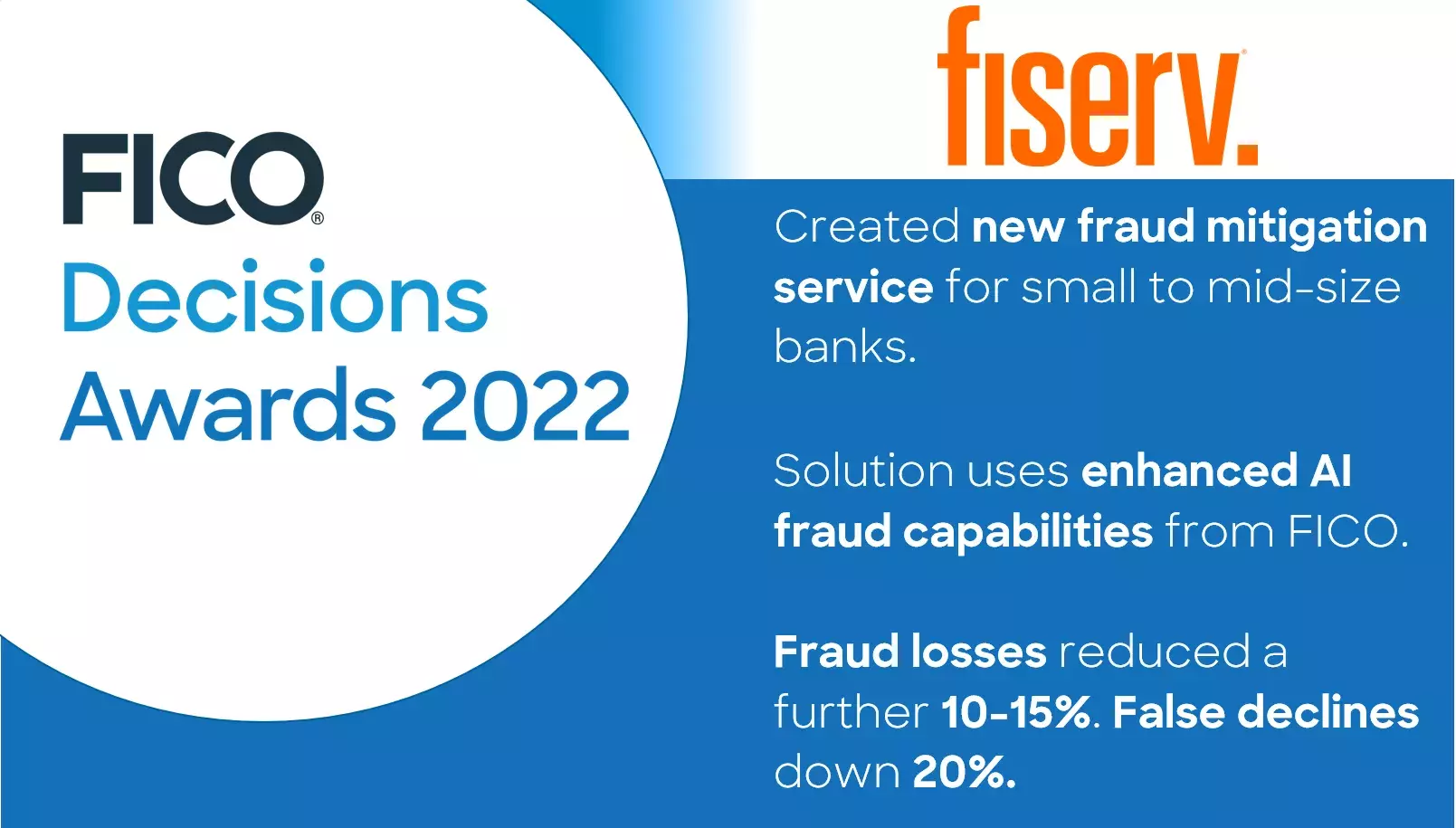
Fiserv, a leading global provider of payments and financial services technology solutions, has developed a new fraud mitigation service that has reduced fraud losses, which were already low by industry standards, by 10 to 15% for its small to midsize credit union and bank clients. False declines — legitimate transactions wrongly flagged as fraudulent — decreased by an average of 20%.
Card Risk Mitigation: EnFact® Advanced Scoring from Fiserv builds on FICO® Falcon® Fraud Manager by adding patented neural network modeling technology to deliver real-time detection of suspicious card transactions. The solution brings together the enhanced artificial intelligence capabilities of Adaptive Analytics, FICO® Fraud Predictor and Global Intelligent Profiles, providing a cohesive, complementary and holistic approach. The grouping of these FICO models enables Fiserv to provide a solution that adapts to fraud as it evolves through any client, cardholder, channel, or transaction type.
You can read more about this story in the full media release.
Keeping Up With The Fraudsters
“The current fast-paced payments environment presents the challenge of mitigating fraudulent transactions while simultaneously reducing cardholder friction,” said Patrick Davie, senior vice president, product strategy, Card Services at Fiserv. “Our clients are seeing excellent results from these new capabilities, both in terms of a marked fall off in fraud, and also in a drop in instances of overly-sensitive risk controls blocking legitimate activity — something that is becoming almost as big of an issue as the fraud losses that traditional antifraud technologies are designed to prevent.”
The new offering keeps up with changes in the value, volume, and timing of transactions. It accounts for changes in merchant categories and transaction locations, which are particularly relevant as card-present transactions decreased at the onset of the pandemic and shoppers quickly gravitated online. The weekly delivery of updated FICO Fraud Predictor merchant profiles ensures Fiserv has the most up-to-date merchant risk data, Adaptive Analytics technology identifies new fraud trends as they emerge, while Global Intelligent Profiles monitors ATM machines to identify high-risk terminals. When combined with the cardholder profiles and FICO’s Behavior Sorted List (B-List) technology, Fiserv protected the cardholder experience by understanding what was “normal”, even as transaction patterns shifted.
Delivering for Small to Mid-Sized Banks
Fiserv has documented impressive results:
- 10 to 15% reduction in fraud losses for banks and credit unions relative to their performance prior to using the solution
- An average 20% reduction in the false decline rate reducing customer frustration
- 50% decrease in fraud basis points for banks using Fiserv fraud mitigation solutions compared to those not using these tools
For its achievements, Fiserv won a 2022 FICO® Decisions Award for AI, machine learning & optimization.
“Fraud protection as a service is a compelling idea,” said Sibulelo Ncamani, head of operational risk and governance at Absa Bank and one of the FICO Decisions Awards judges. “Fiserv has combined three technologies so that the sum of these tools is greater than their individual parts. The beauty of the grouping is that it is blended into one, simple to use solution for their customers.”
How FICO Can Help You Reduce Fraud Losses
- Discover the power of FICO® Falcon® Fraud Manager for Partners
- Learn more about FICO's Adaptive Analytics for fraud.
- Find out how you can secure the merchant network with FICO® Fraud Predictor

Popular Posts

Average U.S. FICO® Score at 716, Indicating Improvement in Consumer Credit Behaviors Despite Pandemic
The FICO Score is a broad-based, independent standard measure of credit risk
Read more
The GSE Data Is Public. Here's What It Shows About Credit Score Modernization.
Independent Milliman analysis of GSE historical data confirms what anyone can now verify directly: FICO® Score 10T is the most predictive score.
Read more
FICO® Score High Achievers: Is Age the Only Factor?
<p>FICO’s latest research on <a href="http://www.fico.com/en/blogs/risk-compliance/us-credit-quality-rising-the-beat-goes-on/" target="_blank">national FICO® Score distribution</a> shows that US credit quality continues to trend upwards, with an increasing number of consumers scoring in the highest scores ranges. Given that, we decided it was time to refresh our study on “<a href="http://www.fico.com/en/blogs/risk-compliance/infographic-what-does-a-high-credit-scorer-look-like/" target="_blank">FICO® Score high achievers</a>,” where we examine the credit behavioural profiles of consumers with higher credit scores.</p> <p>As expected, our latest study showed that older people generally have higher scores, as has been the case in our <a href="http://www.fico.com/en/blogs/risk-compliance/age-before-beauty-credit-worthiness-before-youth/" target="_blank">past research</a>. This is largely because they have trade lines that have been open longer, which leads to higher scores (assuming the trade lines are in good standing and all other things equal). The most credit savvy among you will remember that length of credit history accounts for roughly 15% of the overall <a href="http://www.myfico.com/CreditEducation/WhatsInYourScore.aspx" target="_blank">FICO® Score calculation</a>.</p> <p>But for younger consumers, it isn’t too helpful to say, “just wait until you are 50 years old, and that will fix things!” Thus, I decided to dive deeper with our analysis, including looking at the credit behavioural characteristics of younger consumers with high FICO® Scores.</p> <p>In this analysis, I looked at credit characteristics for the two highest score bands, 750-799 and 800-850, which have about 16% and 23% of the population, respectively. I further broke this down by looking at the characteristics of the youngest 15% in each group, which occurs at age 29 for the 750-799 group and 43 for the 800-850. We used FICO<strong>®</strong> Score 9 for our analysis, and examined typical variables of the categories that go into the make-up of the score.</p> <p><a href="http://www.fico.com/en/blogs/wp-content/uploads/2016/10/FICO-Score-High-Achiever-table.png"><img class="alignnone size-full wp-image-29367" src="http://www.fico.com/en/blogs/wp-content/uploads/2016/10/FICO-Score-High-Achiever-table.png" alt="fico-score-high-achiever-table" width="715" height="747" /></a></p> <p>Since there’s a lot to dissect in this chart, I’ll highlight a few findings that struck me: <ul> <li><strong>Credit history.</strong> Higher scores are undoubtedly associated with a longer time on file. What’s striking is the higher average time on file for the 800+ group, both overall and for revolving accounts (the most common trade line). Clearly, it helps to start credit use early in life – but that’s not the sole determining factor for high scoring. The younger cohorts in both the 800+ and 750-799 groups have time on file medians significantly less than their older counterparts.</li> <li><strong>New credit.</strong> High credit scorers do, in fact, pursue new credit. We see little variation in months since last trade line opening and last inquiry among all groups observed.</li> <li><strong>Pay on time.</strong> As you might expect, the further in the past the delinquency, the higher the score – and that’s <u>if</u> a delinquency ever happened. 95% of the 800+ people and 72% of the 750-799 group have never been delinquent, which is a striking contrast to the 57% for the total population. The percentages for the younger groups are even higher, especially so for the 750-799ers. Collection items are also scarce for these high scorers. While 23% of the national population have collection items greater than $99, the figures are only 0.5% for the 800+ group and 3% for the 750-799 group. It is clear that, in conjunction with starting a credit file early, paying on time is a key trait of the FICO® Score high achiever.</li> <li><strong>Balance and utilization.</strong> Finally, we look at how credit is being used, focusing on revolving product use. (Since most people only have one mortgage or one auto loan, variation in instalment product figures is minimal and driven by payment history, which is near perfect for high scorers, as we’ve seen.) FICO® Score high achievers tend to have more open revolving accounts. While the % active trades and utilization are generally lower, by no means do high scorers avoid the use of credit products. What drives the difference here is the amount of <u>available</u> revolving credit utilized. The 800+ group is roughly 1/4 of the national median, both in total and on their highest utilized card; they also have lower balances and more cards<em>. </em>The 750-799 group is more active and higher utilized, but still only at 2/3 of the national figures. The young 750-799 group compensate with lower revolving balances and, as a result, lower utilization, which is in line with what we see for the 800+ group.</li> <li><strong>Benchmarks.</strong> I’d like to point out that while this study provides good benchmarks of the typical credit traits of the FICO® Score high achiever, individual credit profiles will vary widely. And keep in mind that when we sort groups of consumers as a whole by different behaviours, some results may look superficially odd. For example, the 800+ band has a longer median average open account time (128 months) than average revolving months on file (140 months).</li> </ul> So, what do we conclude? A huge takeaway is that high scorers don’t have too much in the way of serious delinquencies and negative public record data.</p> <p>In most respects, the young 800+ people are like their peer group. They really only differ markedly in their shorter credit history and higher non-mortgage balance, both of which are a function of life stage. Our results show that you don’t have to be a credit product hermit; these high scorers have more credit cards. The takeaway is to start credit activity early and maintain well-managed and moderate usage.</p> <p>In many ways, the young 750-799 people are more interesting because their age profile is much younger. Their credit characteristics differ more from their peer group, particularly in terms of length of credit history. They compensate by having almost pristine credit records and lower balances.</p> <p>Ultimately, 39% of US consumers are FICO® Score high achievers, which they accomplish by following common-sense credit practices. It ain’t rocket science!</p>
Read moreTake the next step
Connect with FICO for answers to all your product and solution questions. Interested in becoming a business partner? Contact us to learn more. We look forward to hearing from you.