Insurance Microservices Provide Needed Agility Today
Monolithic architecture hinders the evolution of cloud-hosted platforms — microservices are proving more effective at meeting insurers' demands for agility


Agility is everything right now for insurers. Rising risk exposure, changing personal circumstances and a continually evolving financial picture mean they need to adapt at speed, at scale, as their market dictates - or even quicker.
But many firms are already constrained by siloed insights, data and conventional thinking. Instead, it’s time to embrace new ways of working and doing business, to flex and adapt with changing global markets and customer expectations.
There’s been a lot of talk around adoption of bespoke platforms in insurance – but are they already too restrictive, monolithic, or even fit for purpose? Do they meet the needs of anything other than mass-markets, or on the flip side, the specific niche-uses they were designed for?
Why Insurance Microservices Count in a World of Monoliths
Microservices are precisely segmented processes adopted to replace large legacy applications typically developed to meet the needs of a mass market. The reason for microservices’ growing adoption is the need to build more flexible, independently deployable insurance systems.
Applications are easier to build and maintain when they are broken down into smaller, composable pieces that all work seamlessly together. While each component is continuously developed and separately maintained, the overall application then becomes the greater sum of all these constituent and interactive parts. It flies in the face of more traditional, monolithic insurance applications which were developed, deployed and are maintained as one giant operating system.
By their nature microservices are dynamic, agile, scalable, portable, reusable and more. They are at odds with the insurance industry's reputation for being static and sluggish when it comes to responding to customer demand. Insurers today know they need more flexibility, are hungry to adapt and win a greater market share.
Systems that also support multi-channel distribution and integration with agents and aggregators will typically offer faster times to market, real-time insight, streaming data and analytics, or faster response times for better customer experience.
Any innovations that help disrupt the typical insurance value chain — with new business models, new products, or routes to improved billing, faster claims processing and subsequent pay-outs — are likely to drive growth, while keeping customers happy and loyal.
Insurers Must Balance Rapidly Evolving Market Forces and Emerging Technology
A quickly changing economic picture coupled with the need for increasingly agile back-office systems is driving significant disruption. In fact, many are now obliged to play catch-up to meet the needs and expectations of today’s customers. It means chasing ever-faster times-to-market, resulting in missed opportunities and lost business to more agile peers.
Those that have already invested in predictive analytics to make faster decisions, straight-through processing, integrated design and systems that enhance customer experiences, are already on the front foot.
Monolithic architecture is now deemed a major hinderance to the evolution of new generation cloud-hosted platforms, particularly when microservices are proving more effective at meeting the ever-increasing demands of insurers.
In fact, our strategic clients are increasingly seeing the benefits and advantages of putting more control in the hands of their key business users. Many noted that out-the-box solutions simply failed to offer the flexibility needed to meet their specific industry sector requirements.
Having more control over underwriting models, without the level of restrictions imposed by legacy IT systems, was also a huge area of appeal. Clearly, with fewer IT restrictions, staff are empowered to directly tackle business-specific issues and deliver change in agile manner — at speed and at scale.
At the same time, having a cloud-based technology platform that could grow with them while delivering critical benefits across all business lines and channels offers a significant competitive advantage.
Fractured Customer Experiences Can Be Fixed
More and more insurers are now attempting to decompose their monolithic core into more loosely coupled and manageable components, especially when it comes to rating, underwriting or defining business rules and product models.
But they should also look at the way modern banking architectures and real-time data have become key lynchpins to success in financial services. Top performers are able to scrutinise the value of every consumer, enabling analytics teams to increase revenue by incorporating disparate data sources via digital decisioning, and get a more comprehensive picture of the potential each customer offers.
It’s a route that’s likely to be a win-win for insurers as they will also be able to make the most of improved agility, speed-to-market, automation and scalability.
Cloud-Hosted Platforms Are Empowering Businesses
FICO Platform is already helping firms augment their legacy systems, consume new data sources and rapidly deploy new and emerging use cases to meet changing market requirements.
It’s fair to say digital decisioning has already revolutionized customer experiences for millions across the world, all thanks to a platform approach that lends itself to innovation, agility and interchangeable microservices. FICO Platform empowers teams to readily develop data streaming pipelines alongside new analytically powered applications, which in turn rapidly and cost-effectively deliver the right customer outcomes and a clear return on investment.
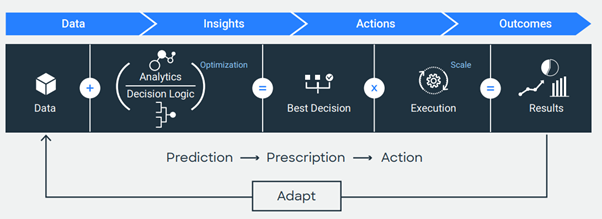
At the heart of FICO Platform are our enterprise capabilities. They're organized into sets of related functionalities that span Data to Insights to Actions to Outcomes — together they enable you to quickly deliver applied intelligence solutions at speed and scale, across the customer lifecycle - regardless of your use case.
How FICO Is Helping Insurers Increase Agility
- Visit the FICO industry-specific Insurance webpage here.
- Read the industry report FICO Enterprise Intelligence Network for Insurance.
- Read the blog Optimization and Automation Point the Way for Insurance Claims.
- Read the report Digital Insurance Special Report: Hastening the Speed of Change.
- Accelerating The March Towards Digitization in the Insurance Industry: Part I.
- Accelerating The March Towards Digitization in the Insurance Industry: Part II.
Popular Posts

Average U.S. FICO® Score at 716, Indicating Improvement in Consumer Credit Behaviors Despite Pandemic
The FICO Score is a broad-based, independent standard measure of credit risk
Read more
The GSE Data Is Public. Here's What It Shows About Credit Score Modernization.
Independent Milliman analysis of GSE historical data confirms what anyone can now verify directly: FICO® Score 10T is the most predictive score.
Read more
FICO® Score High Achievers: Is Age the Only Factor?
<p>FICO’s latest research on <a href="http://www.fico.com/en/blogs/risk-compliance/us-credit-quality-rising-the-beat-goes-on/" target="_blank">national FICO® Score distribution</a> shows that US credit quality continues to trend upwards, with an increasing number of consumers scoring in the highest scores ranges. Given that, we decided it was time to refresh our study on “<a href="http://www.fico.com/en/blogs/risk-compliance/infographic-what-does-a-high-credit-scorer-look-like/" target="_blank">FICO® Score high achievers</a>,” where we examine the credit behavioural profiles of consumers with higher credit scores.</p> <p>As expected, our latest study showed that older people generally have higher scores, as has been the case in our <a href="http://www.fico.com/en/blogs/risk-compliance/age-before-beauty-credit-worthiness-before-youth/" target="_blank">past research</a>. This is largely because they have trade lines that have been open longer, which leads to higher scores (assuming the trade lines are in good standing and all other things equal). The most credit savvy among you will remember that length of credit history accounts for roughly 15% of the overall <a href="http://www.myfico.com/CreditEducation/WhatsInYourScore.aspx" target="_blank">FICO® Score calculation</a>.</p> <p>But for younger consumers, it isn’t too helpful to say, “just wait until you are 50 years old, and that will fix things!” Thus, I decided to dive deeper with our analysis, including looking at the credit behavioural characteristics of younger consumers with high FICO® Scores.</p> <p>In this analysis, I looked at credit characteristics for the two highest score bands, 750-799 and 800-850, which have about 16% and 23% of the population, respectively. I further broke this down by looking at the characteristics of the youngest 15% in each group, which occurs at age 29 for the 750-799 group and 43 for the 800-850. We used FICO<strong>®</strong> Score 9 for our analysis, and examined typical variables of the categories that go into the make-up of the score.</p> <p><a href="http://www.fico.com/en/blogs/wp-content/uploads/2016/10/FICO-Score-High-Achiever-table.png"><img class="alignnone size-full wp-image-29367" src="http://www.fico.com/en/blogs/wp-content/uploads/2016/10/FICO-Score-High-Achiever-table.png" alt="fico-score-high-achiever-table" width="715" height="747" /></a></p> <p>Since there’s a lot to dissect in this chart, I’ll highlight a few findings that struck me: <ul> <li><strong>Credit history.</strong> Higher scores are undoubtedly associated with a longer time on file. What’s striking is the higher average time on file for the 800+ group, both overall and for revolving accounts (the most common trade line). Clearly, it helps to start credit use early in life – but that’s not the sole determining factor for high scoring. The younger cohorts in both the 800+ and 750-799 groups have time on file medians significantly less than their older counterparts.</li> <li><strong>New credit.</strong> High credit scorers do, in fact, pursue new credit. We see little variation in months since last trade line opening and last inquiry among all groups observed.</li> <li><strong>Pay on time.</strong> As you might expect, the further in the past the delinquency, the higher the score – and that’s <u>if</u> a delinquency ever happened. 95% of the 800+ people and 72% of the 750-799 group have never been delinquent, which is a striking contrast to the 57% for the total population. The percentages for the younger groups are even higher, especially so for the 750-799ers. Collection items are also scarce for these high scorers. While 23% of the national population have collection items greater than $99, the figures are only 0.5% for the 800+ group and 3% for the 750-799 group. It is clear that, in conjunction with starting a credit file early, paying on time is a key trait of the FICO® Score high achiever.</li> <li><strong>Balance and utilization.</strong> Finally, we look at how credit is being used, focusing on revolving product use. (Since most people only have one mortgage or one auto loan, variation in instalment product figures is minimal and driven by payment history, which is near perfect for high scorers, as we’ve seen.) FICO® Score high achievers tend to have more open revolving accounts. While the % active trades and utilization are generally lower, by no means do high scorers avoid the use of credit products. What drives the difference here is the amount of <u>available</u> revolving credit utilized. The 800+ group is roughly 1/4 of the national median, both in total and on their highest utilized card; they also have lower balances and more cards<em>. </em>The 750-799 group is more active and higher utilized, but still only at 2/3 of the national figures. The young 750-799 group compensate with lower revolving balances and, as a result, lower utilization, which is in line with what we see for the 800+ group.</li> <li><strong>Benchmarks.</strong> I’d like to point out that while this study provides good benchmarks of the typical credit traits of the FICO® Score high achiever, individual credit profiles will vary widely. And keep in mind that when we sort groups of consumers as a whole by different behaviours, some results may look superficially odd. For example, the 800+ band has a longer median average open account time (128 months) than average revolving months on file (140 months).</li> </ul> So, what do we conclude? A huge takeaway is that high scorers don’t have too much in the way of serious delinquencies and negative public record data.</p> <p>In most respects, the young 800+ people are like their peer group. They really only differ markedly in their shorter credit history and higher non-mortgage balance, both of which are a function of life stage. Our results show that you don’t have to be a credit product hermit; these high scorers have more credit cards. The takeaway is to start credit activity early and maintain well-managed and moderate usage.</p> <p>In many ways, the young 750-799 people are more interesting because their age profile is much younger. Their credit characteristics differ more from their peer group, particularly in terms of length of credit history. They compensate by having almost pristine credit records and lower balances.</p> <p>Ultimately, 39% of US consumers are FICO® Score high achievers, which they accomplish by following common-sense credit practices. It ain’t rocket science!</p>
Read moreTake the next step
Connect with FICO for answers to all your product and solution questions. Interested in becoming a business partner? Contact us to learn more. We look forward to hearing from you.