New Trends in Payments Fraud in Asia Post-Pandemic
Why consumers are moving to banks with the best fraud and scam prevention

The Growth of Real-time Payments and Fraud in Asia
The payments landscape in Asia is rapidly evolving, thanks to the emergence of new payment methods. The trend towards mobile payments has bolstered the use of mobile devices for financial transactions and spurred innovation across industries, while real-time payments have delivered incredible efficiency and convenience by providing a digital equivalent of physical cash that allows people to pay for things instantaneously.
In Asia, these technologies are being adopted by a rapidly growing middle class with increasing disposable income and a rising demand for financial services. The adoption has of course been turbo-charged by the pandemic. In India for example, our research showed that 95 percent of consumers do all or most of their banking online and have been keen adopters of real-time payments, with 78 percent uptake this year, a level significantly higher than customers in leading economies such as the U.S. (26%) and Germany (20%).
The appeal of these banking innovations has also made it a honeypot for fraud. Scammers are attracted to the increase in money flows and finding new inexperienced consumers to con online. One such cybercrime called Authorized Push Payment (APP) fraud, is a scam where fraudsters trick a target into sending them money. This makes this scheme particularly difficult to detect and prevent.
What’s concerning is that not all customers may be aware of the risks involved in banking services like real-time payments. As money is transferred near instantly to a peer or to a merchant, victims don’t have a window of time where they can try to reverse a payment once they realize they have been deceived. Fraudsters also swiftly launder it through multiple accounts, making it difficult to trace.
Indians Most Concerned About APP Fraud
FICO’s research revealed that Indian consumers were the most awake to the threat of Authorized Push Payment fraud. Fifteen percent of Indians said it was the type of fraud that concerned them the most. This was much higher than the U.S. (5%), the UK (6%), Indonesia (10%) and Thailand (9%).
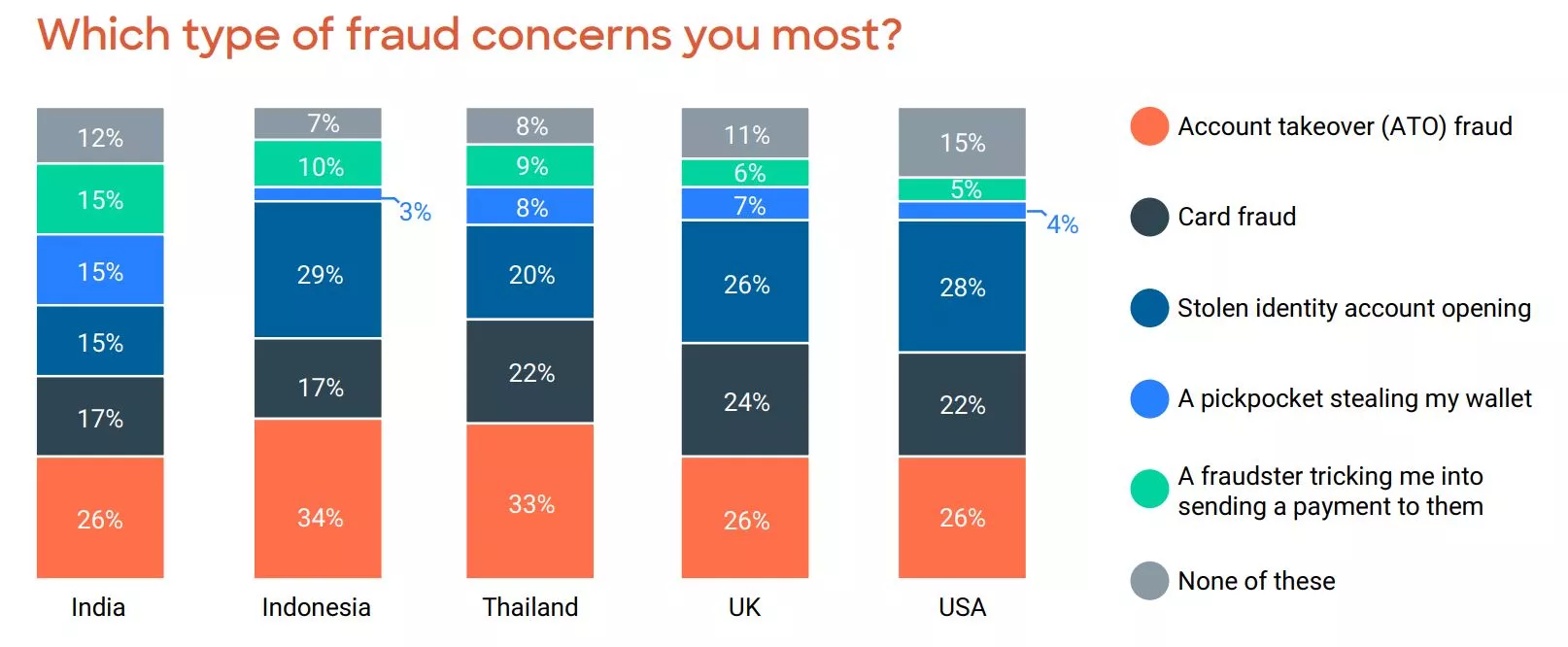
What we are seeing is that APP fraud is becoming a bigger problem in India and across Asia as we see a boom in the use of real-time payments. Real-time payment systems such as India’s Unified Payments Interface (UPI) have been a prime target for fraud as transaction volume on the platform grows at a breakneck pace. One of the issues is that the platform is often used for transacting small dollar amounts, where hardly any authentication or verification checks are used, making users more vulnerable to fraud.
Protecting real-time payments requires analytics that look for changes in customer behavior such as using accounts or devices outside of their usual habits, as well as standard anomalies such as time-of-day or frequency of a transfer. FICO has found that the use of targeted profiling of customer behavior to spot scams has yielded some impressive results with 50 percent more scam transactions detected.
Fraud and Scam Protection the Top Consideration When Selecting a New Financial Account
Asian consumers are looking for banks that will protect them from scams like APP fraud. FICO’s latest survey has revealed that good fraud protection is now the top consideration when consumers are looking to open a new financial account. In the Philippines, 2 in 5 consumers see it as the top priority, with a further 1 in 4 saying it is the second most important consideration. The story is similar in Malaysia, with 1 in 3 ranking security first and a further 1 in 4 ranking it second.
This is a significant opportunity for banks that are leading the field in fraud and scam protection. It means that almost 23 million Filipinos and 7 million Malaysians are filtering financial providers to find those with the strongest security. This shows that good fraud protection can be a bank’s biggest competitive advantage rather than just an overhead.
Balancing Strong Fraud Protection with Convenience
Asian consumers are also becoming more aware of the efforts banks are making to protect them against crimes such as identity theft, account takeover and card fraud. 61 percent of Filipinos said that identity checks have increased when making online purchases and 56 percent have experienced more identity checks when they log into accounts.
It is important however to balance these checks to make sure they don’t provide too much friction to the banking process. The survey found for example that many Malaysians won’t open an account if the identity checks are too difficult or time-consuming. 37 percent gave up opening a savings account, 29 percent on a credit card and 27 percent on a personal loan.
Further to this, 26 percent of Malaysians said troublesome checks meant they reduced their use or stopped using their bank account and 27 percent their credit card.
When it comes to convenience, 41 percent of customers in India are most irritated by declined transaction alerts for fraud that are late or never arrive. A further quarter (26%) of customers dislike banks changing the methods used to authenticate customers.
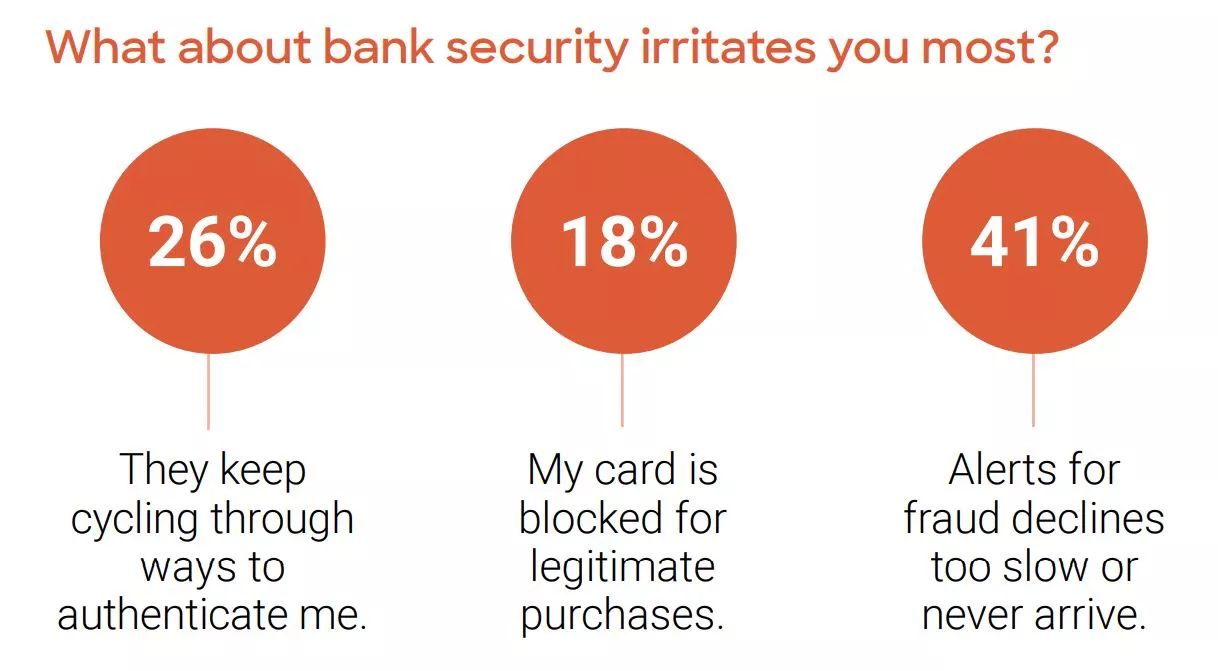
The uptick in adoption of digital payment modes not only expands the fraud attack surface but makes for a more complex set of customer experience concerns. These pit the need for superior fraud management against the desire for easier customer communication, authentication, and verification preferences.
As new scams and frauds emerge, banks are increasingly challenged with balancing customer experience needs against managing fraud risks and controls such as securing payment verification. Implementing effective account security technologies that reduce friction is therefore a priority.
Read more about our research findings for Asia here:
Fraud survey findings news release for The Philippines
See How FICO Can Help You Improve Your Fraud Prevention to Make it a Sales Asset
- Read our blog on FICO’s Scam Detection Score and how its use of targeted profiling of customer behavior has resulted in 50 percent more scam transactions detected.
- Read an article from Malaysia’s Star newspaper on why fraud protection is crucial to consumers
- Read our blog on How Can Banks Stop Authorised Push Payment Fraud?
- Take a listen to our ‘Around the World in Scams’ podcast looking at some of the challenges faced in Asia

Popular Posts

Average U.S. FICO® Score at 716, Indicating Improvement in Consumer Credit Behaviors Despite Pandemic
The FICO Score is a broad-based, independent standard measure of credit risk
Read more
The GSE Data Is Public. Here's What It Shows About Credit Score Modernization.
Independent Milliman analysis of GSE historical data confirms what anyone can now verify directly: FICO® Score 10T is the most predictive score.
Read more
FICO® Score High Achievers: Is Age the Only Factor?
<p>FICO’s latest research on <a href="http://www.fico.com/en/blogs/risk-compliance/us-credit-quality-rising-the-beat-goes-on/" target="_blank">national FICO® Score distribution</a> shows that US credit quality continues to trend upwards, with an increasing number of consumers scoring in the highest scores ranges. Given that, we decided it was time to refresh our study on “<a href="http://www.fico.com/en/blogs/risk-compliance/infographic-what-does-a-high-credit-scorer-look-like/" target="_blank">FICO® Score high achievers</a>,” where we examine the credit behavioural profiles of consumers with higher credit scores.</p> <p>As expected, our latest study showed that older people generally have higher scores, as has been the case in our <a href="http://www.fico.com/en/blogs/risk-compliance/age-before-beauty-credit-worthiness-before-youth/" target="_blank">past research</a>. This is largely because they have trade lines that have been open longer, which leads to higher scores (assuming the trade lines are in good standing and all other things equal). The most credit savvy among you will remember that length of credit history accounts for roughly 15% of the overall <a href="http://www.myfico.com/CreditEducation/WhatsInYourScore.aspx" target="_blank">FICO® Score calculation</a>.</p> <p>But for younger consumers, it isn’t too helpful to say, “just wait until you are 50 years old, and that will fix things!” Thus, I decided to dive deeper with our analysis, including looking at the credit behavioural characteristics of younger consumers with high FICO® Scores.</p> <p>In this analysis, I looked at credit characteristics for the two highest score bands, 750-799 and 800-850, which have about 16% and 23% of the population, respectively. I further broke this down by looking at the characteristics of the youngest 15% in each group, which occurs at age 29 for the 750-799 group and 43 for the 800-850. We used FICO<strong>®</strong> Score 9 for our analysis, and examined typical variables of the categories that go into the make-up of the score.</p> <p><a href="http://www.fico.com/en/blogs/wp-content/uploads/2016/10/FICO-Score-High-Achiever-table.png"><img class="alignnone size-full wp-image-29367" src="http://www.fico.com/en/blogs/wp-content/uploads/2016/10/FICO-Score-High-Achiever-table.png" alt="fico-score-high-achiever-table" width="715" height="747" /></a></p> <p>Since there’s a lot to dissect in this chart, I’ll highlight a few findings that struck me: <ul> <li><strong>Credit history.</strong> Higher scores are undoubtedly associated with a longer time on file. What’s striking is the higher average time on file for the 800+ group, both overall and for revolving accounts (the most common trade line). Clearly, it helps to start credit use early in life – but that’s not the sole determining factor for high scoring. The younger cohorts in both the 800+ and 750-799 groups have time on file medians significantly less than their older counterparts.</li> <li><strong>New credit.</strong> High credit scorers do, in fact, pursue new credit. We see little variation in months since last trade line opening and last inquiry among all groups observed.</li> <li><strong>Pay on time.</strong> As you might expect, the further in the past the delinquency, the higher the score – and that’s <u>if</u> a delinquency ever happened. 95% of the 800+ people and 72% of the 750-799 group have never been delinquent, which is a striking contrast to the 57% for the total population. The percentages for the younger groups are even higher, especially so for the 750-799ers. Collection items are also scarce for these high scorers. While 23% of the national population have collection items greater than $99, the figures are only 0.5% for the 800+ group and 3% for the 750-799 group. It is clear that, in conjunction with starting a credit file early, paying on time is a key trait of the FICO® Score high achiever.</li> <li><strong>Balance and utilization.</strong> Finally, we look at how credit is being used, focusing on revolving product use. (Since most people only have one mortgage or one auto loan, variation in instalment product figures is minimal and driven by payment history, which is near perfect for high scorers, as we’ve seen.) FICO® Score high achievers tend to have more open revolving accounts. While the % active trades and utilization are generally lower, by no means do high scorers avoid the use of credit products. What drives the difference here is the amount of <u>available</u> revolving credit utilized. The 800+ group is roughly 1/4 of the national median, both in total and on their highest utilized card; they also have lower balances and more cards<em>. </em>The 750-799 group is more active and higher utilized, but still only at 2/3 of the national figures. The young 750-799 group compensate with lower revolving balances and, as a result, lower utilization, which is in line with what we see for the 800+ group.</li> <li><strong>Benchmarks.</strong> I’d like to point out that while this study provides good benchmarks of the typical credit traits of the FICO® Score high achiever, individual credit profiles will vary widely. And keep in mind that when we sort groups of consumers as a whole by different behaviours, some results may look superficially odd. For example, the 800+ band has a longer median average open account time (128 months) than average revolving months on file (140 months).</li> </ul> So, what do we conclude? A huge takeaway is that high scorers don’t have too much in the way of serious delinquencies and negative public record data.</p> <p>In most respects, the young 800+ people are like their peer group. They really only differ markedly in their shorter credit history and higher non-mortgage balance, both of which are a function of life stage. Our results show that you don’t have to be a credit product hermit; these high scorers have more credit cards. The takeaway is to start credit activity early and maintain well-managed and moderate usage.</p> <p>In many ways, the young 750-799 people are more interesting because their age profile is much younger. Their credit characteristics differ more from their peer group, particularly in terms of length of credit history. They compensate by having almost pristine credit records and lower balances.</p> <p>Ultimately, 39% of US consumers are FICO® Score high achievers, which they accomplish by following common-sense credit practices. It ain’t rocket science!</p>
Read moreTake the next step
Connect with FICO for answers to all your product and solution questions. Interested in becoming a business partner? Contact us to learn more. We look forward to hearing from you.