The Impact of Medical Debt Collections on FICO® Scores
FICO® Score 9 introduces two noteworthy changes in the way the FICO® Score assesses collection information, including medical debt

Recently, 31 states announced a joint settlement agreement with the three major credit bureaus regarding changes to the reporting and treatment of consumer credit data, including medical debt collections.
The handling of medical debt collections is an extremely important issue as the adoption of FICO® Score 9 gains traction. As we explained in a prior blog post, FICO® Score 9 introduces two noteworthy changes in the way the FICO® Score assesses collection information (i.e., information about credit accounts that have been sent to third-party collection agencies), including medical collections. First, FICO® Score 9 disregards all paid collection accounts. Second, FICO® Score 9 differentiates between unpaid medical collections and unpaid non-medical collections. These changes were implemented based on extensive research showing they would improve the score’s predictiveness.
Given the tremendous interest in medical debt collections, it’s worth taking a closer look at these two decisions.
Ignoring Paid Collection Accounts
As we prepared to develop FICO® Score 9, we evaluated the treatment of paid collection accounts. Based on our research, we concluded that ignoring collection accounts that have been paid would help the FICO® Score’s predictiveness.
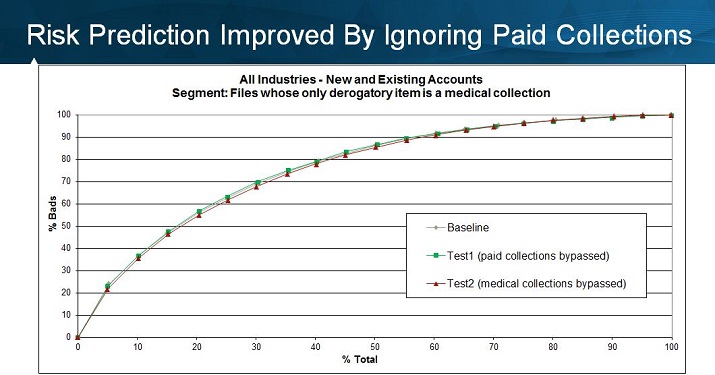
For example, the chart below shows one such segment of the population where bypassing paid collections resulted in a more predictive score. The “baseline” score shown here represents the status quo (i.e., including paid collections in the calculation of the score). “Test1” (the green line) represents a version of the score with paid collections bypassed from the calculation of the score. For this segment whose only derogatory information in the credit file is a medical collection, we found that ignoring paid collections resulted in a slightly more predictive model, as evidenced by the fact that the “Test1” curve is slightly above the “Baseline” curve.
Keep in mind that any missed payments associated with the original credit account before it was sent to the collection agency will still be considered by FICO® Score 9. It is only the third-party collection account that is ignored, if and when that collection account is paid.
Note the chart also shows that ignoring ALL medical collections, regardless of whether those accounts have been paid, can have an adverse impact on score predictiveness. This is evident by examining the red “Test2” curve, which falls slightly below the baseline curve, indicating weaker predictive power.
Intuitively this makes sense given the prevalence of medical collections – over half of all consumer collection accounts are medical collections, and the vast majority (~90%) of those accounts are unpaid. Our research has consistently found that individuals with unpaid collections are more risky (i.e., less likely to repay loans) than those who do not have unpaid accounts. Therefore, it is not surprising that disregarding this information could harm the FICO® Score’s predictive power.
Differentiating Medical Collections from Non-Medical Collections
The second key enhancement to the treatment of collection account information by FICO® Score 9 is the differentiation of unpaid medical collections and unpaid non-medical collections. Thanks to enhancements in the data elements captured in the bureau file, it became possible in the past few years to distinguish medical and non-medical collection agency accounts at all three major credit bureaus.
We leveraged the refined bureau data to analyze risk patterns associated with medical and non-medical collections. The graphic below (pulled from a sample of millions of anonymous consumer credit files) illustrates our key finding: consumers with unpaid medical collections are less likely to default on credit accounts in the future than people with unpaid non-medical collections.
Note that while consumers with unpaid medical collections are less risky than those with unpaid non-medical collections, they are still substantially more risky than the population with no derogatory information in their files (represented by the horizontal blue line in the graphic below).
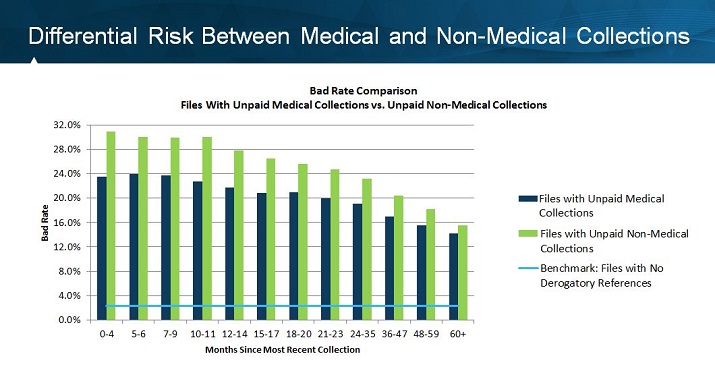
As a result of the findings shown above, we introduced two sets of variables in the FICO® Score 9 algorithm – one set that evaluates only unpaid medical collections, and one set that evaluates only unpaid non-medical collections. This differentiated treatment resulted in unpaid medical collections having a smaller impact on the FICO® Score than unpaid non-medical collections. In fact, we found the median score for consumers whose only major credit blemish is a medical collection (or even multiple medical collections) to be approximately 25 points higher with FICO® Score 9 than previous versions of the FICO® Score.
As data scientists, we constantly challenge ourselves to make the FICO® Score more reliable and predictive. Often the changes are subtle. However, we occasionally find that changes to the treatment of major items in credit reports, such as third-party collection accounts, hold the key to improving our scoring algorithm.

Popular Posts

Average U.S. FICO® Score at 716, Indicating Improvement in Consumer Credit Behaviors Despite Pandemic
The FICO Score is a broad-based, independent standard measure of credit risk
Read more
The GSE Data Is Public. Here's What It Shows About Credit Score Modernization.
Independent Milliman analysis of GSE historical data confirms what anyone can now verify directly: FICO® Score 10T is the most predictive score.
Read more
FICO® Score High Achievers: Is Age the Only Factor?
<p>FICO’s latest research on <a href="http://www.fico.com/en/blogs/risk-compliance/us-credit-quality-rising-the-beat-goes-on/" target="_blank">national FICO® Score distribution</a> shows that US credit quality continues to trend upwards, with an increasing number of consumers scoring in the highest scores ranges. Given that, we decided it was time to refresh our study on “<a href="http://www.fico.com/en/blogs/risk-compliance/infographic-what-does-a-high-credit-scorer-look-like/" target="_blank">FICO® Score high achievers</a>,” where we examine the credit behavioural profiles of consumers with higher credit scores.</p> <p>As expected, our latest study showed that older people generally have higher scores, as has been the case in our <a href="http://www.fico.com/en/blogs/risk-compliance/age-before-beauty-credit-worthiness-before-youth/" target="_blank">past research</a>. This is largely because they have trade lines that have been open longer, which leads to higher scores (assuming the trade lines are in good standing and all other things equal). The most credit savvy among you will remember that length of credit history accounts for roughly 15% of the overall <a href="http://www.myfico.com/CreditEducation/WhatsInYourScore.aspx" target="_blank">FICO® Score calculation</a>.</p> <p>But for younger consumers, it isn’t too helpful to say, “just wait until you are 50 years old, and that will fix things!” Thus, I decided to dive deeper with our analysis, including looking at the credit behavioural characteristics of younger consumers with high FICO® Scores.</p> <p>In this analysis, I looked at credit characteristics for the two highest score bands, 750-799 and 800-850, which have about 16% and 23% of the population, respectively. I further broke this down by looking at the characteristics of the youngest 15% in each group, which occurs at age 29 for the 750-799 group and 43 for the 800-850. We used FICO<strong>®</strong> Score 9 for our analysis, and examined typical variables of the categories that go into the make-up of the score.</p> <p><a href="http://www.fico.com/en/blogs/wp-content/uploads/2016/10/FICO-Score-High-Achiever-table.png"><img class="alignnone size-full wp-image-29367" src="http://www.fico.com/en/blogs/wp-content/uploads/2016/10/FICO-Score-High-Achiever-table.png" alt="fico-score-high-achiever-table" width="715" height="747" /></a></p> <p>Since there’s a lot to dissect in this chart, I’ll highlight a few findings that struck me: <ul> <li><strong>Credit history.</strong> Higher scores are undoubtedly associated with a longer time on file. What’s striking is the higher average time on file for the 800+ group, both overall and for revolving accounts (the most common trade line). Clearly, it helps to start credit use early in life – but that’s not the sole determining factor for high scoring. The younger cohorts in both the 800+ and 750-799 groups have time on file medians significantly less than their older counterparts.</li> <li><strong>New credit.</strong> High credit scorers do, in fact, pursue new credit. We see little variation in months since last trade line opening and last inquiry among all groups observed.</li> <li><strong>Pay on time.</strong> As you might expect, the further in the past the delinquency, the higher the score – and that’s <u>if</u> a delinquency ever happened. 95% of the 800+ people and 72% of the 750-799 group have never been delinquent, which is a striking contrast to the 57% for the total population. The percentages for the younger groups are even higher, especially so for the 750-799ers. Collection items are also scarce for these high scorers. While 23% of the national population have collection items greater than $99, the figures are only 0.5% for the 800+ group and 3% for the 750-799 group. It is clear that, in conjunction with starting a credit file early, paying on time is a key trait of the FICO® Score high achiever.</li> <li><strong>Balance and utilization.</strong> Finally, we look at how credit is being used, focusing on revolving product use. (Since most people only have one mortgage or one auto loan, variation in instalment product figures is minimal and driven by payment history, which is near perfect for high scorers, as we’ve seen.) FICO® Score high achievers tend to have more open revolving accounts. While the % active trades and utilization are generally lower, by no means do high scorers avoid the use of credit products. What drives the difference here is the amount of <u>available</u> revolving credit utilized. The 800+ group is roughly 1/4 of the national median, both in total and on their highest utilized card; they also have lower balances and more cards<em>. </em>The 750-799 group is more active and higher utilized, but still only at 2/3 of the national figures. The young 750-799 group compensate with lower revolving balances and, as a result, lower utilization, which is in line with what we see for the 800+ group.</li> <li><strong>Benchmarks.</strong> I’d like to point out that while this study provides good benchmarks of the typical credit traits of the FICO® Score high achiever, individual credit profiles will vary widely. And keep in mind that when we sort groups of consumers as a whole by different behaviours, some results may look superficially odd. For example, the 800+ band has a longer median average open account time (128 months) than average revolving months on file (140 months).</li> </ul> So, what do we conclude? A huge takeaway is that high scorers don’t have too much in the way of serious delinquencies and negative public record data.</p> <p>In most respects, the young 800+ people are like their peer group. They really only differ markedly in their shorter credit history and higher non-mortgage balance, both of which are a function of life stage. Our results show that you don’t have to be a credit product hermit; these high scorers have more credit cards. The takeaway is to start credit activity early and maintain well-managed and moderate usage.</p> <p>In many ways, the young 750-799 people are more interesting because their age profile is much younger. Their credit characteristics differ more from their peer group, particularly in terms of length of credit history. They compensate by having almost pristine credit records and lower balances.</p> <p>Ultimately, 39% of US consumers are FICO® Score high achievers, which they accomplish by following common-sense credit practices. It ain’t rocket science!</p>
Read moreTake the next step
Connect with FICO for answers to all your product and solution questions. Interested in becoming a business partner? Contact us to learn more. We look forward to hearing from you.