Top 5 Fraud Manager Considerations During COVID-19
Being nimble and awake to the rapid changes occurring to bank fraud will be essential.

History tells us that things like natural disasters, times of economic instability, and fears of recession or unemployment provide the perfect environment for increased fraud and financial crime. Criminals also run their own businesses, and fear is an opportunity to exploit. So, I thought I would outline my top 5 fraud manager considerations during COVID-19.
The scale of those affected during this pandemic, not necessarily by the virus but by the critical physical distancing measures is breathtaking. I don’t think anyone really envisaged a scenario quite like what we’re currently experiencing. So what must we consider when it comes to our customers, the fraudsters and our anti-fraud teams. Here are some of my thoughts on the matter:
1) Top 5 Fraud Manager Considerations During COVID-19:
We owe our customers protection during these unusual times
It's imperative that we do our best to protect our customers from fraud during this vulnerable time, especially when record numbers of people are losing their jobs, unable to work, and facing adversity with their health.
We need to ensure that they have access to their funds and aren’t faced with inabilities to pay for essential items. Blocked cards and frozen funds that are under investigation are a major headache to consumers and nimble organizations will be doing all they can to minimize these and to look at how they might make their policies more flexible.
We need to be proactive in our communications to customers around scams. They need to know how to avoid them, what to look for and what to do if they think they see something unusual. Banks need to ensure that any suspicious activities on their accounts can be confirmed with them quickly and efficiently and that if they do fall victims, that the situation is managed quickly to minimize the impact on their lives.
2) Top 5 Fraud Manager Considerations During COVID-19:
Scams are now tailored, so we need to modify our strategies
A few weeks ago, the US Justice Department brought its first fraud case related to COVID-19 forward. They issued a restraining order to block a website claiming to be distributing vaccines that was facilitating a wire-fraud scheme and “intentionally making false statements” about the vaccines - which do not exist.
We will certainly see an increase in fraud during this time. Scams will use COVID-19 to drive an emotional response to get people to click on links resulting in malware and ransomware attacks. Examples include fake emails from CDC, WHO, and FEMA. Phishing emails for airfare refunds, charitable contributions, fake cures and vaccines, financial relief, federal emergency funds, and more will proliferate. This will result in more cases of account takeover during this time and for months ahead. A number of articles have already been published showing this is already happening.
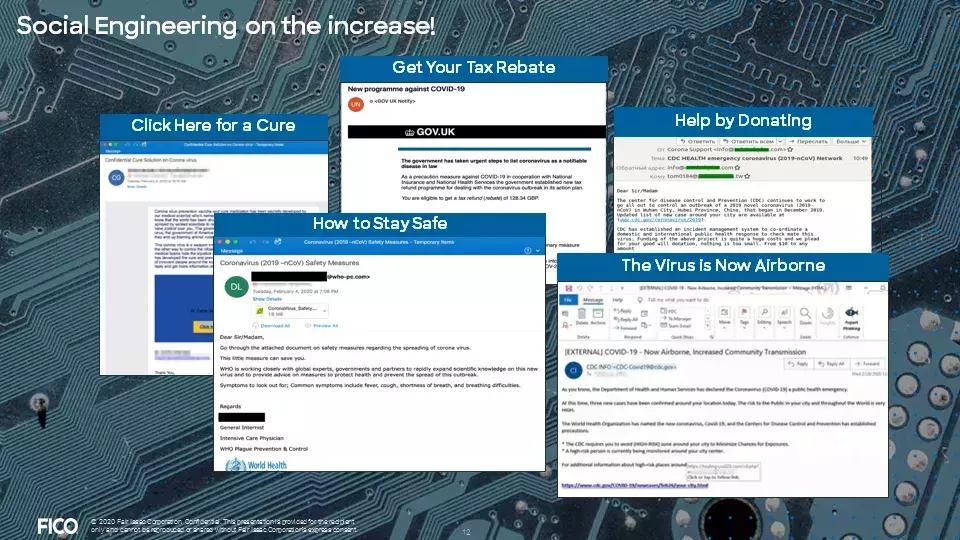
As anti-fraud professionals, we should:
- Be aware of increased account takeover and customers susceptible to scams and help by educating our customers (Here is some recent advice and tips for consumers)
- Link our authentication, non-monetary and high-risk transactional decisioning to guard against application and takeover fraud
- Improve our defenses, and refresh our operations handbook, to handle the increase in mule accounts for money laundering
- Be aware that internal fraud and employee abuse may also be on the rise during these times
3) Top 5 Fraud Manager Considerations During COVID-19:
Increase collaboration between anti-fraud and financial crimes teams
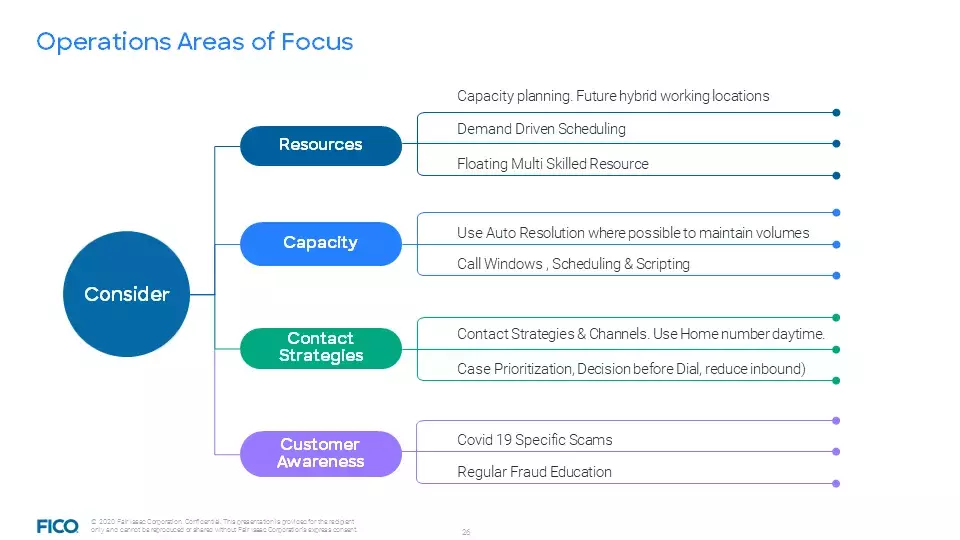
This current situation is also impacting everyone’s ability to work in a business as usual mode. We have less staff in the office. And there may well be challenges accessing critical systems including fraud management tools remotely.
It’s important to maintain channels of communication to ensure that new threats and trends are communicated quickly. Also, with reduced staff in the office, it’s important to consider other operational changes such as an increase in the volume of cases that go to auto-resolution to assist with operational capacity.
4) Top 5 Fraud Manager Considerations During COVID-19:
Behavioral shifts necessitate fraud control shifts
Card Fraud
Due to stay-at-home directives worldwide, the card transactional mix for many clients is going to change. For example, grocery and other merchant category codes (MCCs) will shift in pattern and volume. We will also see the number of card-not-present (CNP) transactions increasing, it’s not the client’s usual transaction mix.
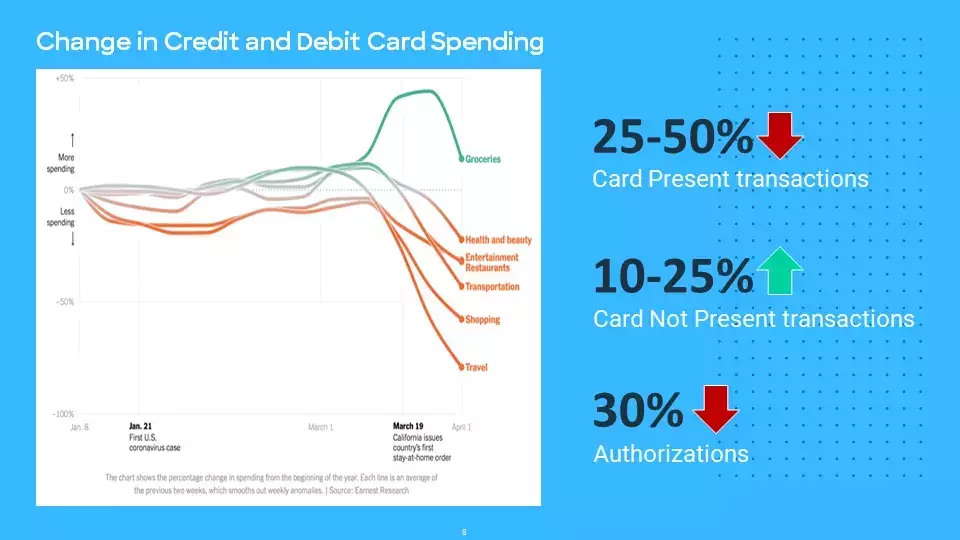
Fraud managers should consider:
- How this consumer shift may affect your current fraud strategies
- The customer experience impact of declines at this time
- How an increased amount of point-of-sale (POS) based transactions compared with the customer’s normal could look out of pattern
- An elevated amount of CNP transactions from the usual frequency/spend. Again, consider the impact of declines when for some people this is perhaps their only way of staying safe.
- Equally, expect to see an increase in CNP fraud and “Friendly Fraud” across gaming, media and subscription-based services, during this time
Retail Banking Channels
We are also seeing a shift in the channel mix for customers overall. There will, of course, be less use of the branch, more use of online/mobile banking. That will include an increase in the people registering for those channels that previous didn’t have mobile/online Banking. There will also be an increase in the potential account takeover risks.
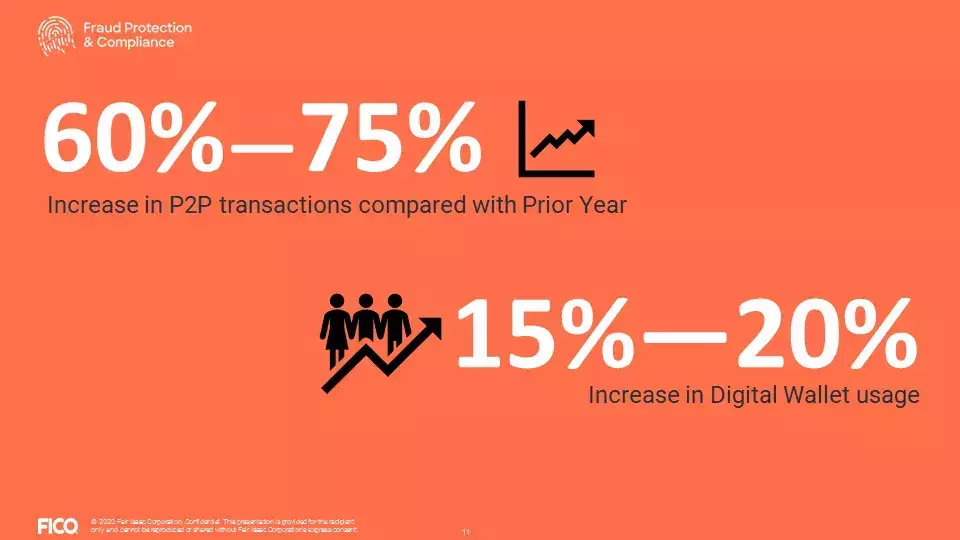
Fraud managers should consider:
- That it’s important to be able to make cross-channel decisions during this time
- That we need to increase authentication frequencies over and above the norm
- Customer’s regular geolocations are going to change, in fact, they should be at their house more! This should make It easier to see when it’s really the customer accessing their account versus fraudsters who are often attacking from other geolocations
5) Top 5 Fraud Manager Considerations During COVID-19:
A rise in application fraud and identity theft
As people consider getting additional credit to get them through this period (loans, credit cards), we may see an increase in synthetic, 1st Party bust-out fraud and identity theft.
We have seen a lot of data has been compromised, so we are going to have to be on guard for identity theft and account takeover that look to exploit faster payment systems. A recent graph by Krebs Security showed that thousands of illicit or nefarious websites with a link to COVID-19 have been published to try to farm or steal data or inject malicious code.
Hopefully, these five areas have given you something to think about as a fraud manager. There are plenty of ‘new normals’ for banking fraud prevention in a world impacted by COVID-19. Being nimble and awake to the rapid changes occurring will be essential. Having AI-powered fraud and financial crime platforms will be a close second. Now is the time to use technology to detect trends and out-of-pattern changes so that fraud loses and company reputations can be managed during this trying time.
If you have enjoyed this blog, you may also want to read some of our recent fraud pieces including:

Popular Posts

Average U.S. FICO® Score at 716, Indicating Improvement in Consumer Credit Behaviors Despite Pandemic
The FICO Score is a broad-based, independent standard measure of credit risk
Read more
The GSE Data Is Public. Here's What It Shows About Credit Score Modernization.
Independent Milliman analysis of GSE historical data confirms what anyone can now verify directly: FICO® Score 10T is the most predictive score.
Read more
FICO® Score High Achievers: Is Age the Only Factor?
<p>FICO’s latest research on <a href="http://www.fico.com/en/blogs/risk-compliance/us-credit-quality-rising-the-beat-goes-on/" target="_blank">national FICO® Score distribution</a> shows that US credit quality continues to trend upwards, with an increasing number of consumers scoring in the highest scores ranges. Given that, we decided it was time to refresh our study on “<a href="http://www.fico.com/en/blogs/risk-compliance/infographic-what-does-a-high-credit-scorer-look-like/" target="_blank">FICO® Score high achievers</a>,” where we examine the credit behavioural profiles of consumers with higher credit scores.</p> <p>As expected, our latest study showed that older people generally have higher scores, as has been the case in our <a href="http://www.fico.com/en/blogs/risk-compliance/age-before-beauty-credit-worthiness-before-youth/" target="_blank">past research</a>. This is largely because they have trade lines that have been open longer, which leads to higher scores (assuming the trade lines are in good standing and all other things equal). The most credit savvy among you will remember that length of credit history accounts for roughly 15% of the overall <a href="http://www.myfico.com/CreditEducation/WhatsInYourScore.aspx" target="_blank">FICO® Score calculation</a>.</p> <p>But for younger consumers, it isn’t too helpful to say, “just wait until you are 50 years old, and that will fix things!” Thus, I decided to dive deeper with our analysis, including looking at the credit behavioural characteristics of younger consumers with high FICO® Scores.</p> <p>In this analysis, I looked at credit characteristics for the two highest score bands, 750-799 and 800-850, which have about 16% and 23% of the population, respectively. I further broke this down by looking at the characteristics of the youngest 15% in each group, which occurs at age 29 for the 750-799 group and 43 for the 800-850. We used FICO<strong>®</strong> Score 9 for our analysis, and examined typical variables of the categories that go into the make-up of the score.</p> <p><a href="http://www.fico.com/en/blogs/wp-content/uploads/2016/10/FICO-Score-High-Achiever-table.png"><img class="alignnone size-full wp-image-29367" src="http://www.fico.com/en/blogs/wp-content/uploads/2016/10/FICO-Score-High-Achiever-table.png" alt="fico-score-high-achiever-table" width="715" height="747" /></a></p> <p>Since there’s a lot to dissect in this chart, I’ll highlight a few findings that struck me: <ul> <li><strong>Credit history.</strong> Higher scores are undoubtedly associated with a longer time on file. What’s striking is the higher average time on file for the 800+ group, both overall and for revolving accounts (the most common trade line). Clearly, it helps to start credit use early in life – but that’s not the sole determining factor for high scoring. The younger cohorts in both the 800+ and 750-799 groups have time on file medians significantly less than their older counterparts.</li> <li><strong>New credit.</strong> High credit scorers do, in fact, pursue new credit. We see little variation in months since last trade line opening and last inquiry among all groups observed.</li> <li><strong>Pay on time.</strong> As you might expect, the further in the past the delinquency, the higher the score – and that’s <u>if</u> a delinquency ever happened. 95% of the 800+ people and 72% of the 750-799 group have never been delinquent, which is a striking contrast to the 57% for the total population. The percentages for the younger groups are even higher, especially so for the 750-799ers. Collection items are also scarce for these high scorers. While 23% of the national population have collection items greater than $99, the figures are only 0.5% for the 800+ group and 3% for the 750-799 group. It is clear that, in conjunction with starting a credit file early, paying on time is a key trait of the FICO® Score high achiever.</li> <li><strong>Balance and utilization.</strong> Finally, we look at how credit is being used, focusing on revolving product use. (Since most people only have one mortgage or one auto loan, variation in instalment product figures is minimal and driven by payment history, which is near perfect for high scorers, as we’ve seen.) FICO® Score high achievers tend to have more open revolving accounts. While the % active trades and utilization are generally lower, by no means do high scorers avoid the use of credit products. What drives the difference here is the amount of <u>available</u> revolving credit utilized. The 800+ group is roughly 1/4 of the national median, both in total and on their highest utilized card; they also have lower balances and more cards<em>. </em>The 750-799 group is more active and higher utilized, but still only at 2/3 of the national figures. The young 750-799 group compensate with lower revolving balances and, as a result, lower utilization, which is in line with what we see for the 800+ group.</li> <li><strong>Benchmarks.</strong> I’d like to point out that while this study provides good benchmarks of the typical credit traits of the FICO® Score high achiever, individual credit profiles will vary widely. And keep in mind that when we sort groups of consumers as a whole by different behaviours, some results may look superficially odd. For example, the 800+ band has a longer median average open account time (128 months) than average revolving months on file (140 months).</li> </ul> So, what do we conclude? A huge takeaway is that high scorers don’t have too much in the way of serious delinquencies and negative public record data.</p> <p>In most respects, the young 800+ people are like their peer group. They really only differ markedly in their shorter credit history and higher non-mortgage balance, both of which are a function of life stage. Our results show that you don’t have to be a credit product hermit; these high scorers have more credit cards. The takeaway is to start credit activity early and maintain well-managed and moderate usage.</p> <p>In many ways, the young 750-799 people are more interesting because their age profile is much younger. Their credit characteristics differ more from their peer group, particularly in terms of length of credit history. They compensate by having almost pristine credit records and lower balances.</p> <p>Ultimately, 39% of US consumers are FICO® Score high achievers, which they accomplish by following common-sense credit practices. It ain’t rocket science!</p>
Read moreTake the next step
Connect with FICO for answers to all your product and solution questions. Interested in becoming a business partner? Contact us to learn more. We look forward to hearing from you.