

Selecting the right algorithm for a nonlinear problem - when to use the XPRS library instead of XSLP
This chapter focuses on the nonlinear capabilities of the FICO Xpress Optimizer. While Xpress XSLP is able to efficiently solve most nonlinear problems to local optimality, there are two reasons to use other Xpress libraries:
- Subclasses of nonlinear problems for which the Xpress Optimizer features specialized algorithms that are able to solve those problems more efficiently and in larger sizes. These are notably convex quadratic programming and convex quadratically constrained problems and their mixed integer counterparts.
- Situations in which a global optimum of a nonlinear problem is required. The functionality of FICO Xpress Global also allows solving nonconvex QPs, MIQPs, NLPs and MINLPs to proven global optimality.
It is also possible to separate the convex quadratic information from the rest of XSLP, and let the Xpress XPRS optimizer handle it directly, which is good modelling practice.
Convex Quadratic and Quadratically Constrained Quadratic Programs (QPs and QCQPs)
Convex Quadratic Programming (QP) problems are an extension of Linear Programming (LP) problems where the objective function may include a second order polynomial. Quadratically Constrained Quadratic Programs (QCQPs) further extend QP problems by allowing the constraints to also include second order polynomials. The FICO Xpress Optimizer can be used directly for solving QP and QCQP problems (and their Mixed Integer versions MIQP and MIQCQP).
A QCQP problem may be written as:
| minimize: | c1x1+...+cnxn+xTQ0x | ||
| subject to: | a11x1+...+a1nxn+xTQ1x | ≤ | b1 |
| ... | |||
| am1x1+...+amnxn+xTQmx | ≤ | bm | |
| l1≤x1≤u1,...,ln≤xn≤un |
where any of the lower or upper bounds li or ui may be infinite.
If there are no other nonlinearities in the problem, the XPRS library provides specialized algorithms for the solution of convex QP and QCQP (and their integer counterparts MIQP and MIQCQP) problems, that are much more efficient than solving the problem as a general nonlinear problem with XSLP.
Convexity
A fundamental property for nonlinear optimization problems, thus in QCQP as well, is convexity. A region is called convex, if for any two points from the region the connecting line segment is also part of the region.
The lack of convexity may give rise to several unfavorable model properties. Lack of convexity in the objective may introduce the phenomenon of locally optimal solutions that are not global ones (a local optimal solution is one for which a neighborhood in the feasible region exists in which that solution is the best). While the lack of convexity in constraints can also give rise to local optimums, it may even introduce non–connected feasible regions as shown in Figure Non-connected feasible regions.
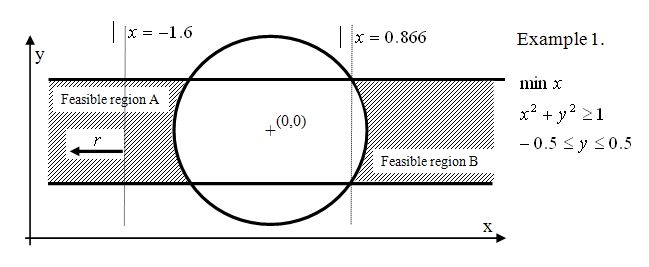
Figure 27.1: Non-connected feasible regions
In this example, the feasible region is divided into two parts. Over feasible region B, the objective function has two alternative local optimal solutions, while over feasible region A the objective is not even bounded.
For convex problems, each locally optimal solution is a global one, making the characterization of the optimal solution efficient.
Characterizing Convexity in Quadratic Constraints
A quadratic constraint of form
defines a convex region if and only if Q is a so–called positive semi–definite (PSD) matrix.
A rectangular matrix Q is PSD by definition if for any vector (not restricted to the feasible set of a problem) x it holds that xTQx≥0.
It follows that for greater or equal constraints
the negative of Q shall be PSD.
A nontrivial quadratic equality constraint (one for which not every coefficient is zero) always defines a nonconvex region.
An intuitive way of checking this property, is that the quadratic part shall always only make a constraint harder to satisfy (i.e. taking the quadratic part away shall always be a relaxation of the original problem).
There are certain constructs however, that can easily be recognized as being non convex:
- the product of two variables say xy without having both x2 and y2 defined;
- having - x2 in any quadratic expression in a less or equal, or having x2 in any greater or equal row.
As a general rule, a convex quadratic objective and convex quadratic constraints are best handled by the XPRS library; while all nonconvex counterparts should be modelled as XSLP structures. It then depends on the application whether FICO Xpress Nonlinear is required (e.g., because of user functions) or FICO Xpress Global is the necessary solver (e.g., because a bound on the optimal objective is needed). Both use the same modelling API and, license and required features permitting, users can seamlessly switch between one solver and the other.
© 2001-2026 Fair Isaac Corporation. All rights reserved. This documentation is the property of Fair Isaac Corporation (“FICO”). Receipt or possession of this documentation does not convey rights to disclose, reproduce, make derivative works, use, or allow others to use it except solely for internal evaluation purposes to determine whether to purchase a license to the software described in this documentation, or as otherwise set forth in a written software license agreement between you and FICO (or a FICO affiliate). Use of this documentation and the software described in it must conform strictly to the foregoing permitted uses, and no other use is permitted.