5 Keys to Using AI and Machine Learning in Fraud Detection
If done properly, using AI and machine learning in fraud detection can clearly distinguish legitimate and fraudulent behaviors while adapting over time to new tactics

Payment fraud is an ideal use case for machine learning and artificial intelligence (AI), and has a long track record of successful use. When consumers get a call, text, email or in-app messages from their card issuer asking them to validate a transaction, or informing them of fraud on their card, they may not even suspect that behind this bit of excellent customer service are a brilliant set of algorithms, such as neural networks. Recently, however, there has been so much hype around the use of AI and machine learning in fraud detection that it has been difficult for many to distinguish myth from reality. At times, you might come to the conclusion that AI and machine learning have just been invented, or just been applied to payments fraud for the first time!
In this blog series, I’m going to explore the five keys to using AI and machine learning in fraud detection. The insights here are based on FICO’s 25+ years in this field, protecting billions of cards worldwide, and my own experience in fraud solution management over the last 23 years.
Let’s dig in, shall we?
Machine Learning and Artificial Intelligence in Fraud
Before we get to Key 1, here’s a brief definition of what we’re talking about, since even the terms machine learning and AI are subject to misuse.
Machine learning refers to analytic techniques that “learn” patterns in datasets without being guided by a human analyst. AI refers to the broader application of specific kinds of analytics to accomplish tasks, from driving a car to, yes, identifying a fraudulent transaction. For our purposes, think of machine learning as a way to build analytic models, and AI as the use of those models.
Machine learning helps data scientists efficiently determine which transactions are most likely to be fraudulent, while significantly reducing false positives. The techniques are extremely effective in fraud detection and prevention, as they allow for the automated discovery of fraudulent and non-fraudulent patterns across large volumes of streaming transactions.
If done properly, machine learning can clearly distinguish legitimate and fraudulent behaviors while adapting over time to new, previously unseen fraud tactics. This can become quite complex as there is a need to interpret patterns in the data and apply data science to continually improve the ability to distinguish normal behavior from abnormal behavior. This kind of real-time fraud detection requires thousands of computations to be accurately performed in milliseconds.
Without a proper understanding of the domain, as well as fraud-specific data science techniques, you can easily employ machine learning algorithms that learn the wrong thing, resulting in a costly mistake that is difficult to unwind. Just as people can learn bad habits, so too can a poorly architected machine learning model.
Key 1 — Integrating Supervised and Unsupervised AI Models in a Cohesive Strategy
Because organized crime schemes fraudsters use are so sophisticated and quick to adapt, defense strategies based on any single, one-size-fits-all analytic technique will produce sub-par results. Each use case should be supported by expertly crafted anomaly detection techniques that are optimal for the problem at hand. As a result, both supervised and unsupervised models play important roles in fraud detection and must be woven into comprehensive, next- generation fraud strategies.
A supervised model, the most common form of machine learning across all disciplines, is a model that is trained on a rich set of properly “tagged” transactions. Each transaction is tagged as either fraud or non-fraud. The models are trained by ingesting massive amounts of tagged transaction details in order to learn patterns that best reflect legitimate behaviors. When developing a supervised model, the amount of clean, relevant training data is directly correlated with model accuracy.
Unsupervised models are designed to spot anomalous behavior in cases where tagged transaction data is relatively thin or non-existent. In these cases, a form of self-learning must be employed to surface patterns in the data that are invisible to other forms of analytics.
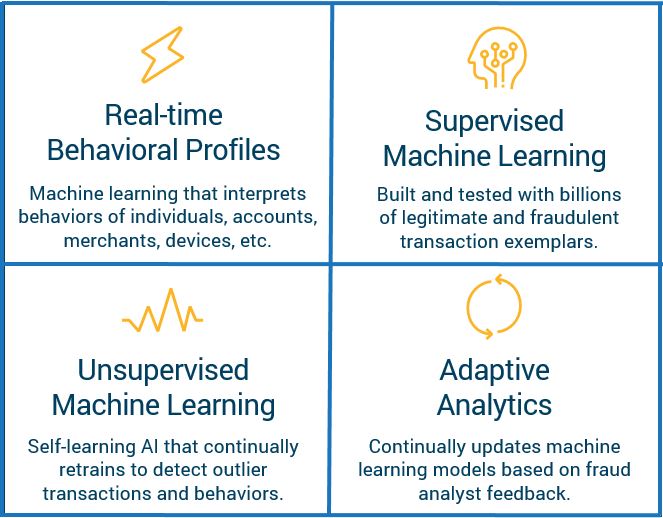
Unsupervised models are designed to discover outliers that represent previously unseen forms of fraud. These AI-based techniques detect behavior anomalies by identifying transactions that do not conform to the majority. For accuracy, these discrepancies are evaluated at the individual level as well as through sophisticated peer group comparison.
By choosing an optimal blend of supervised and unsupervised AI techniques you can detect previously unseen forms of suspicious behavior while quickly recognizing the more subtle patterns of fraud that have been previously observed across billions of accounts. A good example of this occurs in our FICO Falcon Platform, with its Cognitive Fraud Analytics.
Follow me on Twitter @FraudBird.
Find Out More About AI and Machine Learning in Fraud Detection
- Review Key 2: Applying Behavioral Profiling Analytics in Fraud Detection
- Review Key 3: Distinguishing Specialized from Generic Behavior Analytics
- Review Key 4: Leveraging Large Datasets to Develop Models
- Review Key 5: Adaptive Analytics and Self-Learning AI
- Discover FICO's fraud solutions
- Read our white paper Fighting Scams with AI Decisioning
This is an update of a post originally posted on July 3, 2018.

Popular Posts

Average U.S. FICO® Score at 716, Indicating Improvement in Consumer Credit Behaviors Despite Pandemic
The FICO Score is a broad-based, independent standard measure of credit risk
Read more
The GSE Data Is Public. Here's What It Shows About Credit Score Modernization.
Independent Milliman analysis of GSE historical data confirms what anyone can now verify directly: FICO® Score 10T is the most predictive score.
Read more
FICO® Score High Achievers: Is Age the Only Factor?
<p>FICO’s latest research on <a href="http://www.fico.com/en/blogs/risk-compliance/us-credit-quality-rising-the-beat-goes-on/" target="_blank">national FICO® Score distribution</a> shows that US credit quality continues to trend upwards, with an increasing number of consumers scoring in the highest scores ranges. Given that, we decided it was time to refresh our study on “<a href="http://www.fico.com/en/blogs/risk-compliance/infographic-what-does-a-high-credit-scorer-look-like/" target="_blank">FICO® Score high achievers</a>,” where we examine the credit behavioural profiles of consumers with higher credit scores.</p> <p>As expected, our latest study showed that older people generally have higher scores, as has been the case in our <a href="http://www.fico.com/en/blogs/risk-compliance/age-before-beauty-credit-worthiness-before-youth/" target="_blank">past research</a>. This is largely because they have trade lines that have been open longer, which leads to higher scores (assuming the trade lines are in good standing and all other things equal). The most credit savvy among you will remember that length of credit history accounts for roughly 15% of the overall <a href="http://www.myfico.com/CreditEducation/WhatsInYourScore.aspx" target="_blank">FICO® Score calculation</a>.</p> <p>But for younger consumers, it isn’t too helpful to say, “just wait until you are 50 years old, and that will fix things!” Thus, I decided to dive deeper with our analysis, including looking at the credit behavioural characteristics of younger consumers with high FICO® Scores.</p> <p>In this analysis, I looked at credit characteristics for the two highest score bands, 750-799 and 800-850, which have about 16% and 23% of the population, respectively. I further broke this down by looking at the characteristics of the youngest 15% in each group, which occurs at age 29 for the 750-799 group and 43 for the 800-850. We used FICO<strong>®</strong> Score 9 for our analysis, and examined typical variables of the categories that go into the make-up of the score.</p> <p><a href="http://www.fico.com/en/blogs/wp-content/uploads/2016/10/FICO-Score-High-Achiever-table.png"><img class="alignnone size-full wp-image-29367" src="http://www.fico.com/en/blogs/wp-content/uploads/2016/10/FICO-Score-High-Achiever-table.png" alt="fico-score-high-achiever-table" width="715" height="747" /></a></p> <p>Since there’s a lot to dissect in this chart, I’ll highlight a few findings that struck me: <ul> <li><strong>Credit history.</strong> Higher scores are undoubtedly associated with a longer time on file. What’s striking is the higher average time on file for the 800+ group, both overall and for revolving accounts (the most common trade line). Clearly, it helps to start credit use early in life – but that’s not the sole determining factor for high scoring. The younger cohorts in both the 800+ and 750-799 groups have time on file medians significantly less than their older counterparts.</li> <li><strong>New credit.</strong> High credit scorers do, in fact, pursue new credit. We see little variation in months since last trade line opening and last inquiry among all groups observed.</li> <li><strong>Pay on time.</strong> As you might expect, the further in the past the delinquency, the higher the score – and that’s <u>if</u> a delinquency ever happened. 95% of the 800+ people and 72% of the 750-799 group have never been delinquent, which is a striking contrast to the 57% for the total population. The percentages for the younger groups are even higher, especially so for the 750-799ers. Collection items are also scarce for these high scorers. While 23% of the national population have collection items greater than $99, the figures are only 0.5% for the 800+ group and 3% for the 750-799 group. It is clear that, in conjunction with starting a credit file early, paying on time is a key trait of the FICO® Score high achiever.</li> <li><strong>Balance and utilization.</strong> Finally, we look at how credit is being used, focusing on revolving product use. (Since most people only have one mortgage or one auto loan, variation in instalment product figures is minimal and driven by payment history, which is near perfect for high scorers, as we’ve seen.) FICO® Score high achievers tend to have more open revolving accounts. While the % active trades and utilization are generally lower, by no means do high scorers avoid the use of credit products. What drives the difference here is the amount of <u>available</u> revolving credit utilized. The 800+ group is roughly 1/4 of the national median, both in total and on their highest utilized card; they also have lower balances and more cards<em>. </em>The 750-799 group is more active and higher utilized, but still only at 2/3 of the national figures. The young 750-799 group compensate with lower revolving balances and, as a result, lower utilization, which is in line with what we see for the 800+ group.</li> <li><strong>Benchmarks.</strong> I’d like to point out that while this study provides good benchmarks of the typical credit traits of the FICO® Score high achiever, individual credit profiles will vary widely. And keep in mind that when we sort groups of consumers as a whole by different behaviours, some results may look superficially odd. For example, the 800+ band has a longer median average open account time (128 months) than average revolving months on file (140 months).</li> </ul> So, what do we conclude? A huge takeaway is that high scorers don’t have too much in the way of serious delinquencies and negative public record data.</p> <p>In most respects, the young 800+ people are like their peer group. They really only differ markedly in their shorter credit history and higher non-mortgage balance, both of which are a function of life stage. Our results show that you don’t have to be a credit product hermit; these high scorers have more credit cards. The takeaway is to start credit activity early and maintain well-managed and moderate usage.</p> <p>In many ways, the young 750-799 people are more interesting because their age profile is much younger. Their credit characteristics differ more from their peer group, particularly in terms of length of credit history. They compensate by having almost pristine credit records and lower balances.</p> <p>Ultimately, 39% of US consumers are FICO® Score high achievers, which they accomplish by following common-sense credit practices. It ain’t rocket science!</p>
Read moreTake the next step
Connect with FICO for answers to all your product and solution questions. Interested in becoming a business partner? Contact us to learn more. We look forward to hearing from you.