Getting More Americans Into Homes Is the Goal. Scoring Them Better Is How We Get There.
Accurate credit scores open more doors to homeownership. Weakening credit scoring standards does not.

VantageScore's latest white paper makes a bold claim: by assigning a credit score to 33 million additional Americans, VantageScore 4.0 would generate nearly 5 million mortgage-ready borrowers and $1 trillion in origination opportunity.
The goal of putting more Americans into homes is what FICO® Scores were built for — the trusted standard in today’s $13 trillion U.S. mortgage market. The question alone has never been whether to score more people. The question is whether the scores generated on potential borrowers are predictive enough to actually help get more approved: to get them through underwriting, into a home, and into a mortgage they can affordably sustain.
The debate isn't whether to expand homeownership. It's how.
VantageScore promises 5 million more borrowers. The data doesn’t support this claim.
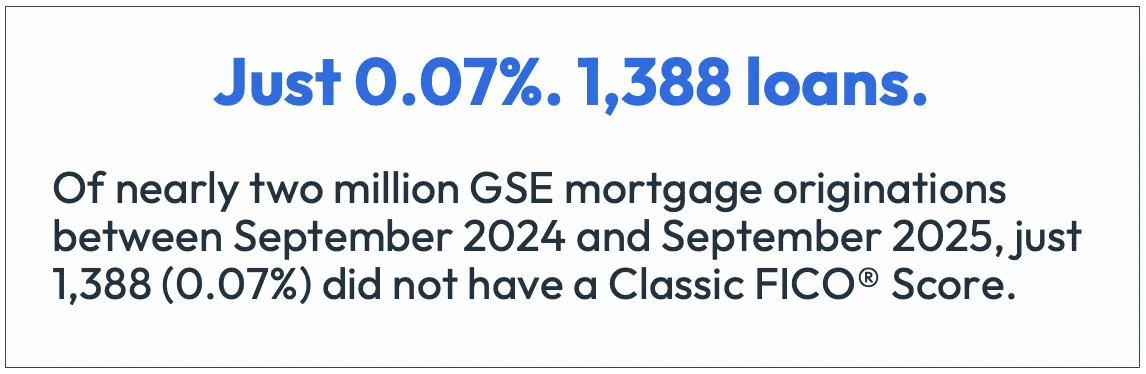
VantageScore claims scoring 33 million more Americans unlocks nearly 5 million mortgage-ready borrowers and $1 trillion in origination opportunity. The market data says otherwise: of nearly two million GSE mortgage originations between September 2024 and September 2025, just 1,388 did not have a Classic FICO® Score. That is 0.07% of the market.
A closer look at who these consumers are.
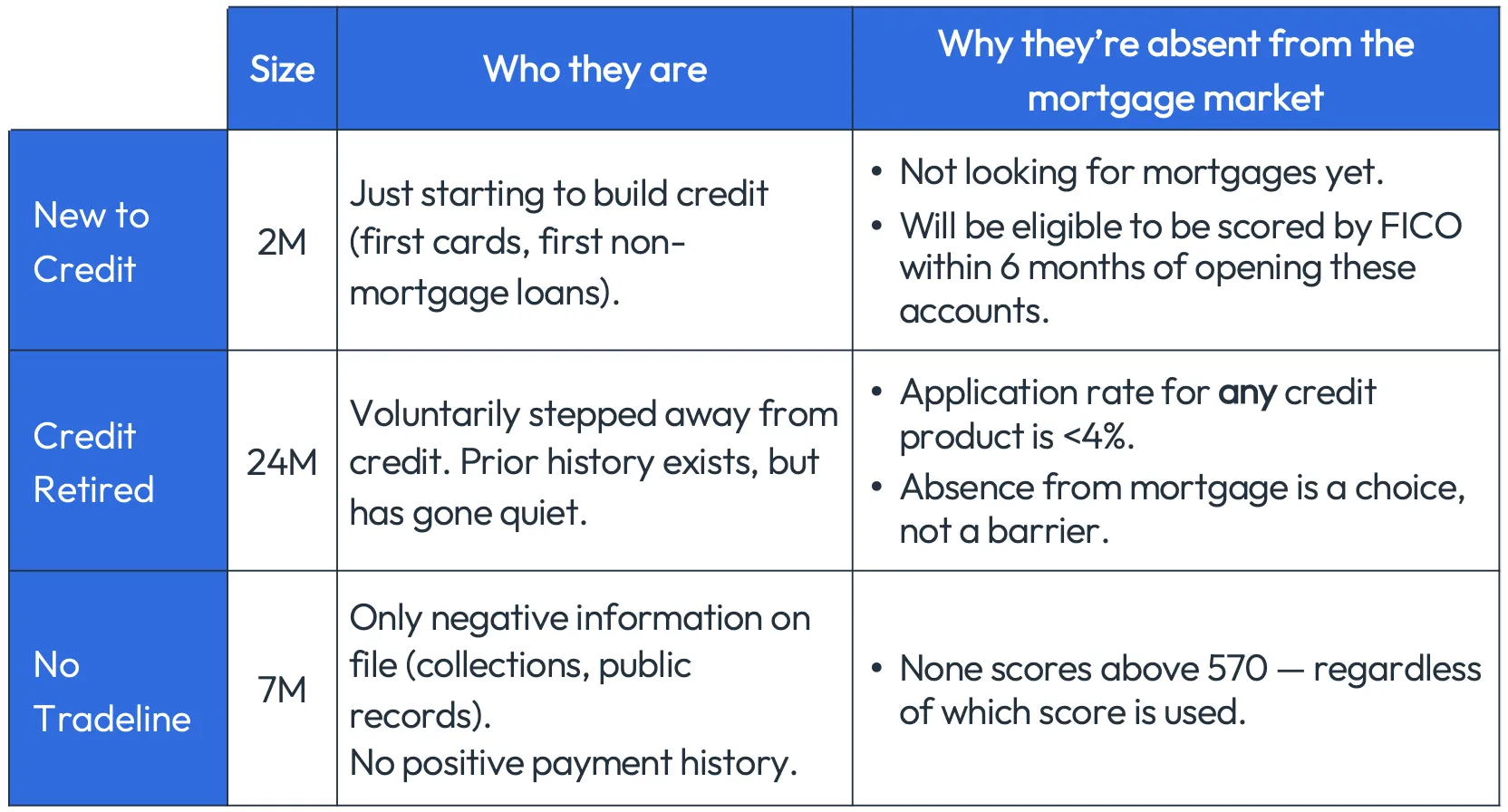
VantageScore describes three distinct groups within their 33 million claim. Their own research reveals why these consumers are not mortgage-seeking — and why scoring them doesn't change that.
New to credit consumers (2M): just starting to build credit (first cards, first loans). Importantly, from seeking their first access to credit, they will be eligible to be scored by FICO within six months of opening these accounts.
Credit retired consumers (24M): voluntarily stepped away from credit. The application rate for this population for any credit product is under 4%. This group is generally not seeking credit — their absence from the credit market, including the mortgage market, is a choice, not a barrier.
No tradeline consumers (7M): only negative information on file (collections, public records) with no positive payment history to offset it. No consumer in this segment scores above 570 under any scoring model, including the VantageScore model.
According to VantageScore's own data, not a single consumer in this population scores 700 or higher. Under the preliminary score mapping from the GSE implementation of VantageScore 4.0, not one clears the Classic FICO® Score equivalent of 680. This gap between the VantageScore 4.0 distribution segmentation and average credit qualification is a perfect example of how credit qualification cannot be solved by the lower credit score standards used in the VantageScore model to achieve “more scores.”
Across all three groups, the barrier isn't the absence of a score. It's the absence of credit readiness — and a different scoring model doesn't change that.
Scoring consumers on the same data with lessened standards doesn't help them get into homes affordably.
Minimum scoring criteria are not arbitrary restrictions. They exist because a score with insufficient data behind it isn't reliably predictive — and a score you can't rely on doesn't serve the borrower, the lender, or the investor.
For borrowers, the consequences are real. A less predictive score that misidentifies creditworthiness doesn't just affect who gets approved — it affects the terms they're offered. Borrowers who are more creditworthy than their score suggests they are would pay more than they should.
For lenders, loans approved on the basis of an inaccurate assessment carry more risk than anticipated, resulting in higher losses. And that uncertainty doesn't stay with the lender. When loans reach the secondary market carrying scores investors can't fully trust, credit becomes harder to get and more expensive — for the very borrowers the expansion was meant to help.
The data isn't the difference. The model is. A better-built model means more qualified borrowers approved, more accurate pricing, and loans that perform.
FICO® Score 10T and VantageScore 4.0 have access to the exact same credit bureau sources and can incorporate the exact same trended credit data. The performance gap is how that data is used when the model is built, and that’s what separates a score you can trust from one you can't.
The answer is clear. Independent analysis by actuarial firm Milliman of GSE historical loan data found FICO® Score 10T outperformed VantageScore 4.0 in predictive accuracy — with the gap most pronounced for first-time homebuyers, where FICO® Score 10T delivers more than 10% greater predictive lift.

FICO® Score 10T achieves this without the mortgage-specific variables that disadvantage first-time homebuyers — incorporating trended credit data and rental payment history that reflects how these borrowers actually manage their finances. FICO® Score 10T scores them better.
And that advantage is not limited to who gets approved. It affects what they pay. FICO analyzed the 4.7 million first-time homebuyer loans in the GSE historical dataset and found that 33% of first-time homebuyers shift to a worse pricing tier under VantageScore 4.0 — meaning VantageScore 4.0 results in higher rates, and higher monthly payments. Further, there is a “minus 20-point score adjustment” being utilized in the GSE proof-of-concept pilot of VantageScore 4.0, to account for differences in the calibration of the models in terms of default risk at a given score. With the “minus 20-point score adjustment” applied, nearly two thirds (63%) of first-time homebuyers would be placed in a worse pricing tier under VantageScore 4.0.
Accuracy determines not just whether someone gets a mortgage — it determines what they pay for it.
A more predictive score means more responsible approvals, at lower interest rates, for the consumers who matter most to the mission of expanding homeownership.
Getting more Americans into homes is the goal. Scoring them better is how we get there.
For every borrower, the most accurate credit score is also the most valuable one — not just for getting approved, but for getting approved at the terms they deserve. FICO® Score 10T is the most predictive score for mortgage lending, outperforming VantageScore 4.0 across mortgage types, time periods, and every predictive measure tested. That predictive accuracy translates directly to more approvals, better rates for consumers, and loans that borrowers can sustain.
For first-time homebuyers, that accuracy is the difference between getting into a home and being priced out of one.
Lowering the scoring bar does not raise the homeownership rate. It raises the cost of credit for borrowers, the risk of loss for lenders, and the uncertainty for investors. A score that more accurately reflects creditworthiness opens more doors — and keeps more borrowers in the homes they worked to get into.

Popular Posts

Average U.S. FICO® Score at 716, Indicating Improvement in Consumer Credit Behaviors Despite Pandemic
The FICO Score is a broad-based, independent standard measure of credit risk
Read more
The GSE Data Is Public. Here's What It Shows About Credit Score Modernization.
Independent Milliman analysis of GSE historical data confirms what anyone can now verify directly: FICO® Score 10T is the most predictive score.
Read more
FICO® Score High Achievers: Is Age the Only Factor?
<p>FICO’s latest research on <a href="http://www.fico.com/en/blogs/risk-compliance/us-credit-quality-rising-the-beat-goes-on/" target="_blank">national FICO® Score distribution</a> shows that US credit quality continues to trend upwards, with an increasing number of consumers scoring in the highest scores ranges. Given that, we decided it was time to refresh our study on “<a href="http://www.fico.com/en/blogs/risk-compliance/infographic-what-does-a-high-credit-scorer-look-like/" target="_blank">FICO® Score high achievers</a>,” where we examine the credit behavioural profiles of consumers with higher credit scores.</p> <p>As expected, our latest study showed that older people generally have higher scores, as has been the case in our <a href="http://www.fico.com/en/blogs/risk-compliance/age-before-beauty-credit-worthiness-before-youth/" target="_blank">past research</a>. This is largely because they have trade lines that have been open longer, which leads to higher scores (assuming the trade lines are in good standing and all other things equal). The most credit savvy among you will remember that length of credit history accounts for roughly 15% of the overall <a href="http://www.myfico.com/CreditEducation/WhatsInYourScore.aspx" target="_blank">FICO® Score calculation</a>.</p> <p>But for younger consumers, it isn’t too helpful to say, “just wait until you are 50 years old, and that will fix things!” Thus, I decided to dive deeper with our analysis, including looking at the credit behavioural characteristics of younger consumers with high FICO® Scores.</p> <p>In this analysis, I looked at credit characteristics for the two highest score bands, 750-799 and 800-850, which have about 16% and 23% of the population, respectively. I further broke this down by looking at the characteristics of the youngest 15% in each group, which occurs at age 29 for the 750-799 group and 43 for the 800-850. We used FICO<strong>®</strong> Score 9 for our analysis, and examined typical variables of the categories that go into the make-up of the score.</p> <p><a href="http://www.fico.com/en/blogs/wp-content/uploads/2016/10/FICO-Score-High-Achiever-table.png"><img class="alignnone size-full wp-image-29367" src="http://www.fico.com/en/blogs/wp-content/uploads/2016/10/FICO-Score-High-Achiever-table.png" alt="fico-score-high-achiever-table" width="715" height="747" /></a></p> <p>Since there’s a lot to dissect in this chart, I’ll highlight a few findings that struck me: <ul> <li><strong>Credit history.</strong> Higher scores are undoubtedly associated with a longer time on file. What’s striking is the higher average time on file for the 800+ group, both overall and for revolving accounts (the most common trade line). Clearly, it helps to start credit use early in life – but that’s not the sole determining factor for high scoring. The younger cohorts in both the 800+ and 750-799 groups have time on file medians significantly less than their older counterparts.</li> <li><strong>New credit.</strong> High credit scorers do, in fact, pursue new credit. We see little variation in months since last trade line opening and last inquiry among all groups observed.</li> <li><strong>Pay on time.</strong> As you might expect, the further in the past the delinquency, the higher the score – and that’s <u>if</u> a delinquency ever happened. 95% of the 800+ people and 72% of the 750-799 group have never been delinquent, which is a striking contrast to the 57% for the total population. The percentages for the younger groups are even higher, especially so for the 750-799ers. Collection items are also scarce for these high scorers. While 23% of the national population have collection items greater than $99, the figures are only 0.5% for the 800+ group and 3% for the 750-799 group. It is clear that, in conjunction with starting a credit file early, paying on time is a key trait of the FICO® Score high achiever.</li> <li><strong>Balance and utilization.</strong> Finally, we look at how credit is being used, focusing on revolving product use. (Since most people only have one mortgage or one auto loan, variation in instalment product figures is minimal and driven by payment history, which is near perfect for high scorers, as we’ve seen.) FICO® Score high achievers tend to have more open revolving accounts. While the % active trades and utilization are generally lower, by no means do high scorers avoid the use of credit products. What drives the difference here is the amount of <u>available</u> revolving credit utilized. The 800+ group is roughly 1/4 of the national median, both in total and on their highest utilized card; they also have lower balances and more cards<em>. </em>The 750-799 group is more active and higher utilized, but still only at 2/3 of the national figures. The young 750-799 group compensate with lower revolving balances and, as a result, lower utilization, which is in line with what we see for the 800+ group.</li> <li><strong>Benchmarks.</strong> I’d like to point out that while this study provides good benchmarks of the typical credit traits of the FICO® Score high achiever, individual credit profiles will vary widely. And keep in mind that when we sort groups of consumers as a whole by different behaviours, some results may look superficially odd. For example, the 800+ band has a longer median average open account time (128 months) than average revolving months on file (140 months).</li> </ul> So, what do we conclude? A huge takeaway is that high scorers don’t have too much in the way of serious delinquencies and negative public record data.</p> <p>In most respects, the young 800+ people are like their peer group. They really only differ markedly in their shorter credit history and higher non-mortgage balance, both of which are a function of life stage. Our results show that you don’t have to be a credit product hermit; these high scorers have more credit cards. The takeaway is to start credit activity early and maintain well-managed and moderate usage.</p> <p>In many ways, the young 750-799 people are more interesting because their age profile is much younger. Their credit characteristics differ more from their peer group, particularly in terms of length of credit history. They compensate by having almost pristine credit records and lower balances.</p> <p>Ultimately, 39% of US consumers are FICO® Score high achievers, which they accomplish by following common-sense credit practices. It ain’t rocket science!</p>
Read moreTake the next step
Connect with FICO for answers to all your product and solution questions. Interested in becoming a business partner? Contact us to learn more. We look forward to hearing from you.