How to Use AI to Improve Customer Communications: A Practical Guide for Financial Services
Learn three proven approaches to deploying AI in customer communications — from agentic voice agents to domain-specific language models — and why purpose-built AI is needed


Key Takeaways
- The ROI gap is real, but closeable. Only one in five AI initiatives are delivering measurable ROI, according to Gartner. The differentiator is not budget or access to technology, it is deploying AI that is purpose-built for your domain and connected to real business outcomes.
- Agentic AI is moving from concept to production. The industry has evolved from scripted chatbots to large language model assistants and is now entering the era of true agentic AI: multi-agent systems that initiate conversations, negotiate outcomes, and fully close the loop with customers without human intervention.
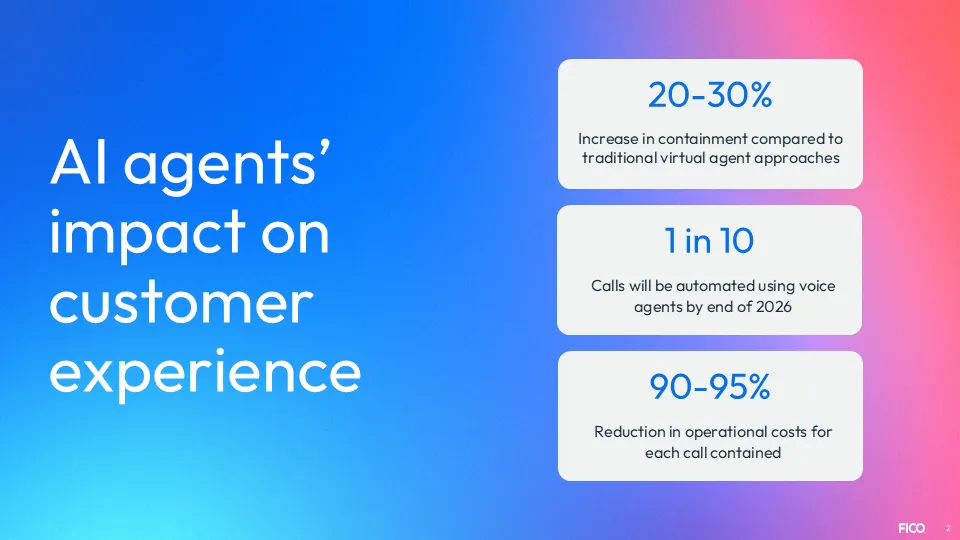
- The business case for conversational agents is compelling. AI-powered voice and text agents are already demonstrating a 20–30% improvement in containment rates over rules-based systems, and a 90–95% reduction in operational cost per contained call. One in ten calls is estimated to be fully automatable by voice agents by end of year, and that figure may be conservative. Conversational agents are also unlocking complex use cases that traditional virtual agents couldn’t contain.
- Generic models are not fit for financial services. A model trained on internet data is not equipped for payment negotiation, hardship identification, or fraud verification. Domain-specific, focused language models outperform general-purpose alternatives on specialized tasks, are massively more compute-efficient, and keep customer data sovereign and auditable.
- Every customer interaction is a data asset. Each AI-managed touchpoint captures information that can be used to personalize future communications, improve decisioning, and deepen customer relationships, creating a compounding value loop over time.
There’s no shortage of headlines about artificial intelligence reshaping the business world. Boards are demanding AI strategies. CEOs are name-dropping it in every earnings call. Analysts are calling it the most transformative technology shift of our lifetime. And yet, according to Gartner, only one in five AI initiatives are actually delivering measurable ROI. An MIT study puts the failure rate even higher, estimating that 95% of AI projects fail to return any meaningful value.
This raises the stakes for businesses looking to use AI to transform customer communications and the customer experience.
For financial services organizations in particular, the cost to serve customers is a constant battleground. Margins are under pressure, and every institution is looking for ways to do more with less, but not at the expense of compliance or customer experience. Ungoverned AI in financial services is not a cost saver. It is a liability.
At the same time, competition is fragmenting the value chain. Fintechs, neobanks, and embedded finance players are all competing for pieces of your customer relationship. The moat is no longer the speed of deployment. The moat is the expertise embedded in the model you are using. And customer loyalty, once lost, is hard to win back.
The decision window with customers is also shrinking. Fraud happens in milliseconds. A customer in financial hardship decides within the first few seconds of a call whether they are going to engage or hang up. That means AI in customer communications has to operate at speed, within governed infrastructures, and without creating risk.
A New Paradigm: From Reactive to Agentic
To understand where AI in customer communications is headed, it helps to trace the journey from where it started.
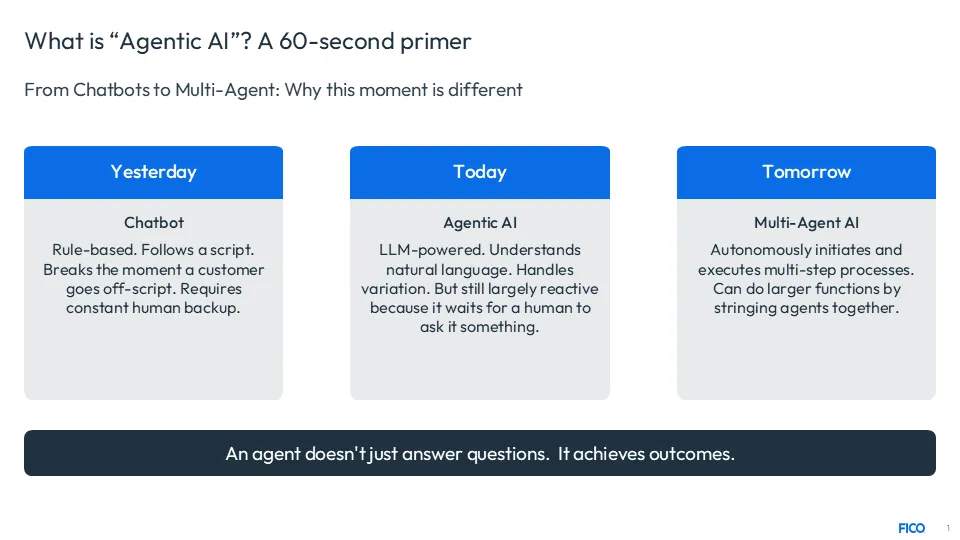
The first generation of automated customer interaction was the chatbot: rules-based, scripted, and effective only until a customer said something outside the decision tree. Anyone who has navigated a “press one for billing” phone menu knows the frustration. The moment a customer says something like “I want to pay, but I need to talk about my situation first,” the whole process breaks down and the call gets transferred to a human agent. That transfer is essentially the system admitting defeat.
The second generation — where much of the industry sits today — is large language model-powered assistants. These understand natural language and can hold a real conversation. But most of what is marketed as an “AI agent” today is, in reality, still a reactive system. It waits for a human to ask it something. It does not go and do things on its own.
The third generation — and this is where leading organizations are now investing — is true agentic AI. Multi-agent systems can initiate conversations, execute multi-step interactions across multiple channels, understand tone, detect financial hardship, negotiate payment terms, and fully close the loop with a customer. They do not just answer questions. They achieve outcomes.
This shift is fundamental, and it is happening now. Here are three approaches that represent best practice in deploying AI for customer communications.
Approach 1: Conversational Agents
Conversational agents are the front line of AI-powered customer interaction. Built on multi-agent architectures, these systems can handle voice and text interactions end-to-end, from authenticating a customer to guiding them through a collections process or transaction verification, without a human agent ever being involved.
The business case is compelling. Research and real-world deployments are showing a 20 to 30% increase in containment rates compared to traditional rules-based systems. That means fewer escalations and fewer calls consuming your human agents’ time for tasks that AI can handle. Industry estimates suggest that one in ten calls could be fully automated using voice agents by the end of this year, and many practitioners believe that figure is conservative. The operational cost reduction per contained call is estimated at 90 to 95%.
But the value of conversational agents goes beyond cost reduction. Every touchpoint with a customer is an opportunity to capture information about their financial situation, their preferences, their sentiment toward your institution. A well-designed conversational agent does not just help the customer self-resolve in the moment. It builds a richer customer profile that can be used to personalize future communications and improve decision-making for everything from cross-selling to fraud detection.
Consider how this works in a collections context:
- A customer who is 21 days past due receives an outbound call.
- The agent authenticates them, explains the situation, and offers a range of payment plan options.
- The customer selects a plan that works for their circumstances, say, 12 monthly installments.
- The agent records the agreement, sends a confirmation email, and closes the loop.
The entire interaction is governed, auditable, and compliant. And the information captured — that this customer prefers installment payments, that they are experiencing short-term financial difficulty — becomes a valuable input for future decisioning. Since the customer provided their preference, you can use that in future interactions to provide a customized plan up front.
The same principle applies in fraud prevention. Rather than sending a one-way informational alert about a suspicious transaction, a conversational agent can actually talk to the customer. It can ask: do you know who you are transferring this money to? When did you last speak with them? By getting that information, the agent both helps the customer self-resolve and captures data that can inform future fraud decisions for related accounts.
For organizations implementing conversational agents, particularly in voice, the architecture matters enormously. A production-grade voice agent requires a reliable speech-to-text service, a large language model with enough contextual intelligence to handle the inevitable imperfections in speech recognition, integration with offer and account data, and a text-to-speech layer that sounds natural enough to keep customers engaged. Vendors need to understand the full end-to-end telephony and voice path, not just the AI component. And crucially, the system must be safe, compliant, and designed for the speed that voice conversations demand. The goal is sub-second latency, so that the interaction feels as natural as talking to a human.
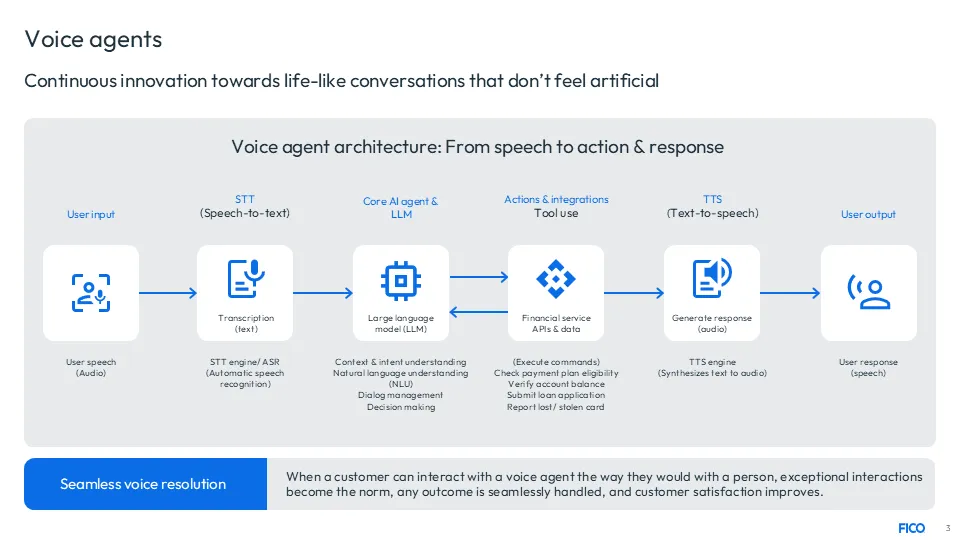
FICO® Platform Communications Capability delivers conversational agents across both voice and text channels, with out-of-the-box agents for collections, fraud, and transaction verification. It also has a conversational agent builder for organizations that need custom workflows tailored to their specific processes.
Approach 2: Focused Language Models
If conversational agents are the front line, the language model powering them is the foundation. And this is where many AI deployments go wrong.
General-purpose models (the large language models behind tools like ChatGPT and Gemini) are trained on vast amounts of internet data. They are impressively capable across a huge range of tasks. But in specialized domains like financial services, “one size fits all” is actually “one size fits none.” A model trained on celebrity gossip, Reddit threads, and news articles is not equipped to handle the nuanced, high-stakes conversations that define financial services customer interactions.
The alternative is a focused language model trained not on the internet at large, but on decades of domain-specific data. In financial services, that means training on payment negotiations, hardship identification, fraud verification, right-party communication, and the full spectrum of collections and origination interactions. The difference between a general model and a focused model is not a minor technical distinction. It is the whole ballgame.
There are four meaningful advantages to focused language models in this context.
- They outperform general models on domain-specific tasks. When the task involves understanding financial hardship or negotiating a payment, a model trained specifically on those scenarios will consistently outperform a model that has to generalize from unrelated training data.
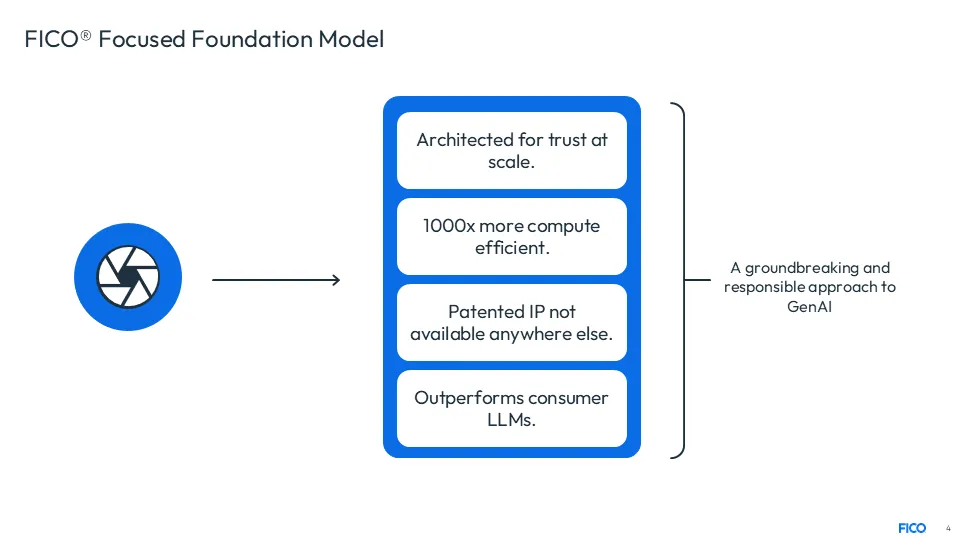
- They are dramatically more compute-efficient. A focused model is built from the ground up to do less work and get better answers, because it is not wading through billions of parameters of irrelevant information. The performance improvement can be massively more efficient. That efficiency directly enables the sub-second latency that voice interactions require.
- Data sovereignty is preserved. With a general-purpose model hosted by a third party, you are effectively sending your customer conversations to someone else’s infrastructure and hoping for the best. A focused language model that operates within your own or your vendor’s controlled environment means that data is sovereign, auditable, and secure. In financial services, that is not a nice-to-have. It is a requirement.
- Focused models are genuinely defensible as a competitive asset. They cannot be replicated by a competitor simply purchasing access to a public model. The training data, the domain expertise embedded in the architecture, and the years of investment in building the foundational model represent a durable competitive advantage.
Gartner has identified financial services and banking as one of the top three domains that most need focused language models. FICO has been building its foundational model for years, training it on financial conversations and decisioning data. The resulting FICO® Focused Language Models (FLMs) are purpose-built for financial services, not fine-tuned from a general base. That distinction matters.
Approach 3: AI-Powered Internal Assistants
Conversational agents and focused language models address the customer-facing side of communications. But there is an equally important application of AI on the operational side: empowering the people who configure, manage, and oversee these systems to work smarter and faster.
This is where AI-powered internal assistants come in. They represent a third dimension of best practice that is often overlooked in discussions about AI in customer communications.
An embedded AI assistant within a customer communications capability can democratize expertise across an organization. New team members can ask questions and get answers instantly, without having to track down the one person who has been in the role for years and “just knows” how everything works. Experienced practitioners can use it to accelerate their own workflows: analyzing complex solution logic, identifying unused or misconfigured elements, and generating plain-language summaries of intricate multi-channel strategies.
Consider the practical implications. A team member wants to understand a complex collection strategy with multiple subflows and communication channels. Rather than spending hours reading through configuration menus and documentation, they can simply ask the assistant to summarize the logic, identify areas for improvement, or flag anything that looks broken or inactive. The assistant, which is context-aware and understands what solution the user is working in, can analyze everything and provide a clear, actionable answer in seconds.
The same assistant can help with case analysis. Reviewing a long customer interaction log (a multi-turn voice conversation, for example) to extract the key facts is time-consuming and error-prone when done manually. An AI assistant can synthesize all of that into a concise summary, highlighting the resolution, the customer’s chosen payment arrangement, and any notable points in the conversation. That is not just a productivity gain; it is a quality and compliance benefit.
Perhaps most valuably, an AI assistant can be loaded with your organization’s own documentation, policies, and best practices. That means the knowledge base reflects your standards, your processes, and your institutional expertise. The assistant becomes a living repository of organizational knowledge, accessible to everyone.
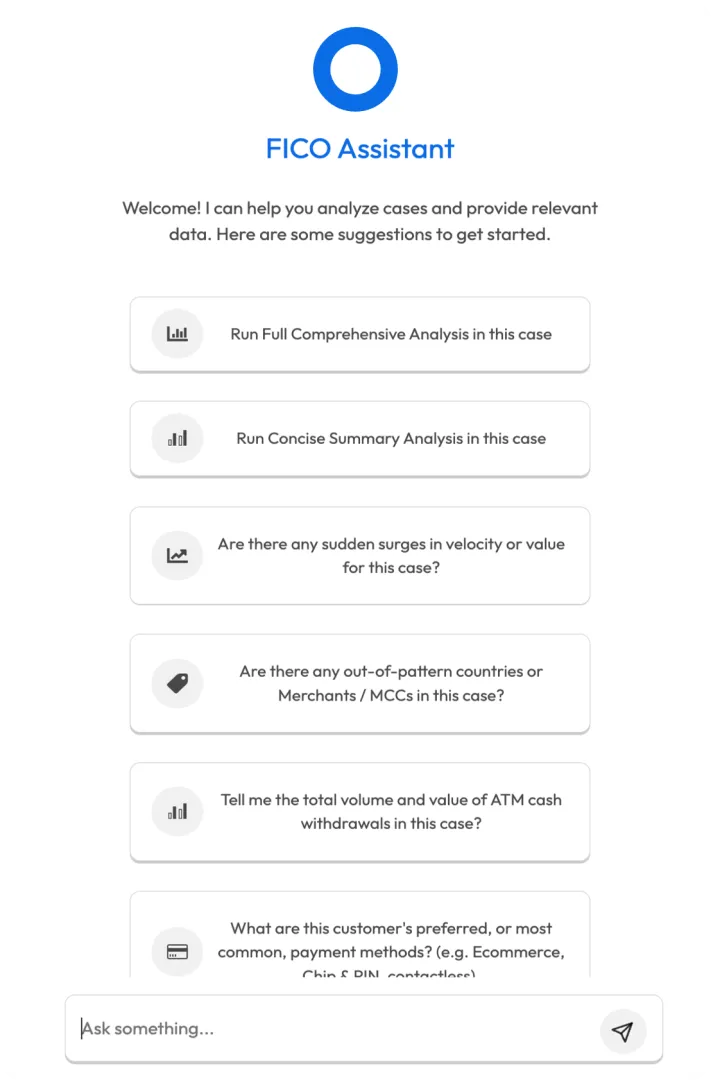
FICO® Assistant, embedded within the FICO® Platform - Communications Capability, is designed to do exactly this. Users can interact with the product through a natural language interface, ask questions, optimize configurations, and gain insights from case reporting without manually reviewing logs.
Building the Value Loop
What makes AI in customer communications genuinely transformative is the feedback loop it creates between communication and decision-making.
Every customer interaction generates information. That information, when captured systematically and fed into a decisioning platform, improves the quality of future decisions. Better decisions lead to more relevant, more personalized communications. More personalized communications generate better customer responses and richer data. And so the cycle continues.
This is what separates AI-enabled customer communications from a simple automation exercise. It is not about replacing a human with a bot. It is about building a system that continuously learns, adapts, and improves — one that gets smarter about each customer with every interaction, and uses that intelligence to deliver better outcomes for both the customer and the institution.
The organizations that will win with AI in customer communications are those who understand this flywheel effect and invest accordingly. They will choose models built for their domain, not fine-tuned from generic ones. They will design systems that capture and use information, not just process transactions. And they will govern their AI rigorously, because in financial services, ungoverned AI is a major risk.
- How FICO Can Help You Improve Customer Engagement Read 3 Ways Conversational AI Aids Collections & Customer Support
- See how Customer Communications Services for Fraud engages customers in real time to disrupt a variety of fraud typologies
- Learn how real-time customer communication can be a competitive differentiator across the entire customer lifecycle
Frequently Asked Questions
Traditional chatbots are rules-based systems that follow a fixed script. The moment a customer says something outside the expected decision tree, the interaction breaks down and gets transferred to a human agent. Today's large language model-powered assistants are an improvement, understanding natural language and holding a real conversation, but they are still fundamentally reactive: they wait for a human to prompt them. Agentic AI is the next step. These are multi-agent systems that can initiate conversations, execute multi-step interactions across multiple channels, detect customer sentiment and financial hardship, negotiate outcomes like payment terms, and fully close the loop , all without human intervention. The distinction is important: agentic AI doesn't just answer questions, it achieves outcomes.
A focused language model (FLM) is an AI model trained specifically on domain-relevant data, rather than on broad internet content. General-purpose models like ChatGPT or Gemini are trained on vast amounts of mixed data (news, social media, web pages) which makes them capable across many tasks but poorly suited to the nuanced, high-stakes conversations that define financial services. A focused language model trained on decades of financial conversations — covering payment negotiation, hardship identification, fraud verification, and right-party communication — will consistently outperform a general model on those specific tasks. Beyond accuracy, focused models are dramatically more compute-efficient, which enables the sub-second response times that voice interactions demand. They also keep customer data sovereign and auditable within a controlled environment, rather than routing sensitive conversations through a third party's infrastructure. This is a critical compliance consideration for regulated industries.
FICO® Platform - Communications Capability is designed to manage AI-powered customer interactions across voice and text channels. It includes out-of-the-box conversational agents for collections, fraud, and transaction verification, as well as a conversational agent builder for organizations that need custom workflows. It also includes FICO Assistant, an embedded AI assistant that helps internal users configure and optimize their communication strategies, analyze cases, and get answers to product questions, all through a natural language interface.
Every AI-managed customer interaction is an opportunity to capture information about a customer's financial situation, their payment preferences, their sentiment toward your institution. When that information is fed into a decisioning platform, it improves the quality of future decisions across the entire customer lifecycle: more relevant offers, more personalized communications, better fraud signals. Those better decisions in turn drive more meaningful customer interactions, which generate richer data. This flywheel effect is what separates a genuine AI communications strategy from a simple automation exercise.
Popular Posts

Average U.S. FICO® Score at 716, Indicating Improvement in Consumer Credit Behaviors Despite Pandemic
The FICO Score is a broad-based, independent standard measure of credit risk
Read more
The GSE Data Is Public. Here's What It Shows About Credit Score Modernization.
Independent Milliman analysis of GSE historical data confirms what anyone can now verify directly: FICO® Score 10T is the most predictive score.
Read more
FICO® Score High Achievers: Is Age the Only Factor?
<p>FICO’s latest research on <a href="http://www.fico.com/en/blogs/risk-compliance/us-credit-quality-rising-the-beat-goes-on/" target="_blank">national FICO® Score distribution</a> shows that US credit quality continues to trend upwards, with an increasing number of consumers scoring in the highest scores ranges. Given that, we decided it was time to refresh our study on “<a href="http://www.fico.com/en/blogs/risk-compliance/infographic-what-does-a-high-credit-scorer-look-like/" target="_blank">FICO® Score high achievers</a>,” where we examine the credit behavioural profiles of consumers with higher credit scores.</p> <p>As expected, our latest study showed that older people generally have higher scores, as has been the case in our <a href="http://www.fico.com/en/blogs/risk-compliance/age-before-beauty-credit-worthiness-before-youth/" target="_blank">past research</a>. This is largely because they have trade lines that have been open longer, which leads to higher scores (assuming the trade lines are in good standing and all other things equal). The most credit savvy among you will remember that length of credit history accounts for roughly 15% of the overall <a href="http://www.myfico.com/CreditEducation/WhatsInYourScore.aspx" target="_blank">FICO® Score calculation</a>.</p> <p>But for younger consumers, it isn’t too helpful to say, “just wait until you are 50 years old, and that will fix things!” Thus, I decided to dive deeper with our analysis, including looking at the credit behavioural characteristics of younger consumers with high FICO® Scores.</p> <p>In this analysis, I looked at credit characteristics for the two highest score bands, 750-799 and 800-850, which have about 16% and 23% of the population, respectively. I further broke this down by looking at the characteristics of the youngest 15% in each group, which occurs at age 29 for the 750-799 group and 43 for the 800-850. We used FICO<strong>®</strong> Score 9 for our analysis, and examined typical variables of the categories that go into the make-up of the score.</p> <p><a href="http://www.fico.com/en/blogs/wp-content/uploads/2016/10/FICO-Score-High-Achiever-table.png"><img class="alignnone size-full wp-image-29367" src="http://www.fico.com/en/blogs/wp-content/uploads/2016/10/FICO-Score-High-Achiever-table.png" alt="fico-score-high-achiever-table" width="715" height="747" /></a></p> <p>Since there’s a lot to dissect in this chart, I’ll highlight a few findings that struck me: <ul> <li><strong>Credit history.</strong> Higher scores are undoubtedly associated with a longer time on file. What’s striking is the higher average time on file for the 800+ group, both overall and for revolving accounts (the most common trade line). Clearly, it helps to start credit use early in life – but that’s not the sole determining factor for high scoring. The younger cohorts in both the 800+ and 750-799 groups have time on file medians significantly less than their older counterparts.</li> <li><strong>New credit.</strong> High credit scorers do, in fact, pursue new credit. We see little variation in months since last trade line opening and last inquiry among all groups observed.</li> <li><strong>Pay on time.</strong> As you might expect, the further in the past the delinquency, the higher the score – and that’s <u>if</u> a delinquency ever happened. 95% of the 800+ people and 72% of the 750-799 group have never been delinquent, which is a striking contrast to the 57% for the total population. The percentages for the younger groups are even higher, especially so for the 750-799ers. Collection items are also scarce for these high scorers. While 23% of the national population have collection items greater than $99, the figures are only 0.5% for the 800+ group and 3% for the 750-799 group. It is clear that, in conjunction with starting a credit file early, paying on time is a key trait of the FICO® Score high achiever.</li> <li><strong>Balance and utilization.</strong> Finally, we look at how credit is being used, focusing on revolving product use. (Since most people only have one mortgage or one auto loan, variation in instalment product figures is minimal and driven by payment history, which is near perfect for high scorers, as we’ve seen.) FICO® Score high achievers tend to have more open revolving accounts. While the % active trades and utilization are generally lower, by no means do high scorers avoid the use of credit products. What drives the difference here is the amount of <u>available</u> revolving credit utilized. The 800+ group is roughly 1/4 of the national median, both in total and on their highest utilized card; they also have lower balances and more cards<em>. </em>The 750-799 group is more active and higher utilized, but still only at 2/3 of the national figures. The young 750-799 group compensate with lower revolving balances and, as a result, lower utilization, which is in line with what we see for the 800+ group.</li> <li><strong>Benchmarks.</strong> I’d like to point out that while this study provides good benchmarks of the typical credit traits of the FICO® Score high achiever, individual credit profiles will vary widely. And keep in mind that when we sort groups of consumers as a whole by different behaviours, some results may look superficially odd. For example, the 800+ band has a longer median average open account time (128 months) than average revolving months on file (140 months).</li> </ul> So, what do we conclude? A huge takeaway is that high scorers don’t have too much in the way of serious delinquencies and negative public record data.</p> <p>In most respects, the young 800+ people are like their peer group. They really only differ markedly in their shorter credit history and higher non-mortgage balance, both of which are a function of life stage. Our results show that you don’t have to be a credit product hermit; these high scorers have more credit cards. The takeaway is to start credit activity early and maintain well-managed and moderate usage.</p> <p>In many ways, the young 750-799 people are more interesting because their age profile is much younger. Their credit characteristics differ more from their peer group, particularly in terms of length of credit history. They compensate by having almost pristine credit records and lower balances.</p> <p>Ultimately, 39% of US consumers are FICO® Score high achievers, which they accomplish by following common-sense credit practices. It ain’t rocket science!</p>
Read moreTake the next step
Connect with FICO for answers to all your product and solution questions. Interested in becoming a business partner? Contact us to learn more. We look forward to hearing from you.