The Maslow's Hierarchy of Digital Transformation: 5 Levels
Just as very few people achieve “self-actualization” in life, not many companies achieve full digital transformation; here are the stages to help map your journey to the top

Business leaders frequently ask, “How much does it cost to achieve digital transformation?” It’s a fair question. Unfortunately, the answer is – just like you can’t buy love, health, or happiness – companies can’t “buy” digital transformation: it’s the result of a methodical, multi-tiered process of continuous improvement. In other words, it’s a journey, and that means there are some guideposts to navigate.
It’s not unlike Maslow’s Hierarchy of Needs. Anyone who’s ever taken a psychology course is familiar with Abraham Maslow and his famous five-level pyramid: the peak of performance is “self-actualization,” which represents your fullest potential – a rare and difficult state to unlock.
Maslow’s Hierarchy is a fitting metaphor for attaining your digital transformation: 91% of companies –virtually all financial institutions and most insurers, telcos, retailers, and leaders in other industries -- have a digital transformation strategy in place. But very few claim to have actualized their digital transformation potential: they get stuck somewhere along the way to the top due to the complexity of digital banking and insurance. Think about it this way: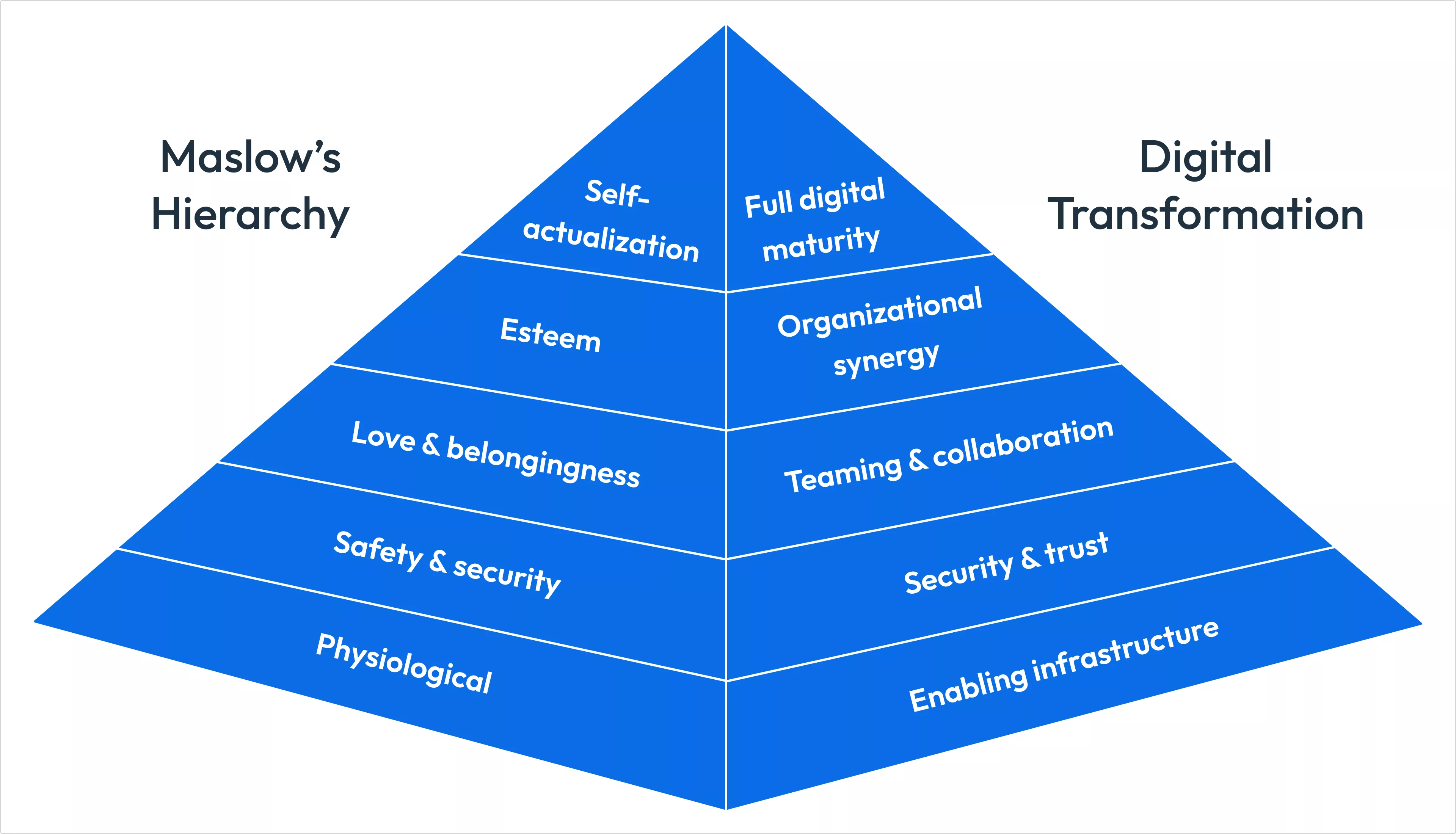
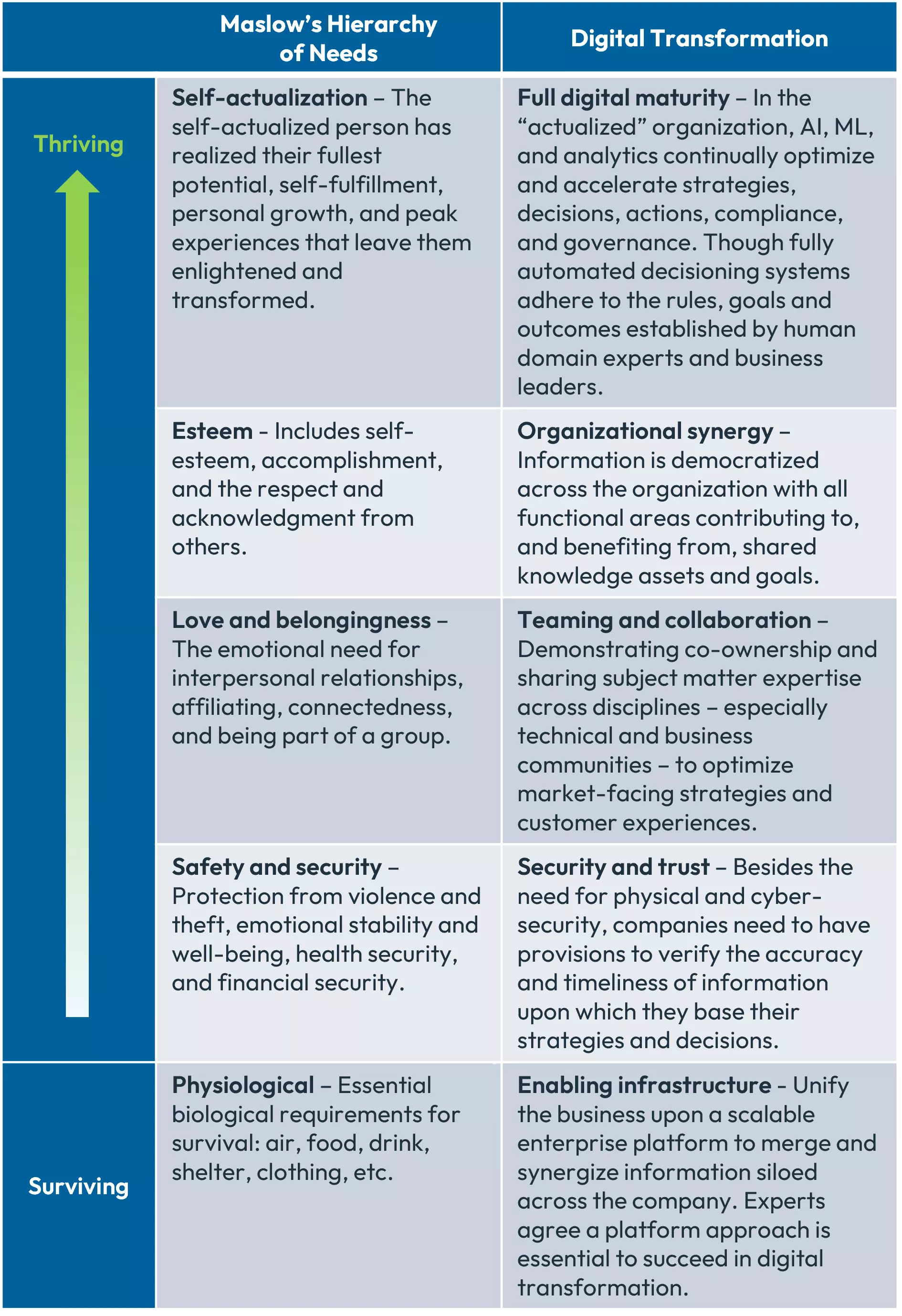
In either case, failure to reach the top of the pyramid is the result of not mastering lower-level stages along the way. Just as you can’t achieve self-actualization if you lack safety and security, financial institutions and insurers can’t achieve digital transformation if employees can’t collaborate, build synergy, and make customer experiences their shared top priority for compelling digital banking and insurance strategies. This stumbling block is why fintech and insurtech upstarts are thriving.
From “Digital Transformation” to “Digital Actualization”
In the case of digital transformation, financial services and insurance companies must start at the bottom level and solidify their capabilities before they can graduate to the next level. And they can’t buy their way there: IDC projected that companies would invest $10 trillion in digital transformation through 2025, but the composite estimate from McKinsey, Boston Consulting Group , KPMG and Bain & Company found that just 18% would achieve their digital transformation goals.
The end goals of digital transformation in the banking industry are to increase revenue and improve efficiency ratio in banking (and increase revenue and improve combined ratio in insurance.) This occurs when they succeed in creating a customer-centric culture that aligns people, processes, and technology from across the enterprise, and focuses them on the common goal: creating compelling, hyper-personalized customer experiences that draw upon the organization’s full portfolio.
When achieved, this shared applied knowledge is often called an “enterprise intelligence network,” the business equivalent of self-actualization. If you are new to the concept of an enterprise intelligence network in the context of digital transformation, here’s what each of those terms mean:
- Enterprise: All information across your organization and beyond is synergized and mobilized for customer-centric action in real-time, wherever, whenever, and however it is needed.
- Intelligence: Artificial Intelligence, machine learning, analytics, and business knowledge contextualize, optimize, and memorialize every shred of data, resulting in iteratively smarter, personalized customer decisions.
- Network: At every node of interaction between everyone from internal employees to all of your customer touchpoint across all channels, ensuring pre-validated next-best-actions are standing by to ensure delightful user experiences, increased satisfaction, better retention, and a higher share-of-wallet.
Thus, an enterprise intelligence network empowers financial services and insurance firms to make ever-smarter, ever-faster, and ever more-profitable business decisions, wherever and whenever data can be leveraged to gain sustained competitive advantage… the ultimate goal of digital transformation.
It empowers those in financial services and insurance firms to predict, analyze, and optimize customer interactions; giving them the ability to make better customer decisions in real-time, leveraging data from across the enterprise using advanced analytics, decision modeling, and AI… all working synergistically in an open and extensible platform to simultaneously transform the customer experience and advance the company’s goal of accelerating time-to-value in digital banking and insurance in a manner that fintech and insuretech competitors cannot.
Done in proper sequence, the steps described above provide a good course heading for those responsible for planning their company’s digital transformation strategy in the banking industry or insurance. Each company’s starting point, journey, and finish line is as unique as a fingerprint… but with planning and persistence, every company has a path to the apex.
And getting there will do wonders for your self-actualization.
Learn How FICO Platform Can Power Your Digital Transformation
- Explore innovation with FICO Platform
- Watch the video “FICO® Platform: Applied Intelligence, when and where it matters”
- Read the whitepaper “FICO® Enterprise Intelligence Network: Redefining the next generation of applied intelligence”
- See customers discuss their use of FICO Platform
- Read the article from The Journal of Digital Banking, “How Financial Services Leaders Are Using Enterprise Intelligence to Optimize Efficiency Ratios”
- Watch FICO Platform in action with the story of your everyday consumer, Digital Jane

Popular Posts

Average U.S. FICO® Score at 716, Indicating Improvement in Consumer Credit Behaviors Despite Pandemic
The FICO Score is a broad-based, independent standard measure of credit risk
Read more
The GSE Data Is Public. Here's What It Shows About Credit Score Modernization.
Independent Milliman analysis of GSE historical data confirms what anyone can now verify directly: FICO® Score 10T is the most predictive score.
Read more
FICO® Score High Achievers: Is Age the Only Factor?
<p>FICO’s latest research on <a href="http://www.fico.com/en/blogs/risk-compliance/us-credit-quality-rising-the-beat-goes-on/" target="_blank">national FICO® Score distribution</a> shows that US credit quality continues to trend upwards, with an increasing number of consumers scoring in the highest scores ranges. Given that, we decided it was time to refresh our study on “<a href="http://www.fico.com/en/blogs/risk-compliance/infographic-what-does-a-high-credit-scorer-look-like/" target="_blank">FICO® Score high achievers</a>,” where we examine the credit behavioural profiles of consumers with higher credit scores.</p> <p>As expected, our latest study showed that older people generally have higher scores, as has been the case in our <a href="http://www.fico.com/en/blogs/risk-compliance/age-before-beauty-credit-worthiness-before-youth/" target="_blank">past research</a>. This is largely because they have trade lines that have been open longer, which leads to higher scores (assuming the trade lines are in good standing and all other things equal). The most credit savvy among you will remember that length of credit history accounts for roughly 15% of the overall <a href="http://www.myfico.com/CreditEducation/WhatsInYourScore.aspx" target="_blank">FICO® Score calculation</a>.</p> <p>But for younger consumers, it isn’t too helpful to say, “just wait until you are 50 years old, and that will fix things!” Thus, I decided to dive deeper with our analysis, including looking at the credit behavioural characteristics of younger consumers with high FICO® Scores.</p> <p>In this analysis, I looked at credit characteristics for the two highest score bands, 750-799 and 800-850, which have about 16% and 23% of the population, respectively. I further broke this down by looking at the characteristics of the youngest 15% in each group, which occurs at age 29 for the 750-799 group and 43 for the 800-850. We used FICO<strong>®</strong> Score 9 for our analysis, and examined typical variables of the categories that go into the make-up of the score.</p> <p><a href="http://www.fico.com/en/blogs/wp-content/uploads/2016/10/FICO-Score-High-Achiever-table.png"><img class="alignnone size-full wp-image-29367" src="http://www.fico.com/en/blogs/wp-content/uploads/2016/10/FICO-Score-High-Achiever-table.png" alt="fico-score-high-achiever-table" width="715" height="747" /></a></p> <p>Since there’s a lot to dissect in this chart, I’ll highlight a few findings that struck me: <ul> <li><strong>Credit history.</strong> Higher scores are undoubtedly associated with a longer time on file. What’s striking is the higher average time on file for the 800+ group, both overall and for revolving accounts (the most common trade line). Clearly, it helps to start credit use early in life – but that’s not the sole determining factor for high scoring. The younger cohorts in both the 800+ and 750-799 groups have time on file medians significantly less than their older counterparts.</li> <li><strong>New credit.</strong> High credit scorers do, in fact, pursue new credit. We see little variation in months since last trade line opening and last inquiry among all groups observed.</li> <li><strong>Pay on time.</strong> As you might expect, the further in the past the delinquency, the higher the score – and that’s <u>if</u> a delinquency ever happened. 95% of the 800+ people and 72% of the 750-799 group have never been delinquent, which is a striking contrast to the 57% for the total population. The percentages for the younger groups are even higher, especially so for the 750-799ers. Collection items are also scarce for these high scorers. While 23% of the national population have collection items greater than $99, the figures are only 0.5% for the 800+ group and 3% for the 750-799 group. It is clear that, in conjunction with starting a credit file early, paying on time is a key trait of the FICO® Score high achiever.</li> <li><strong>Balance and utilization.</strong> Finally, we look at how credit is being used, focusing on revolving product use. (Since most people only have one mortgage or one auto loan, variation in instalment product figures is minimal and driven by payment history, which is near perfect for high scorers, as we’ve seen.) FICO® Score high achievers tend to have more open revolving accounts. While the % active trades and utilization are generally lower, by no means do high scorers avoid the use of credit products. What drives the difference here is the amount of <u>available</u> revolving credit utilized. The 800+ group is roughly 1/4 of the national median, both in total and on their highest utilized card; they also have lower balances and more cards<em>. </em>The 750-799 group is more active and higher utilized, but still only at 2/3 of the national figures. The young 750-799 group compensate with lower revolving balances and, as a result, lower utilization, which is in line with what we see for the 800+ group.</li> <li><strong>Benchmarks.</strong> I’d like to point out that while this study provides good benchmarks of the typical credit traits of the FICO® Score high achiever, individual credit profiles will vary widely. And keep in mind that when we sort groups of consumers as a whole by different behaviours, some results may look superficially odd. For example, the 800+ band has a longer median average open account time (128 months) than average revolving months on file (140 months).</li> </ul> So, what do we conclude? A huge takeaway is that high scorers don’t have too much in the way of serious delinquencies and negative public record data.</p> <p>In most respects, the young 800+ people are like their peer group. They really only differ markedly in their shorter credit history and higher non-mortgage balance, both of which are a function of life stage. Our results show that you don’t have to be a credit product hermit; these high scorers have more credit cards. The takeaway is to start credit activity early and maintain well-managed and moderate usage.</p> <p>In many ways, the young 750-799 people are more interesting because their age profile is much younger. Their credit characteristics differ more from their peer group, particularly in terms of length of credit history. They compensate by having almost pristine credit records and lower balances.</p> <p>Ultimately, 39% of US consumers are FICO® Score high achievers, which they accomplish by following common-sense credit practices. It ain’t rocket science!</p>
Read moreTake the next step
Connect with FICO for answers to all your product and solution questions. Interested in becoming a business partner? Contact us to learn more. We look forward to hearing from you.