Shifting Customers from Branches to Digital Account Opening
FICO survey shows even digital-savvy customers still prefer to open accounts in branches - understanding their reasons can help you give them confidence in digital channels

Every day, 307.2 million people are online in the US. That’s 85% of Americans. Across the globe, it’s 5.44 billion people - 62% of the global population.
Organizations across all sectors have been developing ecosystems to cater to these digital natives, who want convenient, personalised and seamless digital experiences.
While financial institutions are also moving in the same direction, some consumer behaviour in this space remains at odds with the general trend towards digital.
In our recent global research to understand what drives consumer behaviour when it comes to their interactions with financial institutions, we found a clear “willingness” to open most financial accounts digitally. For example, 73.9% of US citizens would be willing to apply for a credit card online. 62.1% would be willing to do the same for a savings account, 65.9% for a mobile phone and 58.5% for a personal bank account.
For “bigger ticket” financial products, however, this willingness drops substantially. Only 20.3% of Americans would apply for a mortgage digitally, 21.9% for a car loan, 24.2% for a personal loan and 27.1% for a BNPL loan. The picture across the globe is similar, with 58.1% willing to apply for a credit card digitally, 69.9% for a savings account, 63.3% for a mobile phone and 56.3% for a personal bank account, but substantially lower numbers for those big ticket items, particularly mortgages and car loans - 14% and 17.9%.
Moreover, we discovered that despite the willingness to open most financial accounts digitally, people overwhelmingly still prefer an in-branch experience.
This raises the question: What are the primary opportunities that financial institutions have to improve the digital journey (or maybe experience) for their customers?
A More Personal Approach to Originations
Although complexity varies between certain products — mortgage, car loan, personal loan — many of the details required from consumers are the ssimilar for each product. It suggests that customers may not be getting the information or the experience they need from the journey they are on.
This is particularly true of the younger generation, aged 18 to 24 years old. Despite being the digital generation, they are more averse to applying online for a mortgage (10.7%), car loan (13%) or personal loan (18.3%). Lack of financial resource will of course be a factor here, but lack of financial knowledge and experience will also be key. This group is more likely to want guidance when applying for more complex products.
At a time when convenience and speed are increasingly separating the front runners from the rest in the digital journey, this consumer preference to apply for products in branch must be viewed as a sign for financial institutions to assess and understand what needs to change in the existing customer journey, especially in the digital space.
Fraud Remains at the Heart of Consumer Concerns
While most people in the US see value in the ease (60.6%), speed (57.9) and flexibility of being able to open an account anywhere (57.7%) and at any time (62.8%), only 37.6% believe the digital route is secure.
Concerns about becoming victims to bank-related fraud are very real, particularly when it comes to stolen cards and identify theft. One in five (22%) US consumers worry that their credit or debit card details would be stolen and used to apply for credit, while one in three (32%) worry that their identity would be used by a fraudster to open an account in their name.
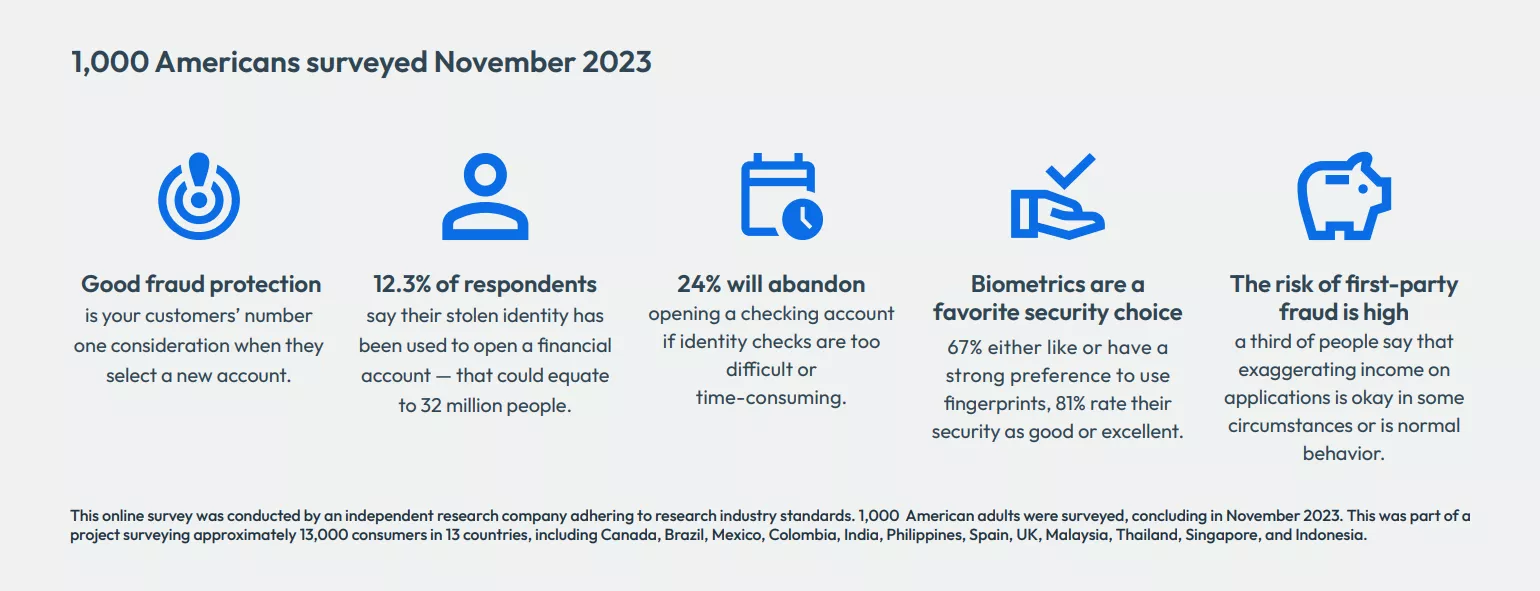
And it’s a reasonable concern. The Federal Trade Commission received 5.7 million fraud and identity theft reports last year, while cybercrime losses according to the FBI reached $10.2 billion.
Financial institutions have moved quickly to address soaring levels of fraud with the implementation of additional security measures. American consumers have certainly noticed this. 45% have noted the increase in identity checks when making a purchase online, while 39.7% have noted it when logging into their bank accounts.
This isn’t necessarily negative. For nearly a third of consumers in the US, good fraud protection is the number one consideration when it comes to choosing a financial services provider.
However, there’s only so much friction customers will endure. One in four (24.4%) US consumers have still abandoned opening a bank account when identity checks proved too difficult or time consuming. One in five (21.6%) have stopped or reduced their use for the same reason.
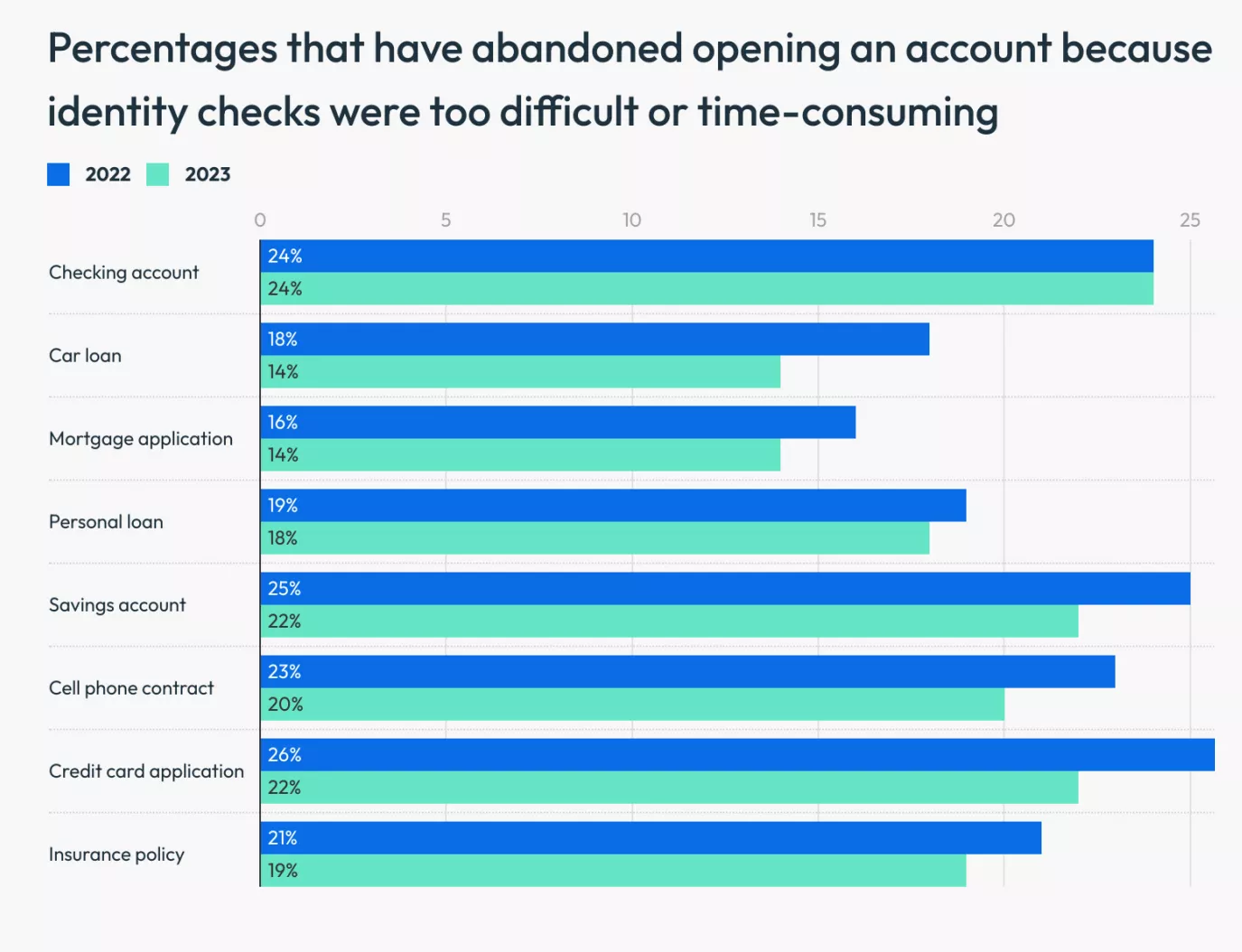
A deep sense of security without increased friction levels is the balance needed here.
Addressing the Gaps and Siloes in Banking Decisions
The internal make-up of many large financial organizations is a siloed one. Each department undertakes its own distinct workflow to manage credit risk, detect fraud and ensure regulatory compliance. The checks can be extensive and customers are repeatedly asked to provide the same information. This information is not shared, so it leads to fragmented and frustrating customer experiences, as well as significant levels of unnecessary costs. It also creates major gaps and blind spots that criminals take advantage of.
This disconnect between departments and data has resulted in some complex fraudulent schemes. For example, criminals have taken the details of deceased individuals and applied for loans, which have been approved. How? The inability to link the right data together at the right time. Banks must make fast decisions in succession across multiple channels and through many facets of different account and product lifecycles.
These siloed organizations also have multiple point solutions that suffer from limited integration. Individually they contribute value. Combined into a cohesive ecosystem, however, they have the potential to revolutionise. Organizations would see significant benefits, from enhanced efficiencies to more cost-effective and customer-centric onboarding processes.
This is what the award-winning FICO Platform — a modern, API-first decision intelligence platform — is doing. It enables specialist solutions to be brought together. Data is centralized and formatted to facilitate seamless data sharing across functions. Running from a single platform, it orchestrates their use — and this has been the game changer for forward-thinking financial institutions.
Orchestration is how banks can move from procedural processes that aim to treat each fraud type differently to a strategy that includes coordinated capabilities and responses, informed by AI and machine learning. For example, individual behaviors that form part of a wider fraud scheme may not trigger anything on their own, but taken together with a centralized, orchestrated viewpoint, the patterns are detectable. This is the unified, authoritative version of the truth, and it’s driving better experiences and outcomes for customers while helping stop fraud.
Conclusion
Most new customers are genuine and want to feel secure, understood and in control when pursuing a financial application online. Amongst them will be stolen or fabricated identities or poor credit risks. With the cost of acquiring a new customer exceeding $644, losses can be high.
For large, complex organizations where customer journeys span many channels with disconnected systems and processes, the game changer will be a centralised, platform-based orchestration approach.
It’s only when the right data and decisions are being applied at the right time and in the right place that positive customer experiences and effective fraud management will finally align and balance.
How FICO Platform Helps Improve Your Originations Strategies
- Explore FICO Platform for Originations
- Watch FICO Chief Product & Technology Officer Bill Waid discuss Applied Intelligence and FICO Platform
- Learn more about how to protect your organization from application fraud during the originations process
- Discover more about what Americans think about how financial services organizations manage fraud in the originations process

Popular Posts

Average U.S. FICO® Score at 716, Indicating Improvement in Consumer Credit Behaviors Despite Pandemic
The FICO Score is a broad-based, independent standard measure of credit risk
Read more
The GSE Data Is Public. Here's What It Shows About Credit Score Modernization.
Independent Milliman analysis of GSE historical data confirms what anyone can now verify directly: FICO® Score 10T is the most predictive score.
Read more
FICO® Score High Achievers: Is Age the Only Factor?
<p>FICO’s latest research on <a href="http://www.fico.com/en/blogs/risk-compliance/us-credit-quality-rising-the-beat-goes-on/" target="_blank">national FICO® Score distribution</a> shows that US credit quality continues to trend upwards, with an increasing number of consumers scoring in the highest scores ranges. Given that, we decided it was time to refresh our study on “<a href="http://www.fico.com/en/blogs/risk-compliance/infographic-what-does-a-high-credit-scorer-look-like/" target="_blank">FICO® Score high achievers</a>,” where we examine the credit behavioural profiles of consumers with higher credit scores.</p> <p>As expected, our latest study showed that older people generally have higher scores, as has been the case in our <a href="http://www.fico.com/en/blogs/risk-compliance/age-before-beauty-credit-worthiness-before-youth/" target="_blank">past research</a>. This is largely because they have trade lines that have been open longer, which leads to higher scores (assuming the trade lines are in good standing and all other things equal). The most credit savvy among you will remember that length of credit history accounts for roughly 15% of the overall <a href="http://www.myfico.com/CreditEducation/WhatsInYourScore.aspx" target="_blank">FICO® Score calculation</a>.</p> <p>But for younger consumers, it isn’t too helpful to say, “just wait until you are 50 years old, and that will fix things!” Thus, I decided to dive deeper with our analysis, including looking at the credit behavioural characteristics of younger consumers with high FICO® Scores.</p> <p>In this analysis, I looked at credit characteristics for the two highest score bands, 750-799 and 800-850, which have about 16% and 23% of the population, respectively. I further broke this down by looking at the characteristics of the youngest 15% in each group, which occurs at age 29 for the 750-799 group and 43 for the 800-850. We used FICO<strong>®</strong> Score 9 for our analysis, and examined typical variables of the categories that go into the make-up of the score.</p> <p><a href="http://www.fico.com/en/blogs/wp-content/uploads/2016/10/FICO-Score-High-Achiever-table.png"><img class="alignnone size-full wp-image-29367" src="http://www.fico.com/en/blogs/wp-content/uploads/2016/10/FICO-Score-High-Achiever-table.png" alt="fico-score-high-achiever-table" width="715" height="747" /></a></p> <p>Since there’s a lot to dissect in this chart, I’ll highlight a few findings that struck me: <ul> <li><strong>Credit history.</strong> Higher scores are undoubtedly associated with a longer time on file. What’s striking is the higher average time on file for the 800+ group, both overall and for revolving accounts (the most common trade line). Clearly, it helps to start credit use early in life – but that’s not the sole determining factor for high scoring. The younger cohorts in both the 800+ and 750-799 groups have time on file medians significantly less than their older counterparts.</li> <li><strong>New credit.</strong> High credit scorers do, in fact, pursue new credit. We see little variation in months since last trade line opening and last inquiry among all groups observed.</li> <li><strong>Pay on time.</strong> As you might expect, the further in the past the delinquency, the higher the score – and that’s <u>if</u> a delinquency ever happened. 95% of the 800+ people and 72% of the 750-799 group have never been delinquent, which is a striking contrast to the 57% for the total population. The percentages for the younger groups are even higher, especially so for the 750-799ers. Collection items are also scarce for these high scorers. While 23% of the national population have collection items greater than $99, the figures are only 0.5% for the 800+ group and 3% for the 750-799 group. It is clear that, in conjunction with starting a credit file early, paying on time is a key trait of the FICO® Score high achiever.</li> <li><strong>Balance and utilization.</strong> Finally, we look at how credit is being used, focusing on revolving product use. (Since most people only have one mortgage or one auto loan, variation in instalment product figures is minimal and driven by payment history, which is near perfect for high scorers, as we’ve seen.) FICO® Score high achievers tend to have more open revolving accounts. While the % active trades and utilization are generally lower, by no means do high scorers avoid the use of credit products. What drives the difference here is the amount of <u>available</u> revolving credit utilized. The 800+ group is roughly 1/4 of the national median, both in total and on their highest utilized card; they also have lower balances and more cards<em>. </em>The 750-799 group is more active and higher utilized, but still only at 2/3 of the national figures. The young 750-799 group compensate with lower revolving balances and, as a result, lower utilization, which is in line with what we see for the 800+ group.</li> <li><strong>Benchmarks.</strong> I’d like to point out that while this study provides good benchmarks of the typical credit traits of the FICO® Score high achiever, individual credit profiles will vary widely. And keep in mind that when we sort groups of consumers as a whole by different behaviours, some results may look superficially odd. For example, the 800+ band has a longer median average open account time (128 months) than average revolving months on file (140 months).</li> </ul> So, what do we conclude? A huge takeaway is that high scorers don’t have too much in the way of serious delinquencies and negative public record data.</p> <p>In most respects, the young 800+ people are like their peer group. They really only differ markedly in their shorter credit history and higher non-mortgage balance, both of which are a function of life stage. Our results show that you don’t have to be a credit product hermit; these high scorers have more credit cards. The takeaway is to start credit activity early and maintain well-managed and moderate usage.</p> <p>In many ways, the young 750-799 people are more interesting because their age profile is much younger. Their credit characteristics differ more from their peer group, particularly in terms of length of credit history. They compensate by having almost pristine credit records and lower balances.</p> <p>Ultimately, 39% of US consumers are FICO® Score high achievers, which they accomplish by following common-sense credit practices. It ain’t rocket science!</p>
Read moreTake the next step
Connect with FICO for answers to all your product and solution questions. Interested in becoming a business partner? Contact us to learn more. We look forward to hearing from you.