Using AI to Improve Debt Collection and Recovery Strategies
See how AI and conversational AI strengthen debt collection strategies by optimizing outreach, boosting response rates, and improving customer experience

AI in Debt Collection Is a Game Changer
While AI has been used in fraud detection for more than 30 years, it has had fewer applications in debt collection. That is changing. AI can help debt collectors work more efficiently, and support borrowers to remain current on their accounts with timely messaging and easy self-service payments. Today, that opportunity has expanded well beyond basic automation, with machine learning, explainable AI, and increasingly, agentic AI, reshaping how collections and recovery strategies are built, optimized, and executed.
Key Takeaways
- Financial strain is rising, making smarter collection strategies essential. From 2023 to 2024, 18% of U.S. credit card consumers began paying only the minimum, while missed payments increased across the board. This growing pressure makes AI-driven collection strategies critical for protecting recovery and managing loss.
- Customer experience now carries as much weight as the product itself. A FICO survey found that 88% of consumers value their experience with a financial institution as highly as its products, yet only 28% feel that experience is a good one. Timely, personalized communication is the clearest path to closing that gap. AI helps institutions reach the right customer, at the right time, on the right channel, with the right message.
- AI strengthens collections across three core areas. It powers account segmentation, treatment optimization, and communications at scale, and ultimately drives smarter digital self-service, helping institutions reach the customer and improve business outcomes.
- Every collections conversation makes the next one smarter. When an AI agent captures why a customer fell behind, which channel they responded to, or what payment plan they accepted, that information doesn't stay in one interaction. It enriches the customer's ongoing profile and improves the next outreach decision.
- Conversational AI drives higher containment and measurable business outcomes. By automating payment arrangements and hardship scenarios, conversational AI increases containment rates, boosts self-service, and frees agents to focus on complex cases, delivering value for both customers and institutions.
- Agentic AI is redefining what full automation can look like in collections, with explainability as its foundation. Agentic systems can manage an entire consumer interaction, verifying identity, confirming transactions, and capturing payment promises, with self-service resolution targeted at over 80% of eligible interactions. As this level of autonomy grows, explainable AI ensures every decision remains logged and auditable, keeping automated collections strategies compliant and trustworthy at scale.
Minimum Payments and Missed Payments Are Rising
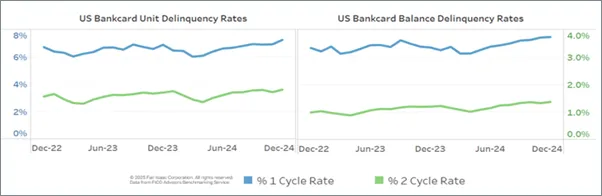
More concerning is the considerable increase in customers making only minimum payments. Data from 2023 to 2024, covering 130 million U.S. consumers, particularly those with credit cards, reveals two clear warning signs:
- 18% now pay only the minimum. Previously, about half of this population paid either their balance in full or more than the monthly payment but now the trend is toward the minimum, which may indicate growing financial strain.
- Missed payments are climbing. Customers missing one payment rose 5.3%, and those missing two payments rose 6.3%.
From my experience in loss prevention, when the number of customers missing two or more payments rises, it signals increased stress and the need to reassess underwriting practices, client outreach, and the strategies used to help customers keep their accounts current. This is precisely where automated delinquency flagging becomes valuable, identifying these early warning signs across large portfolios in real time, well before an account reaches a stage where recovery options narrow.
Turning to customer experience, FICO's 2024 customer experience survey found that 88% of respondents consider their experience with a financial institution just as important as the products themselves. However, only 28% feel they are actually having a good experience. Many attribute this gap to disconnected or non-timely communication, creating a disjointed feeling when interacting with financial institutions. Customers cite clear, timely communication and automated collections outreach with easy self-service options as top priorities.
Why Is Omni-Channel Communications Used in Debt Collection Strategies?
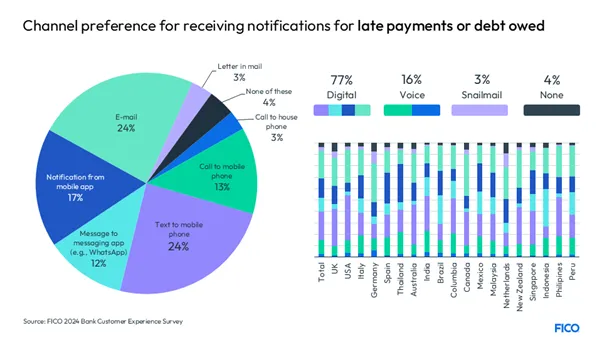
When it comes to communication channels, traditional methods such as phone calls are becoming less effective, with current right-party contact rates rarely exceeding 8–10%. Customer channel preferences are shifting toward more immediate and visible options:
- Text and push notifications: Most customers now prefer to be contacted by text message or push notification for debt or payment reminders, as these methods are more immediate and visible.
- Email: While still relevant in an omnichannel strategy, email is less effective when used alone due to inbox overload however, when coupled with SMS/RCS, Voice, and push notifications it can be part of an intelligent communication strategy to enhance consumer trust and self-service action.
As customer volume and channel count grow, automated collections outreach, sequencing text, voice, email, and push notifications based on individual response patterns, becomes the more scalable way to coordinate this kind of communication.
How Orchestrating Channels Supports Collections Automation
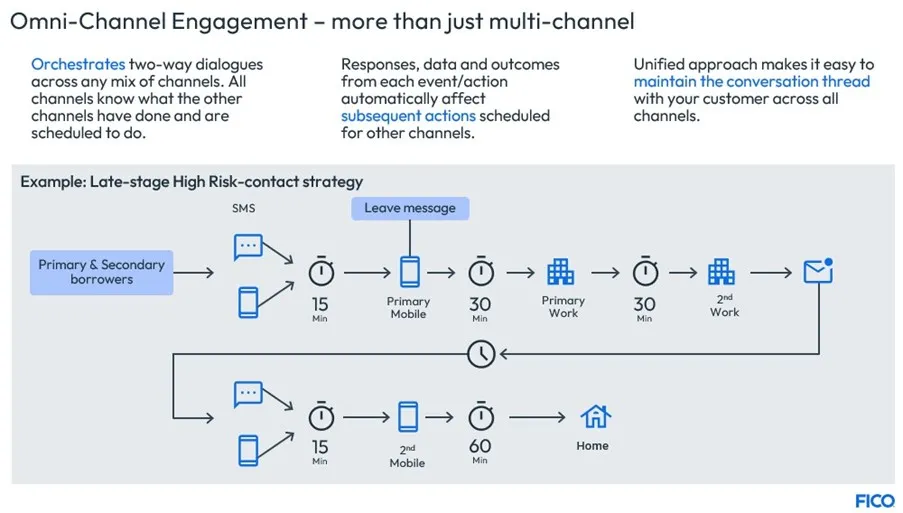
A true omni-channel approach—using channels is now the best way to ensure that customers are notified of issues and given opportunities to resolve them. Rather than using siloed channels (e.g., dialers, texts, emails, push notifications operating independently), integrating these channels and sequencing them within the same day significantly increases the chances of reaching the customer and prompts quicker responses.
This kind of orchestration across channels is what collections automation delivers at scale, removing the manual coordination burden from collections teams while maintaining consistent, compliant messaging.
Intelligent, data-driven communications also help identify customer preferences. If a customer responds to a text or IVR call, that information is used to shape future outreach. Sometimes, simply asking for a customer’s preferred channel is the most straightforward way to capture this data. The goal is to reach the right customer at the right time, on the right channel, with the right message, using interoperable channels and personalized messaging strategies.
How AI, Optimization, and Communications Improve Debt Collections and Recovery
- Segmentation of Accounts: AI can analyze vast amounts of customer data, including communication history and payment behavior, to group similar accounts based on shared characteristics. This kind of pattern recognition across large account portfolios is a core application of machine learning for collections, where models identify shared risk and behavior characteristics that would be impractical to detect manually, laying the groundwork for the treatment and outreach strategies that follow.
- Treatment Optimization: Optimization technology determines the best treatment strategy for each account, whether that's a specific offer or payment plan, to reach business goals such as collecting more payments, within a given set of business constraints. This account-level strategy decisioning is a direct, practical example of collections optimization.
- Communications: AI-powered communications determine the best channel and timing, with the best messages to maximize response. Natural language processing (NLP) powers conversational AI, driving advanced digital self-service experiences where customers can resolve issues quickly and discreetly. How AI, Optimization, and Communications Improve Debt Collections and Recovery
Let’s drill into the communication example.
How to Drive Outcomes by Using AI in Debt Collection Strategies
Getting collections communications right comes down to three things working together: knowing the best time and channel to reach a customer, being able to hold an actual conversation once you do, and giving customers a way to resolve things themselves. AI changes what's possible on all three fronts, treating customers with respect while giving them the self-service tools to resolve debt situations independently.
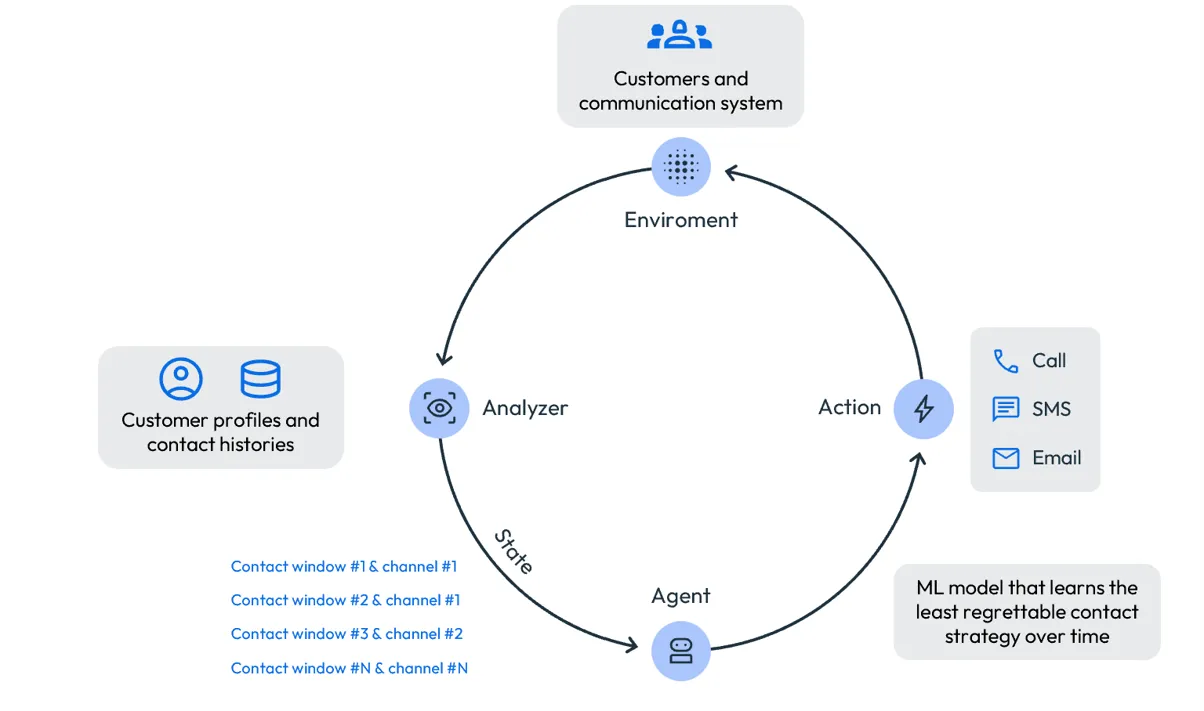
Start with timing and channel. Consider a scenario where a financial institution uses AI to analyze customer profiles and contact history. It might discover that one customer prefers voice calls in the afternoon and is more likely to respond at midday. Acting on that insight, the institution can deliver communications at the time and through the channel that customer actually prefers, increasing the odds of a timely response.
The benefits of this approach are twofold:
- Moving customers from the “late responder” cohort to the “early responder” group saves costs and avoids over-communication, resulting in a better customer experience.
- Increasing overall response rates leads to higher self-service and improved outcomes for both customers and the institution. In some cases, this approach can even help identify customers at risk of delinquency before they miss a payment, enabling proactive outreach and support.
Challenge: How Do you Determine the Right Communications Strategy?
Knowing when and how to reach someone is only half the equation. What happens once the conversation starts matters just as much, which is where conversational AI comes in. Conversational AI is revolutionizing collection communication strategies by enabling genAI that can handle payment arrangements, hardship scenarios, and other interactions, from routine to complex interactions, automating what once required a live agent. This is a clear example of AI collections automation, replacing manual, agent-led interactions with self-directed digital resolution paths that operate without a live agent on every case.
The quality of that conversation depends on what's powering it. Focused foundation models are trained specifically on financial conversations and decisioning data, rather than adapted from a general-purpose model built on broad internet content. Because they never learn anything outside that domain, they can't surface something irrelevant or inaccurate mid-conversation, and their understanding of hardship situations, collections regulations, and payment negotiation holds up under real operating conditions. That focus is what lets them act with the judgment a regulated industry actually requires, rather than the surface-level fluency a general-purpose model brings to the same conversation.
Put the three pieces together, AI-driven decisioning for the best time and channel, conversational AI to engage the customer, and digital self-service to let them act, and you get the path to hyper-personalization in collection strategies. This trio of technologies enables personalized and seamless engagement throughout the delinquency lifecycle.
Every one of these conversations also feeds back into the system. When an agent captures a payment promise, it also captures the financial circumstances driving the delinquency and the customer's preferred channel and time going forward. That information doesn't stay in one interaction. It enriches the customer's profile and makes the next contact decision, in collections or elsewhere in the business, start from a better-informed position.
What is the Role of Agentic AI in Collections?
Building on this level of coordinated automation, agentic AI represents a further advancement, in which a system executes a multi-step process autonomously, operating within boundaries that a person defines and approves, rather than completing a single isolated task. In a collections context, this is exemplified by a conversational agent managing an entire consumer interaction: verifying identity, confirming a transaction, and capturing a payment promise, all without any live-agent involvement.
This approach is designed to accelerate resolution significantly, with autonomous resolution targeted at over 80% of eligible interactions, reducing the volume of cases that require live-agent involvement.
Why Explainable AI Matters in Collections and Recovery
As collections strategies increasingly rely on automated and agentic decisioning, AI explainability becomes essential to maintaining compliance and institutional trust.
Each decision made needs to be logged in detail, encompassing which agents were involved, conversation details, and payment arrangements reached, providing risk and compliance teams with verifiable evidence of what occurred and why, rather than a retrospective explanation of an otherwise opaque process. Authorization protocols, operational guardrails, and data protection measures must be embedded directly within the platform, reducing security review to a procedural formality rather than a recurring bottleneck for each new use case.
The Time for AI in Debt Collection Strategies Is Now
While AI is a popular buzzword, its true value lies in driving measurable business outcomes: increasing containment rates (the percentage of customers who resolve issues without needing an agent), boosting response and resolution rates, and creating positive customer experiences. Containment rates are a crucial metric—indicating how many customers can resolve their situation independently, freeing up agents to focus on cases that require human intervention.
Modern tools empower customers to resolve debts independently while enabling institutions to optimize collections strategies and resource allocation. With the right approach, AI-powered communications can deliver positive outcomes for both customers and businesses.
How FICO Can Help You Improve Debt Collection Strategies
- See how conversational AI is reshaping collections engagement. In this FICO World presentation, Collections: Delivering Superior Customer Journeys with Conversational AI and Enhanced Self-Service, FICO's product and collections experts explore the current state of collections, evolving consumer expectations, and how automated collections outreach and omni-channel orchestration are transforming customer journeys.
- See the measurable results behind AI collections optimization. Download Unlocking the Power of Collections and Recovery Analytics to learn how prescriptive analytics and treatment optimization have improved collection and recovery performance by as much as 30 percent. One organization achieved a 10% reduction in roll rate from 30-day delinquencies to write-offs within six months, without increasing operational costs or headcount, for a projected annual write-off savings of $5 million.
- See why explainability isn't optional in high-stakes collections decisions. This FICO® Platform overview, FICO® Platform Decision Agents and the Future of Agentic AI, uses debt collection as its defining example: how a late-paying customer is treated carries real regulatory and auditability stakes, making explainable AI collections and recovery essential. Gartner predicts that by 2027, half of all business decisions will be automated or augmented by AI agents.
- Read the Hot Topic Q&A, New Frontiers in the Collections Industry, to discover how an omni-channel approach transforms debt collection strategies and learn the five success drivers of omni-channel communication: customer experience, operating expenses, compliance and risk, collection success, and employee satisfaction.
- Learn how FICO® Platform powers debt collection strategies that are digital-first, outcome-focused, and compliant, and see how Westpac New Zealand achieved a 25% increase in digital engagement, a 40% cost reduction, and 10% higher customer rehabilitation rates. Read the whitepaper.
- Explore an automated collections strategy for telecommunications that transforms collections from a cost center into a strategic advantage through four critical applications to separate recoverable debt from fraudulent cases.
This is an update of a post from 2025.
Frequently Asked Questions
Return on investment typically materializes across three dimensions: improved recovery and response rates, reduced cost-to-collect through automation and self-service, and lower write-offs enabled by earlier, more precisely targeted intervention. Institutions can quantify this value by benchmarking resolution rate, containment rate, and cost-to-collect prior to and following deployment, then monitoring reductions in roll rates and charge-offs over time.
Collections remains a highly regulated discipline, and automation does not diminish that responsibility. A well-designed communications approach can, in fact, strengthen compliance by centralizing engagement rules across all channels, capturing and tracking customer consent, and maintaining a comprehensive audit trail of contact timing, frequency, tone, and customer response. Because requirements vary by jurisdiction and product, engagement strategies should be configured in consultation with legal and compliance teams.
Most AI used in collections so far has been algorithmic: a model scores an account or forecasts who is likely to pay, and a person or a rules engine decides what to do with that score. Agentic AI closes that gap. It carries a process through multiple steps on its own, operating within boundaries a person defines and approves, rather than stopping at a prediction. In a collections context, that could mean a single interaction where an agent verifies the customer's identity, confirms the outstanding balance, and captures a payment promise, without a live agent handling each step individually.
Recovery rate represents only one dimension of performance. A comprehensive assessment should encompass containment rate, response and resolution rates, cost-to-collect, roll-rate reduction, and customer-experience indicators such as complaint volume and self-service adoption.
Each plays a distinct but interconnected role. Machine learning does the analysis, finding patterns across account and payment history to group similar customers and predict behavior, and it keeps improving as information feed back into the model. Agentic AI is the layer that acts on that analysis. It carries a multi-step interaction through to resolution, verifying identity, deciding next steps, and capturing a payment promise, without someone manually triggering each part. Generative AI is what agentic AI draws on to actually converse, producing natural, context-aware responses that adapt to what the customer says rather than reading from a fixed script. A modern collections strategy leverages all three together, rather than treating them as interchangeable or sequential.

Popular Posts

Average U.S. FICO® Score at 716, Indicating Improvement in Consumer Credit Behaviors Despite Pandemic
The FICO Score is a broad-based, independent standard measure of credit risk
Read more
The GSE Data Is Public. Here's What It Shows About Credit Score Modernization.
Independent Milliman analysis of GSE historical data confirms what anyone can now verify directly: FICO® Score 10T is the most predictive score.
Read more
FICO Statement on FHFA and FHA Updates to Credit Score Modernization
FICO supports FHFA’s announcement that the long-anticipated historical data for FICO® Score 10T will be released to the mortgage market.
Read moreTake the next step
Connect with FICO for answers to all your product and solution questions. Interested in becoming a business partner? Contact us to learn more. We look forward to hearing from you.