A 7-Step Enterprise Fraud Framework to Redefine Scam Prevention
There is no one silver bullet for stopping scams — effective defense requires a multi-layered strategy

Scams (or authorized push payments) are the scourge of the day.
While no formal figures exist, it is estimated that the global scam losses exceed $1 trillion per annum. Organized crime is at the heart of this increase, with some estimates putting 1.5 million employed as professional scamsters.
The rising professionalism of the scamsters, the availability of “off the shelf” scam tools (e.g., phish kits), the very high “gross margin”, the increasing digitization of customer experiences, and inadequate law enforcement are all contributing to a continued increase in scams across the world.
The regulatory expectations, and the associated cost of compliance, vary by market. The most extreme position exists in the UK, where financial institutions are liable for up to £85k in almost all cases. Most regulators are examining the “Shared Responsibility Framework” framework, and it is reasonable to assume that FIs will have to bear an increasing share of this cost.
Customer expectations prize fraud defenses when selecting a FI. In a global survey of 18,000 customers, some 60% ranked “Good Fraud Protection” as either their top or the second priority. This was followed by “Ease of Use” (43%). While seemingly at odds, these two are the opposite sides of the same coin. Effective scam detection, measured by a high value detection rate at an acceptable level of false positives, becomes a key business growth imperative.
7 Steps to Scam Prevention
There is no one silver bullet defense against scams. The ideal scenario – a fully alert customer – remains unrealistic.
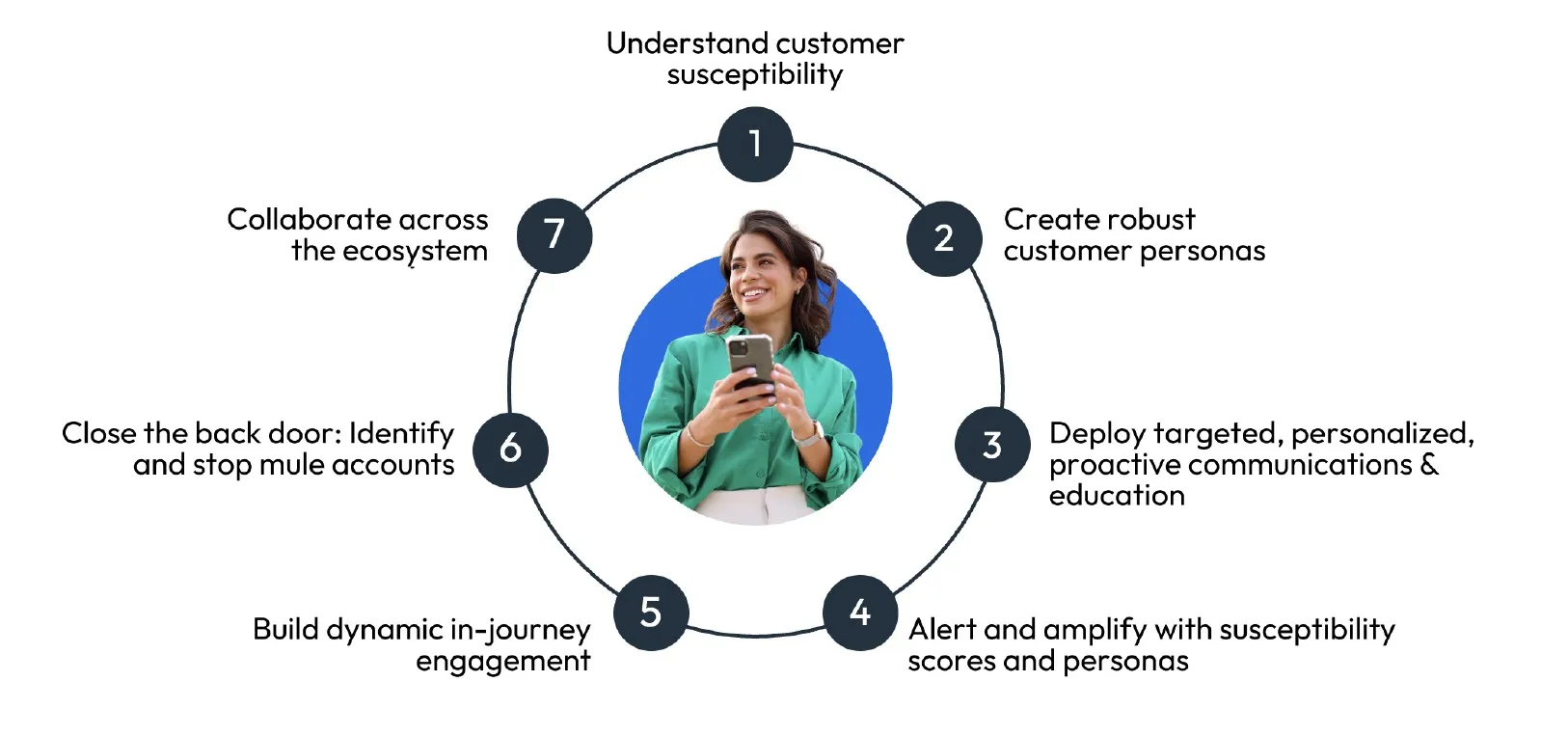
Instead, effective defense requires a multi-layered strategy. The following 7-step framework offers a practical, intelligence-driven approach toward scam defense.
- Understand Customer Susceptibility
The framework begins with proactive assessment of customer vulnerability through sophisticated susceptibility scoring. This involves harvesting both monetary transactions and non-monetary events across all customer touchpoints to create always-on customer profiles. This requires an applied intelligence platform that enables real-time assessment that evolves with each customer interaction. (Note: This approach needs to be vetted against local privacy and permissibility requirements.) - Create Robust Customer Personas
By developing personas that reflect psychographic and behavioral characteristics, institutions can assess specific scam vulnerabilities. For example, customers with high investible income who engage in cryptocurrency trading may be particularly susceptible to investment scams. Knowing customers helps to protect them. - Deploy Targeted, Personalized, Proactive Communication and Education
Generic scam warnings prove largely ineffective. The framework emphasizes hyper-personalized, contextual messaging aligned to individual risk profiles and scam types, creating more informed and alert customers. Breaking the scammer's spell is critical. - Alert and Amplify with the Susceptibility Score
At the heart of scam detection lies sophisticated monitoring of customer behavior and activity. The framework recommends multi-layered decisioning that first identifies anomalies, then determines whether they're associated with scams or traditional fraud. Enterprise fraud capabilities can "amplify" transaction scores based on customer susceptibility and personas. - Build Dynamic In-Journey Engagement
Understanding that customers in "hot states" often ignore generic warnings, the framework emphasizes dynamic, personalized dialogue that creates appropriate friction and reflection opportunities. This may include cooling-off periods or post-transaction follow-up when customers are more receptive. - Close the Back Door
Since stolen funds must flow through mule accounts, the framework emphasizes real-time intervention capabilities beyond traditional anti-money laundering controls. This requires transitioning from monthly batch assessments to instantaneous monitoring and account freezing. - Collaborate across the Ecosystem
Build a formal ecosystem across the regulator, law enforcement, telcos, social media platforms, and industry bodies to facilitate data sharing and best practice. This is probably the hardest task.
Download the complete 7-step framework whitepaper as a roadmap for transforming scam prevention from compliance obligation into strategic advantage.
How to Operationalize the Enterprise Fraud Framework
Scam prevention demands more than traditional fraud controls — it requires a sophisticated, data-driven platform capable of analyzing vast volumes of signals in real time, while maintaining the right balance between customer protection and experience. FICO operationalizes this framework by integrating advanced analytics, orchestration, and engagement capabilities across the customer lifecycle.
Dynamic Profiles
FICO® Platform continuously ingests non-monetary and transactional data, integrating third-party APIs and behavioral data to maintain evolving customer profiles. This dynamic view enables institutions to measure scam susceptibility in context and detect emerging risk patterns early.
Speed and Throughput Capacity
With the ability to process tens of thousands of transactions per second, the system ensures risk assessments and customer interventions occur instantaneously — essential when scam funds can move within seconds.
FICO® Marketplace Integration
FICO Marketplace is a digital data hub created to give FICO Platform users easy access to third-party data providers via API connections. Specialist risk-signal providers — such as behavioral analytics, device intelligence, and telecom data — can be seamlessly integrated into existing decision flows. This open approach ensures access to best-in-class capability and agility in adapting to new threat vectors without extensive redevelopment.
Transactional Composition
Transaction compositions represent a state-of-the-art orchestration capability, allowing institutions to “compose” complex workflows that link signals, models, policies, and actions across the enterprise. This enables a consistent, explainable, and adaptive approach to scam detection and prevention across all channels.
AI and Machine Learning
Gain access to FICO consortium models, along with FICO’s award-winning detection model with a dedicated scam score. Regionally available insights like Scam Signal can also provide valuable intelligence for scam management.
Omni-Channel Engagement
Use built-in customer communication capabilities that leverage the customer’s channel of choice. Effective scam prevention requires seamless communication across preferred customer channels — mobile apps, SMS, email, or voice. Built-in customer communication capabilities enable real-time channel transitions, ensuring scam warnings reach customers in context while minimizing friction and maximizing impact.
The Path Forward
The scam epidemic represents an existential threat to customer trust and institutional stability. Financial institutions that wait for regulatory mandates or perfect solutions will find themselves at a significant disadvantage.
Success requires ruthless measurement and tagging of both structured and unstructured data to create virtuous feedback loops. Equally critical is constant engagement with operations teams and active monitoring to assess new vectors and anticipate emerging attack patterns.
As the threat landscape continues evolving, financial institutions must embrace proactive, intelligence-driven strategies that protect customers while maintaining operational efficiency. Use the seven-step framework whitepaper as a roadmap to transform scam prevention from compliance obligation into strategic advantage and position for success in an increasingly complex risk environment.
Learn More about How FICO Can Help You Stop Scams
- Download the 7-step framework as a roadmap to transform scam prevention from compliance obligation into strategic advantage
- Learn more about scams: What is Push Payment Fraud?
- Read How Scam Prevention and Scam Detection Help Banks and Customers

Popular Posts

Average U.S. FICO® Score at 716, Indicating Improvement in Consumer Credit Behaviors Despite Pandemic
The FICO Score is a broad-based, independent standard measure of credit risk
Read more
The GSE Data Is Public. Here's What It Shows About Credit Score Modernization.
Independent Milliman analysis of GSE historical data confirms what anyone can now verify directly: FICO® Score 10T is the most predictive score.
Read more
FICO® Score High Achievers: Is Age the Only Factor?
<p>FICO’s latest research on <a href="http://www.fico.com/en/blogs/risk-compliance/us-credit-quality-rising-the-beat-goes-on/" target="_blank">national FICO® Score distribution</a> shows that US credit quality continues to trend upwards, with an increasing number of consumers scoring in the highest scores ranges. Given that, we decided it was time to refresh our study on “<a href="http://www.fico.com/en/blogs/risk-compliance/infographic-what-does-a-high-credit-scorer-look-like/" target="_blank">FICO® Score high achievers</a>,” where we examine the credit behavioural profiles of consumers with higher credit scores.</p> <p>As expected, our latest study showed that older people generally have higher scores, as has been the case in our <a href="http://www.fico.com/en/blogs/risk-compliance/age-before-beauty-credit-worthiness-before-youth/" target="_blank">past research</a>. This is largely because they have trade lines that have been open longer, which leads to higher scores (assuming the trade lines are in good standing and all other things equal). The most credit savvy among you will remember that length of credit history accounts for roughly 15% of the overall <a href="http://www.myfico.com/CreditEducation/WhatsInYourScore.aspx" target="_blank">FICO® Score calculation</a>.</p> <p>But for younger consumers, it isn’t too helpful to say, “just wait until you are 50 years old, and that will fix things!” Thus, I decided to dive deeper with our analysis, including looking at the credit behavioural characteristics of younger consumers with high FICO® Scores.</p> <p>In this analysis, I looked at credit characteristics for the two highest score bands, 750-799 and 800-850, which have about 16% and 23% of the population, respectively. I further broke this down by looking at the characteristics of the youngest 15% in each group, which occurs at age 29 for the 750-799 group and 43 for the 800-850. We used FICO<strong>®</strong> Score 9 for our analysis, and examined typical variables of the categories that go into the make-up of the score.</p> <p><a href="http://www.fico.com/en/blogs/wp-content/uploads/2016/10/FICO-Score-High-Achiever-table.png"><img class="alignnone size-full wp-image-29367" src="http://www.fico.com/en/blogs/wp-content/uploads/2016/10/FICO-Score-High-Achiever-table.png" alt="fico-score-high-achiever-table" width="715" height="747" /></a></p> <p>Since there’s a lot to dissect in this chart, I’ll highlight a few findings that struck me: <ul> <li><strong>Credit history.</strong> Higher scores are undoubtedly associated with a longer time on file. What’s striking is the higher average time on file for the 800+ group, both overall and for revolving accounts (the most common trade line). Clearly, it helps to start credit use early in life – but that’s not the sole determining factor for high scoring. The younger cohorts in both the 800+ and 750-799 groups have time on file medians significantly less than their older counterparts.</li> <li><strong>New credit.</strong> High credit scorers do, in fact, pursue new credit. We see little variation in months since last trade line opening and last inquiry among all groups observed.</li> <li><strong>Pay on time.</strong> As you might expect, the further in the past the delinquency, the higher the score – and that’s <u>if</u> a delinquency ever happened. 95% of the 800+ people and 72% of the 750-799 group have never been delinquent, which is a striking contrast to the 57% for the total population. The percentages for the younger groups are even higher, especially so for the 750-799ers. Collection items are also scarce for these high scorers. While 23% of the national population have collection items greater than $99, the figures are only 0.5% for the 800+ group and 3% for the 750-799 group. It is clear that, in conjunction with starting a credit file early, paying on time is a key trait of the FICO® Score high achiever.</li> <li><strong>Balance and utilization.</strong> Finally, we look at how credit is being used, focusing on revolving product use. (Since most people only have one mortgage or one auto loan, variation in instalment product figures is minimal and driven by payment history, which is near perfect for high scorers, as we’ve seen.) FICO® Score high achievers tend to have more open revolving accounts. While the % active trades and utilization are generally lower, by no means do high scorers avoid the use of credit products. What drives the difference here is the amount of <u>available</u> revolving credit utilized. The 800+ group is roughly 1/4 of the national median, both in total and on their highest utilized card; they also have lower balances and more cards<em>. </em>The 750-799 group is more active and higher utilized, but still only at 2/3 of the national figures. The young 750-799 group compensate with lower revolving balances and, as a result, lower utilization, which is in line with what we see for the 800+ group.</li> <li><strong>Benchmarks.</strong> I’d like to point out that while this study provides good benchmarks of the typical credit traits of the FICO® Score high achiever, individual credit profiles will vary widely. And keep in mind that when we sort groups of consumers as a whole by different behaviours, some results may look superficially odd. For example, the 800+ band has a longer median average open account time (128 months) than average revolving months on file (140 months).</li> </ul> So, what do we conclude? A huge takeaway is that high scorers don’t have too much in the way of serious delinquencies and negative public record data.</p> <p>In most respects, the young 800+ people are like their peer group. They really only differ markedly in their shorter credit history and higher non-mortgage balance, both of which are a function of life stage. Our results show that you don’t have to be a credit product hermit; these high scorers have more credit cards. The takeaway is to start credit activity early and maintain well-managed and moderate usage.</p> <p>In many ways, the young 750-799 people are more interesting because their age profile is much younger. Their credit characteristics differ more from their peer group, particularly in terms of length of credit history. They compensate by having almost pristine credit records and lower balances.</p> <p>Ultimately, 39% of US consumers are FICO® Score high achievers, which they accomplish by following common-sense credit practices. It ain’t rocket science!</p>
Read moreTake the next step
Connect with FICO for answers to all your product and solution questions. Interested in becoming a business partner? Contact us to learn more. We look forward to hearing from you.