The Composable Enterprise: Trends & Benefits from Composability
Executives, digital innovators, DevOps leaders, and line of business leaders should embrace a composable business model to gain agility and other benefits

Today’s digital landscape is being driven by the growing need for “composable enterprises” – business capability models that can quickly and seamlessly evolve in response to changing customer demands and market conditions. Executives, digital innovators, DevOps leaders, and line of business leaders must come together to drive this transformation forward.
In this blog post, you will learn about several key trends defining the composable architecture, what it is, and how to become a truly composable enterprise — one that can respond faster than the competition while maintaining trust and improving outcomes throughout the process of getting there.
Characteristics of a Composable Enterprise
Modularity, autonomy, and interoperability are the three key building blocks of a composable enterprise:
- Modularity is when data is organized into small, discrete units that can be used to create new data sets quickly and easily.
- Autonomy refers to the ability of components within an organization’s data architecture to operate independently from one another as business capabilities. while still functioning as part of an overarching data platform.
- Interoperability is the ability for data to flow between multiple silos without any manual intervention from IT or other departments in the organization.
By leveraging these three characteristics, organizations have access to deeper insights faster and can automate services delivery with intelligent automation toolsets that deliver real-time data feeds across all aspects of operations.
Benefits of the Composable Enterprise Model
The composable enterprise model helps organizations realize digital transformation with numerous benefits. Firstly, data science and product management teams can work more productively together to drive deeper insights across the organization’s operations and customer data. These insights and access to data lead to more effective decisions that drive better customer experiences, increased ROI, and improved business capabilities and outcomes.
Secondly, digital experience teams can quickly scale innovative solutions with enhanced agility by leveraging a modular data architecture and complex problem solving for creating intuitive solutions, without depending on IT resources or third-party vendors.
Finally, uniquely skilled innovators can work together in an open collaboration environment enabled by platforms rather than purpose-built OTS software products to develop and iterate powerful disruptive applications that keep the business healthy and ahead of the curve.
Kubernetes, Microservices and No-Code Tools Unlock Composability
Kubernetes is an open-source system for automating the deployment, scaling, and management of containerized applications. It provides a platform for deploying a wide range of services from existing workloads to microservices, streaming data services, machine learning applications and more. Kubernetes can be used to quickly scale existing architecture and provide improved composability, and reliability in monitoring and managing services.
Microservices architecture is a design pattern which breaks up a larger application into smaller, loosely coupled services. These services are independent and can be deployed, managed, and scaled independently of each other. By breaking up the composable architecture into smaller, more manageable chunks, organizations can quickly and easily introduce new features and packaged business services to meet customer needs.
No-code tools are a new breed of design and service delivery tools that allow business subject matter experts to create, test, and deploy powerful new applications without writing code. These tools leverage architecture and protocols that are built on top of existing cloud infrastructure, enabling organizations to quickly spin up sophisticated business applications without depending on IT.
Collectively, these capabilities help businesses to understand customer needs and compose solutions quickly and cost-effectively, which is the key to success in today’s digital economy. Gartner recently reported, “Organizations that embraced — and continue to embrace — the building blocks and principles of composable business were able to successfully leverage existing digital investments and, the best-case scenario, accelerate investment.”
Composable Enterprise Accelerators
By embracing a more composable business model, organizations have the power to turn their vision into reality. FICO Platform is top rated for offering a cloud-native, applied intelligence platform that accelerates the digital transformation journey. It empowers enterprises to move faster, make better decisions and drive customer engagement with an end-to-end platform that enables seamless and modular digital transformation regardless of where you currently are in your roadmap.
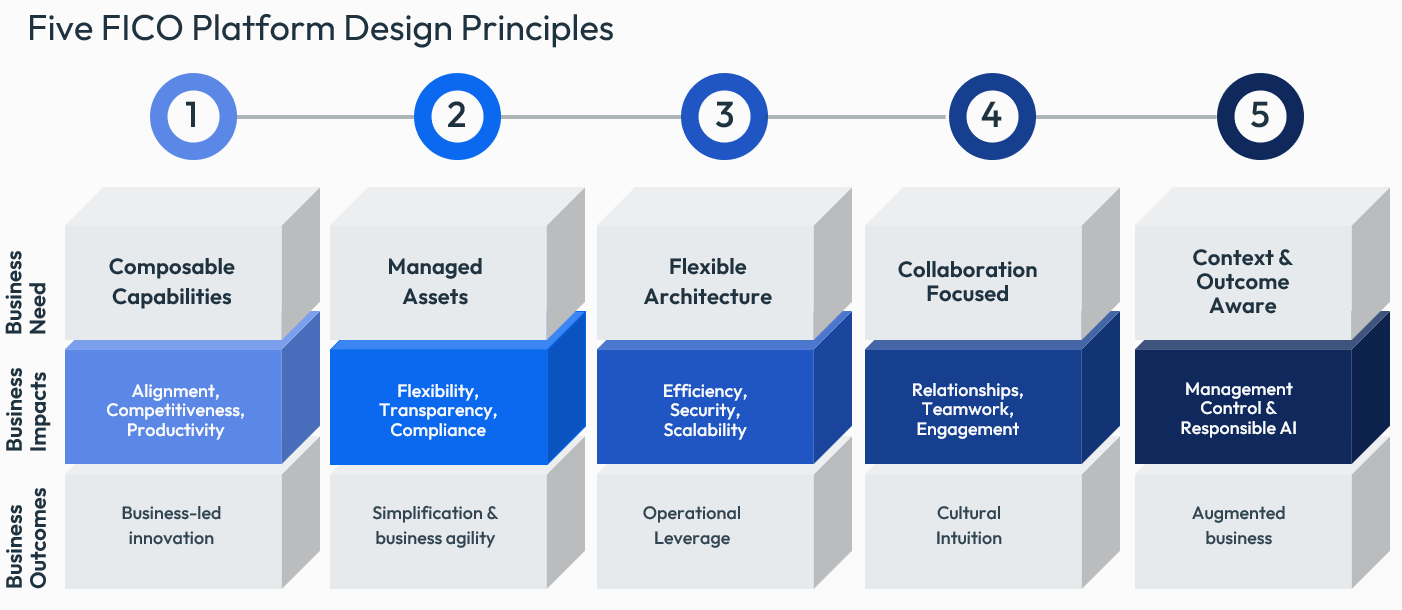
Composability is one of the five design principles for FICO Platform
How FICO Platform Helps You Build a Composable Enterprise
- Explore FICO Platform
- See why Forrester ranked FICO as a leader in digital decisioning systems
- Watch FICO Chief Product & Technology Officer Bill Waid discuss Applied Intelligence and FICO Platform

Popular Posts

Average U.S. FICO® Score at 716, Indicating Improvement in Consumer Credit Behaviors Despite Pandemic
The FICO Score is a broad-based, independent standard measure of credit risk
Read more
The GSE Data Is Public. Here's What It Shows About Credit Score Modernization.
Independent Milliman analysis of GSE historical data confirms what anyone can now verify directly: FICO® Score 10T is the most predictive score.
Read more
FICO® Score High Achievers: Is Age the Only Factor?
<p>FICO’s latest research on <a href="http://www.fico.com/en/blogs/risk-compliance/us-credit-quality-rising-the-beat-goes-on/" target="_blank">national FICO® Score distribution</a> shows that US credit quality continues to trend upwards, with an increasing number of consumers scoring in the highest scores ranges. Given that, we decided it was time to refresh our study on “<a href="http://www.fico.com/en/blogs/risk-compliance/infographic-what-does-a-high-credit-scorer-look-like/" target="_blank">FICO® Score high achievers</a>,” where we examine the credit behavioural profiles of consumers with higher credit scores.</p> <p>As expected, our latest study showed that older people generally have higher scores, as has been the case in our <a href="http://www.fico.com/en/blogs/risk-compliance/age-before-beauty-credit-worthiness-before-youth/" target="_blank">past research</a>. This is largely because they have trade lines that have been open longer, which leads to higher scores (assuming the trade lines are in good standing and all other things equal). The most credit savvy among you will remember that length of credit history accounts for roughly 15% of the overall <a href="http://www.myfico.com/CreditEducation/WhatsInYourScore.aspx" target="_blank">FICO® Score calculation</a>.</p> <p>But for younger consumers, it isn’t too helpful to say, “just wait until you are 50 years old, and that will fix things!” Thus, I decided to dive deeper with our analysis, including looking at the credit behavioural characteristics of younger consumers with high FICO® Scores.</p> <p>In this analysis, I looked at credit characteristics for the two highest score bands, 750-799 and 800-850, which have about 16% and 23% of the population, respectively. I further broke this down by looking at the characteristics of the youngest 15% in each group, which occurs at age 29 for the 750-799 group and 43 for the 800-850. We used FICO<strong>®</strong> Score 9 for our analysis, and examined typical variables of the categories that go into the make-up of the score.</p> <p><a href="http://www.fico.com/en/blogs/wp-content/uploads/2016/10/FICO-Score-High-Achiever-table.png"><img class="alignnone size-full wp-image-29367" src="http://www.fico.com/en/blogs/wp-content/uploads/2016/10/FICO-Score-High-Achiever-table.png" alt="fico-score-high-achiever-table" width="715" height="747" /></a></p> <p>Since there’s a lot to dissect in this chart, I’ll highlight a few findings that struck me: <ul> <li><strong>Credit history.</strong> Higher scores are undoubtedly associated with a longer time on file. What’s striking is the higher average time on file for the 800+ group, both overall and for revolving accounts (the most common trade line). Clearly, it helps to start credit use early in life – but that’s not the sole determining factor for high scoring. The younger cohorts in both the 800+ and 750-799 groups have time on file medians significantly less than their older counterparts.</li> <li><strong>New credit.</strong> High credit scorers do, in fact, pursue new credit. We see little variation in months since last trade line opening and last inquiry among all groups observed.</li> <li><strong>Pay on time.</strong> As you might expect, the further in the past the delinquency, the higher the score – and that’s <u>if</u> a delinquency ever happened. 95% of the 800+ people and 72% of the 750-799 group have never been delinquent, which is a striking contrast to the 57% for the total population. The percentages for the younger groups are even higher, especially so for the 750-799ers. Collection items are also scarce for these high scorers. While 23% of the national population have collection items greater than $99, the figures are only 0.5% for the 800+ group and 3% for the 750-799 group. It is clear that, in conjunction with starting a credit file early, paying on time is a key trait of the FICO® Score high achiever.</li> <li><strong>Balance and utilization.</strong> Finally, we look at how credit is being used, focusing on revolving product use. (Since most people only have one mortgage or one auto loan, variation in instalment product figures is minimal and driven by payment history, which is near perfect for high scorers, as we’ve seen.) FICO® Score high achievers tend to have more open revolving accounts. While the % active trades and utilization are generally lower, by no means do high scorers avoid the use of credit products. What drives the difference here is the amount of <u>available</u> revolving credit utilized. The 800+ group is roughly 1/4 of the national median, both in total and on their highest utilized card; they also have lower balances and more cards<em>. </em>The 750-799 group is more active and higher utilized, but still only at 2/3 of the national figures. The young 750-799 group compensate with lower revolving balances and, as a result, lower utilization, which is in line with what we see for the 800+ group.</li> <li><strong>Benchmarks.</strong> I’d like to point out that while this study provides good benchmarks of the typical credit traits of the FICO® Score high achiever, individual credit profiles will vary widely. And keep in mind that when we sort groups of consumers as a whole by different behaviours, some results may look superficially odd. For example, the 800+ band has a longer median average open account time (128 months) than average revolving months on file (140 months).</li> </ul> So, what do we conclude? A huge takeaway is that high scorers don’t have too much in the way of serious delinquencies and negative public record data.</p> <p>In most respects, the young 800+ people are like their peer group. They really only differ markedly in their shorter credit history and higher non-mortgage balance, both of which are a function of life stage. Our results show that you don’t have to be a credit product hermit; these high scorers have more credit cards. The takeaway is to start credit activity early and maintain well-managed and moderate usage.</p> <p>In many ways, the young 750-799 people are more interesting because their age profile is much younger. Their credit characteristics differ more from their peer group, particularly in terms of length of credit history. They compensate by having almost pristine credit records and lower balances.</p> <p>Ultimately, 39% of US consumers are FICO® Score high achievers, which they accomplish by following common-sense credit practices. It ain’t rocket science!</p>
Read moreTake the next step
Connect with FICO for answers to all your product and solution questions. Interested in becoming a business partner? Contact us to learn more. We look forward to hearing from you.