How FICO Optimization Could Help Keep Hospitals Running During Blackouts
Award-winning paper demonstrates the power of mathematical optimization and FICO Xpress to deliver sustainable, resilient energy solutions, solving an urgent need in South Africa


Since its launch in 2022, the FICO Xpress Best Paper Award has celebrated outstanding contributions to mathematical optimization, operations research (OR), and related disciplines. The 2025 competition again featured many excellent submissions, making the task of the award committee anything but easy.
This year’s award goes to:
Jusse Hirwa, Alexander Zolan, William Becker, Tülay Flamand, and Alexandra Newman for their paper "Optimizing design and dispatch of a resilient renewable energy microgrid for a South African hospital". Applied Energy 348 (2023).

The committee highlighted the paper’s originality and its inspiring example of “using OR for social good.” The authors show remarkable dedication in addressing a highly complex, real-world challenge — guiding the reader step by step through system design, optimization modeling, and dispatch strategies.
In this blog post, we dive deeper into their work and show how their approach demonstrates the power of mathematical optimization to deliver sustainable, resilient energy solutions, using FICO Xpress.
What Optimization Problem Was the Team Trying to Solve?
Access to reliable electricity remains a major challenge across sub-Saharan Africa. A significant portion of the population either lacks access altogether or receives electricity, but while experiencing frequent outages. Many households without electricity still rely on hazardous fuels for lighting and cooking, which poses serious health and safety risks and reduces productivity, particularly among children and women, who are often responsible for household routines.
Even among communities connected to the national grid, power supply remains inconsistent. Frequent, sudden outages disrupt daily life and economic activity. Industrial and commercial sectors suffer significant losses. As the paper notes, "In 2018, 78% of firms in sub-Saharan Africa experienced power outages, compared to 46% of those in East Asia and the Pacific, 32% of those in Europe and Central Asia, and 59% of those in Latin America and the Caribbean. Additionally, manufacturing firms in sub-Saharan Africa experienced outages averaging 50 h per month, the highest of any region in the world."
Improving the reliability of electricity in sub-Saharan Africa is essential, as businesses play a central role in job creation and are critical to the region’s economic stability. In addition, hospitals require continuous power to maintain medical equipment, conduct surgeries, and store temperature-sensitive medications.
In response to unreliable grids, backup systems, typically diesel generators, designed using a rule-of-thumb, are widely used. While these generators serve as a short-term fix, they are often oversized, inefficient, costly to operate, and do not represent a long-term power solution.
How Was Optimization Used to Address the Problem of Unreliable Electric Grids?
The winning optimization paper focuses on reliability, more precisely on ensuring consistent performance during routine, short-term disruptions. Specifically, alongside existing infrastructure, the authors consider additional technologies, including photovoltaics (PV), battery storage, combined heat and power (CHP), and thermal systems. Particularly, CHP systems offer an integrated solution by producing both electricity and thermal energy from a single fuel source. When coupled with a chiller, they can also support cooling needs, making them remarkably versatile. Moreover, incorporating renewable energy sources alongside efficient CHP systems leads to substantial emissions reductions compared to traditional power plants and standalone heating systems such as boilers or heat pumps.
Which Optimization Problem Solver Method Was Used?
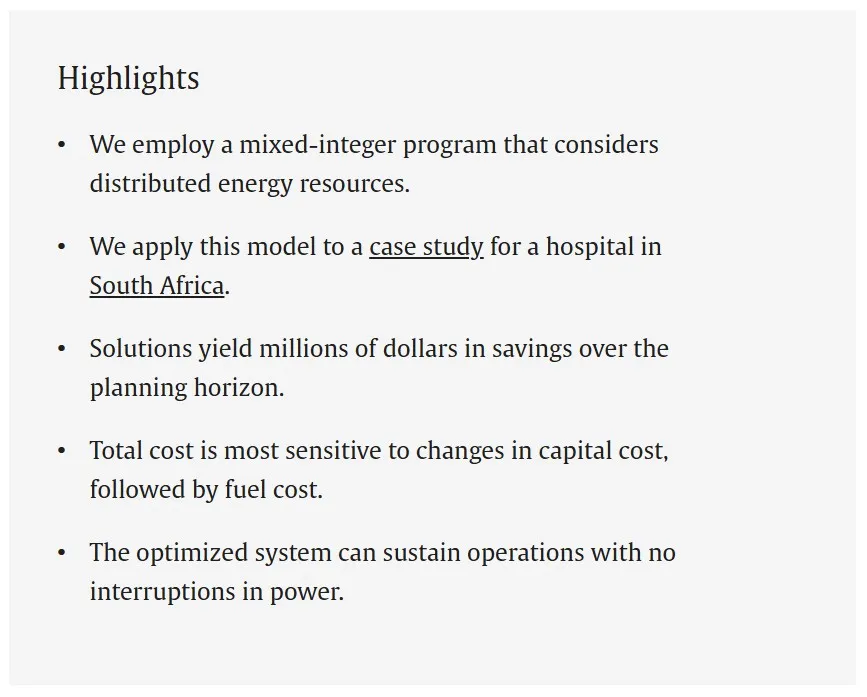
Considering the wide set of technologies, the authors propose a mixed-integer linear programming (MILP) model that provides the best (i.e., optimal) design (size and mix) and dispatch strategies for distributed generation systems that minimize lifecycle costs (capital costs, operational costs, and utility charges) while meeting heating, cooling, and electricity demands, even during frequent outages.
The authors applied this model to optimize the design and dispatch of a hospital microgrid in Johannesburg, South Africa, where energy outages pose direct threats to patient care and operational continuity.
Key Features of the Xpress Optimization SolverFICO Xpress Optimization Solver distinguishes itself by delivering advanced mathematical optimization capabilities through a suite of high-performance algorithms, including state-of-the-art linear, mixed-integer, and nonlinear solvers. The optimization platform supports a broad range of modeling environments, enabling users to construct sophisticated decision models in Python, Mosel, Java, and other widely adopted languages to facilitate seamless integration into existing decision workflows. Robust prescriptive analytics features allow organizations to address large-scale, industry-specific optimization problems (such as supply chain network design, resource allocation, and transportation planning) with speed and scalability.
Xpress Optimization incorporates intuitive modeling tools within a comprehensive API, and is engineered for enterprise-grade reliability, offering parallel processing, cloud deployment options, and support for massive datasets. |
The Process: How Xpress Optimization Could Help Keep Hospitals Running During Blackouts
The authors first generated load profiles tailored to the South African healthcare sector using climate and hospital configuration data, adapted from U.S. Department of Energy prototypes and adjusted to reflect the specific conditions in South Africa. They implemented the large-scale model in AMPL and solved it using FICO Xpress to near optimality within an hour. The model simultaneously determines:
- Design decisions (capacity and technology mix for PV, CHP, batteries, chillers, boilers)
- Hourly dispatch decisions across a whole year, accounting for variability in demand, resource availability, and outages
The optimal solution recommended by the optimization model includes a combination of PV, CHP, battery storage, and an absorption chiller. The integration of these technologies creates a well-balanced microgrid capable of handling both routine operations and disruptions. Compared to typical rule-of-thumb designs, the optimized solution achieves over $2 million in cost savings across the system’s lifetime. Results suggest that technologies such as absorption chillers, typically excluded, are shown to reduce electricity demand charges effectively, even without CHP.
The authors evaluated the system’s robustness using an outage simulator, which demonstrates that the optimized decisions improve resilience significantly, enabling the hospital to sustain five-hour outages with 100% reliability and ten-hour outages with 65% reliability. They also conducted sensitivity analyses which reveal that PV sizing is most affected by capital cost, fuel prices, and electrical demand variability, while CHP and absorption chiller sizing are highly sensitive to fuel costs. This approach is applicable not only to hospitals, but also to other high-impact facilities in emerging economies.
We at FICO warmly congratulate Jusse, Alexander, William, Tülay, and Alexandra on winning the 2025 FICO Xpress Best Paper Award. Among a field of many excellent submissions, their innovative and impactful research truly stood out.
Like many other research teams worldwide, the authors are members of our Academic Partner Program. Join our FICO Xpress Optimization Community and learn about our free community licenses for everyone and our fully-fledged free licenses for all academics. The call for the 2026 edition of the FICO Xpress Best Paper Award is out now: Consider submitting your Xpress-related research paper!
How FICO Can Help Solve Optimization Problems in Other Industries
FICO® Xpress Optimization offers a wide range of innovative optimization algorithms that are fast, scalable, and robust to solve complex problems across all industries. We leverage decades of FICO innovation in optimization combined with real-word expertise to deliver business value to hundreds of customers worldwide.
For every application, from logistics to credit risk to supply chain resilience, FICO Xpress Optimization supports a wide range of advanced analytics use cases. Users can build models using intuitive coding interfaces (Python, Mosel, Java, R, .NET, C++, and more) and adapt them to different industries to execute high-performance optimization routines that are purpose-built to improve accuracy, scalability, and decision quality. This makes it ideal not only for data scientists and operations researchers, but also for business users working in increasingly AI-driven environments.
- Explore FICO® Platform’s combined AI, machine learning, and optimization stack, from model design to deployment and its enterprise optimization capability
- See FICO Xpress Optimization in action and request a 60-day free trial license
- Join our FICO Xpress Optimization Community
Popular Posts

Average U.S. FICO® Score at 716, Indicating Improvement in Consumer Credit Behaviors Despite Pandemic
The FICO Score is a broad-based, independent standard measure of credit risk
Read more
The GSE Data Is Public. Here's What It Shows About Credit Score Modernization.
Independent Milliman analysis of GSE historical data confirms what anyone can now verify directly: FICO® Score 10T is the most predictive score.
Read more
FICO Statement on FHFA and FHA Updates to Credit Score Modernization
FICO supports FHFA’s announcement that the long-anticipated historical data for FICO® Score 10T will be released to the mortgage market.
Read moreTake the next step
Connect with FICO for answers to all your product and solution questions. Interested in becoming a business partner? Contact us to learn more. We look forward to hearing from you.