How to Use Blockchain to Build Responsible AI: An Award-Winning Approach
FICO’s use of blockchain to develop artificial intelligence is recognized in awards from Global Finance and the Banking Tech Awards

“Innovation doesn’t happen overnight,” says the introduction to The Innovators 2023—Global Winners in Global Finance Magazine. In fact, innovation can take years to be recognized. This was the case with FICO’s now-patented use of blockchain technology for artificial intelligence and analytic model governance; the U.S. patent application was filed in 2018 and was granted in 2023.
As the principal inventor on this patent, I am extremely gratified that FICO’s novel application of blockchain technology has been recognized with two awards. Global Finance named it one of the World’s Best Financial Innovations 2023. And now this technology has won a Banking Tech Award for Tech of the Future.
Innovation Doesn’t Gain Traction Overnight
Many inventors’ innovations were ahead of their time — contact lenses, solar cells, flushing toilets and electric cars, to name a very few. When I first began blogging about blockchain technology being used for AI model governance in 2017, I got a lot of side-eye and confused looks. Here’s how I described applying blockchain technology to AI, in my 2018 AI predictions blog:
Beyond its association with cryptocurrencies, blockchain technology will soon record “time chains of events,” as applied to contracts, interactions and occurrences. In these “time chains,” people and the items we interact with will have encrypted identities. The blockchain that is distributed will be the single source of truth, allowing audit trails of data usage in models, particularly in data permission rights… Beyond that, data event chains will create new opportunities for graph analytics and novel new AI algorithms to consume relationship data at scale.
In 2018 I refined these concepts, producing a patent application around using blockchain to ensure that all the decisions made about a machine learning (ML) model are being recorded and are auditable. These include the model’s variables, model design, training and test data utilized, selection of features, the ability to view the model’s raw latent features, and recording to the blockchain all scientists who built different portions of the variable sets, and participated in model creation and model testing. In 2023, the granted patent is described as:
“Blockchain for Data and Model Governance” – Covering the concept of a shared ledger that is leveraged to track end-to-end provenance of the development, operationalization, and monitoring of a machine learning models in an immutable manner. The solution and underlying methodology enforce the use of a corporate model development standard to ensure Responsible AI practices are abided by organizations.
Accountability Matters in Artificial Intelligence
As enabled by blockchain technology, the sum and total record of these decisions provides the visibility required to effectively govern models. Model governance and transparency are essential in building ethical AI technology which is auditable; as a data scientist and member of the global analytics community, creating ethical analytic technology is very important to me, particularly in my role of serving financial and enterprise customers.
The meteoric rise of ChatGPT and other large language model (LLM) tools similarly propelled artificial intelligence ethics (more pointedly, AI “hallucinations”) into the upper echelons of pop culture. In 2023, ordinary citizens gained first-hand knowledge of the perils of “black box” artificial intelligence for the first time; they were using it every day to do everything from cheat on homework to fuel body dysmorphia. All of a sudden, everyone wanted to know how, and why, these AI models work. But because their decisioning isn’t explained by creators such as OpenAI, Anthropic, Google, Meta and dozens of others, we don’t know.
I believe we are in the throes of an AI accountability crisis, which frankly will get worse before it gets better. It will only get better as businesses and consumers demand that AI models be more explainable.
How Blockchain Can Reduce Negative Outcomes from Artificial Intelligence
More than a decade ago, long before blockchain and ChatGPT became buzzwords, I began implementing a structured approach to AI model development in my data science organization. In 2010 I instituted a development process centered on an analytic tracking document (ATD). This approach detailed model design, variable sets, scientists assigned, train and testing data, and success criteria, breaking down the entire development process into three or more agile sprints.
I recognized that a structured approach was required because I’d seen far too many negative outcomes from what had become the norm across much of the banking industry: a lack of validation and accountability. A decade ago, the typical lifespan of an analytic model looked like this:
- A data scientist builds a model, self-selecting the variables it contains. This led to scientists creating redundant variables, not using validated variable design and creating new errors in model code. In the worst cases, a data scientist might make decisions with variables that could introduce bias, model sensitivity, or target leaks.
- When the same data scientist leaves the organization, his or her directories are typically deleted. Often, there were a number of different directories and it was unclear what directory(ies) were responsible for the final model. The company wouldn’t have the source code for the model or might have just pieces of it. No one could definitively understand how the model was built, the data on which it was built, and the assumptions that factored into the model build.
- Ultimately this becomes a high-risk situation when the model is assumed to have been built properly and that it will behave well—but not really knowing either. This would often result in being unable to validate the model or understand under what conditions the model should be used. These realities drive unnecessary risk or a large number of models being discarded and rebuilt, often repeating the journey above.
Unfortunately, the companies releasing LLM AI systems do not exercise anywhere near the level of prudence or restraint of financial institutions. Driven by pressure to go to market faster than competitors, LLMs are quickly released “into the wild”—which has been compared to “open sourcing the Manhattan Project”—escalating their unpredictability and resulting in negative outcomes for the people and businesses using them.
A Blockchain to Codify Accountability
My patent describes how to codify AI, analytic and machine learning model development using blockchain technology to associate a chain of entities, work tasks and requirements with a model, including testing and validation checks. Blockchain replicates the approach I use to build models in my organization––essentially a contract between my scientists, managers and me that describes:
- What the model is
- The model’s objectives
- How we’ll build that model
- Areas that the model must improve upon, for example, a 30% improvement in card not present (CNP) fraud at a transaction level
- The degrees of freedom the scientists have to solve the problem, and those they don’t
- Re-use of trusted and validated variable and model code snippets
- Prescribing the model algorithms allowed
- Training and test data requirements
- Specific model testing and model validation checklists
- Specific assigned analytic scientists to build the variables, models, train them and those who will validate code, confirm results, perform testing of the model variables and model output
- Ethics and robustness tests prescribed
- Specific success criteria for the model and specific customer segments
- Specific analytic sprints, tasks and scientists assigned, and formal sprint reviews/approvals of requirements met.
As illustrated in Figure 1, all this gets broken into a set of requirements, roles and tasks which are put on the blockchain to be formally assigned, worked, validated and completed. Having individuals who are tracked against each of the requirements, the team then assesses a set of existing collateral, which are typically pieces of previous validated variable code and models. Some variables have been approved in the past, others will be adjusted, and still others will be new. The blockchain then records each time the variable is used in this model — for example, any code that was adopted from code stores, written new and changes that were made — who did it, which tests were done and the modeling manager who approved it, and my sign-off.
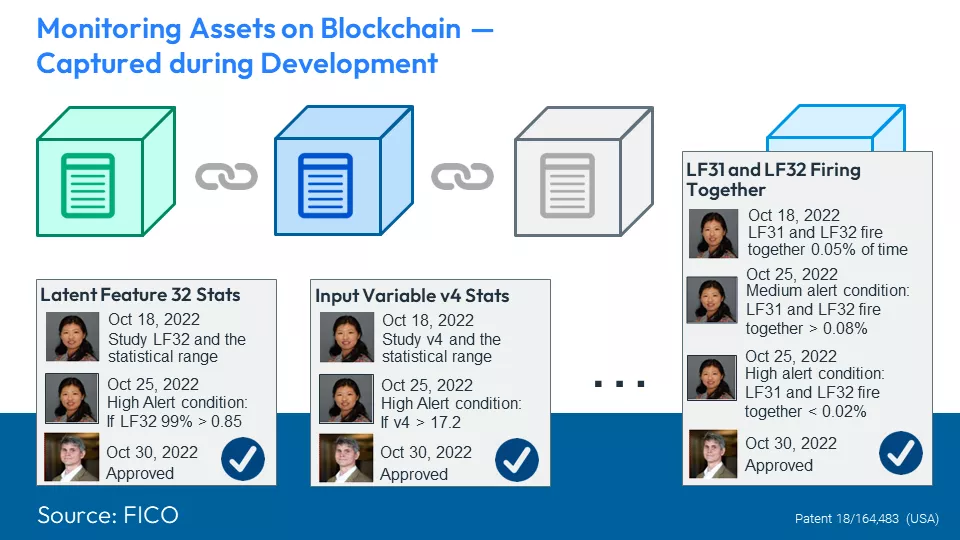
In this way, blockchain enforces the proper use of the approved machine learning algorithms supported by the corporate model development standard. Moreover, it ensures that all ethics and robustness tests are completed, in addition to each requirement and success/acceptance criterion being met. No model is released without this process being completed, and it is all enforced using the blockchain.
Models with More Explainability, Less Bias and Fewer Hallucinations
In sum, overlaying the model development process on the blockchain gives the analytic model its own entity, life, structure and description. Model development becomes a structured process, at the end of which detailed documentation can be produced to ensure that all elements have gone through the proper review. These can be also revisited at any time in the future, and provides essential assets for use in model governance.
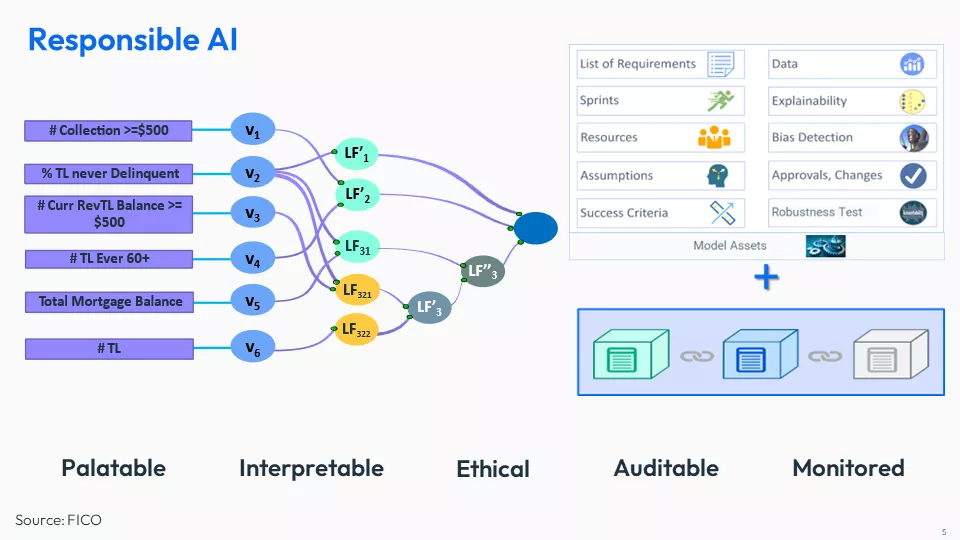
This use of blockchain to orchestrate the corporate model development standard and agile model development process also can be used by parties outside the development organization. If an external party wanted to audit the way a critical model was built, their review could produce a statement such as, “all variables haven been reviewed and were approved by …” Likewise, if a revision or change in requirements made us want to understand all uses in production of variable #51817 from our large asset inventory of variables, we could easily query the blockchain to pinpoint any deployments in production models.
With blockchain to persist the analytic model development process, it becomes highly transparent and subsequent decisions auditable, a critical factor in delivering AI technology that is ethical and explainable. Explainability is essential in eradicating bias and “hallucinations” from the AI models used to make decisions that affect individuals’ financial lives—and, in the case of LLMs, their daily lives.
It's true that innovation doesn’t happen overnight. But the need for innovation to be applied sometimes does. I believe our society is at that moment today with widespread use of LLM artificial intelligence tools; more than ever, model governance is paramount in creating AI that is explainable, ethical and safe.
How FICO Can Help You Develop and Use Responsible AI

Popular Posts

Average U.S. FICO® Score at 716, Indicating Improvement in Consumer Credit Behaviors Despite Pandemic
The FICO Score is a broad-based, independent standard measure of credit risk
Read more
The GSE Data Is Public. Here's What It Shows About Credit Score Modernization.
Independent Milliman analysis of GSE historical data confirms what anyone can now verify directly: FICO® Score 10T is the most predictive score.
Read more
FICO® Score High Achievers: Is Age the Only Factor?
<p>FICO’s latest research on <a href="http://www.fico.com/en/blogs/risk-compliance/us-credit-quality-rising-the-beat-goes-on/" target="_blank">national FICO® Score distribution</a> shows that US credit quality continues to trend upwards, with an increasing number of consumers scoring in the highest scores ranges. Given that, we decided it was time to refresh our study on “<a href="http://www.fico.com/en/blogs/risk-compliance/infographic-what-does-a-high-credit-scorer-look-like/" target="_blank">FICO® Score high achievers</a>,” where we examine the credit behavioural profiles of consumers with higher credit scores.</p> <p>As expected, our latest study showed that older people generally have higher scores, as has been the case in our <a href="http://www.fico.com/en/blogs/risk-compliance/age-before-beauty-credit-worthiness-before-youth/" target="_blank">past research</a>. This is largely because they have trade lines that have been open longer, which leads to higher scores (assuming the trade lines are in good standing and all other things equal). The most credit savvy among you will remember that length of credit history accounts for roughly 15% of the overall <a href="http://www.myfico.com/CreditEducation/WhatsInYourScore.aspx" target="_blank">FICO® Score calculation</a>.</p> <p>But for younger consumers, it isn’t too helpful to say, “just wait until you are 50 years old, and that will fix things!” Thus, I decided to dive deeper with our analysis, including looking at the credit behavioural characteristics of younger consumers with high FICO® Scores.</p> <p>In this analysis, I looked at credit characteristics for the two highest score bands, 750-799 and 800-850, which have about 16% and 23% of the population, respectively. I further broke this down by looking at the characteristics of the youngest 15% in each group, which occurs at age 29 for the 750-799 group and 43 for the 800-850. We used FICO<strong>®</strong> Score 9 for our analysis, and examined typical variables of the categories that go into the make-up of the score.</p> <p><a href="http://www.fico.com/en/blogs/wp-content/uploads/2016/10/FICO-Score-High-Achiever-table.png"><img class="alignnone size-full wp-image-29367" src="http://www.fico.com/en/blogs/wp-content/uploads/2016/10/FICO-Score-High-Achiever-table.png" alt="fico-score-high-achiever-table" width="715" height="747" /></a></p> <p>Since there’s a lot to dissect in this chart, I’ll highlight a few findings that struck me: <ul> <li><strong>Credit history.</strong> Higher scores are undoubtedly associated with a longer time on file. What’s striking is the higher average time on file for the 800+ group, both overall and for revolving accounts (the most common trade line). Clearly, it helps to start credit use early in life – but that’s not the sole determining factor for high scoring. The younger cohorts in both the 800+ and 750-799 groups have time on file medians significantly less than their older counterparts.</li> <li><strong>New credit.</strong> High credit scorers do, in fact, pursue new credit. We see little variation in months since last trade line opening and last inquiry among all groups observed.</li> <li><strong>Pay on time.</strong> As you might expect, the further in the past the delinquency, the higher the score – and that’s <u>if</u> a delinquency ever happened. 95% of the 800+ people and 72% of the 750-799 group have never been delinquent, which is a striking contrast to the 57% for the total population. The percentages for the younger groups are even higher, especially so for the 750-799ers. Collection items are also scarce for these high scorers. While 23% of the national population have collection items greater than $99, the figures are only 0.5% for the 800+ group and 3% for the 750-799 group. It is clear that, in conjunction with starting a credit file early, paying on time is a key trait of the FICO® Score high achiever.</li> <li><strong>Balance and utilization.</strong> Finally, we look at how credit is being used, focusing on revolving product use. (Since most people only have one mortgage or one auto loan, variation in instalment product figures is minimal and driven by payment history, which is near perfect for high scorers, as we’ve seen.) FICO® Score high achievers tend to have more open revolving accounts. While the % active trades and utilization are generally lower, by no means do high scorers avoid the use of credit products. What drives the difference here is the amount of <u>available</u> revolving credit utilized. The 800+ group is roughly 1/4 of the national median, both in total and on their highest utilized card; they also have lower balances and more cards<em>. </em>The 750-799 group is more active and higher utilized, but still only at 2/3 of the national figures. The young 750-799 group compensate with lower revolving balances and, as a result, lower utilization, which is in line with what we see for the 800+ group.</li> <li><strong>Benchmarks.</strong> I’d like to point out that while this study provides good benchmarks of the typical credit traits of the FICO® Score high achiever, individual credit profiles will vary widely. And keep in mind that when we sort groups of consumers as a whole by different behaviours, some results may look superficially odd. For example, the 800+ band has a longer median average open account time (128 months) than average revolving months on file (140 months).</li> </ul> So, what do we conclude? A huge takeaway is that high scorers don’t have too much in the way of serious delinquencies and negative public record data.</p> <p>In most respects, the young 800+ people are like their peer group. They really only differ markedly in their shorter credit history and higher non-mortgage balance, both of which are a function of life stage. Our results show that you don’t have to be a credit product hermit; these high scorers have more credit cards. The takeaway is to start credit activity early and maintain well-managed and moderate usage.</p> <p>In many ways, the young 750-799 people are more interesting because their age profile is much younger. Their credit characteristics differ more from their peer group, particularly in terms of length of credit history. They compensate by having almost pristine credit records and lower balances.</p> <p>Ultimately, 39% of US consumers are FICO® Score high achievers, which they accomplish by following common-sense credit practices. It ain’t rocket science!</p>
Read moreTake the next step
Connect with FICO for answers to all your product and solution questions. Interested in becoming a business partner? Contact us to learn more. We look forward to hearing from you.