Intelligent Decisioning Starts with Decision-Ready Data
The key to better decisions is decision-ready data, and DataOps ensures that delivering trusted data becomes repeatable

Over the last 30 years in data architecture, the technologies used to store, integrate, transform, and consume data have changed dramatically. We moved from traditional databases and warehouses to data lakes, cloud platforms, data products, and now an era increasingly shaped by AI and intelligent decisioning. Yet through all that change, one architectural challenge has remained remarkably consistent: How to get the right data, in the right condition, to the place where the business needs to use it to make a decision.
For organizations making operational decisions at scale, that challenge becomes particularly important. The sophisticated models, rules, analytics, and decisioning capabilities powering these operations depend on data coming from across the enterprise. Historically, operationalizing that data to be “decision-ready” has required significant engineering effort. But it doesn’t have to anymore.
In this blog post, we’ll cover what decision-ready data is, why it matters, and how DataOps is the critical capability for accelerating its value in enterprise decision-making workflows.
Key Takeaways
- Decision-available data and decision-ready data are not the same. Making data accessible to a decisioning solution like FICO® Platform is only the first step. Decision-ready data must also be trusted, governed, contextualized, and fit for the specific decision it is intended to support.
- The data pipeline is part of the decision architecture. Decisions are only as reliable as the data delivered to them. The pipelines that prepare, validate, govern, and deliver that data are therefore not simply upstream plumbing, they are an integral part of how trusted decisions are produced.
- DataOps makes decision-ready data turnkey. DataOps operationalizes the processes required to continuously deliver trusted data for decisioning through automation, testing, observability, governance, and repeatable delivery practices. FICO® Platform - DataOps Capability provides agentic data engineering functionality; organizations can take this further by using specifications to express intent and using agentic AI to help automate the engineering required to turn that intent into decision-ready data.
What is Decision-Ready Data?
When we talk about decisioning, our attention naturally gravitates toward the decision itself: whether to offer a customer a premium credit card or another banking product, whether a transaction may be fraudulent, what credit limit is appropriate, or which action to take when an account becomes delinquent in pursuit of a larger objective to maximize customer value, manage risk, reduce losses, and so on. But if you look further upstream, it’s clear that none of these decisions happen without data. And it’s not just any data. Just because data is available to a decisioning process does not mean that it is ready for it.
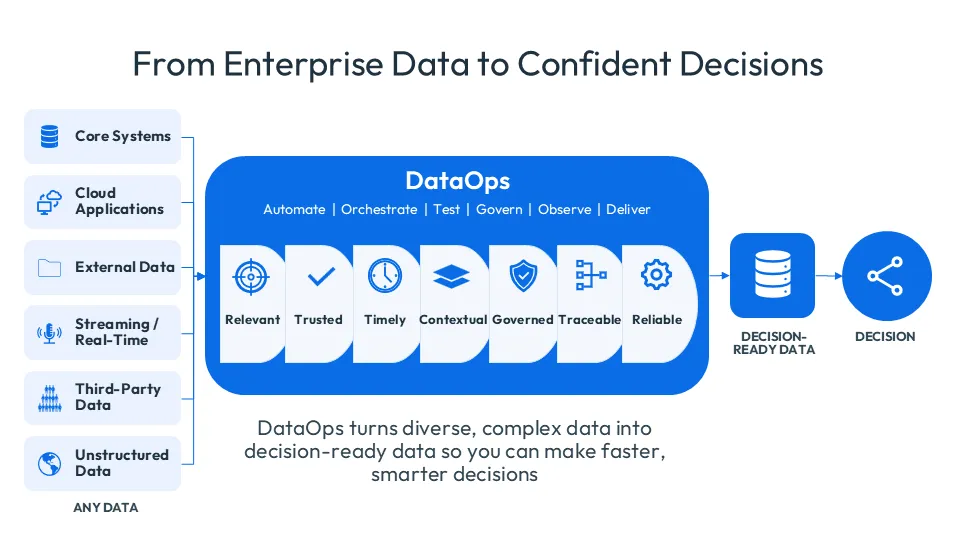
While the specific requirements will vary depending on the decision and use case, decision-ready data should be:
- Relevant - aligned to the specific decision and business context it is intended to support.
- Trusted - validated for quality, accuracy, completeness, and consistency appropriate to that decision.
- Timely - available at the freshness and latency required when the decision needs to be made.
- Contextualized - accompanied by the business meaning and semantics necessary to interpret it correctly.
- Governed - subject to appropriate policies for access, security, privacy, and acceptable use.
- Traceable - supported by lineage and metadata that show where the data came from and how it was transformed.
- Reliable - delivered through observable, tested pipelines that can consistently meet the operational requirements of the decision.
Consider something as simple as a region. One data source may represent California as “Region: California,” while another represents it as “Region: CA.” Both values are available and understandable to a person, but unless the decisioning process understands that they represent the same thing, they can produce inconsistent results. Is the data available? Yes. Is it decision-ready? Not yet.
Before a model scores something, a rule evaluates it, or an application recommends an action, data has already traveled through an entire lifecycle. It has been sourced, integrated, transformed, tested, governed, and delivered. Decisions have already been made about what the data means, how it should be structured, which transformations should be applied, what level of quality is acceptable, and who should be allowed to use it.
Every one of those choices can affect the decision that eventually follows.
Furthermore, data’s decision-readiness cannot be determined by looking at data quality alone. Data has to be fit for the specific purpose for which it will be used. Gartner’s CIO Guide to AI-Ready Data has made this point in its research on AI-ready data, describing readiness in the context of specific use cases rather than as a one-size-fits-all state. Its framework considers alignment, qualification, and governance and emphasizes that readiness requires continuous iteration rather than a one-time certification.
This is why we need to move beyond asking whether data is merely available to a decisioning process. The more important question is whether that data is decision-ready.
Why Does Decision-Ready Data Matter?
If a pipeline fails, data becomes stale, a schema drifts unexpectedly, a transformation introduces an error, or an untested change reaches production, the problem is no longer confined to data engineering. The downstream decision can be affected as well, which can impact revenue or customer satisfaction due to incorrect prices, unassigned deliveries, or too few worker shifts.
A dataset that is perfectly acceptable for a monthly report may be inappropriate for a decision that must be made in seconds. Data that is sufficiently current for one decision may be stale for another. A field that has little consequence in one business process could materially change the outcome of another. Quality, timeliness, context, governance, lineage, and reliability therefore need to be considered in relation to how the data will be used in the downstream decisioning process.
That means the data pipeline isn't simply plumbing supporting intelligent decisioning. It is a living, breathing part of the decision architecture.
Imagine a financial institution using a decision service to determine which banking product or offer is most relevant for a customer. The decision might consider the customer's relationship with the bank, account activity, spending patterns, and other data to determine whether an upgrade to a premium card or another banking product is appropriate.
Now imagine that one of those inputs, such as recent transaction activity, arrives as a blank value because the information is temporarily unavailable. Somewhere along the data pipeline, that blank value is interpreted as a numerical zero. Nothing necessarily fails. The pipeline completes, the data arrives, and the decision service receives a technically valid value. But “we don't know the customer's recent transaction activity” and “the customer has no recent transaction activity” are very different things. That difference could result in the customer receiving an irrelevant offer or never receiving an offer for a product that may have been a much better fit.
How Do You Get Decision-Ready Data?
We’ve established that decision-ready data is the key to true enterprise intelligence. But how do you achieve it? DataOps.
DataOps brings software engineering disciplines into the data lifecycle so that delivering trusted data becomes repeatable rather than dependent on disconnected scripts, manual handoffs, and individual expertise. It provides the operational tools, practices, and infrastructure needed to continuously build, test, deploy, govern, observe, and improve the pipelines and data products supporting the business.
This is important because data engineering has traditionally placed enormous responsibility on the individuals building and operating those pipelines. The engineer not only has to understand what needs to be built, but often has to assemble much of the operational machinery surrounding it. Testing frameworks, deployment processes, environment configurations, monitoring, change management, and governance controls can become separate engineering efforts of their own.
DataOps changes that operating model by making those concerns part of the engineering lifecycle itself.
Gartner’s Market Guide for DataOps Tools identifies orchestration, observability, deployment automation, test automation, and environment management as core DataOps tool capabilities. It also notes that these tools can reduce the manual effort and operational friction involved in managing increasingly complex data pipelines.
The real value, however, isn't any one of those capabilities. It is what happens when they work together.
Instead of building a pipeline and later determining how to test, deploy, monitor, and govern it, those requirements can become part of how the pipeline is engineered from the beginning. Changes can be versioned and traceable. Testing can become continuous. Environment deployments can become repeatable. Governance controls can be incorporated into workflows. Observability can provide ongoing feedback about what is actually happening once data reaches production.
For a data architect, that represents an important shift. We are no longer designing only the movement and structure of data. We can design the operational expectations surrounding that data as part of the architecture.
Where to Go Next with FICO and DataOps?
Better decisions begin long before a decision is made. It starts with the process of going from available data to decision-ready data. That process, powered by DataOps, is the operational foundation for answering them consistently in service of resilient and efficient enterprise decisioning.
Did we understand what the business needed? Did we select the right data? Did we capture the context and requirements? Was it engineered according to our standards? Was it tested? Was it governed? Can we trace what changed? Can we observe how it behaves in production? And can we demonstrate that the resulting data is appropriate for the decision we are asking it to support?
Those questions are not separate from intelligent decisioning. They are part of it.
With DataOps capabilities a part of FICO® Platform, a new relationship between data engineering and decisioning is before us. One in which the data organization doesn't simply deliver data to the edge of a decisioning platform and hand it off. It participates in creating a continuous, governed, observable path from enterprise data to business decision.
While the technologies surrounding that journey have changed, the fundamental data architecture responsibility has not. The job is still to ensure that the right data reaches the right place, with the right meaning, quality, context, and controls for the way it will be used in making a decision.
Intelligent decisioning doesn't begin when the decision is made. It begins with making the data ready for the decision and DataOps is how we get there.
How FICO Can Help You Improve Data Readiness and Decision Management
- Explore the data capabilities of FICO® Platform
- Download the IDC MarketScape: Worldwide Decision Intelligence Platforms 2026 Vendor Assessment to learn why FICO was named a Leader and what to look for when evaluating a decision intelligence platform vendor
- Read the FICO® Platform - Intelligent Decisions Capability Brief and learn how to make more precise, consistent, and intelligent decisions across your enterprise
- Watch the FICO® World 2026 Decision Intelligence and Dynamic Profiling presentation to hear leaders from Gartner, Capgemini, Lloyds and Bradesco discuss the power of decision intelligence platforms and the keys to success
Frequently Asked Questions
One of the primary challenges is ensuring that data coming from existing systems is not simply available to the decisioning platform, but decision-ready. Enterprise data may come from many systems with different structures, semantics, quality standards, transformation logic, and governance requirements. As that data moves through pipelines, meaning can also be unintentionally changed. A value that is technically valid, such as a blank field converted to a numerical zero, can reach a decision service carrying the wrong meaning without causing a visible technical failure.
DataOps helps address these challenges by making testing, deployment automation, governance, traceability, and observability part of the engineering lifecycle. This creates a more standardized and repeatable path for delivering trusted, contextualized, and reliable data to decisioning applications.
Reliability requires continuously validating that the data remains fit for the decision it is supporting. Upstream schemas can change, data quality can shift, transformation logic can be modified, and business requirements can evolve. A pipeline that was producing decision-ready data yesterday should not automatically be assumed to be doing so today.
DataOps helps organizations manage that change through continuous testing, observability, versioning and traceability. Automated testing can identify quality regressions and unexpected changes before they affect production, while observability provides ongoing insight into how data and pipelines are behaving. Versioning and lineage make it possible to understand what changed, when it changed, and what downstream decisions may be affected.
The result is a shift from treating data readiness as a one-time validation to treating quality, traceability and observability as continuous engineering responsibilities throughout the lifecycle.
Seamless integration starts by treating existing data warehouses and enterprise applications as part of the decision architecture rather than simply as sources to connect. The first step is understanding what data a decision requires, where that data resides, what it means, how current it must be, and what quality and governance requirements apply to its use.
DataOps provides the operational layer between the existing data and the decisioning platform. Pipelines can integrate and transform the required data while continuously testing its quality, applying governance controls, maintaining lineage and observing its delivery in production. This allows organizations to build on their existing data investments while creating a repeatable path for turning enterprise data into decision-ready data.
Data governance is not simply a compliance layer sitting beside a decisioning system. It is part of the foundation for trusted decisioning. Every decision downstream is shaped by choices made earlier in the data lifecycle: what data was sourced, how it was integrated, what transformations were applied, who is permitted to use it, and what standards and policies were enforced.
Embedding governance into the data lifecycle helps ensure that data is traceable, auditable, appropriately controlled and fit for the specific decision it is intended to support. This also provides an important foundation for responsible and ethical AI by establishing provenance and accountability for the data used by models and decisioning systems. Ethical AI requires considerations beyond the data pipeline, but organizations cannot effectively evaluate and govern AI-driven decisions if they cannot understand and trust the data behind them.
Trustworthy decisions require trustworthy data, and trustworthy data requires governance throughout the lifecycle, not governance added at the end.

Popular Posts

Average U.S. FICO® Score at 716, Indicating Improvement in Consumer Credit Behaviors Despite Pandemic
The FICO Score is a broad-based, independent standard measure of credit risk
Read more
The GSE Data Is Public. Here's What It Shows About Credit Score Modernization.
Independent Milliman analysis of GSE historical data confirms what anyone can now verify directly: FICO® Score 10T is the most predictive score.
Read more
FICO Statement on FHFA and FHA Updates to Credit Score Modernization
FICO supports FHFA’s announcement that the long-anticipated historical data for FICO® Score 10T will be released to the mortgage market.
Read moreTake the next step
Connect with FICO for answers to all your product and solution questions. Interested in becoming a business partner? Contact us to learn more. We look forward to hearing from you.