Why Determinism Matters More Than Speed for Real-Time Customer Data
For regulated enterprises, real-time data creates value only when every decision can be traced, explained, and governed - here's how FICO Platform achieves this

A credit line increase is identified in a monthly batch review. An offer mails a week later. By the time it arrives, the customer has already accepted a competitor’s offer. The institution did not lose the opportunity because its people moved too slowly; it lost because its architecture described the customer as they were, not as they are.
A dynamic profile closes that gap. It is not simply a database or a stored snapshot; it is an always-on context layer that continuously updates account information and behavioral insights from device usage, merchant activity, and other relevant events. Deterministic features are computed from defined rules, so the same inputs produce the same outputs, with lineage back to the events that produced them. Predictive models may still use that governed context, but the underlying data and transformations remain inspectable and reproducible.
Key Takeaways
- Dynamic profiles make real-time data governable, not merely faster. Deterministic features and event-level lineage enable institutions to inspect how decision context was assembled instead of relying on an opaque output.
- Delayed, reconstructed data isn't a volume issue. It's a structural one: signals get captured in systems built to serve their own function, not to maintain a current picture of an entity, so decisions run on stale snapshots.
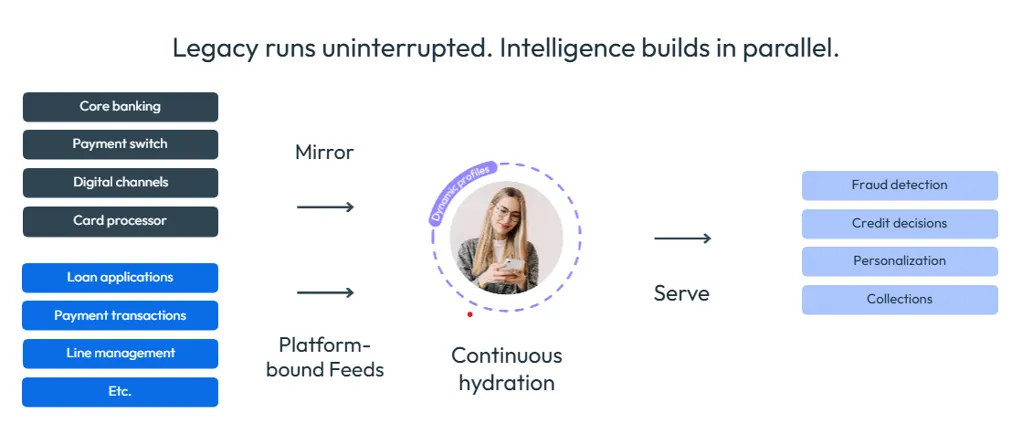
- Adoption doesn't require a rip-and-replace. Data streams can mirror into a parallel path that builds the context layer without disrupting core banking, payment, or card processing systems already in production.
The real shift is in what counts as evidence for a decision. Once context is continuously updated and auditable, that becomes the new baseline regulators, auditors, and customers expect. Institutions that move early set that bar for slower peers.
Why Customer Data Arrives Too Late
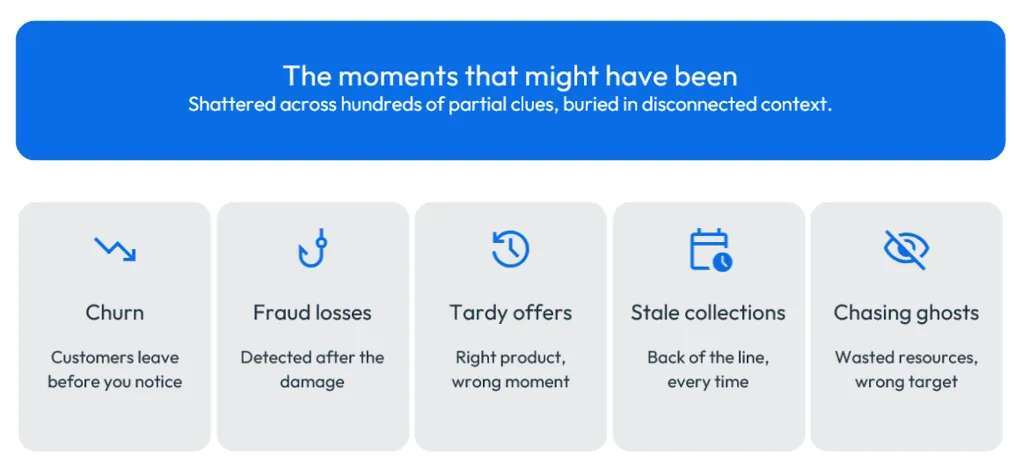
Many enterprise decisions still rely on customer data that describes a moment already past. The problem is not that behavioral signals are captured too late; it is that those signals often must be consolidated, transformed, and made available before a decision engine can use them.
This isn’t a volume problem. Organizations already capture enormous amounts of data on customers, accounts, devices, and merchants, but that data is scattered across siloed systems built to serve their own function rather than to build a current picture of an entity.
Decision systems often cannot wait for enterprise-wide consolidation. When architectures are optimized for periodic reconstruction rather than continuously updated entity context, fraud signals may be acted on only after losses occur, offers may arrive after the relevant moment, and collections strategies may lag changes in a customer’s circumstances.
Compliance Is the Constraint Most Discussions Skip
For a regulated institution, speed without explainability can create risk rather than advantage. A model output alone is not enough; the institution must be able to show the data, rules, controls, and governance behind the resulting decision. This is where determinism becomes more than a technical detail. Event-to-state lineage enables authorized users to inspect and explain how the decision context was assembled, while data classification, privacy controls, and business logic remain governed by the institution.
How FICO® Platform Deploys Real-Time Customer Data Without Diluting Governance
Adopting a real-time context layer does not necessarily require replacing core banking, payment, or card-processing systems that took years to stabilize. Where the existing architecture supports it, relevant data streams can be mirrored into a parallel path that builds and validates the profile layer while production traffic continues to flow. Once the layer meets the institution’s requirements for performance, accuracy, resilience, security, and governance, fraud detection, credit decisions, and collections can begin using it in a controlled rollout.
This approach allows a risk team to improve the context used in approvals and loss detection while preserving the stability of the systems that existing portfolios depend on.
What’s Underneath: The Four Layers of a Dynamic Profile
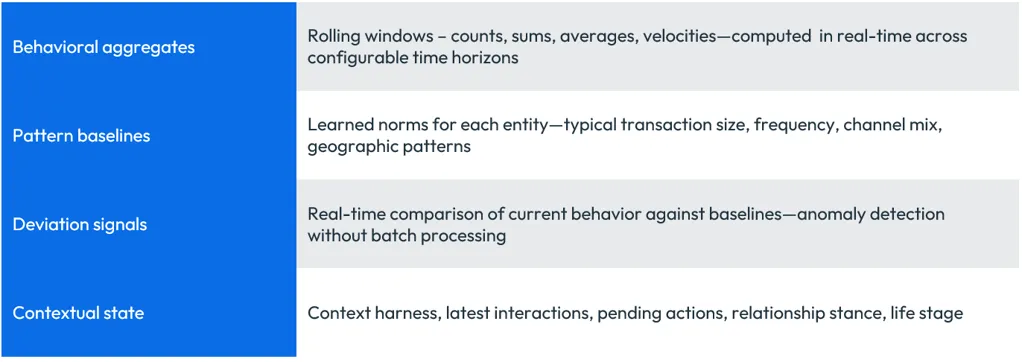
This context is built in four layers: behavioral aggregates, such as rolling counts, sums, averages, and velocities across configurable time windows; pattern baselines that establish what is typical for an entity; deviation signals that compare current activity with those baselines in real time; and contextual state that captures the entity’s latest interactions and relationship status. Together, these layers convert incoming events into governed context that decision strategies and models can use.
FICO® Platform applies this layered approach to support governed, auditable decisioning at enterprise scale.
Why Dynamic Profiles Change the Adoption Conversation
The governance and deployment cases reinforce each other. A context layer that is explainable end to end and introduced alongside existing systems addresses two common barriers: confidence in how decisions are made and risk to production operations. A practical starting point is to select one high-value decision, identify the events and features that materially affect it, build a governed entity profile, and test the resulting decision outcomes against the current process. Expansion should follow only after the institution has validated value, control, and operational resilience.
Determinism Becomes the Baseline
The competitive advantage will not come from producing another millisecond of speed in isolation. It will come from making every real-time decision current, traceable, and defensible. That is the standard financial institutions should design for now—and the standard by which their decisions will increasingly be judged.
Learn More About FICO’s Real-Time Customer Profiling Capabilities
- Explore FICO® Platform to see how organizations can combine data, analytics, decisioning, and applications to improve decisions across the customer lifecycle.
- Learn how FICO’s real-time contextual profiling capabilities create a governed library of raw and derived data for use in real-time decisions.
- Read how dynamic profiling turns transaction signals into real-time customer-intent insights.
- Learn how real-time decisioning can stop a scam before funds leave an account by reading the Fighting Scams with AI Decisioning whitepaper.
- Download the FICO Focused Foundation Model Executive Brief to understand how domain-specific models deliver the precision and auditability financial services demands.
Frequently Asked Questions
A dynamic profile is a continuously updated representation of a customer, account, device, merchant, or other entity that incorporates new events and derived behavioral features as they arrive. Unlike a traditional operational database, which records transactions or current system state for a specific purpose, a dynamic profile combines information from multiple sources to maintain decision-ready context. The distinction is not simply update frequency: it is the profile’s ability to preserve governed, time-sensitive context and make it available to decisions as events occur.
FICO® Platform provides a unified, cloud-native architecture for building, deploying, and governing data, analytics, models, decisioning, and applications at enterprise scale. Its architecture combines governed data and intelligence with composable capabilities, enabling organizations to operate real-time decisions with the transparency and control required in regulated industries.
Real-time customer profiling improves the relevance of decisions by using current behavior and context rather than relying only on historical snapshots. In fraud management, faster access to behavioral signals can help identify suspicious activity earlier. In personalization, current context can improve the timing and relevance of interactions. In credit and collections, updated information can support more responsive strategies, subject to the institution’s models, policies, controls, and applicable requirements. The broader benefit is not speed alone, but the ability to act on timely context with clear governance and lineage.

Popular Posts

Average U.S. FICO® Score at 716, Indicating Improvement in Consumer Credit Behaviors Despite Pandemic
The FICO Score is a broad-based, independent standard measure of credit risk
Read more
The GSE Data Is Public. Here's What It Shows About Credit Score Modernization.
Independent Milliman analysis of GSE historical data confirms what anyone can now verify directly: FICO® Score 10T is the most predictive score.
Read more
FICO Statement on FHFA and FHA Updates to Credit Score Modernization
FICO supports FHFA’s announcement that the long-anticipated historical data for FICO® Score 10T will be released to the mortgage market.
Read moreTake the next step
Connect with FICO for answers to all your product and solution questions. Interested in becoming a business partner? Contact us to learn more. We look forward to hearing from you.