The Web Channel: Living Up to Its Digital Self-Service Promise
Turn two-way digital engagement into efficient self-service with a web channel that transforms fraud resolution, right party contact, application conversion, collections, and more

Think about the last time you had to call your bank. Maybe you spotted an unfamiliar transaction on your statement. Maybe your application got stuck waiting on a document you'd already submitted. Maybe you just needed to update an email address or make a payment and somehow ended up on hold for twenty minutes.
These moments are frustrating because they feel so unnecessary. The technology to handle them digitally has existed for years. So why are so many of them still happening over the phone?
The answer comes down to a missing piece: a web channel that actually does something, dynamic and personalized, launched from another digital communication channel, like WhatApp, SMS, or email. When a customer opens the link, they land in a secure web experience built specifically for them, one designed to engage, collect what's needed, keep things moving without a human having to step in, and then feed key information back to the source system for better decisioning.
The web channel is reshaping what digital self-service can actually do.
Key Takeaways
- A secure web channel turns a message into a completed action. SMS/RCS, email, and WhatsApp are examples of digital channels used to reach customers, but they can't collect a signature, verify an identity, or process a payment on their own. The web channel is the destination that makes those messages actionable: a personalized, branded experience where the customer can review information, respond, and submit, with key information routed automatically back into the source system.
- Fraud resolution gets faster and more accurate when customers respond digitally. Reviewing a full transaction history on a secure web page and marking items as legitimate or fraudulent removes the guesswork and pressure of a live phone conversation. Responses become more precise, false positives drop, and when a case does need to escalate, agents already have the customer's input in hand. The same web-based confirmation flow can pause a suspicious payment before it completes, stopping scams rather than just detecting them after the fact.
- Collections shift from confrontation to self-service. A delinquent customer directed to a private, secure web page can review their balance and set up a payment on their own schedule. That discretion and control improves self-cure rates, reduces roll rates, and lightens agent workload, all while keeping customers in the relationship rather than pushing them to disengage.
- A simple web form can be the difference between a completed application and an abandoned one. Applications commonly stall not because a customer changed their mind, but because they had no easy way to supply one more document or detail. Meeting them on their preferred channel and pointing them to a short web form to close that gap is often enough to keep the process, and the relationship, moving forward.
- The web channel is the connective tissue across every one of these use cases. Fraud alerts, identity verification, collections, and application conversion look like separate problems, but they share the same underlying fix: a consistent, secure, branded web experience that customers recognize and trust.
The Problem with "Good Enough"
Organizations have invested heavily in customer communications over the past decade, adding more automation, personalization, and channels. For routine interactions, that investment has paid off.
But some of the most critical moments in the customer journey have remained manual and costly. Not because organizations haven't tried to fix them, but because fixing them requires more than just sending a message. It requires a secure, personalized digital experience, where customers can engage and act, all within a web channel.
Four Ways the Web Channel is Advancing Digital Self-Service
Fraud Alerts that Prevent Losses
When suspicious activity is flagged on an account, the typical response is still a phone call. An agent reads out a list of transactions. The customer tries to remember whether they made them. It's slow, it's imprecise, and it puts all the burden on the agent.
There's a better way. When customers are reached on their preferred channel and directed to a secure web experience built specifically for their account, they can review their full transaction history and mark each item as legitimate or fraudulent in a single submission (see the fraud verification interface image below). The experience is frictionless, tailored to that customer and alert, and responses become more accurate. Legitimate transactions are processed with minimal disruption. And when escalation is needed, fraud agents enter every conversation already equipped with customer’s input.
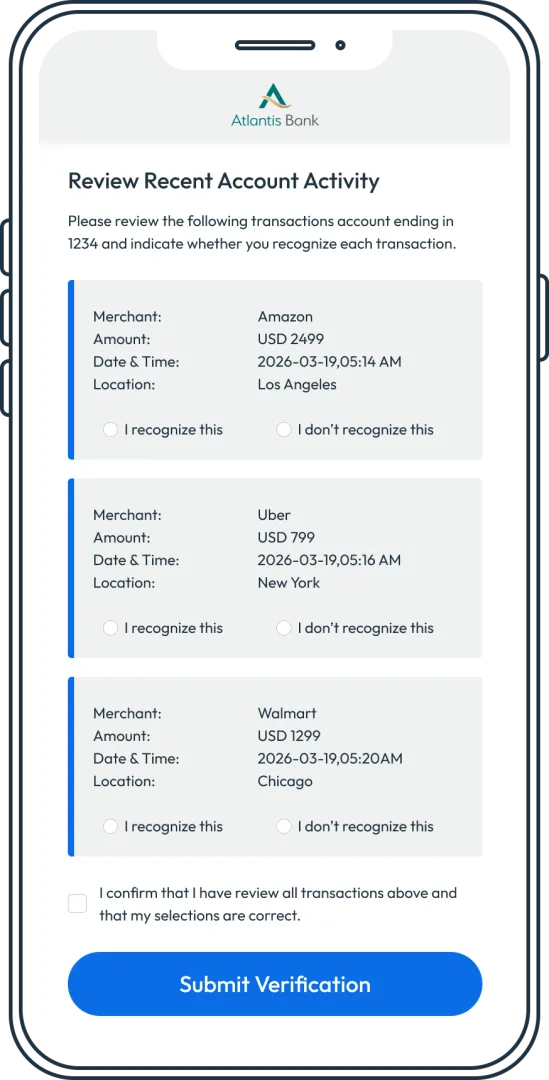
The same approach can stop scams before they happen. When a suspicious payment is initiated, a well-timed alert can send the customer to a secure web page to pause and confirm before the transaction goes through, with routing logic that either releases the transaction or escalates it automatically based on their response.
Frictionless Identity Verification
Nobody enjoys knowledge-based authentication. But right-party contact verification doesn't have to feel like an interrogation.
When authentication questions are delivered inside a clean, branded web experience launched directly from a message that reached the customer, responses are scored and routed in real time behind the scenes. Applications move forward, identities are confirmed, and the whole thing happens without any human intervention, inside a web channel the customer trusts because it looks and feels like the organization they do business with.
Collections that Don't Feel Like Collections
Outbound collections calls are expensive, easy to ignore, and increasingly ineffective. Typically, the goal of a collections interaction isn't to pressure a customer, but to help customers resolve a balance and stay in good standing. That's a problem a well-designed web channel can solve.
When a delinquent customer is reached on their preferred channel and directed to a secure self-service web page, they can discreetly review their balance, explore available options, and make or schedule a payment on their own terms, at a time that works for them.
Self-cure rates improve, roll rates decrease and agent workloads shrink. Customers who might have disengaged entirely are kept in the relationship because the web experience met them where they were, without the friction that usually gets in the way.
For example, by enhancing debt collection with FICO’s communications capability, Octane Lending achieved major gains in efficiency and early-stage performance:
- 99% digital auto-resolution rate across early-stage collections
- 98.7% total digital containment across all cases
- Managed increased delinquent volume without growing collections team
- 32% of digital payments submitted within 24 hours of communication
Read more about Octane’s success.
Keeping Applications Moving Forward
Here's a scenario most lenders know well. A customer starts an application, gets asked for a piece of additional information, and then disappears. Not because they lost interest, but because the process gave them no easy way to continue.
The fix is simpler than it sounds. When additional information is needed, reaching the customer on their preferred channel and directing them to a simple web form to provide exactly what's required is often enough to keep the process moving. The application continues. The relationship survives. Conversion rates improve, and not because of a major overhaul, but because a small friction point was finally removed.
The Path to Seamless Digital Experiences
Manual print and postage costs add up fast, and phone-based outreach is even more expensive. Agent time and resources don't scale the way digital does, and both channels are slow, costly, and increasingly out of step with how customers expect to be reached. Digital delivery, whether by email, SMS, RCS, messaging apps, or web, is faster, cheaper, but it’s the web channel on the other end of the message that gets things done. Making that switch requires two things most organizations struggle to collect at scale: a verified digital address and consent.
When an email bounces, the opportunity doesn't have to end there. Reaching the customer via SMS, directing them to a web form to provide an updated address, and capturing consent in the same interaction, then feeding that information back into the system automatically, turns a delivery failure into a data asset. No manual cleanup. No starting from scratch.
Over time, the result is a leaner, faster communication operation and a growing pool of customers who can be reached digitally, reliably, on the channels they actually use, and delivered into a personalized web experience.
The Power of the Web Channel
Fraud alert resolution, digital identity verification, collections, application processing, and consent capture are more connected than they might appear. The common thread is the web channel, a secure, personalized web experience launched from whatever channel first reached the customer, built to meet them in the moment, drive self-service, collect what's needed, and keep things moving without defaulting to agent intervention.
When that web channel is consistent, secure, and familiar across every interaction, the experience changes for everyone. Customers trust it because it looks and feels like their bank. Organizations benefit because it's managed in one place, connected to the systems they already use, and built to scale across every use case.
How FICO Can Help You Improve Customer Engagement and Digital Self-Service
- Discover the power of FICO® Platform - Communications Capability
- Explore how FICO helps fight fraud, regardless of channel or portfolio
- See how FICO’s Communications Capability for Fraud engages customers in real time to disrupt a variety of fraud typologies
- Learn how Absa Bank improved results across fraud and collections with customer communications from FICO
Frequently Asked Questions
Getting a customer to engage is what FICO® Platform – Communications Capability is built to solve. Rather than sending outreach at the same time, on the same channel, regardless of how a customer has responded before, the AI-powered capability learns from each customer's behavior at a granular level and recommends the contact strategy most likely to be answered. Instead of relying on whichever channel happened to work once, it continually adjusts as it learns more about when and how that customer engages, so the web channel is actually reached.
FICO’s omni-channel engagement capability ensures conversation continuity across any mix of channels. The web channel is connected across every channel, so that if a customer switches from SMS to email or app, the conversation and the web link carry over with them, picking up right where they left off.
Intelligence gathered during the engagement enriches the customer profile through FICO® Platform’s connected lifecycle architecture. Each interaction sharpens the organization's understanding of the customer, informing every subsequent interaction across the entire customer lifecycle. Key information, such as fraud tags, can also be fed back to the source system to improve decisioning.

Popular Posts

Average U.S. FICO® Score at 716, Indicating Improvement in Consumer Credit Behaviors Despite Pandemic
The FICO Score is a broad-based, independent standard measure of credit risk
Read more
The GSE Data Is Public. Here's What It Shows About Credit Score Modernization.
Independent Milliman analysis of GSE historical data confirms what anyone can now verify directly: FICO® Score 10T is the most predictive score.
Read more
FICO Statement on FHFA and FHA Updates to Credit Score Modernization
FICO supports FHFA’s announcement that the long-anticipated historical data for FICO® Score 10T will be released to the mortgage market.
Read moreTake the next step
Connect with FICO for answers to all your product and solution questions. Interested in becoming a business partner? Contact us to learn more. We look forward to hearing from you.