What Are Callbacks and How Are They Used in Optimization?
Callbacks play a pivotal role in modern optimization but they are rarely used - here's how they work and how they benefit data scientists and operations research professionals

Callbacks play a pivotal role in modern optimization and decision intelligence systems and serve as anchors for seamlessly integrating business logic directly within the complex search algorithms of optimization solvers like FICO Xpress. Callbacks provide a standardized mechanism for interacting with software, extracting intermediate search states from the solver, and injecting user-defined logic and information into the solver. These capabilities foster adaptability across a range of programming environments and optimization software solutions. Callbacks are useful in all kinds of industries, including supply chain, transportation, and energy, where operational complexity and changing business requirements demand speed and precision from optimization tools. Understanding and leveraging callbacks is fundamental for building robust, flexible, and transparent optimization processes that drive critical business decisions.
What Are Callbacks?
Callbacks are specialized functions that are passed to the solver (as arguments of an “add callback” function) and then invoked (or "called back") from the solver to complete a specific action (e.g., check a solution for feasibility regarding some business logic that is not explicitly represented in the model), allowing for customized execution at specific, well-defined points during a process or algorithm. Callbacks exist in all language-specific APIs, be it Python, Java, C, C++, .NET, R, modelling languages such as Mosel and some (not all!) third-party interfaces such as JuMP.
Callbacks form a fundamental mechanism for extending or modifying the behavior of the optimization solver, across all APIs, which is essential for both advanced development and operational excellence in domains like mathematical optimization and prescriptive analytics.
Despite their value, callbacks are often underused. In our experience with FICO Xpress, even among advanced users, only a relatively small group take advantage of them.
Why? Callbacks have a bit of a learning curve, and since their benefits depend on the specific problem at hand, it's not always obvious upfront, even to operations research experts, whether the investment will pay off. Our hope is that this post will demonstrate some of the value callbacks bring and encourage greater usage.
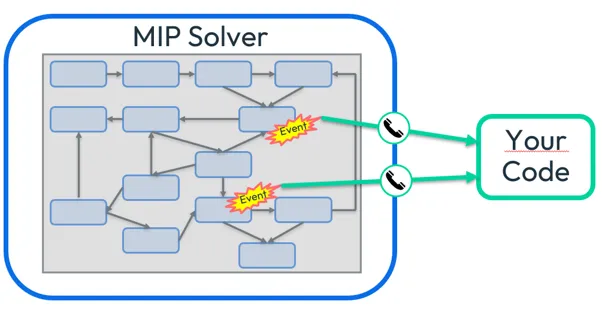
How Do Callbacks Work?
In optimization, callbacks allow users to inject custom logic into core routines such as branch-and-bound, cut generation, or heuristic searches. This approach provides fine-grained control over complex workflows and enables tailored interventions (for example, updating incumbent solutions, logging progress, or dynamically adjusting algorithmic parameters). Callbacks also allow for fundamentally extending the optimization algorithm and changing its behavior. Users can define their own branching operations (including multi-way branching and branching on constraints), add their own cutting planes, and run their own heuristics inside the optimization solver. This custom logic and these customized algorithms are triggered automatically at predefined points during the execution of the search algorithm.
These trigger points include the start or end of a solver phase, each node-processing step in a branch-and-bound algorithm, or events such as finding a new incumbent solution.
The user can request relevant contextual information (such as current variable values, constraint states, or objective bounds) from the callback to make informed decisions in real time and to feed back into the live optimization process. Communication back to the solver can occur in two ways: the user can call specific solver API functions from within the callback. Additionally, some callbacks require communicating information back via the output argument (or, in C, via a pointer). For example, the optimal node callback is called when a branch-and-bound node has been solved to optimality, and it shall return whether the user declares this node infeasible. Callbacks effectively act as hooks that interface between the core solver routines and custom user logic.
Typical Use Cases for Callbacks in Optimization
Typical use cases for callbacks in optimization span a broad spectrum of needs, from enhanced solution monitoring to fine-tuned solver control.
In mixed-integer programming, callbacks are often used to inject custom cuts or heuristics, which can accelerate convergence and improve solution quality when compact model approaches fall short.
Callbacks also facilitate advanced progress tracking by enabling users to log key metrics, such as node counts, incumbent objective values, or time stamps, at each significant stage of the solve process. This capability is particularly valuable in real-time decision intelligence applications, where operational status and solution quality must be visible and actionable throughout lengthy solve cycles.
Let’s look at a couple of concrete use cases! For all technical details of how the various types of callbacks are interweaved with the algorithmic flow of the Xpress MIP and Global Solver, see the image below.
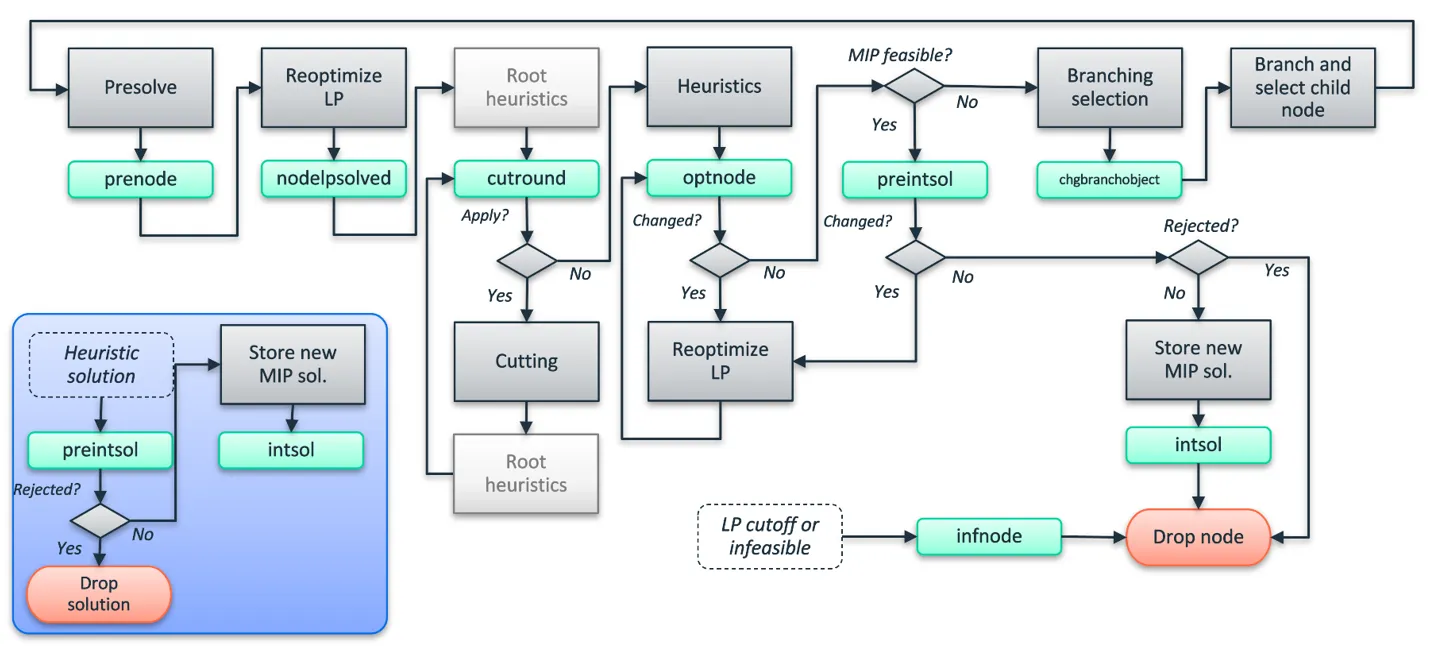
Use Case 1: Logging and Just-in-Time Processing of Intermediate Solutions
Imagine running a real-time optimization application in which the MIP solver works continuously in the background, searching for improving solutions. Rather than waiting for the optimization run to finish, you may want to start working with the best solution found so far (the current incumbent) as soon as it becomes available or do your own logging.
For example, you might visualize the solution to a facility location problem on a map, evaluate it against operational KPIs that are not represented by the solver’s optimality gap, or simply provide your own progress report. Slightly more advanced, you might want to collect the solution to some sort of solution pool or pass it to a custom improvement heuristic that uses domain-specific knowledge. If that heuristic finds a better solution, it can feed the improved solution back into the solver. You might also decide to terminate the optimization early once the incumbent satisfies all relevant business criteria, even if the solver has not yet proved it optimal.
An integer solution callback provides exactly this kind of just-in-time access. The solver invokes the callback whenever it finds a new feasible MIP solution, allowing the application to inspect, process, improve, or act on that solution immediately.
Check out our online example for solution enumeration, which collects the n-best solutions for an optimization problem.
Use Case 2: Strengthening the Model on the Fly
Subtour elimination constraints are perhaps the poster child for solver callbacks.
Consider a vehicle routing problem. For any vehicle tour and any partition of the visited locations into two (nonempty) sets, the vehicle must cross from one set to the other and later return. Constraints that express this requirement are very strong, but they come with a substantial drawback: there are exponentially many potential partitions, and therefore exponentially many corresponding constraints. Adding all of them to the original model would be prohibitive.
Fortunately, only a small fraction of these constraints is usually relevant at any particular point in the search. Instead of generating them in advance, a smart separation algorithm can inspect the LP relaxation solutions produced by the solver, identify the subtour-elimination constraints currently violated, and add only those constraints.
An optimal-node callback is a natural place to implement this separation procedure. The same general pattern applies to many other dynamically generated valid inequalities. Closely related callback mechanisms can also be used for lazy-constraint separation or as a building block for a custom Bender’s decomposition: solve a relaxation, analyze the current solution, and strengthen the model only where necessary. Also see our example for TSP modeled via delayed rows/lazy constraints and our example for a custom Bender’s decomposition.
Use Case 3: Shaping the Search by Reviewing and Refining Solver Decisions
MIP solving ultimately proceeds by exploring a search tree. Therefore, the solver recursively divides the remaining solution space. The choice of variable—or, more generally, branching object—to split the search space on can have a substantial effect on the size and shape of the search tree. It is therefore one of the algorithmic components for which incorporating business logic can be especially valuable.
Consider a network design problem with binary variables indicating whether individual edges are activated. A domain expert may know that decisions on certain critical edges have a particularly large downstream impact: fixing whether one of these edges is open or closed may determine much of the remaining network structure. Given the current partial assignment and the LP relaxation (which indicates which edges are still undecided and how strongly the model currently favors opening them), a user-written code may be able to identify the next strategically important edge more effectively than a generic branching rule.
A branching callback makes it possible to inject this knowledge directly into the search. Whenever the solver is about to branch, the callback can inspect the current search state and serve as a review layer. It can:
- accept the solver’s proposed branching object unchanged;
- replace it with a user-defined branching object; or
- augment the proposed branches with additional implications.
The third option is particularly useful when business logic implies relationships that are difficult or inconvenient to express explicitly as model constraints. For example, fixing one network decision may force several other edges to be opened or closed by some business logic that is not directly expressed via model constraints. Adding these implications directly to the corresponding branches can communicate that knowledge to the solver exactly when it becomes relevant. Our online example for search tree visualization uses newnode and messaging callbacks.
What Are FICO Xpress's Callback Capabilities?
FICO® Xpress offers the most comprehensive suite of callback capabilities in the industry, allowing users to tailor both the behavior and performance of their optimization engines precisely to their needs. By exposing a wide range of callback interfaces (spanning node, cut, incumbent, and heuristic events), FICO Xpress allows practitioners to seamlessly inject custom logic into the heart of mixed-integer linear and nonlinear programming, and other classes of optimization problems.
FICO Xpress also supports integration with external data sources and provides mechanisms for fine-tuned memory and process management within callback routines, ensuring robust, scalable deployments even with large, complex models.
FICO Xpress’s callback framework has been designed to support decision intelligence professionals and operations research teams looking to enhance model transparency, improve audit capability, and achieve optimization outcomes that meet business requirements.
Learn More About FICO Xpress Optimization
- Explore the FICO Xpress Optimization Community
- Download our FICO Xpress Solver solution sheet to learn more about Xpress's high-performance solving capabilities
- Test-drive FICO Xpress with our 60-days free Xpress trial license
- Visit our help center to learn how to define and use callback functions from the Xpress Python interface and check out our examples repository for examples in your favorite programming language and our Python notebook repository

Popular Posts

Average U.S. FICO® Score at 716, Indicating Improvement in Consumer Credit Behaviors Despite Pandemic
The FICO Score is a broad-based, independent standard measure of credit risk
Read more
The GSE Data Is Public. Here's What It Shows About Credit Score Modernization.
Independent Milliman analysis of GSE historical data confirms what anyone can now verify directly: FICO® Score 10T is the most predictive score.
Read more
FICO® Score High Achievers: Is Age the Only Factor?
<p>FICO’s latest research on <a href="http://www.fico.com/en/blogs/risk-compliance/us-credit-quality-rising-the-beat-goes-on/" target="_blank">national FICO® Score distribution</a> shows that US credit quality continues to trend upwards, with an increasing number of consumers scoring in the highest scores ranges. Given that, we decided it was time to refresh our study on “<a href="http://www.fico.com/en/blogs/risk-compliance/infographic-what-does-a-high-credit-scorer-look-like/" target="_blank">FICO® Score high achievers</a>,” where we examine the credit behavioural profiles of consumers with higher credit scores.</p> <p>As expected, our latest study showed that older people generally have higher scores, as has been the case in our <a href="http://www.fico.com/en/blogs/risk-compliance/age-before-beauty-credit-worthiness-before-youth/" target="_blank">past research</a>. This is largely because they have trade lines that have been open longer, which leads to higher scores (assuming the trade lines are in good standing and all other things equal). The most credit savvy among you will remember that length of credit history accounts for roughly 15% of the overall <a href="http://www.myfico.com/CreditEducation/WhatsInYourScore.aspx" target="_blank">FICO® Score calculation</a>.</p> <p>But for younger consumers, it isn’t too helpful to say, “just wait until you are 50 years old, and that will fix things!” Thus, I decided to dive deeper with our analysis, including looking at the credit behavioural characteristics of younger consumers with high FICO® Scores.</p> <p>In this analysis, I looked at credit characteristics for the two highest score bands, 750-799 and 800-850, which have about 16% and 23% of the population, respectively. I further broke this down by looking at the characteristics of the youngest 15% in each group, which occurs at age 29 for the 750-799 group and 43 for the 800-850. We used FICO<strong>®</strong> Score 9 for our analysis, and examined typical variables of the categories that go into the make-up of the score.</p> <p><a href="http://www.fico.com/en/blogs/wp-content/uploads/2016/10/FICO-Score-High-Achiever-table.png"><img class="alignnone size-full wp-image-29367" src="http://www.fico.com/en/blogs/wp-content/uploads/2016/10/FICO-Score-High-Achiever-table.png" alt="fico-score-high-achiever-table" width="715" height="747" /></a></p> <p>Since there’s a lot to dissect in this chart, I’ll highlight a few findings that struck me: <ul> <li><strong>Credit history.</strong> Higher scores are undoubtedly associated with a longer time on file. What’s striking is the higher average time on file for the 800+ group, both overall and for revolving accounts (the most common trade line). Clearly, it helps to start credit use early in life – but that’s not the sole determining factor for high scoring. The younger cohorts in both the 800+ and 750-799 groups have time on file medians significantly less than their older counterparts.</li> <li><strong>New credit.</strong> High credit scorers do, in fact, pursue new credit. We see little variation in months since last trade line opening and last inquiry among all groups observed.</li> <li><strong>Pay on time.</strong> As you might expect, the further in the past the delinquency, the higher the score – and that’s <u>if</u> a delinquency ever happened. 95% of the 800+ people and 72% of the 750-799 group have never been delinquent, which is a striking contrast to the 57% for the total population. The percentages for the younger groups are even higher, especially so for the 750-799ers. Collection items are also scarce for these high scorers. While 23% of the national population have collection items greater than $99, the figures are only 0.5% for the 800+ group and 3% for the 750-799 group. It is clear that, in conjunction with starting a credit file early, paying on time is a key trait of the FICO® Score high achiever.</li> <li><strong>Balance and utilization.</strong> Finally, we look at how credit is being used, focusing on revolving product use. (Since most people only have one mortgage or one auto loan, variation in instalment product figures is minimal and driven by payment history, which is near perfect for high scorers, as we’ve seen.) FICO® Score high achievers tend to have more open revolving accounts. While the % active trades and utilization are generally lower, by no means do high scorers avoid the use of credit products. What drives the difference here is the amount of <u>available</u> revolving credit utilized. The 800+ group is roughly 1/4 of the national median, both in total and on their highest utilized card; they also have lower balances and more cards<em>. </em>The 750-799 group is more active and higher utilized, but still only at 2/3 of the national figures. The young 750-799 group compensate with lower revolving balances and, as a result, lower utilization, which is in line with what we see for the 800+ group.</li> <li><strong>Benchmarks.</strong> I’d like to point out that while this study provides good benchmarks of the typical credit traits of the FICO® Score high achiever, individual credit profiles will vary widely. And keep in mind that when we sort groups of consumers as a whole by different behaviours, some results may look superficially odd. For example, the 800+ band has a longer median average open account time (128 months) than average revolving months on file (140 months).</li> </ul> So, what do we conclude? A huge takeaway is that high scorers don’t have too much in the way of serious delinquencies and negative public record data.</p> <p>In most respects, the young 800+ people are like their peer group. They really only differ markedly in their shorter credit history and higher non-mortgage balance, both of which are a function of life stage. Our results show that you don’t have to be a credit product hermit; these high scorers have more credit cards. The takeaway is to start credit activity early and maintain well-managed and moderate usage.</p> <p>In many ways, the young 750-799 people are more interesting because their age profile is much younger. Their credit characteristics differ more from their peer group, particularly in terms of length of credit history. They compensate by having almost pristine credit records and lower balances.</p> <p>Ultimately, 39% of US consumers are FICO® Score high achievers, which they accomplish by following common-sense credit practices. It ain’t rocket science!</p>
Read moreTake the next step
Connect with FICO for answers to all your product and solution questions. Interested in becoming a business partner? Contact us to learn more. We look forward to hearing from you.