What Is DecisionOps? And Why Is It a Critical Piece in Your AI Strategy?
Learn the basics of DecisionOps and how it helps enterprises realize and amplify value from AI investments faster than ever before

How many data science projects get stalled in development, never crossing the chasm from prototype to operationalized service? How much unrealized revenue is sitting in a code repository, tied to an abandoned model? While investment in AI continues to grow, McKinsey found that only 37 percent of respondents report that AI has had positive enterprise-level financial impact. When it comes to the value of AI initiatives such as decision optimization projects, they are only as successful as the structure, tooling, and workflows in place around them. Enter DecisionOps, the framework for successfully launching and managing decision models.
Key Takeaways
- DecisionOps is the key underpinning to realizing model value. Owning model infrastructure end to end is time-consuming and distracting. Developers get tasked with building tooling instead of building models. Engineers get tasked with re-compiling models instead of integrating the models as services. DecisionOps allows teams to focus on building and deploying more models, iterating on them faster, and scaling to more volume and use cases.
- The benefits of DecisionOps go beyond deployment. Bridging the gap between local development and production systems is one piece of the puzzle. DecisionOps helps teams collaborate more efficiently, pressure-test scenarios, manage and troubleshoot rollout with a complete system of record, and observe model performance to ensure it is delivering expected value.
- DecisionOps is for projects of any maturity. All decision projects should start with DecisionOps, but it's never too late to incorporate it. Leveraging DecisionOps doesn’t require starting from scratch. When all decision projects look and feel the same — be it a brand-new prototype or a 10-year-old service — teams can rely on DecisionOps to handle the repeatable pieces, so they can focus on the things that are not.
What Are Decision Models and How Does DecisionOps Improve Their Use?
In this post, we look at AI projects through the lens of prescriptive decision models that determine what action should be taken with a goal of improving operational efficiency, often by minimizing, maximizing, or satisfying a given business objective such as revenue or customer satisfaction. For example, these types of decision models are used in supply chain optimization to tackle use cases such as last-mile routing and workforce scheduling, and in banking to handle decisions surrounding credit risk and fraud control.
Decision models help teams move from ad hoc decision making to a repeatable, data-driven process that's often implemented through optimization techniques like solvers, rules-based logic, or simulation, and can include the use of predictive models. Decision models can be deployed as executable code and managed like software applications, accessible via an API to run remotely across environments.
Teams are increasingly using a variety of optimization tools in their stack to tackle decision problems across regions and use cases, which means there are more dimensions to manage. For each project, there are many points of friction on the path from model prototype to production. Handoffs between data science, engineering, and business stakeholders are time-consuming. Without a structured approach, these friction points are compounded. Models may not be centralized or standardized, leaving teams to solve a messy model problem rather than delivering value back to the business.
So what’s the answer? DecisionOps. DecisionOps is the framework for operationalizing decision models effectively at scale so they can provide value to the business. Like DevOps for software development or MLOps for managing the model training lifecycle, DecisionOps is a holistic approach for managing the decision lifecycle.
FICO continues to invest in DecisionOps capabilities because applied intelligence is defined not only by the quality of completed projects, but also by the ability to operationalize and manage them at scale, preventing drift and delivering results. The enterprises that will win are the ones that can reliably build, deploy, monitor and govern their decision models at the pace the market demands.
What Is DecisionOps?
DecisionOps is a set of practices, tools and infrastructure for operationalizing decision models quickly, consistently, and reliably. The practices are collaborative and transparent, involving a range of stakeholders from model developers to business users. The tools include purpose-built frameworks and functionality that streamline model development, testing, deployment, and management. The infrastructure provides a common API layer for interacting with decision services that makes integrating into larger architectures and workflows seamless.
Every aspect of DecisionOps is supported by five key pillars:
- Observability: Observability refers to the auditability of the decision service, from detailed run history down to a model changelog. In addition to the model’s output or plan, it’s critical to have visibility into the run logs, metadata, and a complete system of record to answer questions such as, “Which error message came up?”, “What data inputs were used?”, and “Who made updates to the model, and when were they made?”
- Experimentation: Experimentation includes both the remote infrastructure and tooling for validating models by performing acceptance tests, scenario tests, shadow tests, simulations and more. It’s important that decision model testing is transparent and repeatable so teams can clearly understand effects and recreate results.
- Orchestration: Orchestration of decision models encompasses managing models as deployed services. This includes handling upstream and downstream integrations with databases, CRMs, models, custom end-user interfaces and more. Interacting with decision models and other services using APIs simplifies this workflow management.
- Collaboration: Collaboration within (and across) teams is critical to successfully operationalizing decision models. Modelers should be able to share development progress, operators and analysts need a feedback loop to improve plans, and other stakeholders require direct insight into business outcomes and performance.
- Documentation: Documentation is paramount when working with decision services and agentic workflows. Decision guides, business criteria and key metrics should be properly structured and up-to-date for quick and accurate reference and context building. Without good documentation, decision services become a black box to the teammates and agents who rely on and interact with them.
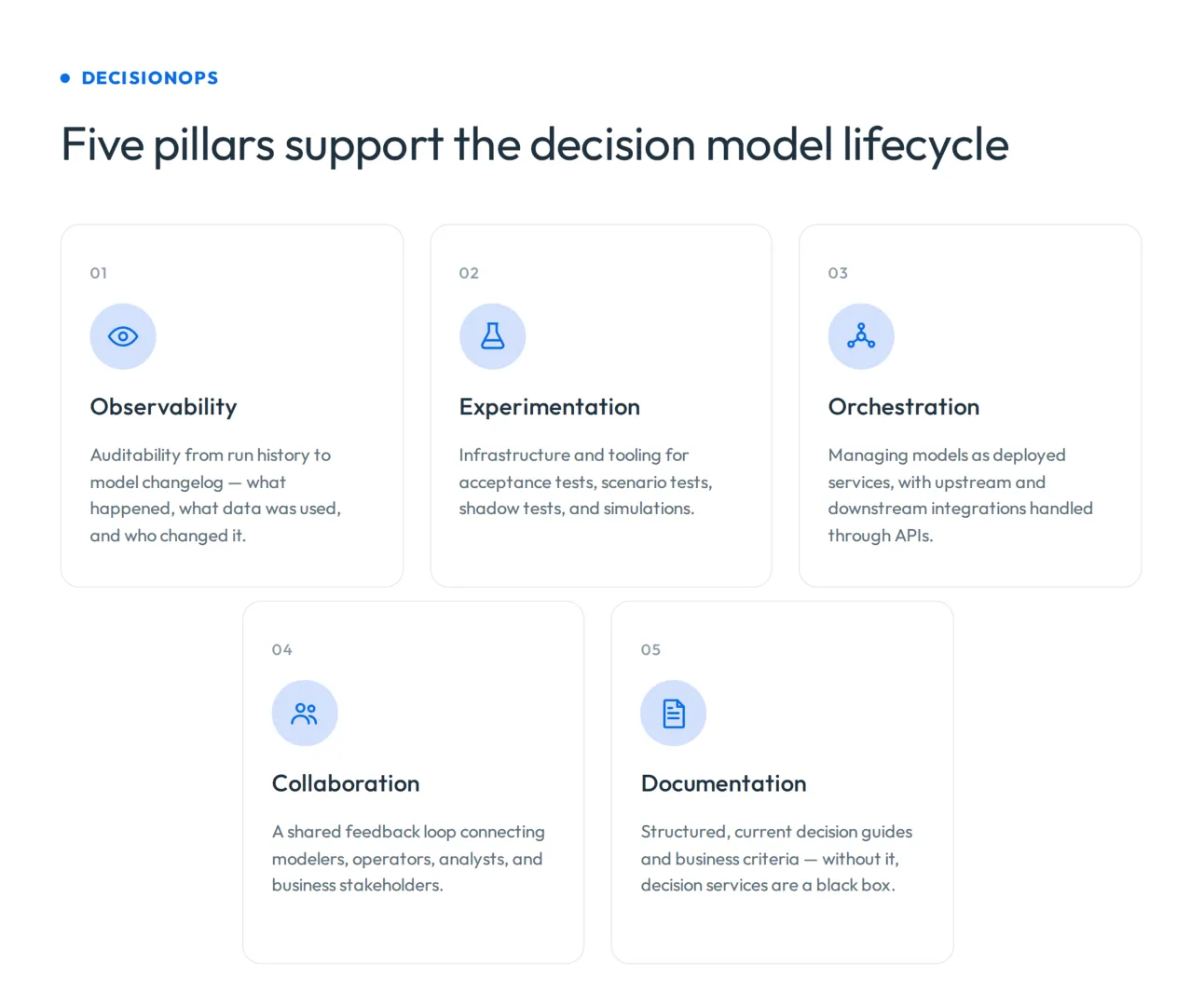
Leveraging each layer of DecisionOps ensures that the model lifecycle is clear, repeatable and transparent at every step to continue adding value to the business.
What Are the Benefits of DecisionOps?
While the reasons why decision projects never make it to production can vary, there are additional hurdles that keep projects from delivering value even after they’re deployed. Those blockers often sound like:
- “Our models are no longer delivering expected ROI and we can’t react quickly.”
- “Our models aren’t centralized or standardized, creating a messy model problem.”
- “Our teams don’t have the resources to consistently run experiments or scenarios.”
- “Our models have to be rewritten or recompiled to use across environments.”
- “Our stakeholders don’t trust the model and frequently request to see alternate plans.”
Any one of these statements can erode trust in a decision service. And they often arise simultaneously. Organizations can address these issues by leveraging DecisionOps to achieve multiple benefits:
Accelerated time to value
Shorten the go-live plan for decision models from years/months to weeks/days and see the impact on business outcomes faster. Teams develop more effectively with collaborative practices, stakeholders have insight into business outcomes sooner, and models are safely integrated into existing systems after passing validation checks.
Efficient scaling, more ROI
Scale to more volume, more regions, and more use cases with a repeatable path to production. DecisionOps creates a unified workflow and system for managing many decision models at once so teams can confidently scale their decision projects.
Less time spent troubleshooting
Audit every decision made with a complete system of record for every decision model. Find issues faster with detailed logs, roll back to previous versions easily, and test model fixes on production data without impacting production systems.
Explainability and regulatory adherence
Meet the increasing standards for model governance and build stakeholder trust with a complete log of every decision made alongside the applied business rules. Access the input data, run metadata, and custom visualizations of key metrics for continuous insight into performance and compliance.
DecisionOps provides these benefits by streamlining the repeatable workloads of a specific team, making it easier for them to collaborate and deliver more projects at a faster pace.
Who Participates in DecisionOps?
There isn’t just one team that benefits from DecisionOps at an organization. You can think about them in three groups: model developers, software engineers, and business stakeholders.
Model developers: Focus on modeling, not on building tooling
DecisionOps provides the infrastructure and tooling for repeatable workflows. With a centralized workspace for managing models and configurations across environments, developers can focus on confidently developing, validating and launching more models from a collaborative space.
Software and infrastructure engineers: Integrate and monitor models as services
DecisionOps minimizes engineering asks so decision services can be integrated and scaled easily. Teams can implement CI/CD for smoother model updates, observe models with a complete system of record, and easily roll out or roll back model versions for faster innovation and safer recovery.
Business stakeholders: Get insight into how models provide real-world value
DecisionOps creates a transparent view into model performance with access to run history to see the model’s plans, experimentation to test hypotheses, and custom reports to analyze business outcomes. Operators and analysts can interact with and audit plans measured against business KPIs, ensuring alignment with other stakeholders and building trust across teams.
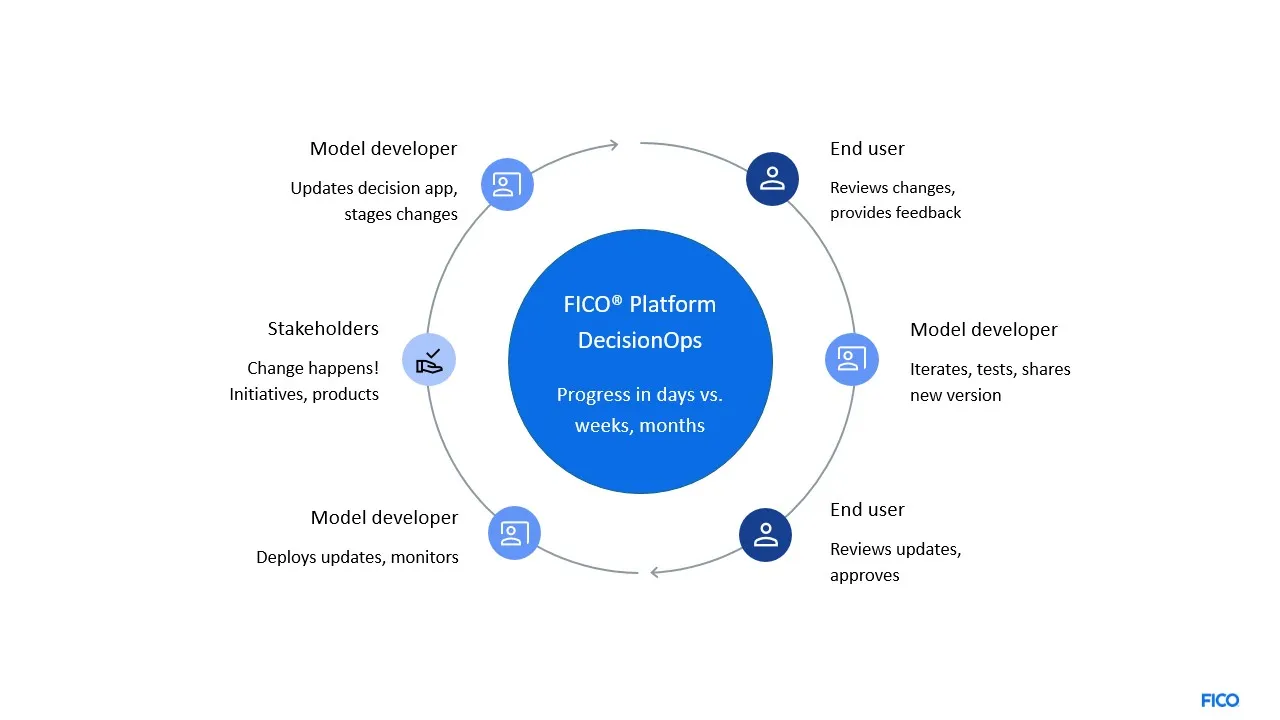
Implementing DecisionOps helps teams work together more effectively and provide value faster to your organization. Getting started doesn’t have to be a big lift. In fact, incorporating DecisionOps can (and should) start now.
Why Get Started with FICO for DecisionOps Today?
Why get started? With DecisionOps, you can easily connect existing projects, accelerate your workflows, and seamlessly integrate into your software stack. Decision models can quietly underperform or become outdated without anyone noticing until business results suffer. Initiatives can stall well before reaching production, resulting in a sunk investment. As boards and regulators increasingly expect AI systems to be explainable and auditable, gaps in traceability can create compliance exposure. FICO® Platform – DecisionOps Capability addresses these concerns.
FICO is a leading intelligent decisioning platform vendor with a native DecisionOps overlay, bringing best-in-class capabilities for decision model experimentation, governance, and observability directly into the FICO ecosystem.
How FICO Can Improve Your Decision Management
- By 2027, Gartner projects that 25% of ungoverned AI decisions will cause financial or reputational loss due to human bias and AI sycophancy. FICO has been named a Leader in the 2026 Gartner® Magic Quadrant™ for Decision Intelligence Platforms, recognized for patented explainability, bias mitigation, and AI agent-based architecture that keep decisions governed and trustworthy. Read the 2026 Gartner Magic Quadrant for Decision Intelligence Platforms report to see the full evaluation.
- Scaling decision models depends on real-time execution, not just good modeling. Gartner's Critical Capabilities report highlights FICO® Platform's real-time event stream processing, complex event detection, and library of decision blueprints as core strengths in Decision Engineering. Download the 2026 Gartner Critical Capabilities for Decision Intelligence Platforms report to see how FICO scores against your DecisionOps requirements.
- Forrester named FICO a Leader among the 15 providers evaluated in AI decisioning, citing strength in decision authoring, testing, and optimization. FICO's governance, including lifecycle management, transparency, extensibility, and observability, was highlighted as core to compliance and monitoring at scale. Access The Forrester Wave: AI Decisioning Platforms report.
- IDC named FICO a Leader in its 2024 MarketScape for Worldwide Decision Intelligence Platforms, citing scalable data integration across internal systems and more than 100 external data sources. The report highlights FICO's flexibility to either provide its own decision models or let customers bring their own, suited for organizations tackling fraud and risk, supply chain, and customer engagement decisioning across industries. Download the IDC MarketScape: Worldwide Decision Intelligence Platforms report to see the full vendor assessment.

Popular Posts

Average U.S. FICO® Score at 716, Indicating Improvement in Consumer Credit Behaviors Despite Pandemic
The FICO Score is a broad-based, independent standard measure of credit risk
Read more
The GSE Data Is Public. Here's What It Shows About Credit Score Modernization.
Independent Milliman analysis of GSE historical data confirms what anyone can now verify directly: FICO® Score 10T is the most predictive score.
Read more
FICO Statement on FHFA and FHA Updates to Credit Score Modernization
FICO supports FHFA’s announcement that the long-anticipated historical data for FICO® Score 10T will be released to the mortgage market.
Read moreTake the next step
Connect with FICO for answers to all your product and solution questions. Interested in becoming a business partner? Contact us to learn more. We look forward to hearing from you.