Are FICO® Scores the Same Around the World?
FICO is committed to creating the most effective credit score for each international market

We are often asked if a FICO® Score is calculated the same around the world. While FICO Scores have been made available for use in over 40 countries across five continents, they are not all the same for many reasons – but let me elaborate.
The Similarities
For over 35 years, FICO has kept a consistent goal globally for FICO® Scores – to leverage credit bureau data to extend credit access while applying its proven methodologies; and to accurately rank order risk in a consistent, explainable, and transparent manner. FICO pioneered the credit scoring model and has decades of experience and innovation that we apply worldwide to FICO® Scores.
Globally, most FICO® Scores for consumer credit risk adhere to the standard range of 300-850 and focus on five key categories of predictive credit bureau data:
- Payment History - how borrowers paid accounts over the length of their credit
- Outstanding Debt - amounts owed by borrowers or how much debt is carried
- Credit History Length - length of a borrower’s credit history
- Pursuit of New Credit - credit accounts most recently opened by a borrower
- Credit Mix – types of credit loan accounts where a borrower has experience like credit cards, retail accounts, installment loans, and mortgages
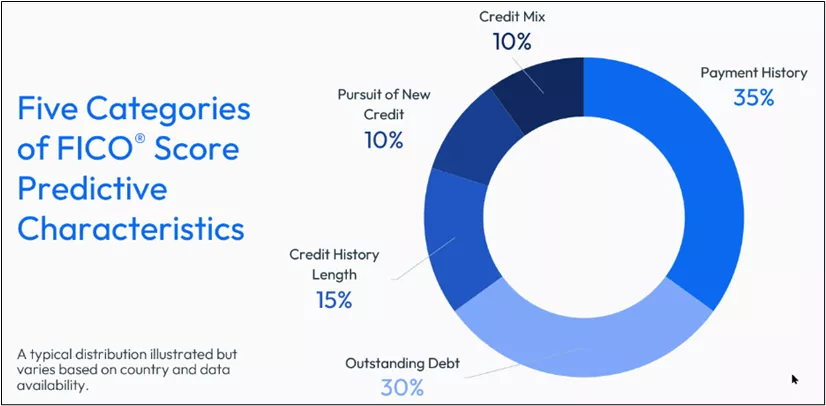
Figure 1 All five categories of predictive characteristics are considered when calculating FICO® Scores. Note: This is a typical distribution illustrated but percentages vary based on country and data availability.
Another core element of any FICO® Score is its explainability and transparency. For every FICO Score calculated, up to four reason codes are provided to indicate why the credit score is not higher, which lends insight to the factors having the largest negative impact on a person’s credit score. These reason codes offer guidance to financial lenders and borrowers to understand how a credit score may be improved over time and guides lenders to direct additional investigations, enhancing the credit decision.
The Differences
While there is significant overlap in the design blueprint of FICO® Scores, there are several variations from country to country:
Odds to Score Relationship
FICO® Scores are designed to rank order risk, where the higher the score, the better the odds of repayment in the future. This means that as the credit score increases, the ratio of those that will pay their credit obligations as agreed to those who will miss payments increases. The odds-to-score relationships can vary widely by country due to variances in the overall credit risk in each market. For example, observed default rates for credit cards range from under 3% to upwards of 10%. The relationship between odds and repayment in each of these markets has a very radical difference and meaning.
In any credit scoring system, both lenders and consumers benefit from a wide distribution of highly-predictive credit scores, with many opportunities to make precise decisions. Forcing alignment across countries with vastly different odds would compress the observed FICO® Score distribution, limit the operating range, and drastically diminish the effectiveness of the FICO Score for lenders in each market.
Performance Window
In developing predictive models, one key design element is determining the length of time that the borrower payment behavior will be evaluated. This is commonly referred to as the performance window, which again, can vary by country.
The most common window for our international FICO Score developments is twelve-months. This is primarily driven by the desire to be aligned with Basel standards, commonly used by banks requiring a 90-day delinquency evaluation over a one-year period.
While a FICO® Score may be developed on a particular performance window, we encourage credit grantors to validate using performance definitions that are most appropriate for their credit portfolio – even if it is different! The FICO Score has proven to rank order risk on different performance window definitions.
Product Inclusion
Worldwide, data captured in a credit report is similar, but entities that contribute data and the types of credit accounts reported can vary significantly in content and quality from country to country.
When we begin the work of deploying a FICO® Score to a new region, detailed research is conducted to understand the credit landscape and thorough data analysis is performed. This includes a review of the product types reported to the credit bureau, the frequency of information reported; and gaining an understanding of the lending instruments in market. The goal is to understand how credit risk is evaluated from a lender perspective and the responsibility and expectations of the borrower for repayment. It’s key to determine where borrowers have been extended credit and how they had the opportunity to demonstrate their ability to repay the debt.
Counting Enquiries
A request to review a consumer’s credit report is commonly recorded by a credit reporting agency as an enquiry. There are two distinct types of enquiries:
- Soft Enquiry - Informational review, such as a consumer reviewing their report for accuracy
- Hard Enquiry - Driven by an application to obtain credit, like applying for a credit card.
This is important to distinguish as enquiry logic varies by country. Our goal is to focus on hard enquiries where a request for credit is being made as it is a predictive element within a FICO® Score. The logic on how hard enquiries are counted is mainly directed by the data captured and the granularity of information at the credit reporting agency. The approach in many countries outside of the US and Canada is to bypass a 14-day window prior to scoring. This is applied to avoid any negative repercussions for someone making multiple enquiries while shopping to obtain the best deal and rates when applying for credit.
Minimum Scoring Criteria
The overall goal of minimum scoring criteria is to ensure the credit scoring system's robustness and accuracy. Borrowers with limited account detail or dated credit histories lack sufficient information in their credit report alone to enable an accurate assessment of the level of repayment risk they present to a lender. If the information available in the credit report does not meet the minimum scoring criteria, a FICO® Score will not be calculated.
A minimum scoring criterion is established based on country-specific and/or market-specific information. This is primarily driven by the types of lending products included in the credit bureau, the frequency that the lenders contribute data to the database, and whether other non-lending types of data are also included. Wherever possible, empirical analysis is conducted to ensure that scores generated on the population meeting the minimum scoring criteria are robust and accurate.
The bottom line is that the FICO® Score is developed in the most optimal way to create an effective credit score for each market. Our drive to create the best-in-market solution creates differences among countries but none that jeopardize the solution’s ability to accurately assess consumer credit risk.
Learn more about FICO® Scores for International Markets and contact us at globalscoreservice@fico.com

Popular Posts

Average U.S. FICO® Score at 716, Indicating Improvement in Consumer Credit Behaviors Despite Pandemic
The FICO Score is a broad-based, independent standard measure of credit risk
Read more
The GSE Data Is Public. Here's What It Shows About Credit Score Modernization.
Independent Milliman analysis of GSE historical data confirms what anyone can now verify directly: FICO® Score 10T is the most predictive score.
Read more
FICO® Score High Achievers: Is Age the Only Factor?
<p>FICO’s latest research on <a href="http://www.fico.com/en/blogs/risk-compliance/us-credit-quality-rising-the-beat-goes-on/" target="_blank">national FICO® Score distribution</a> shows that US credit quality continues to trend upwards, with an increasing number of consumers scoring in the highest scores ranges. Given that, we decided it was time to refresh our study on “<a href="http://www.fico.com/en/blogs/risk-compliance/infographic-what-does-a-high-credit-scorer-look-like/" target="_blank">FICO® Score high achievers</a>,” where we examine the credit behavioural profiles of consumers with higher credit scores.</p> <p>As expected, our latest study showed that older people generally have higher scores, as has been the case in our <a href="http://www.fico.com/en/blogs/risk-compliance/age-before-beauty-credit-worthiness-before-youth/" target="_blank">past research</a>. This is largely because they have trade lines that have been open longer, which leads to higher scores (assuming the trade lines are in good standing and all other things equal). The most credit savvy among you will remember that length of credit history accounts for roughly 15% of the overall <a href="http://www.myfico.com/CreditEducation/WhatsInYourScore.aspx" target="_blank">FICO® Score calculation</a>.</p> <p>But for younger consumers, it isn’t too helpful to say, “just wait until you are 50 years old, and that will fix things!” Thus, I decided to dive deeper with our analysis, including looking at the credit behavioural characteristics of younger consumers with high FICO® Scores.</p> <p>In this analysis, I looked at credit characteristics for the two highest score bands, 750-799 and 800-850, which have about 16% and 23% of the population, respectively. I further broke this down by looking at the characteristics of the youngest 15% in each group, which occurs at age 29 for the 750-799 group and 43 for the 800-850. We used FICO<strong>®</strong> Score 9 for our analysis, and examined typical variables of the categories that go into the make-up of the score.</p> <p><a href="http://www.fico.com/en/blogs/wp-content/uploads/2016/10/FICO-Score-High-Achiever-table.png"><img class="alignnone size-full wp-image-29367" src="http://www.fico.com/en/blogs/wp-content/uploads/2016/10/FICO-Score-High-Achiever-table.png" alt="fico-score-high-achiever-table" width="715" height="747" /></a></p> <p>Since there’s a lot to dissect in this chart, I’ll highlight a few findings that struck me: <ul> <li><strong>Credit history.</strong> Higher scores are undoubtedly associated with a longer time on file. What’s striking is the higher average time on file for the 800+ group, both overall and for revolving accounts (the most common trade line). Clearly, it helps to start credit use early in life – but that’s not the sole determining factor for high scoring. The younger cohorts in both the 800+ and 750-799 groups have time on file medians significantly less than their older counterparts.</li> <li><strong>New credit.</strong> High credit scorers do, in fact, pursue new credit. We see little variation in months since last trade line opening and last inquiry among all groups observed.</li> <li><strong>Pay on time.</strong> As you might expect, the further in the past the delinquency, the higher the score – and that’s <u>if</u> a delinquency ever happened. 95% of the 800+ people and 72% of the 750-799 group have never been delinquent, which is a striking contrast to the 57% for the total population. The percentages for the younger groups are even higher, especially so for the 750-799ers. Collection items are also scarce for these high scorers. While 23% of the national population have collection items greater than $99, the figures are only 0.5% for the 800+ group and 3% for the 750-799 group. It is clear that, in conjunction with starting a credit file early, paying on time is a key trait of the FICO® Score high achiever.</li> <li><strong>Balance and utilization.</strong> Finally, we look at how credit is being used, focusing on revolving product use. (Since most people only have one mortgage or one auto loan, variation in instalment product figures is minimal and driven by payment history, which is near perfect for high scorers, as we’ve seen.) FICO® Score high achievers tend to have more open revolving accounts. While the % active trades and utilization are generally lower, by no means do high scorers avoid the use of credit products. What drives the difference here is the amount of <u>available</u> revolving credit utilized. The 800+ group is roughly 1/4 of the national median, both in total and on their highest utilized card; they also have lower balances and more cards<em>. </em>The 750-799 group is more active and higher utilized, but still only at 2/3 of the national figures. The young 750-799 group compensate with lower revolving balances and, as a result, lower utilization, which is in line with what we see for the 800+ group.</li> <li><strong>Benchmarks.</strong> I’d like to point out that while this study provides good benchmarks of the typical credit traits of the FICO® Score high achiever, individual credit profiles will vary widely. And keep in mind that when we sort groups of consumers as a whole by different behaviours, some results may look superficially odd. For example, the 800+ band has a longer median average open account time (128 months) than average revolving months on file (140 months).</li> </ul> So, what do we conclude? A huge takeaway is that high scorers don’t have too much in the way of serious delinquencies and negative public record data.</p> <p>In most respects, the young 800+ people are like their peer group. They really only differ markedly in their shorter credit history and higher non-mortgage balance, both of which are a function of life stage. Our results show that you don’t have to be a credit product hermit; these high scorers have more credit cards. The takeaway is to start credit activity early and maintain well-managed and moderate usage.</p> <p>In many ways, the young 750-799 people are more interesting because their age profile is much younger. Their credit characteristics differ more from their peer group, particularly in terms of length of credit history. They compensate by having almost pristine credit records and lower balances.</p> <p>Ultimately, 39% of US consumers are FICO® Score high achievers, which they accomplish by following common-sense credit practices. It ain’t rocket science!</p>
Read moreTake the next step
Connect with FICO for answers to all your product and solution questions. Interested in becoming a business partner? Contact us to learn more. We look forward to hearing from you.