BNPL Success: How FICO Platform Addresses 5 Key Challenges
Risk management is a critical issue for Buy Now, Pay Later (BNPL) lending - discover how FICO Platform promotes growth and responsible lending

The BNPL Challenge: Growth Meets Complexity
As buy now, pay later (BNPL) adoption accelerates, lenders face mounting challenges: assessing risk for younger consumers with thin credit files, managing regulatory compliance under tightening credit laws, and delivering seamless customer experiences within milliseconds. Success requires sophisticated solutions that balance profitability, risk management, and regulatory requirements.
What Is Buy Now, Pay Later (BNPL)?
Buy Now, Pay Later (BNPL) programs allow consumers to split purchases into smaller, interest-free installments — often over four to six payments. Once a niche offering, BNPL has rapidly become a mainstream payment method, driven by demand for flexible financing and seamless digital checkout experiences.
In the US Federal Reserve’s 2024 Survey of Household Economics and Decisionmaking, 15% of adults overall reported using BNPL, though usage was higher (19%) among 30-44 and 18-29 age groups. Major retailers and e-commerce platforms have integrated BNPL options at checkout, and financial regulators are now paying closer attention to how these loans are underwritten and reported.
For lenders and financial institutions, this shift introduces both opportunity and complexity: how to extend credit responsibly, manage short-term exposure, and maintain customer satisfaction — all in real time. That’s where FICO’s data-driven innovation comes in.
The FICO Platform Advantage: End-to-End BNPL Management
FICO Platform provides integrated solutions across the entire BNPL lifecycle—from initial customer assessment through ongoing portfolio management. The same spirit of innovation that led to FICO® Score 10 BNPL — incorporating BNPL data into credit scoring — also powers the ongoing research and development behind FICO Platform. Both reflect FICO’s commitment to helping lenders adapt confidently to evolving market dynamics.
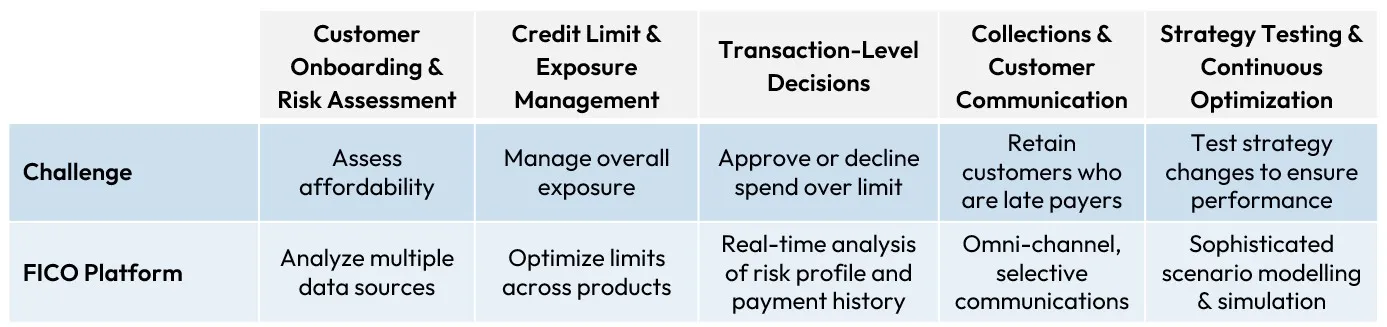
1. Customer Onboarding & Risk Assessment
The Challenge
Globally, many lenders now need to perform upfront affordability checks to ensure customers can repay their purchases, and mitigate the potential for unsustainable debt. This can be a challenge, especially as many BNPL customers are younger with limited credit histories. Having access to additional data sources such as transactional data, open finance data and other BNPL data alongside traditional sources such as spend and payment history will help to make more informed decisions.
How FICO Platform Solves It
FICO Platform transforms risk assessment by integrating multiple data sources into real-time scoring models. When a customer makes a purchase, the platform scans the card authorization and instantly evaluates their eligibility based on performance data from other products, BNPL activity, transactional data, etc. This comprehensive approach enables lenders to offer BNPL options through FICO® Platform – Omni-Channel Engagement Capability to qualified customers at the point of sale, turning a standard card transaction into a personalized installment opportunity with a simple "yes" from the customer.
The platform's ability to incorporate alternative data sources means lenders can confidently serve customers such as those with thin credit files while maintaining sound risk practices and regulatory compliance.
2. Credit Limit & Exposure Management
The Challenge
The total amount of credit a customer can access is unknown to them, but BNPL providers will determine a spending limit that matches their risk tolerance. With emerging credit regulations and responsible lending standards, providers will need to continuously assess a customer’s affordability and credit readiness, ensuring they are not already overindebted when taking out new payment options.
Managing the overall exposure for a customer, across products internally and externally to the provider, is essential for controlling any future risk but also for assessing opportunities to provide more borrowing options.
How FICO Platform Solves It
FICO Platform’s optimization capability revolutionizes limit management by creating intelligent strategies that adapt to each customer's evolving profile. The platform establishes affordability by combining customer-provided information with existing account performance and third-party credit data.
The system continuously evaluates whether customers can handle additional exposure, ensuring that limit expansion aligns with their demonstrated ability to repay while maximizing the lender's profitability opportunities.
3. Transaction-Level Decision Making
The Challenge
When customers approach their available spending limit, lenders face a critical decision point. Automatically declining all transactions protects against risk but sacrifices revenue from creditworthy customers who could safely handle additional exposure.
How FICO Platform Solves It
The platform enables hyper-personalized transaction decisions by analyzing each customer's unique risk profile and payment history. Rather than applying blanket rules, the system identifies low-risk customers who can safely transact above standard thresholds. This sophisticated approach allows lenders to say "yes" more often to the right customers, capturing additional revenue while maintaining disciplined risk management.
The real-time decisioning capability ensures these personalized treatments happen instantly, preserving the seamless customer experience that BNPL users expect.
4. Collections & Customer Communication
The Challenge
Effective BNPL collections require a delicate balance between payment recovery and customer retention. Traditional collection strategies can be aggressive and damage the customer relationship and harm the brand, while overly passive approaches lead to mounting delinquencies. The key is identifying which customers need intervention and delivering the right message through their preferred communication channel.
How FICO Platform Solves It
FICO® Platform – Omni-Channel Engagement Capability transforms collections into a customer-centric process that recognizes most customers will self-cure with minimal intervention. Omni-Channel Engagement Capability adapts to each customer's changing circumstances and communication preferences in the determination of the best channel, timing, and messaging. Some customers respond well to automated SMS reminders, others prefer in-app notifications, while those experiencing financial hardship benefit from a direct conversation with support representatives.
The system dynamically adjusts its approach as customer situations evolve. For instance, if a new customer behavior is observed, Omni-Channel Engagement Capability recognizes new behavior and adjusts subsequent communications accordingly. This intelligent orchestration maintains effective strategies while ensuring timely intervention when needed.
5. Strategy Testing & Continuous Optimization
The Challenge
BNPL programs generate vast amounts of performance data, but translating insights into improved strategies requires sophisticated testing capabilities. Teams must understand which customers are likely to take out BNPL offers and repay on time. They also need to understand which elements of their collections processes work effectively. Testing this, along with changes to risk criteria or marketing strategies, before deploying modifications into live systems is critical.
How FICO Platform Solves It
FICO Business Outcome Simulator empowers teams to move beyond reactive analysis to proactive strategy optimization. The platform enables comprehensive testing of proposed changes through sophisticated scenario modelling, allowing teams to explore "what-if" situations before committing resources.
This capability proves particularly valuable when delinquency trends emerge, helping teams determine whether the solution lies in collections strategy adjustments or whether the underlying issue is with the data and rules used to accept the BNPL in the first place. The result is continuous improvement based on data-driven insights rather than intuition.
The Integrated Advantage for Managing BNPL Risk
The true power of the FICO Platform lies in its integrated approach. Each component feeds insights to others, creating a learning system that becomes more effective over time. Risk assessment improves based on collections outcomes, spending limit strategies evolve based on customer behavior patterns, and communication approaches refine based on response data.
This integration ensures consistent customer treatment throughout their journey while maintaining the flexibility to adapt to changing market conditions, tightening credit laws, and regulatory priorities.
Conclusion: Building Sustainable BNPL Success
The BNPL market's explosive growth presents tremendous opportunities, but sustainable success requires more than just quick deployment. FICO Platform provides the sophisticated infrastructure necessary to capture market opportunities while building the risk discipline and customer relationships that drive long-term profitability.
How FICO Can Improve the Success of Your BNPL Program
Ready to transform your BNPL program from a simple payment option into a competitive advantage? FICO Platform delivers the integrated capabilities that turn BNPL challenges into growth opportunities.

Popular Posts

Average U.S. FICO® Score at 716, Indicating Improvement in Consumer Credit Behaviors Despite Pandemic
The FICO Score is a broad-based, independent standard measure of credit risk
Read more
The GSE Data Is Public. Here's What It Shows About Credit Score Modernization.
Independent Milliman analysis of GSE historical data confirms what anyone can now verify directly: FICO® Score 10T is the most predictive score.
Read more
FICO® Score High Achievers: Is Age the Only Factor?
<p>FICO’s latest research on <a href="http://www.fico.com/en/blogs/risk-compliance/us-credit-quality-rising-the-beat-goes-on/" target="_blank">national FICO® Score distribution</a> shows that US credit quality continues to trend upwards, with an increasing number of consumers scoring in the highest scores ranges. Given that, we decided it was time to refresh our study on “<a href="http://www.fico.com/en/blogs/risk-compliance/infographic-what-does-a-high-credit-scorer-look-like/" target="_blank">FICO® Score high achievers</a>,” where we examine the credit behavioural profiles of consumers with higher credit scores.</p> <p>As expected, our latest study showed that older people generally have higher scores, as has been the case in our <a href="http://www.fico.com/en/blogs/risk-compliance/age-before-beauty-credit-worthiness-before-youth/" target="_blank">past research</a>. This is largely because they have trade lines that have been open longer, which leads to higher scores (assuming the trade lines are in good standing and all other things equal). The most credit savvy among you will remember that length of credit history accounts for roughly 15% of the overall <a href="http://www.myfico.com/CreditEducation/WhatsInYourScore.aspx" target="_blank">FICO® Score calculation</a>.</p> <p>But for younger consumers, it isn’t too helpful to say, “just wait until you are 50 years old, and that will fix things!” Thus, I decided to dive deeper with our analysis, including looking at the credit behavioural characteristics of younger consumers with high FICO® Scores.</p> <p>In this analysis, I looked at credit characteristics for the two highest score bands, 750-799 and 800-850, which have about 16% and 23% of the population, respectively. I further broke this down by looking at the characteristics of the youngest 15% in each group, which occurs at age 29 for the 750-799 group and 43 for the 800-850. We used FICO<strong>®</strong> Score 9 for our analysis, and examined typical variables of the categories that go into the make-up of the score.</p> <p><a href="http://www.fico.com/en/blogs/wp-content/uploads/2016/10/FICO-Score-High-Achiever-table.png"><img class="alignnone size-full wp-image-29367" src="http://www.fico.com/en/blogs/wp-content/uploads/2016/10/FICO-Score-High-Achiever-table.png" alt="fico-score-high-achiever-table" width="715" height="747" /></a></p> <p>Since there’s a lot to dissect in this chart, I’ll highlight a few findings that struck me: <ul> <li><strong>Credit history.</strong> Higher scores are undoubtedly associated with a longer time on file. What’s striking is the higher average time on file for the 800+ group, both overall and for revolving accounts (the most common trade line). Clearly, it helps to start credit use early in life – but that’s not the sole determining factor for high scoring. The younger cohorts in both the 800+ and 750-799 groups have time on file medians significantly less than their older counterparts.</li> <li><strong>New credit.</strong> High credit scorers do, in fact, pursue new credit. We see little variation in months since last trade line opening and last inquiry among all groups observed.</li> <li><strong>Pay on time.</strong> As you might expect, the further in the past the delinquency, the higher the score – and that’s <u>if</u> a delinquency ever happened. 95% of the 800+ people and 72% of the 750-799 group have never been delinquent, which is a striking contrast to the 57% for the total population. The percentages for the younger groups are even higher, especially so for the 750-799ers. Collection items are also scarce for these high scorers. While 23% of the national population have collection items greater than $99, the figures are only 0.5% for the 800+ group and 3% for the 750-799 group. It is clear that, in conjunction with starting a credit file early, paying on time is a key trait of the FICO® Score high achiever.</li> <li><strong>Balance and utilization.</strong> Finally, we look at how credit is being used, focusing on revolving product use. (Since most people only have one mortgage or one auto loan, variation in instalment product figures is minimal and driven by payment history, which is near perfect for high scorers, as we’ve seen.) FICO® Score high achievers tend to have more open revolving accounts. While the % active trades and utilization are generally lower, by no means do high scorers avoid the use of credit products. What drives the difference here is the amount of <u>available</u> revolving credit utilized. The 800+ group is roughly 1/4 of the national median, both in total and on their highest utilized card; they also have lower balances and more cards<em>. </em>The 750-799 group is more active and higher utilized, but still only at 2/3 of the national figures. The young 750-799 group compensate with lower revolving balances and, as a result, lower utilization, which is in line with what we see for the 800+ group.</li> <li><strong>Benchmarks.</strong> I’d like to point out that while this study provides good benchmarks of the typical credit traits of the FICO® Score high achiever, individual credit profiles will vary widely. And keep in mind that when we sort groups of consumers as a whole by different behaviours, some results may look superficially odd. For example, the 800+ band has a longer median average open account time (128 months) than average revolving months on file (140 months).</li> </ul> So, what do we conclude? A huge takeaway is that high scorers don’t have too much in the way of serious delinquencies and negative public record data.</p> <p>In most respects, the young 800+ people are like their peer group. They really only differ markedly in their shorter credit history and higher non-mortgage balance, both of which are a function of life stage. Our results show that you don’t have to be a credit product hermit; these high scorers have more credit cards. The takeaway is to start credit activity early and maintain well-managed and moderate usage.</p> <p>In many ways, the young 750-799 people are more interesting because their age profile is much younger. Their credit characteristics differ more from their peer group, particularly in terms of length of credit history. They compensate by having almost pristine credit records and lower balances.</p> <p>Ultimately, 39% of US consumers are FICO® Score high achievers, which they accomplish by following common-sense credit practices. It ain’t rocket science!</p>
Read moreTake the next step
Connect with FICO for answers to all your product and solution questions. Interested in becoming a business partner? Contact us to learn more. We look forward to hearing from you.