Debt Collection Strategies: Solve the 6 Toughest Challenges
See how optimization improves your collections treatment strategy, strengthens customer experience in collections and drives long-term profitability


When the pandemic hit, debt collection teams everywhere had to throw out their playbooks and adapt fast. What emerged from that chaos were six persistent challenges that are still keeping collection managers awake at night: how do you get personal with thousands of customers? How do you prove your collections strategy actually adds value to the business? How do you adapt quickly when everything keeps changing? How do you stay on the right side of increasingly complex regulations? And perhaps most importantly, what debt collection strategies will help ensure you collect money without destroying customer relationships?
At FICO, we've found that organizations mastering these challenges don't simply improve recovery rates. They transform collections strategy from a necessary operational burden into a strategic advantage that builds customer loyalty and drives long-term profitability.
Key Takeaways
- Treat customers as individuals, not segments. Broad segmentation cannot match each customer's circumstances. Optimization recommends who should self-cure, who suits self-service, and who needs escalation to a human agent.
- Start with the goal, then see the trade-offs. Set an objective, such as maximizing cure rates, and constraints, such as capacity or contact limits. Optimization searches every possible strategy and shows how cash collected, roll rate, and costs trade off, so you can choose your operating point.
- Adapt required changes within hours. Traditional approaches need weeks of analysis to change course. Business users can adjust strategies from single segments to portfolio-wide policies and see forecasted impact immediately.
- Build compliance and customer experience into the strategy. Contact frequency limits and affordability assessments sit inside the strategy logic. NPS and satisfaction ratings are balanced against recovery, protecting lifetime value.
Why Is Traditional Segmentation Not Enough for a Collections Treatment Strategy?
Traditional segmentation is a valuable first step, but its methods are proving increasingly ineffective. By grouping customers based on risk and expected customer behavior, organizations can move away from a one-size-fits-all model and tailor their approach to broad categories of customers.
With each customer representing a unique combination of circumstances, broad-based segmentation approaches can only go so far. Today’s challenges require more precision. This is where optimization comes in, revealing opportunities that traditional incremental improvements often miss. Industry professionals describe optimization as "helicoptering to the mountaintop rather than taking the slow paths up." Rather than making small adjustments to existing strategies, optimization provides a comprehensive view of all possible strategies and their impacts simultaneously so that organizations can choose the most effective path forward.
Moving from Experience to Science
How Have Collections Treatment Strategies Traditionally Been Built?
The most basic approach relies on seasoned professionals who use their experience to create decision logic. These debt collection strategies produce measurable results but are entirely dependent on individual expertise and difficult to scale systematically.
More sophisticated approaches use scorecards and analytical models to predict customer behavior patterns, typically outperforming experience-based methods. The most advanced traditional method involves creating multiple potential debt collection strategies and testing them in simulation environments. Simulation involves the creation of action-effect models, which predict how customers’ payment behavior will change based on a specific collections treatment strategies. This allows you to estimate the performance of a strategy without taking it to market, and hence helps you get to better performing strategies faster.
How Does Optimization Change Collections Treatment Strategy?
Instead of starting with pre-conceived debt collection strategies, optimization begins with questions: "I want a strategy that maximizes my ‘cure rate’, but it must fulfil certain conditions." The optimization algorithm then searches the entire universe of possible strategies to find the one that meets these constraints whilst achieving optimal performance on the chosen target metric. The strategy becomes the output, not the input.
Leveraging optimization to understand trade-offs to produce a set of strategies:
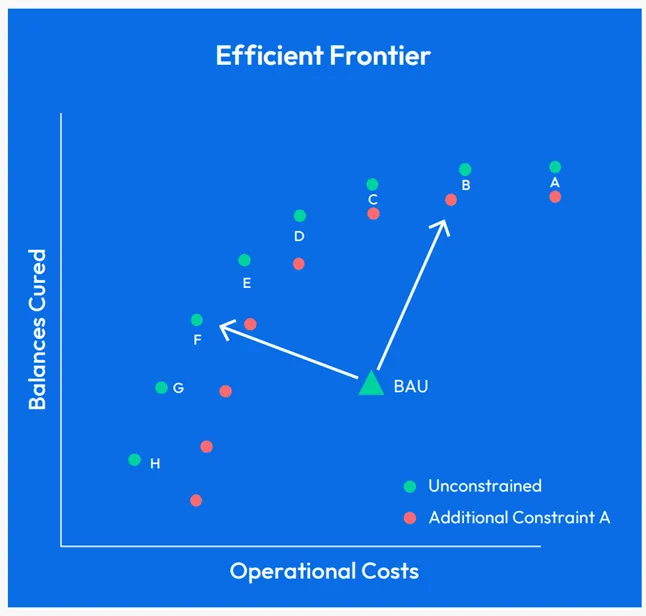
Optimization allows users to quantitatively understand trade-offs between competing targets, such as balances cured and operational costs. In the above chart, each green dot represents an optimal treatment strategy for a given cost budget. Strategy managers can then actively select an appropriate operating point for their organization. If additional constraints are applied (e.g., a channel capacity constraint or an additional mandatory action), the efficient frontier will shift (red dots). This allows you to quantify the costs for individual constraints.
The Six Critical Challenges for Debt Collection Strategies
The six challenges are scale, significance, transparency, speed, compliance, and customer experience.
1. Scale: getting personal with thousands of customers
Collection organizations must provide individualized assistance to large numbers of customers in different financial circumstances. This requires comprehensive data extending beyond traditional credit scores to include payment history, demographic factors, and economic indicators. In case of financial hardship, employment status, household income and expenditure and other factors become relevant.
Modern debt collection strategies powered by optimization can easily analyze this data to recommend which customers should be allowed to self-cure, who are good candidates for self-service resolution options, and which accounts benefit from human agent intervention. It can identify customers likely to appreciate payment reminders, those who may respond well to behavioral incentives, and those who are good candidates for various forbearance and restructuring options.
2. Significance: proving collections strategy adds real business value
Collections, which until recently was thought of largely as a cost center, is taking on increasing significance within enterprises. It's being recognized as an important form of customer engagement, a potential source of competitive advantage, and a powerful contributor not only to bottom-line savings, but also to top-line revenue growth.
The effectiveness of collection and recovery strategies substantially influences impairment costs, charge-offs and net credit losses and can make a substantial contribution to the organization’s bottom line. In addition, collections strategies are measured on broader business metrics, including customer retention, lifetime value, Net Promoter Scores, and overall performance contribution.
It is also important to note that how organizations treat customers during financial stress can impact future business relationships and customer lifetime value.
Optimization helps organizations create debt collection strategies based on looking at the full picture of what each customer is worth, rather than just outstanding balances. This includes customer probability to pay, likelihood of re-default, propensity to churn, and customer lifetime value projections.
3. Transparency: Understand trade-offs between competing targets
Every strategy manager needs to manage against multiple competing targets. By optimizing one target and constraining others, decision optimization allows you to quantitatively understand trade-offs between competing targets, such as impairment charges, roll rate, cash collected and operational costs. This basically draws a map of the universe of feasible strategies and allows organizations to quantitatively discuss the trade-offs between the most relevant targets, and to deliberately choose the operating point that is most appropriate for the organization. This objectifies discussions between the respective stakeholders, and can completely change the way organizations select their approach. Do we need more collectors to address expected volumes? What is the impact on portfolio performance if we reduce the headcount? Optimization can answer such questions in minutes.
4. Speed: adapting quickly
Economic conditions, customer behavior, regulatory changes, and competitive pressures require rapid adjustments that traditional approaches struggle to accommodate quickly. This can affect company-wide performance.
Optimization increases organizational speed-to-market by allowing business users to modify debt collection strategies at any level, from individual segments to portfolio-wide policies, with immediate visibility of forecasted impacts.
Picture this: it's September, and delinquency volumes have spiked because of overspending on summer holidays. But as traditional approaches to strategy management require weeks of analysis and system changes to adapt the strategy¸ volume fluctuations are typically addressed by dropping scheduled campaigns based on gut feeling. With optimization, the approach can be adjusted almost immediately and based on scientific insight.
Or when 20% of call center staff fall ill during flu season, optimization shows exactly how to adjust debt collection strategies to protect performance with reduced capacity.
5. Compliance: staying on the right side of regulatory changes
Regulatory requirements have shifted focus from maximizing customer payments to treating customers fairly. Reducing impairments and preventing losses remain a key responsibility, but understanding affordability and addressing hardship now receive substantially more attention than a decade ago.
Institutions sampling 5% or 10% of interactions are, by definition, blind to most of what is actually happening in their collections environments.
Optimization enables organizations to embed compliance requirements directly into strategy logic, incorporating regulatory constraints, such as contact frequency limits and mandatory affordability assessments, whilst still optimizing for business objectives. The system ensures high-risk accounts receive appropriate service levels and vulnerable customer segments receive enhanced protection.
6. Customer experience: preserving relationships under stress
How organizations treat customers during financial stress significantly impacts future business relationships. Poor collection experiences can permanently damage relationships, affecting future product uptake and referral behavior. Done thoughtfully, however, collections interactions can actually strengthen customer relationships by demonstrating that the organization supports customers during their most challenging moments.
Optimization enables organizations to balance recovery objectives with customer experience metrics, incorporating Net Promoter Scores and satisfaction ratings alongside traditional recovery metrics.
How Does Collections Optimization Work?
Unlike traditional methods that require creating a strategy first and then testing it, optimization takes a fundamentally different approach. It works in three steps:
- Define objectives. It starts with defining primary objectives (such as maximizing cure rates). The objective can also be an alternative portfolio target, for example minimizing end-of-month balances versus minimizing roll rates.
- Set constraints. It sets operational constraints (such as capacity limitations or contact frequency limits). Constraints can also include cost budgets and policy rules, as well as regulatory requirements such as mandatory affordability assessments.
- Search for the optimal solution. It then searches through all possible debt collection strategies to find the optimal solution. Based on action-effect models that predict customer behavior in response to a collection treatment, optimization solvers find the best treatment for each account, distributing available resources optimally across the entire portfolio. This enables organizations to find the right operating point, understanding exactly how staffing decisions impact the trade-off between operational costs and recovery performance.
Think of it like having a crystal ball that can predict how each customer will respond to different approaches. Should you offer John a payment plan immediately or wait a few days? Should you offer Sarah a short payment extension now, or a longer payment plan she is most likely to keep? The system uses models that predict how customers will respond to different approaches to match each customer with the treatment most likely to work, whilst making sure organizations are not wasting resources on approaches that probably won't pay off. The output is an explainable, transparent, scientifically justified strategy that can be put into practice and tested alongside traditionally developed approaches.
How Is Collections Optimization Implemented?
The power of optimization lies in its practical accessibility. Implementation follows a three-phase process: analytics and configuration (requiring analytic expertise), strategy generation (managed by business users), and deployment (standard decision logic implementation requiring no changes to existing operational systems).
The Path Forward
It’s time for organizations to move beyond guesswork to a scientific approach that adapts to specific circumstances, constraints, and goals. That's the power of optimization, turning debt collection strategies from a necessary burden into a strategic advantage that actually strengthens customer relationships whilst improving recovery rates.
How FICO® Platform Can Advance Your Digital Debt Collection Strategies
- Download this white paper to learn how to boost your debt collections performance with FICO Platform and bring the same results to your portfolio.
- Reaching thousands of customers on the channels they prefer is now a baseline expectation in collections, yet many teams still depend on call center capacity. A coordinated omni-channel approach supports self-service, relieves agent workload and improves the customer experience during financial stress. Download the white paper to understand the power and promise of omnichannel communications and how to apply it to your collections strategy.
- Moving from phone-led outreach to digital-first collections can increase payment rates, shorten loan resolution time and lower operating costs. A North American financial services company achieved this through personalized outreach via SMS, email and self-service tools. Read the case study to see how digital-first, personalized collections can improve borrower engagement across your portfolio.
Note: This is an update of a post from 2025.
Frequently Asked Questions
Lenders reduce re-default risk by predicting how likely each customer is to default on a modified plan before offering it. For payment plan modifications, understanding affordability and the likelihood to default on a modified plan is essential. In late collections, optimization can predict propensity and time of re-default for different forbearance solutions, which supports sustainable restructure strategies and clarifies trade-offs between revenue, impairment, and credit loss targets.
Early-stage collections work best when effort is focused where it changes the outcome. In early collections, most customers pay within a couple of days when nudged by a friendly reminder, such as a text message. Customers under financial stress should be spoken to sooner rather than later, so accounts do not roll to later stages of delinquency. Ideally, minimal operational effort goes to customers likely to pay, so agent time is reserved for cases where intervention makes a difference.
Optimization is projected to reduce losses and operating expenses at the same time. The financial services arm of a leading auto manufacturer uses optimization to automatically assign treatments that minimize losses, while meeting staffing constraints that change from month to month. The projected result of these shifts in collections and recovery spending and treatment is a 5% reduction in losses with a simultaneous 5% reduction in operating expenses.
Lenders improve customer experience by giving customers control and discretion. Customers experiencing financial stress expect to engage on their own terms, with control over timing and channel and discretion in sensitive situations. The practical approach is a calibrated hybrid, where digital channels provide accessibility, speed, and privacy, while human touchpoints remain available where empathy, judgment, or reassurance are required.
Treatment intensity should match each customer's needs. Some customers self-cure with minimal contact, others need early outreach and flexible payment options to prevent escalation, and a smaller group requires intensive case management. Applying a uniform strategy across this range produces suboptimal recovery, generates unnecessary cost, and creates friction for customers who did not need it.
Popular Posts

Average U.S. FICO® Score at 716, Indicating Improvement in Consumer Credit Behaviors Despite Pandemic
The FICO Score is a broad-based, independent standard measure of credit risk
Read more
The GSE Data Is Public. Here's What It Shows About Credit Score Modernization.
Independent Milliman analysis of GSE historical data confirms what anyone can now verify directly: FICO® Score 10T is the most predictive score.
Read more
FICO Statement on FHFA and FHA Updates to Credit Score Modernization
FICO supports FHFA’s announcement that the long-anticipated historical data for FICO® Score 10T will be released to the mortgage market.
Read moreTake the next step
Connect with FICO for answers to all your product and solution questions. Interested in becoming a business partner? Contact us to learn more. We look forward to hearing from you.