Loan Origination Automation: Faster Approvals, Reduced Risk
Up to 1 in 5 applicants abandon slow applications. See how AI-driven loan origination automation delivers faster decisions and approvals with less risk.

Loan origination automation has become a defining priority for lenders. The pressure to modernize is relentless: borrowers expect fast, digital-first approvals, while credit and risk leaders must safeguard against dishonesty and fraud. The traditional, form-heavy approach to origination built on paperwork, manual reviews, and redundant questions can no longer keep pace.
Those who embrace automation are discovering that it delivers more than efficiency gains. It reshapes the lending journey, making it faster, more secure, and far less frustrating for the customer, while giving institutions the confidence that risk is being managed in real time. AI-driven decisioning, advanced analytics, and real-time data integrations make this possible across every step of the origination process, from application to approval.
Key Takeaways
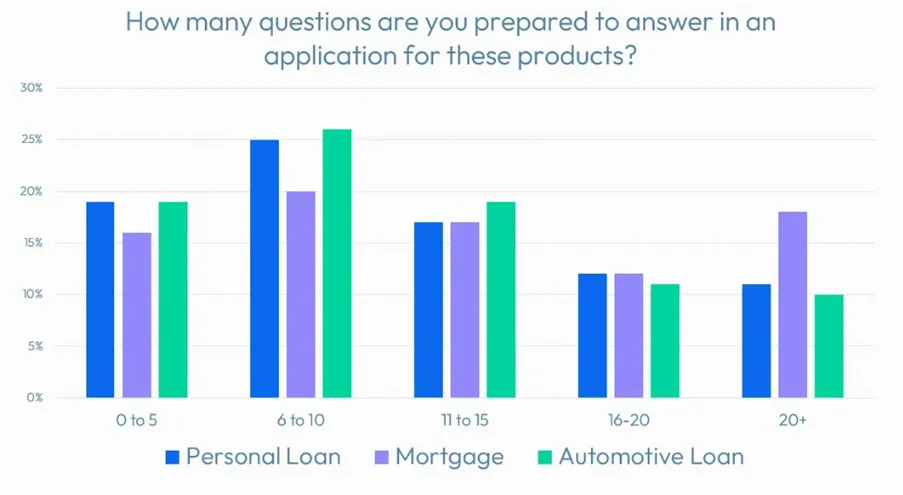
- Friction drives abandonment. Up to one in five applicants abandon a loan application when the process feels too complex, and nearly half will not tolerate more than ten questions.
- Speed sets the benchmark. Most borrowers expect to finish origination in under an hour, and many expect a decision in 30 minutes or less.
- Security should be invisible. Identity verification and fraud detection can run in the background, protecting lenders without adding visible friction for good borrowers.
- Automation lowers costs. Intelligent routing reserves underwriters for cases that need human judgment, while straightforward applications are processed end-to-end by automated systems.
- AI speeds decisions and keeps risk in check. Qualified borrowers can receive instant approvals in under 3 minutes, backed by audit trails, real-time model monitoring, and bias detection and fairness testing.
How Are Borrower Expectations Changing in Loan Origination?
Recent survey data from 1,000 American adults reveals just how sharp the disconnect has become between consumer expectations and traditional origination practices.
Why Do Borrowers Abandon Loan Applications?
Borrowers abandon when an application asks too many questions or when identity checks feel too difficult or time-consuming. Nearly half of borrowers say they will not tolerate more than ten questions in an application. This was part of a project surveying approximately 18,000 consumers in 18 countries.
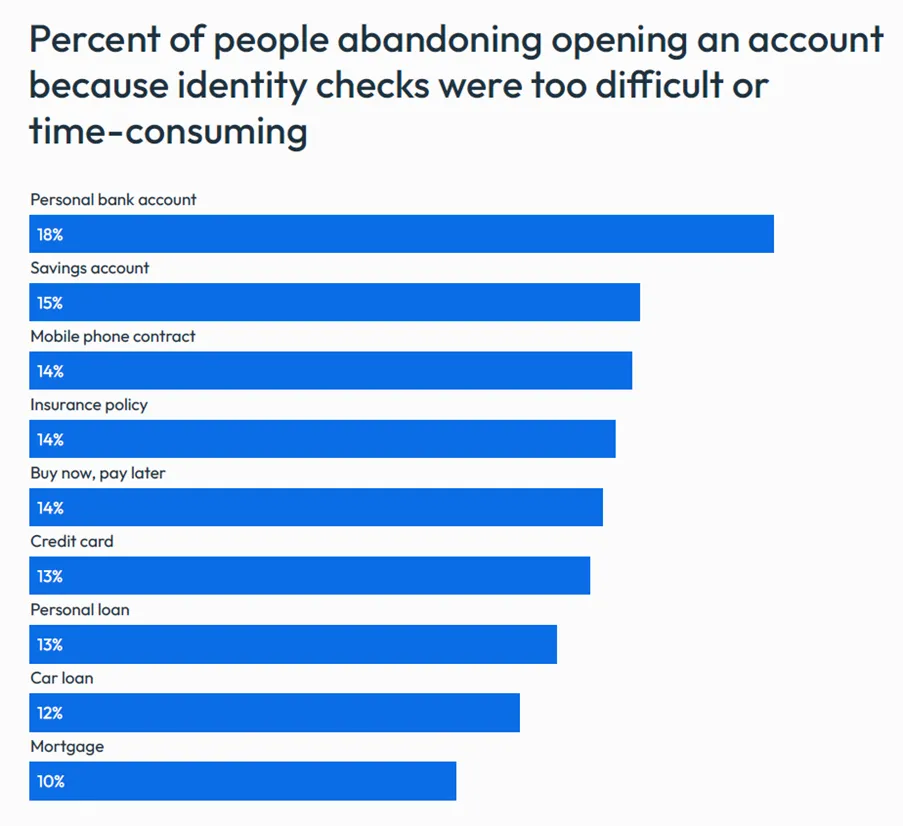
In the same survey, nearly 20% of UK consumers said they had abandoned credit and insurance applications because there were too many questions. Results were similar for other countries. In the U.S., identity checks that are too difficult or time-consuming can drive customers away: 24% will abandon the process of opening a checking account if it becomes too burdensome. In fact, up to one in five applicants abandon their loan application when the process feels too complex.
What is perhaps more unsettling is that a significant share of consumers worldwide said they believe it is acceptable, even normal, to misrepresent information on a loan application. This creates a difficult reality for lenders. On the one hand, they cannot afford to ignore dishonesty in the origination process. On the other, attempts to tighten controls by adding steps or documents often backfire, driving away good borrowers who refuse to endure lengthy forms.
Consumers are also clear about timing. Most expect to complete the origination process in less than an hour. Many expect a decision in 30 minutes or less, and for personal loans, some even set the bar at 10 minutes. Anything beyond that threshold is now uncompetitive.
These insights highlight the urgency of loan origination automation. By using technology to streamline applications, prefill known data, and dynamically adapt questions based on risk, lenders can meet rising consumer expectations without compromising control.
Why Is Loan Origination Automation Now Essential?
For decades, the instinct in credit risk management was to add more steps. More documents, more reviews, more manual oversight. But each new requirement adds friction. And in today’s digital-first market, friction no longer just delays decisions, it causes borrowers to abandon applications entirely.
What Does Failing to Automate Cost Lenders?
The cost of failing to automate is not just lost business; it is also operational strain. Manual origination processes consume enormous amounts of staff time, often tying skilled underwriters to routine cases that could be handled automatically. This misallocation of talent creates inefficiencies and raises costs. Maintaining separate systems for credit decisioning, fraud detection, identity verification and compliance monitoring is financially unsustainable as volumes grow and regulations multiply.
Automation changes this in three ways:
- Automation ensures valuable staff resources are reserved for the cases that genuinely require human judgment.
- Intelligent routing directs complex or high-risk applications to experts, while straightforward applications are processed end-to-end by automated systems. At UnionBank, this automated 30–40% of credit decisioning processes, minimizing manual interventions and errors.
- At the same time, multi-channel automated engagement strategies (including SMS, email, and in-app updates) can collect missing information, guide customers through the process, and keep them informed, all without increasing staff workload.
In short, automation lowers costs while improving both efficiency and customer experience.
How Does Loan Origination Automation Change the Equation?
Loan origination automation changes the equation for lenders. Instead of forcing the borrower to provide endless documentation, automation draws on existing data, validates it instantly, and pushes the decision process forward. Instead of human underwriters slowing the process with manual reviews, AI-powered decisioning models flag anomalies, validate identity, and issue approvals in real time.
AU Small Finance Bank, for example, cut turnaround time from two days to 20 seconds for 25% of customers using FICO® Platform. Instead of treating abandonment as a sales issue, institutions can now see it for what it is: a risk issue, where prime, low-risk borrowers are being lost to faster, more automated competitors.
As mentioned in our Originations in Banking ebook, the gap is stark: critical loan decisions are often trapped in systems that take 3-7 days to process what should be instant approvals, while fintech lenders are approving qualified borrowers in under 5 minutes.
Automation is not just a tool to reduce costs. It is the foundation of a new competitive reality in which speed, transparency, and convenience define success.
How Can Lenders Address Fraud Without Adding Friction?
Lenders can address fraud without adding friction by running identity verification and fraud detection automatically in the background of the origination workflow.
Of course, speed alone is not enough. Fraud and identity risk remain among the greatest challenges in origination, and lenders cannot afford to lower their guard. Yet survey results confirm that complex fraud checks are a major driver of abandonment: 16% of borrowers walk away from auto loans when identity verification feels too complicated, and 20% abandon personal loans for the same reason.
Here again, automation provides the solution. Advanced digital identity tools allow verification to happen invisibly in the background, validating information against real-time data sources without burdening the applicant. Fraud detection models, fueled by behavioral analytics, can flag suspicious patterns without interrupting the majority of borrowers who are acting in good faith.
By embedding these automated controls into the workflow, lenders can strike the balance consumers demand: security without visible friction. Fraud protection should be a core part of customer onboarding, not a separate process. About 32% of U.S. consumers rank good fraud protection as their number one consideration when selecting a new financial account, and 75% would not abandon an application due to identity checks, showing that it is high value for customers.
The Broader Case for Loan Origination Automation
Several market dynamics make automation an urgent priority. Fraud pressures are rising, as synthetic identities and digital scams become more sophisticated. In the U.S., another rising concern among consumers is being tricked by a fraudster to send funds. Operational costs are under scrutiny, and large manual underwriting teams are increasingly unsustainable. Consumers have little patience for delays and now equate fast, simple origination with trust in the institution. Regulators, meanwhile, are demanding more consistency and explainability in credit decisions, something automation can deliver far more reliably than manual processes.
Taken together, these forces point in one direction: automation is not a “nice to have.” It is the backbone of sustainable lending.
Loan Origination Automation in Action: Customer Case Studies
FICO® originations solutions have demonstrated their success across multiple countries and regulatory environments. The following lenders show how those results come together across different markets and portfolios.
Nationwide Building Society
The UK's third-largest mortgage provider and the world's biggest building society moved to centralized decisioning with FICO® Platform, unifying decision-making processes across mortgages, loans, and cards for consistent application of policies and strategies. The result was 50% faster policy changes, real-time credit limit increases, and the successful migration of five products in 12 months.
Mibanco
Latin America's largest microfinance bank implemented FICO® Platform with decisioning and analytics and machine learning capabilities. It achieved a 90% reduction in new credit policy production time and a 20% reduction in IT development expenditure, and can now offer better lending access to thousands of thin-file customers in Peru.
PicPay
PicPay moved from siloed legacy systems to an enterprise platform that supports a comprehensive 360° customer view and puts strategy in the hands of the business team. The outcome was a 10% surge in loan approvals, a decrease in time to market, and readiness to scale using real-time data.
Trust Bank
To launch Singapore's first digitally native bank, Trust Bank needed to scale rapidly, meet aggressive origination targets, and control risk, all with a seamless digital experience. It exceeded its launch origination goals, maintained its risk appetite despite rapid growth, and dynamically adjusted rules in near real time. Trust acquired 100,000 customers in just 10 days and exceeded 450,000 customers in five months, with over 90% of customers onboarded straight through with no manual intervention.
Bradesco
Bradesco used FICO® Originations Solution to achieve a 22% boost in digital revenue from rapid onboarding, a 20% improvement in cross-sell conversions, and top-tier customer satisfaction scores (NPS +15 pts).
The Future of Originations
The lending market is at a paradoxical crossroads. Borrowers want faster, simpler origination, yet credit risk and fraud remain entrenched realities. Manual processes cannot resolve this tension. Loan origination automation can. By embedding intelligence, analytics, and verification into every step of the borrower journey, lenders can deliver instant, digital-first decisions without sacrificing risk control. With as many as one in five applications abandoned due to friction, and most consumers unwilling to wait more than an hour for approval, the institutions that embrace automation will not just survive, they will thrive.
How FICO Helps Lenders Automate Loan Originations
FICO® Platform is designed to help lenders achieve end-to-end loan origination automation. It brings together AI-driven decisioning, advanced analytics, and real-time data integrations to create a seamless, consistent experience across every channel. Fraud and identity verification run invisibly in the background, while personalized risk assessments ensure that each borrower receives a fair and explainable decision.
For CROs and heads of credit risk, FICO provides the agility to adapt origination strategies quickly, improve approval rates, and strengthen portfolio quality. More importantly, it allows institutions to meet rising consumer expectations for speed and simplicity — without ever losing sight of risk.
FICO® Platform provides lenders with the technology foundation to scale and modernize their loan originations process. By unifying advanced decisioning, AI-driven analytics, and real-time data integration, FICO platform allows organizations to automate key parts of the origination journey from identity verification and fraud detection to credit scoring and personalized risk assessment. This not only reduces friction for legitimate borrowers but also enhances control for risk leaders, ensuring consistent, explainable decisions across channels. For CROs and Heads of Credit Risk, FICO Platform delivers the agility to adapt origination strategies quickly, improve approval rates, and strengthen portfolio quality while meeting consumer expectations for speed and simplicity.
Learn More About How FICO Can Help You with Loan Origination
- Application fraud arrives from two directions. 12.3% of American respondents report that their stolen identity was used to open a financial account, which could translate to over 32 million people, and up to a third of Americans find exaggerating income on applications either acceptable in some circumstances or normal. Download the 2025 Consumer Survey to benchmark your identity verification and first-party fraud controls against what customers expect.
- 86% of businesses report productivity gains from AI, yet fewer than 8% have implemented GenAI systematically, and 66% are increasing investment but remain stuck at pilots. The institutions that close this execution gap will be those that build AI that is governed, auditable, and built to scale, with humans working inside defined guardrails. Access the Agentic AI imperative infographic to see how governed AI bridges the gap between knowing and doing in lending decisions
- Fragmented systems limit how quickly and consistently lenders can approve. FICO® Platform can replace 8-12 point solutions with one integrated decision platform, and a Forrester Total Economic Impact study found a net present value of $39.58 million over three years for a composite $10 billion organization. Download the Originations for Banking eBook to review the full lender results behind faster approvals and reduced risk.
- First-party fraud accounts for around 10% of the volume of credit losses but more than 20% of the value, and it is often misidentified as bad debt when teams work in silos. Aligning people, process, and technology also protects the more than $644 it costs financial services organizations to acquire a new customer, according to HubSpot. Download the Breaking Down Siloes white paper to find where the gaps in your organization may be.
- One of Canada's largest banks migrated from on-premises decisioning to FICO® Platform in the cloud, cutting change cycles from months to weeks and deploying more than 100 new origination use cases in under six months, with the risk discipline required at enterprise scale. Download the Leading Canadian bank case study to see how it was done without disrupting core origination processes.
Note: This is an update of a post from 2025.
Frequently Asked Questions
Rule-based systems apply fixed logic that analysts must rewrite by hand, while advanced decision platforms lets lenders author, test, and explain decisions with far less manual effort. FICO's solution sheet on moving from a rules engine to intelligent decisioning cites up to 85% faster policy cycles. It also highlights business-user authoring and native explainability, which support faster approvals and audit readiness.
Lenders should prioritize business-user strategy authoring, built-in explainability, and the ability to simulate, test, and compare strategies before going live. FICO's solution sheet cites up to 50% faster strategy rollouts when business users can make changes without heavy IT queues. The 2025 Consumer Survey also points to API-based identity verification and integrated fraud and originations decisioning as capabilities that reduce delays.
Lenders can reduce abandonment by diagnosing where applicants leave, removing redundant requests, and attracting the right customers to begin with. The Breaking Down Siloes white paper identifies timing, redundancy and customer targeting as the main diagnostic areas. It also recommends orchestrating the originations journey end to end, so each step uses data already collected.
A single platform lets lenders run credit and fraud checks in one shared workflow, so an application can be halted before costly third-party checks are triggered. Where workflows remain separate, both checks still happen, and an identity check during a digital interaction can be followed by a duplicate verification in a later fraud check. Fraud protection handled separately from onboarding creates inefficiencies, increases costs, and leads to duplicated efforts that frustrate customers.

Popular Posts

Average U.S. FICO® Score at 716, Indicating Improvement in Consumer Credit Behaviors Despite Pandemic
The FICO Score is a broad-based, independent standard measure of credit risk
Read more
The GSE Data Is Public. Here's What It Shows About Credit Score Modernization.
Independent Milliman analysis of GSE historical data confirms what anyone can now verify directly: FICO® Score 10T is the most predictive score.
Read more
FICO Statement on FHFA and FHA Updates to Credit Score Modernization
FICO supports FHFA’s announcement that the long-anticipated historical data for FICO® Score 10T will be released to the mortgage market.
Read moreTake the next step
Connect with FICO for answers to all your product and solution questions. Interested in becoming a business partner? Contact us to learn more. We look forward to hearing from you.