Customer-Level Decisioning: Achieving Lifetime Loyalty at Hyper Scale
A new approach to customer segmentation and tailored decisioning is needed - discover the three building blocks making personalization maturity possible

For years, the conversation around personalization in financial services has been dominated by two familiar themes: getting the right offer to the right customer, and doing it efficiently enough to justify the investment. These are worthy goals. But they fundamentally understate the commercial opportunity and the competitive threat that is reshaping the industry right now.
The question for financial service leaders responsible for customer growth and retention is no longer “How do we personalize better?” It is “How do we build a loyalty that compounds over time?” Those are very different problems, and they require very different answers.
Key Takeaways
- The cost of inaction is quantifiable, and it's larger than most budget conversations assume. Poor customer experience is a real cost, and the accumulation of small, disconnected interactions is enough to feel “poor”. This isn’t about a discretionary CX upgrade, it's a measurable drag on revenue that leadership can be held accountable for ignoring.
- Segmentation isn't just outdated, it's actively suppressing revenue. A single "Affluent" segment can contain a divorced professional rebuilding their finances, a small business owner with volatile cash flow, a house-hunting couple, and a retiree drawing down savings, all receiving the same offer. Shifting the conversation from a technical modernization to a direct explanation of where money is being left on the table today paints a clear picture for stakeholders.
- You are not alone in feeling the personalization maturity gap. In a recent poll, respondents rated their own personalization above only basic, and a majority said data silos and legacy systems are the most common barriers. Taking action to close the gaps is an opportunity for market leadership.
The $4 Trillion Cost of Getting It Wrong
Let's start with scale. Poor customer experience puts $4 trillion in consumer spending at risk globally each year, and banking is no exception. Customers now carry the same expectations for great experiences into their financial relationships that they've come to expect everywhere else. But here's the nuance most leaders miss: retention rarely collapses in one catastrophic failure. It erodes gradually, through the accumulation of thousands of small, unremarkable interactions over time.
Think about what that looks like in practice. A customer applies for a mortgage pre-approval online. The bank’s system flags them as “low engagement” because they have not used the mobile app in three months, ignoring the fact that they had been in branch twice and called the contact center. The follow-up communication drops into a generic batch campaign. Three days later, a competitor sends them a personalized, proactive offer with a named relationship manager and a callback link, because their open banking data flagged the same intent signal. That is not a technology failure. That is a data and decisioning failure. And it is playing out thousands of times a day across the industry.
The flip side is an equally compelling opportunity. Personalization leaders were 48% more likely to exceed revenue goals. That shows that those who can demonstrate relevance down to the individual have an edge in customer-led growth.
Your Segmentation Model May Be Working Against You
Traditional segmentation wasn’t wrong, it was the right tool for its era. When interactions were primarily branch-based, when data was limited, and when switching required a 30-day process and a trip to the high street, grouping customers into manageable clusters was a reasonable approach to scale.
But within any segment today, you have customers with wildly different behaviors, contexts, financial situations, and intent. The result is compounding failures that carry direct revenue consequences.
First, segments are often too broad. Customers receive offers that do not reflect their reality, and they feel misunderstood, which quietly accelerates disengagement.
Second, segment-based models are static. By the time a quarterly model refresh has run and a campaign has been built and deployed, the customer’s situation has already changed. The next best action identified is already obsolete. The model is reactive rather than predictive. Organizations are responding to behavior after it has happened, rather than anticipating it and intervening before it is too late.
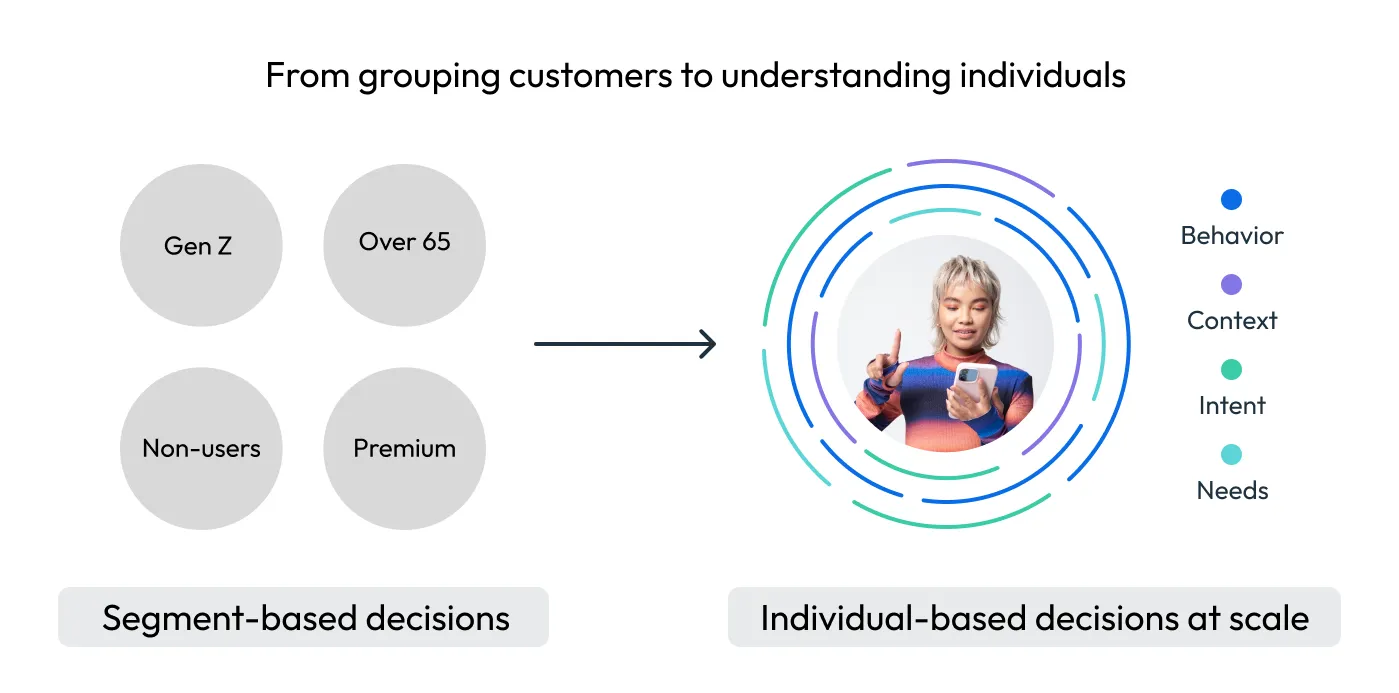
Consider the “Affluent” segment at a typical bank. Within that single label, you might have a recently divorced professional rebuilding their finances, a small business owner with volatile cash flows, a dual-income couple saving for their first home, and a retiree managing drawdown from accumulated wealth. Same segment label, completely different needs, contexts, and appropriate next actions. The label does not just fail to capture that nuance. It actively prevents you from acting on it.
True Personalization: A Commercial Strategy, Not Just a CX Nicety
The shift that is separating the leaders from the rest is the move from 50 broad segments to 50,000 individual customer profiles, or whatever the size of your customer base demands. Every interaction is shaped by what you know about that specific individual at that specific moment.
This is not about building 50,000 separate models or writing 50,000 different rule sets. It means building a system sophisticated enough to make individual-level decisions at scale, automatically, in real time, and continuously improving. And here is the key commercial insight: when interactions become more relevant, engagement increases. When engagement increases, product uptake increases. When product uptake increases, lifetime value increases. Relevance is a growth strategy, not just a CX nicety.
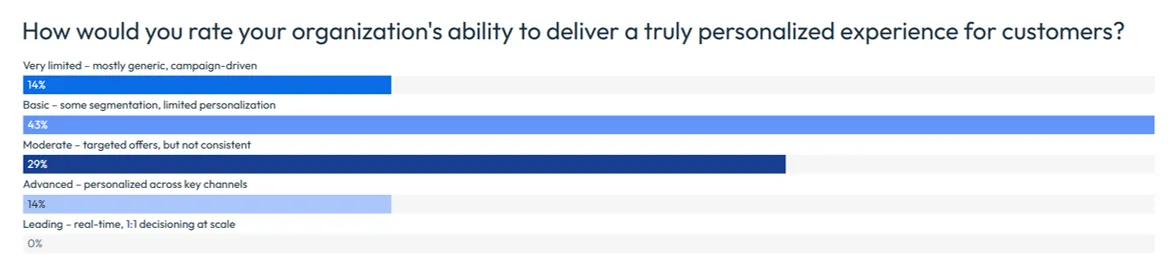
This level of hyper-personalization still eludes most organizations. In a recent informal poll conducted at our FICO World conference, 43% of respondents rated their organization's ability to deliver a truly personalized experience for customers as “only basic: some segmentation but limited personalization”.
When asked about barriers they face in building stand-out customer experiences, 74% responded “data silos” with “legacy systems” not far behind at 68%.
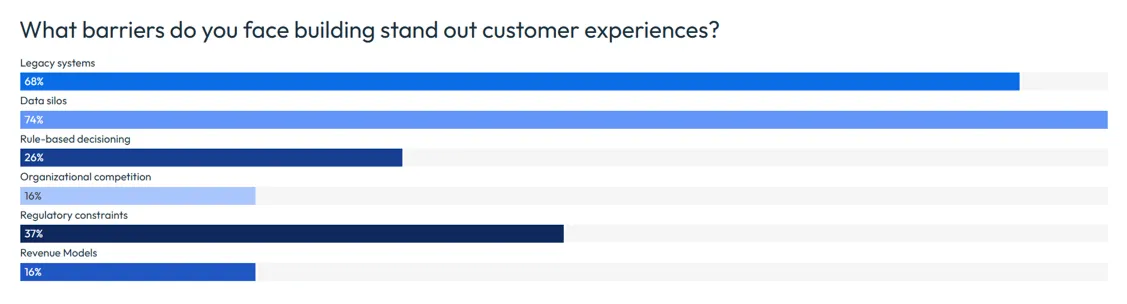
What’s striking when about these results is that they indicate how common the challenges are, and by extension, where you can find opportunity.
The Three Building Blocks Make Personalization Maturity Possible
The ability to finally achieve customer-level decisioning in practice and ACT on it credibly rests on interconnected capabilities working together to deliver:
Dynamic Customer Profiles
Most customer profiles are static snapshots updated overnight in a batch process. They represent where a customer was, not where they are. In a world where customer intent can shift within hours, that lag is critical. A truly dynamic profile is a living, breathing view of the customer that evolves with every single interaction, synthesizing CRM data, transactional data, digital behavior, and service interactions simultaneously.
Consider a customer who reduces their direct debit, stops logging into the mobile app, and raises a complaint within the same week. Individually, each signal might look like noise. Together, they are a clear early warning of churn. A static profile misses it entirely. A dynamic profile catches it in real time and triggers an intervention before the customer has made the decision to leave.
A Decision Engine That Arbitrates, Not Just Recommends
The decision engine evaluates hundreds of signals simultaneously, including churn propensity, lifetime value, recent complaints, signs of financial stress, and product intent. Crucially, it arbitrates between competing possible actions to find the single best one.
Imagine a customer who has just been flagged as high churn risk. In the traditional model, the marketing team might still be pushing a cross-sell campaign to that customer, because they meet the eligibility criteria for a new product. The right action is not to cross-sell. It is to recognize that this customer’s relationship is at risk and to deliver a proactive retention gesture, something that shows you understand them as an individual and value their relationship.
Without arbitration, different parts of the business send competing messages. That inconsistency erodes exactly the trust you are trying to build.
Continuous Learning Loops
This is what separates truly intelligent decisioning from a sophisticated rules system. Every outcome feeds back into the system. Did the retention offer result in the customer staying? Did the personalized onboarding path lead to a second product? Did the early churn intervention reverse the decline in engagement? That signal is used to continuously refine the model at the individual customer level, not in aggregate in a quarterly refresh.
The system gets progressively better at understanding what retains your customers, in your specific market, at this specific moment in time. It identifies which interventions work for which customer profiles. It learns when customers are most receptive to engagement. And it detects new churn patterns as they emerge and adapts accordingly, without waiting for a human to notice the trend. This is how the loyalty engine compounds over time.
What Always-On Decisioning Looks Like Across Every Touchpoint
Understanding what to do is one thing. Delivering it consistently, at scale, across the entire organization is the real challenge. The architecture that makes this work has three layers.
On the data side, customer information distributed across CDPs, core systems, and interaction channels is unified into the dynamic profiles. In the middle, real-time decisioning acts as the control layer, connecting those profiles to next best actions and balancing value, risk, and customer needs. On the execution side, decisions are delivered consistently across mobile, web, branch, and contact center, so the customer receives a coherent experience regardless of how they choose to interact.
This decisioning manifests differently across channels in ways that are worth making explicit.
- Serve relevant product recommendations based on a specific visitor’s website actions.
- In your mobile app, a customer who just made a large transfer sees something completely different from a customer who just missed a payment.
- In the branch, advisors are equipped with fast, explainable recommendations and loyalty recognition triggers, so every human conversation is informed by everything the system knows.
- In the call center, customer intent is assessed before the conversation begins, guiding resolution and offer optimization.
- In digital marketing, offer suppression, frequency capping, and fatigue management ensure you are not bombarding customers with communications that erode the relationship rather than build it.
Performance Benchmarks that Matter
For executives who need to translate this into a board-level conversation, the value benchmarks from organizations operating at best-in-class levels of always-on decisioning are significant. McKinsey reports that banks implementing customer value management engines — with enterprise decisioning, customer data, and always-on marketing capabilities — have increased customer engagement by 20–30 percentage points and customer value by 10–25%.
I’m seeing uplift in cross-sell and upsell acceptance rates because offers are relevant, timely, and contextually appropriate. Consistent policy enforcement through automated decisioning is driving reduction in risk losses. Communications are becoming far more targeted with reduction in irrelevant outreach, protecting customer trust and reducing marketing waste simultaneously. Real-time actions are driving improved conversion rates. And the ability to continuously optimize without waiting for manual campaign cycles is dramatically accelerating speed to market.
One leading North American bank implemented this approach and shifted from broad-based segment campaigns with low engagement and increasing churn to a model with real-time customer profiles incorporating CRM, interaction, and transactional data, with individual-level propensity modeling continuously evaluating the next best action. The results were a 23% increase in customer retention, three times the number of products per customer, and 67% faster onboarding through personalized, dynamic onboarding paths.
Where Growth Leaders Should Start
The most important message here is deliberately simple: you do not need more data. You need to act on the data you already have, at the moment it matters most. Most organizations are sitting on a wealth of customer intelligence that is either not being used in real time, not being synthesized across silos, or not being translated into action at the individual level. That is where the opportunity lies.
The path forward has three stages. First, assess your current personalization maturity honestly. Review your existing capabilities, identify the gaps, and determine which barriers are most limiting your organization right now. Legacy systems, data silos, rule-based decisioning, competing KPIs, regulatory constraints, and entrenched revenue models are all real obstacles, but they are navigable ones. Second, identify the highest-impact, lowest-complexity use case to start with rather than attempting to transform everything simultaneously. Third, build, test, and learn. Validate in production before scaling, using each iteration to build organizational confidence and prove value quickly.
The organizations pulling away from the competition are not the ones that have solved all of these problems at once. They are the ones that strategically chose a starting point, learned, and expanded over time based on demonstrated success.
How FICO Can Help Improve Customer-Level Decisioning
- FICO® Platform unifies customer data from disconnected CRMs, core systems, and channels into a single profile that updates with every interaction, helping institutions move from siloed segmentation to real-time customer-level decisioning for risk, retention, and growth.
- Decision intelligence platforms are reshaping how banks compete, and analysts agree they're worth the investment. Gartner and IDC both point to unified, AI-powered decisioning as the key to breaking through data silos. Explore what decision intelligence software is and whether you should invest in it.
- The best banks anticipate customer needs rather than react to them. FICO's Next Best Action approach builds a 360-degree view of risk, resilience, and behavior, then delivers proactive, personalized engagement at scale. Download the white paper, Next Best Action in Retail Banking, to learn more.
- A unified customer profile is most valuable if you can act on it across the customer lifecycle. FICO's advanced customer management helps you Nurture & Manage relationships and act in real time.
- Banking leaders have relied on FICO for seventy years to turn customer data into profitable relationships. Explore how FICO's banking solutions apply AI and advanced decisioning across deposits, credit cards, lending, and more.
- Results speak to the scale of the opportunity. Bradesco used FICO® Platform to build a hyper-personalized credit strategy that drove more than 30 million visits a month to its loan menu, with over half of those visitors applying and a conversion rate above 30%, while real-time decisioning lifted digital transactions more than 60%.
- Industry leaders agree on the power of hyper-personalized decisions at a platform level. In this FICO World 26 panel on Decision Intelligence and Dynamic Profiling, leaders from Gartner, Capgemini, Lloyds, and Bradesco discuss how dynamic profiling drives loyalty. If your organization is early in this journey, FICO's team can help identify your biggest gaps and fastest wins.
Frequently Asked Questions
Yes, AI-driven approaches are well suited to churn reduction because they can continuously analyze behavioral and transactional signals, such as declining account activity, reduced product usage, and shifts in spending patterns, that traditional statistical models often miss or catch too late. This allows financial institutions to move from reactive win-back campaigns to proactive retention strategies. They can deliver personalized offers or targeted outreach the moment they are most likely to be effective.
Decisioning platforms combine data, analytics, and business rules to help institutions make more consistent, well-balanced decisions across risk, profitability, and customer experience at scale, which reduces the friction customers often feel when similar requests are handled differently across the business. This consistency builds trust over time. When your decisioning platform can continuously learn from outcomes, the quality of decisions, and therefore customer satisfaction, tends to improve. This creates a positive cycle that supports long-term retention.
Agentic AI can act with a degree of autonomy to pursue a goal, such as improving a customer's experience, across multiple steps and channels rather than producing a single isolated recommendation, allowing it to monitor a customer's journey and proactively coordinate the next best action as needs evolve. This cross-organization awareness helps eliminate the fragmented experience that results when each touchpoint is optimized in isolation, creating a more coherent journey that feels responsive to each customer's evolving financial needs.
Adopting AI broadly offers compounding advantages: operationally it can reduce costs and improve accuracy in areas like underwriting, fraud detection, and compliance, while commercially it enables more precise segmentation, personalization, and pricing that drive both revenue and retention. Perhaps most importantly, institutions that build strong data and AI capabilities create a durable competitive advantage and greater resilience, since their decision-making improves continuously as models learn from more data and adapt to shifting risks and customer expectations, making it progressively harder for slower-moving competitors to catch up.
Adopting FICO Platform with a composable, API-first architecture lets you modernize without ripping and replacing. You can bring in new decisioning capabilities without disrupting what's already running and start with a focused use-case to demonstrate success before expanding.

Popular Posts

Average U.S. FICO® Score at 716, Indicating Improvement in Consumer Credit Behaviors Despite Pandemic
The FICO Score is a broad-based, independent standard measure of credit risk
Read more
The GSE Data Is Public. Here's What It Shows About Credit Score Modernization.
Independent Milliman analysis of GSE historical data confirms what anyone can now verify directly: FICO® Score 10T is the most predictive score.
Read more
FICO® Score High Achievers: Is Age the Only Factor?
<p>FICO’s latest research on <a href="http://www.fico.com/en/blogs/risk-compliance/us-credit-quality-rising-the-beat-goes-on/" target="_blank">national FICO® Score distribution</a> shows that US credit quality continues to trend upwards, with an increasing number of consumers scoring in the highest scores ranges. Given that, we decided it was time to refresh our study on “<a href="http://www.fico.com/en/blogs/risk-compliance/infographic-what-does-a-high-credit-scorer-look-like/" target="_blank">FICO® Score high achievers</a>,” where we examine the credit behavioural profiles of consumers with higher credit scores.</p> <p>As expected, our latest study showed that older people generally have higher scores, as has been the case in our <a href="http://www.fico.com/en/blogs/risk-compliance/age-before-beauty-credit-worthiness-before-youth/" target="_blank">past research</a>. This is largely because they have trade lines that have been open longer, which leads to higher scores (assuming the trade lines are in good standing and all other things equal). The most credit savvy among you will remember that length of credit history accounts for roughly 15% of the overall <a href="http://www.myfico.com/CreditEducation/WhatsInYourScore.aspx" target="_blank">FICO® Score calculation</a>.</p> <p>But for younger consumers, it isn’t too helpful to say, “just wait until you are 50 years old, and that will fix things!” Thus, I decided to dive deeper with our analysis, including looking at the credit behavioural characteristics of younger consumers with high FICO® Scores.</p> <p>In this analysis, I looked at credit characteristics for the two highest score bands, 750-799 and 800-850, which have about 16% and 23% of the population, respectively. I further broke this down by looking at the characteristics of the youngest 15% in each group, which occurs at age 29 for the 750-799 group and 43 for the 800-850. We used FICO<strong>®</strong> Score 9 for our analysis, and examined typical variables of the categories that go into the make-up of the score.</p> <p><a href="http://www.fico.com/en/blogs/wp-content/uploads/2016/10/FICO-Score-High-Achiever-table.png"><img class="alignnone size-full wp-image-29367" src="http://www.fico.com/en/blogs/wp-content/uploads/2016/10/FICO-Score-High-Achiever-table.png" alt="fico-score-high-achiever-table" width="715" height="747" /></a></p> <p>Since there’s a lot to dissect in this chart, I’ll highlight a few findings that struck me: <ul> <li><strong>Credit history.</strong> Higher scores are undoubtedly associated with a longer time on file. What’s striking is the higher average time on file for the 800+ group, both overall and for revolving accounts (the most common trade line). Clearly, it helps to start credit use early in life – but that’s not the sole determining factor for high scoring. The younger cohorts in both the 800+ and 750-799 groups have time on file medians significantly less than their older counterparts.</li> <li><strong>New credit.</strong> High credit scorers do, in fact, pursue new credit. We see little variation in months since last trade line opening and last inquiry among all groups observed.</li> <li><strong>Pay on time.</strong> As you might expect, the further in the past the delinquency, the higher the score – and that’s <u>if</u> a delinquency ever happened. 95% of the 800+ people and 72% of the 750-799 group have never been delinquent, which is a striking contrast to the 57% for the total population. The percentages for the younger groups are even higher, especially so for the 750-799ers. Collection items are also scarce for these high scorers. While 23% of the national population have collection items greater than $99, the figures are only 0.5% for the 800+ group and 3% for the 750-799 group. It is clear that, in conjunction with starting a credit file early, paying on time is a key trait of the FICO® Score high achiever.</li> <li><strong>Balance and utilization.</strong> Finally, we look at how credit is being used, focusing on revolving product use. (Since most people only have one mortgage or one auto loan, variation in instalment product figures is minimal and driven by payment history, which is near perfect for high scorers, as we’ve seen.) FICO® Score high achievers tend to have more open revolving accounts. While the % active trades and utilization are generally lower, by no means do high scorers avoid the use of credit products. What drives the difference here is the amount of <u>available</u> revolving credit utilized. The 800+ group is roughly 1/4 of the national median, both in total and on their highest utilized card; they also have lower balances and more cards<em>. </em>The 750-799 group is more active and higher utilized, but still only at 2/3 of the national figures. The young 750-799 group compensate with lower revolving balances and, as a result, lower utilization, which is in line with what we see for the 800+ group.</li> <li><strong>Benchmarks.</strong> I’d like to point out that while this study provides good benchmarks of the typical credit traits of the FICO® Score high achiever, individual credit profiles will vary widely. And keep in mind that when we sort groups of consumers as a whole by different behaviours, some results may look superficially odd. For example, the 800+ band has a longer median average open account time (128 months) than average revolving months on file (140 months).</li> </ul> So, what do we conclude? A huge takeaway is that high scorers don’t have too much in the way of serious delinquencies and negative public record data.</p> <p>In most respects, the young 800+ people are like their peer group. They really only differ markedly in their shorter credit history and higher non-mortgage balance, both of which are a function of life stage. Our results show that you don’t have to be a credit product hermit; these high scorers have more credit cards. The takeaway is to start credit activity early and maintain well-managed and moderate usage.</p> <p>In many ways, the young 750-799 people are more interesting because their age profile is much younger. Their credit characteristics differ more from their peer group, particularly in terms of length of credit history. They compensate by having almost pristine credit records and lower balances.</p> <p>Ultimately, 39% of US consumers are FICO® Score high achievers, which they accomplish by following common-sense credit practices. It ain’t rocket science!</p>
Read moreTake the next step
Connect with FICO for answers to all your product and solution questions. Interested in becoming a business partner? Contact us to learn more. We look forward to hearing from you.