First Impressions That Drive Loyalty: Reinventing Customer Acquisition in Real Time
Winning banks are more precise about which customers they target, more intelligent about the data they use to evaluate them, and more adaptive in how they personalize offers

Financial services leaders responsible for growth already understand that the distance between a well-designed acquisition strategy and one that actually performs at scale comes down to execution. The ability to be first in responding to a prospect’s needs is routinely constrained by legacy infrastructure and siloed data that was hardcoded years ago and hasn’t moved since.
Nowhere is this more consequential than in originations. Unlike a first sale in most industries, extending credit to acquire the wrong customer, whether due to inadequate risk assessment or fraud, does not just affect that one account. The cost compounds across risk reserves, operational remediation, and early attrition.
Get origination decisions right, and you create exponential power to increase revenue. Get them wrong, and the repercussions cascade down the expense line through fraud controls, credit risk controls, and operational expense. Every action, from the offer presented to a prospect to the final approval, either compounds your growth or compounds your costs. That calculus applies whether you are onboarding an auto loan, credit card, mortgage, or a small business line of credit.
This post is about what separates institutions that execute well at that moment from those that don't, and where the gaps most commonly appear.
Key Takeaways
- Precision is what turns first impressions at acquisition into loyalty and lifetime value. Winning banks are more specific in targeting, more intelligent about the data used to evaluate them, more adaptive in personalizing offers, and more operationally efficient in moving applicants through to activation. Together, these traits are what convert a single good decision into a loyal, long-term customer relationship.
- The competitive bar has permanently shifted. New entrants without legacy infrastructure, those who can offer seamless digital experiences, and embedded finance players entering through open APIs have reset customer expectations. Lenders are losing deals daily not because of weaker products, but because competitors' offers feel faster, more tailored, and easier to navigate.
- Most acquisition breakdowns trace back to the same root cause: a funnel that fails at the top. Siloed systems struggle to personalize offers in real time and often need third-party data before a credible offer can even be made, while rigid decision logic creates friction that causes applicants to abandon mid-journey.
- Smarter data orchestration drives profitable growth. A well-designed decision flow helps strategically manage spend on third-party validation. This improves unit economics without sacrificing decision quality, and enables multiple tailored offer paths that convert better and retain longer.
- Manual review, done poorly, is an overlooked pitfall. When a rigid "fail one, fail all" policy overloads review queues with cases that don't need human judgment, decisions slow overall and abandonment increases. High-performing institutions reserve manual review for genuinely ambiguous cases and automate the rest — carefully starting with validated use cases so they can expand with confidence.
The Competitive Landscape Has Changed — Permanently
Fintech disruptors, unburdened by legacy infrastructure, are moving fast and meeting consumers exactly where they want to be. Tech giants have reset the bar for seamless digital experience. Embedded finance is opening the door for entirely new competitors entering banking through open APIs.
But competitive pressure alone doesn't tell the full story of what's at stake. Every acquisition decision has a downstream effect on profitability, not just volume. Winning the wrong customer at scale is as damaging as losing the right one. When offers attract disproportionately high-risk applicants or fraud slips through at originations, the cost compounds across credit risk reserves, operational remediation, and early attrition. A growth strategy built on volume without precision quickly becomes a liability. In a recent FICO World conference in-session poll, attendees identified “attracting and converting credit worthy prospects” and “balancing speed and accuracy in the decisioning process” as the top two issues when asked what the biggest challenge in new customer acquisition their organization faced.
For most lenders, the root of both problems is the same: a funnel that breaks down at the top end. At the attraction stage, legacy systems struggle to personalize offers in real time. Data is limited, and qualification data typically needs to be sourced from third parties before a credible offer can be made. At onboarding, rigid decision logic creates friction that costs you applicants mid-journey. That means deals lost every single day, not to a superior product, but to competitors whose offers feel more tailored, arrive faster, and come wrapped in a smoother overall experience. The gap between your strategy and your results lives in those moments.
Building the Engine: From Decision Flow to Profitable Growth
So what does it actually take to have both the best offer and be first to the table? It starts with a decision engine capable of orchestrating the right data, from the right sources, at the right moment across every channel and product.
When new requests arrive from multiple sources, whether direct customer applications, third-party sales channels, or internal sales functions, you need to rapidly determine which data to leverage. That means intelligently sequencing calls to open banking services, credit bureaus, income verification platforms, fraud prevention tools, and other enrichment sources to build a complete picture of each applicant. Only once that picture is assembled does meaningful decisioning become possible.
With a compiled view in hand, you can optimize product offers and personalize the experience in ways that convert. Rather than a single take-it-or-leave-it offer, you present multiple paths to yes: different rate structures, fee options, reward configurations, each calibrated to what that specific customer is most likely to accept. Offers built this way convert at higher rates and attract customers more likely to remain and grow their relationship with you.
A well-designed decision flow concentrates resources on the prospects most likely to close, most likely to stay, and most likely to expand. That translates to yield optimization across the entire acquisition funnel.
The Hidden Cost of Getting Data Wrong
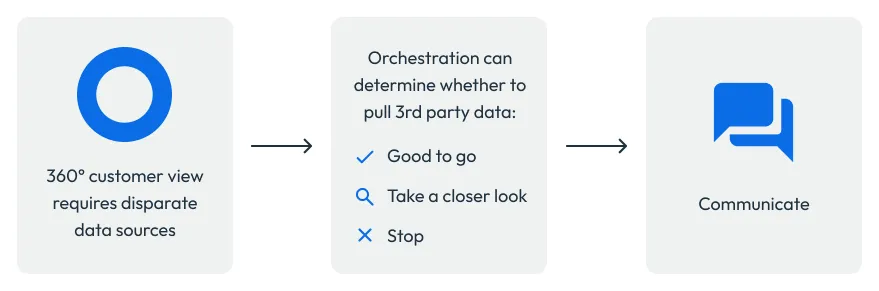
One of the most overlooked levers in acquisition economics is data orchestration cost. Third-party data isn’t free, and a poorly architected decision flow will burn through budget pulling expensive verification data on applicants who were never viable prospects. As one head of fraud at a major U.S. bank told me: “We could be right every time at originations from a fraud perspective, but we’d be paying $30 per application.”
Industry leaders solve this by building qualifying checks into the decision flow upfront, ensuring high-cost data pulls only happen when warranted. This cuts noise, focuses resources on high-value prospects, and improves the unit economics of acquisition without sacrificing decision quality. For institutions processing applications at scale, this is a meaningful improvement to the profitability of the entire funnel.
Reducing Manual Review as a Competitive Advantage
Your competitors are not winning on product alone. In many cases they are winning because their decisioning is faster, their queues are shorter, and their applicants reach a decision before yours do. That speed build trust with potential customers. Manual review, often treated as an operational issue, is in practice one of the most significant and underappreciated drags on acquisition performance.
The problem starts with policy design. A rigid "fail one, fail all" approach routes any application that trips a single rule straight to the manual queue, regardless of whether a human reviewer is actually needed. The queue fills with volume that should have been auto-decisioned. Reviewers are overwhelmed. Cases that genuinely warrant human judgment wait alongside dozens that don't, slowing everything down and driving applicant abandonment at exactly the moment you should be closing.
Fixing this is involves deploying human judgment with greater precision. High-performing institutions build decision flows that evaluate the full picture of each applicant, including behavioral signals and third-party data, and reserve manual review for the subset of cases where it genuinely adds value. Everything else moves through automatically.
Getting there requires discipline. The institutions that achieve lasting results start narrow, defining one specific problem, designing a decision flow to address it, and validating outcomes before expanding. Those that try to overhaul everything at once tend to generate a pilot result and stall. The incremental approach is how durable improvement compounds over time.
The Strategic Imperative
With nearly two-thirds (64%) of consumers preferring to buy from companies that tailor experiences to their specific needs, every step in the acquisition loop carries real market consequence. Winning banks are more precise about which customers they target, more intelligent about the data they use to evaluate them, more adaptive in how they personalize offers, and more operationally efficient in how they move applicants through to activation. This ultimately leads to loyal, satisfied customers.
The question for your organization is: where in the funnel is execution breaking down? Can you deliver the real-time offers and trusted decisions that turn first impressions into long-term growth?
How FICO Can Help Improve Customer Acquisition
Imprecise targeting, slow data assembly, rigid offer logic, and overloaded manual review queues share a common root cause: infrastructure that was never designed to support a single, real-time decisioning flow.
FICO® Platform closes that gap by bringing data connectivity, analytics, and decisioning together into one cohesive framework. Workflows are orchestrated to keep third-party data spend proportional to prospect value, addressing the problem of paying a premium to verify applicants who don’t qualify.
Once that data picture is assembled, FICO Platform's AI & Analytics and Optimization capabilities work together to move institutions beyond a single take-it-or-leave-it offer. Rather than a static policy tier, the platform evaluates multiple calibrated paths, rate structures, fee options, and reward configurations in real time, matching each offer to what a specific applicant is most likely to accept and retain. This precision at the top of the funnel converts into loyalty further down it.
On manual review, FICO Platform lets institutions replace a rigid "fail one, fail all" policy with decision logic that evaluates the full picture of an applicant and routes only genuinely ambiguous cases to a human reviewer. Everything else moves through automatically, shortening queues and reducing the abandonment that happens while applicants wait.
And with a composable architecture, institutions don't need to overhaul all their processes at once. Teams can validate a narrow decision flow against real data, confirm it performs, and expand from there, ensuring durable results.
Learn More
- Read our blog post on improving real-time customer acquisition in banking
- Watch our video to learn about techniques that achieve 100% instant digital decisioning
- Watch how T-Mobile uses the FICO® Platform to individualize customer treatments for prospecting and underwriting customers
- Explore the power of FICO Platform and FICO solutions for attracting and engaging customers

Popular Posts

Average U.S. FICO® Score at 716, Indicating Improvement in Consumer Credit Behaviors Despite Pandemic
The FICO Score is a broad-based, independent standard measure of credit risk
Read more
The GSE Data Is Public. Here's What It Shows About Credit Score Modernization.
Independent Milliman analysis of GSE historical data confirms what anyone can now verify directly: FICO® Score 10T is the most predictive score.
Read more
FICO Statement on FHFA and FHA Updates to Credit Score Modernization
FICO supports FHFA’s announcement that the long-anticipated historical data for FICO® Score 10T will be released to the mortgage market.
Read moreTake the next step
Connect with FICO for answers to all your product and solution questions. Interested in becoming a business partner? Contact us to learn more. We look forward to hearing from you.