What Is Customer Acquisition? How to Create a Great Customer Acquisition Strategy
Customer acquisition is a strategic process to attract and convert the right buyers into paying customers, and has specific requirements in financial services

What Is Customer Acquisition?
Customer acquisition refers to the strategic process and activities a business employs to attract and convert prospective buyers into paying customers. Customer acquisition encompasses the complete journey from initial brand awareness through final purchase decision, creating a predictable and sustainable pipeline of new customers that drives long-term business growth and profitability.
At its core, customer acquisition is about more than simply gaining new customers: it's about implementing a systematic, repeatable methodology to identify, attract, and convert the right customers who are most likely to become loyal, high-value advocates.
Key Takeaways
- Customer acquisition is a full-funnel process, not a single tactic. It covers attraction, nurturing, qualification, conversion, and onboarding. Lead generation sits at the top of that funnel, and retention is its complement.
- Financial services acquisition has to be risk-aware. Every offer should match the institution’s risk thresholds and pricing. This guards against adverse selection and fraud while still supporting growth.
- AI makes acquisition faster, more personalized, and cheaper. Predictive, generative, and agentic AI choose the right offer, channel, and timing for each prospect. That cuts wasted spend and lowers customer acquisition cost.
- Customer experience decides who stays. FICO’s 2025 customer experience survey found that 47% of customers would leave their bank over a bad experience. That ranks above data security concerns (43%), a fraud event (40%), and poor value for money (39%).
- FICO’s six-step strategy turns this into results. The steps are define the ideal customer, craft the value proposition, select channels, create targeted content, nurture leads, and optimize through testing. Trust Bank used FICO Platform to acquire 100,000 customers in 10 days.
What is the Impact of Customer Acquisition?
Customer acquisition is not just about gaining new customers, it directly impacts the entire organization.
- Revenue Growth: Each new customer represents immediate revenue and potential for repeat business
- Profitability: When you apply an effective risk management process, your acquisition process directly impacts profitability by ensuring that the customers you attract meet your risk thresholds
- Market Expansion: Acquiring customers helps businesses capture larger market share and establish competitive positioning
- Business Scalability and Future Planning: A robust acquisition process enables sustainable growth and the ability to plan for long-term growth
- Investor Confidence: Strong customer acquisition demonstrates business viability and traction to stakeholders and investors
- Risk Mitigation and Long-Term Viability: Diversifying the customer base reduces dependency on any single market segment
Having talked about what customer acquisition is, it’s important to be clear on how it’s different to related areas that influence customer numbers – specifically marketing, lead generation and retention
How Does Customer Acquisition Differ From Marketing?
While closely related, marketing and customer acquisition serve distinct purposes:
| Marketing | Customer Acquisition |
Focus on awareness:
| Focus on conversion:
|
The Differences Between Customer Acquisition and Lead Generation
Lead generation is a critical component within the broader customer acquisition process, not a separate strategy. The full customer acquisition funnel comprises awareness to purchase, with the following stages:
- Attraction: Drawing in and capturing lead information (lead generation)
- Nurturing: Educating leads through targeted content
- Qualification: Identifying purchase-ready prospects
- Conversion: Guiding decisions and closing sales
- Onboarding: Completing first transaction
The success of these stages combined is typically measured through customer acquisition cost, conversion rates by stage, time to conversion and customer lifetime value
Lead generation falls into the Attraction stage, at the very top of the customer acquisition funnel and aims to capture contact information from interested prospects and convert strangers into identified leads.
Common approaches to lead capture include the use of:
- Gated content (ebooks, whitepapers, templates)
- Newsletter signups
- Webinar registrations
- Free tool offerings
- Contact form submissions
And the success of lead generation is measured by thenumber of leads, cost per lead, conversion rates on landing pages
So whilst lead generation represents the identification of interested prospects from various sources, it is simply a part of the much broader customer acquisition process that will ultimately convert those prospects into paying customers
What Are the Differences Between Customer Acquisition and Customer Retention?
Whilst customer acquisition is outward facing with the intention to target prospects who haven’t purchased yet, customer retention is much more inward facing.
| Customer Acquisition Aims to: | Customer Retention Aims to: |
|
|
It’s important to note that acquisition and retention aren't competing priorities, they're complementary. Both are essential to create sustainable growth where satisfied customers stay longer, spend more, and attract new customers on your behalf.
The Role of Different Customer Acquisition Channels
Customer acquisition takes place across multiple platforms and channels simultaneously and leverages a mix of channels to reach prospects where they are and guide them toward conversion. Common customer acquisition channels include:
- Organic Search (SEO): captures traffic from people actively searching for products or solutions
- Paid Search (PPC): generates immediate visibility and traffic from targeted search queries
- Organic Social Media: builds presence and community on social platforms without paid promotion.
- Paid Social Media: reaches target audiences with sponsored content on social platforms
- Email Marketing: nurtures leads, maintains ongoing relationships, drives conversions through direct communication with prospects and customers
- Referral Programs: incentivizes existing customers to refer new prospects
- Affiliate Marketing: partners with third parties who promote your products for commission
- Events: connects with prospects in virtual or in-person gatherings
- Freemium Models: offers basic product access free, with paid premium features to demonstrate solution value and convert users to customers
However, the most effective customer acquisition strategies don't rely on a single channel, with the best adopting an omni-channel approach.
How Is AI Changing Customer Acquisition?
What is AI Customer Acquisition?
AI customer acquisition is the strategic use of artificial intelligence to attract, evaluate, and convert prospects into customers, from first contact through onboarding.
An AI customer acquisition strategy draws on three types of AI:
- Predictive AI models quantify risk and likelihood to respond
- Generative AI capabilities add context to messages and interactions
- Agentic AI systems plan and execute multi-step decisions within guardrails
How Does AI Support Better Customer Acquisition?
AI is helping customer acquisition become faster, more intelligent, and more personalized.
AI-first organizations can use AI analytics to tailor all their touch points (from landing pages to follow-up offers) to each prospect in real time. AI can also help customer communications, decisioning, and customer data converge into a single platform, where it can be used todecide whether to engage a prospect, on which channel, and toward what outcome, so the outreach and the message are best suited to each prospect.
AI can also support customer acquisition by improving customer experience, which is crucial when it comes to customer acquisition and retention. FICO’s 2025 customer experience survey revealed that bad customer experience is the #1 reason people will leave their bank: 47% of customers say they would leave their bank provider because of bad experience, and bad customer experience ranks higher than data security concerns (43%), a fraud event (40%), and poor value for money (39%).
FICO Platform leverages AI to improve customer experience by giving every interaction context. A shared, continuously updated customer profile means the tone, timing, and awareness of a customer’s situation stay consistent no matter which team is engaging them. This prevents contradictory outreach, such as a promotional offer reaching a customer in financial hardship.
How to Build a Customer Acquisition Strategy
An effective customer acquisition strategy involves several interconnected elements:
- Strategic Planning: Identifying ideal customer profiles, understanding their needs and pain points, and developing targeted approaches to reach them. A study from Salesforce found that 73% of customers expect companies to understand their unique needs and expectations: strategic, personalized engagement with prospects is no longer optional.
- Omni-Channel Engagement: Leveraging omnichannel communication to connect with prospects where they are
- Data-Driven Decision Making: Using applied analytics, predictive modeling, and performance metrics to optimize strategies and improve conversion rates
- Lead Nurturing: Guiding potential customers through the buying journey with personalized content, offers, and experiences
- Conversion Optimization: Refining processes and touchpoints to maximize the percentage of prospects who become customers
- Hyper-Personalization: Hyper-personalization plays a key role in acquiring customer: a study from Deloitte found that 80% of customers say they’re more likely to do business with a company if it offers personalized experiences.
Here are the six steps needed to create a customer acquisition strategy.
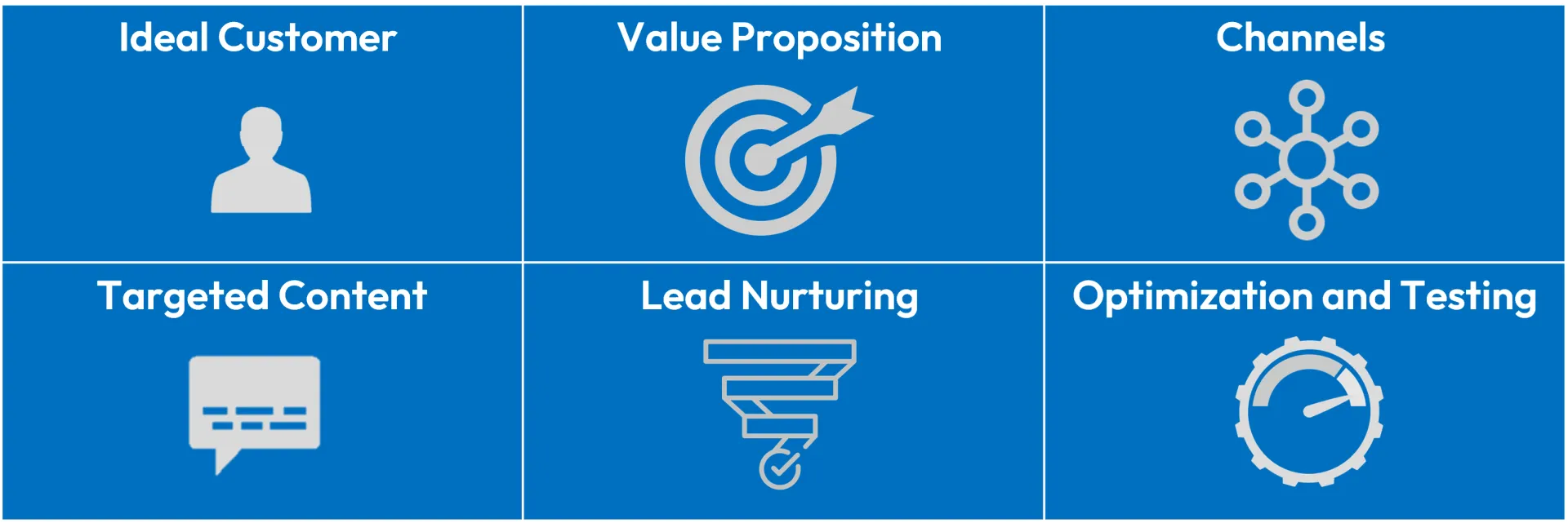
Step 1: Define Your Ideal Customer
Understanding exactly who you're trying to reach is the foundation of any successful customer acquisition strategy.
- Create detailed buyer personas that go beyond basic demographics to include buying behaviors, pain points, decision-making authority, and buying triggers. Validate these through customer analytics and sales team insights rather than assumptions alone.
- Leverage data-driven audience identification by analyzing your existing customer base to identify patterns among your most profitable customers, then use AI, predictive analytics and machine learning to score prospects based on their likelihood to convert and deliver long-term value.
- Implement strategic segmentation by using AI to divide your market into distinct groups based on demographics, behaviors, or needs, then develop differentiated acquisition strategies for each segment while prioritizing based on potential lifetime value and acquisition cost.
Here, as throughout the customer acquisition process, financial services companies must address the critical need for robust risk management. Extending financial products or additional credit carries inherent risks, including the possibility of granting offers to individuals who may not be able to manage them responsibly, or falling victim to fraudsters who misrepresent their identities or intentions. Effective risk management involves setting risk thresholds and aligning pricing strategies with risk.
FICO solutions for intelligent customer profiling can help, such as FICO® Scores for creditworthiness assessment (available in many markets worldwide) and FICO® Platform for building custom predictive models. FICO Platform capabilities can support the development of the predictive models and profiling that allows the identification of which customers that align to your risk appetite and are most likely to find value in your products. Its ability to find value in even complex data such as transactions is already helping clients to expand addressable markets by identifying creditworthy prospects who lack traditional credit histories.
Step 2: Craft Your Value Proposition
Your value proposition is the clear, compelling statement that explains why a prospect should choose your product or service over alternatives.
- Identify unique selling points that differentiate your offering from competitors, focusing on outcomes and transformations rather than just features. Quantify benefits with specific metrics, timeframes, or cost savings, and ensure differentiators are meaningful to your target audience.
- Address specific customer pain points by conducting deep research into the challenges your target customers face, then map your solution's capabilities directly to these problems using customer language and providing proof through case studies and testimonials.
- Maintain messaging consistency across all customer touchpoints by developing a core messaging framework, training all customer-facing teams on key messages, and regularly auditing touchpoints to ensure unified communication of your value proposition throughout the buyer journey.
Step 3: Select Acquisition Channels
As we saw earlier, being strategic in your channel selection ensures you invest resources where they'll generate the highest return.
- Evaluate channels systematically by assessing where your target audience seeks information, analyzing each channel's cost structure and ROI potential, considering your internal capabilities and resources, and testing channel effectiveness with pilot campaigns before committing significant budgets.
- Implement a multi-channel approach recognizing that buyers interact with brands across multiple touchpoints before purchasing. Create integrated campaigns where channels work synergistically, use cross-channel attribution to understand contribution, and balance "always-on" channels with campaign-based tactics.
- Data integration: Track customer interactions across channels for holistic view
- Optimize channel mix using data and analytics to allocate budget proportionally to channel performance while maintaining diversification. FICO's intelligent decision capabilities can help you determine optimal channel combinations based on prospect characteristics and predicted conversion likelihood.
Achieving all of this requires analytics and segmentation to ensure the correct channels are chosen, the ability to trial new approaches via champion/challenger trials and data-rich, flexible communications capabilities. Through its industry-leading, integrated, analytical capabilities, decision execution and omni-channel engagement capabilities, FICO Platform is uniquely positioned to drive the selection of the best channels.
Step 4: Create Targeted Content & Messaging
Generic content will fail to resonate with users accustomed to hyper-personalization.
- Deploy advanced personalization strategies by segmenting content delivery based on prospect attributes and behaviors, using dynamic content that adjusts based on visitor characteristics, implementing behavioral triggers for timely relevance, and leveraging customers analytics to automatically tailor offers based on customer profiles.
- Develop diverse content types mapped to the buyer journey including educational content (blogs, guides, videos) for awareness, thought leadership (whitepapers, research) for credibility, social proof (case studies, testimonials) for trust, interactive content (calculators, assessments) for engagement, and sales enablement materials (demos, ROI calculators) for decision-making.
- Scale content production and distribution by repurposing successful content across multiple formats to maximize ROI, using marketing automation to deliver the right content at the right time, and maintaining quality standards that reflect your brand authority.
- Maintain consistency within a flexible framework is vital. Whilst diversity of content and channels, as well as a dynamic approach to content selection and timing is important, it’s equally important to maintain unified brand voice and value proposition across all channels and content.
- Use AI to personalize customer communications at scale. AI makes it possible to tailor customer communications to each prospect without building every message by hand. AI models analyze behavior, transaction patterns, and profile data to choose the offer, the channel, and the timing most likely to resonate, then assemble the message from modular content. The result is that thousands of prospects can each receive a relevant message while brand voice and compliance requirements stay consistent.
One key challenge in financial services is adverse selection, which arises when credit offers are not competitive enough, attracting a disproportionate number of higher-risk applicants who have fewer options elsewhere. This can lead to elevated default rates and undermine the profitability of acquisition efforts. To mitigate this, financial institutions must leverage comprehensive credit data and advanced decisioning strategies — capabilities central to FICO’s acquisition solutions. By integrating these tools into the acquisition workflow, organizations can accurately assess applicant risk, detect potential fraud, and ensure that offers are both attractive and sustainable, supporting growth without compromising on security or profitability.
The importance of timely relevance is often underestimated, but making the right decision at the right time can be the difference between gaining a customer or losing a lead. Real-time event streaming and profiling, on FICO Platform, can identify customer specific trigger events, that allow appropriate offers to be assessed. When combined with the ability to configure diverse communications content to engage customers with the chosen offer, then the powerful combination of right offer, at the right time, through the right channel with the right content is available; all on a single platform.
Step 5: Implement Lead Nurturing
Most prospects aren't ready to buy on first contact. Lead nurturing maintains engagement and builds relationships until conversion.
- Build automated nurture campaigns including email drip sequences that deliver progressively detailed information, trigger-based workflows that respond to specific prospect behaviors, lead scoring systems that route high-value leads to sales automatically, and re-engagement campaigns for cold leads using different messaging angles.
- Enable sales teams with intelligence and tools by establishing clear lead handoff criteria, providing engagement history and behavioral signals, creating playbooks with recommended approaches by segment, and implementing real-time alerts when high-value leads take meaningful actions.
- Use AI to tailor lead nurturing to each prospect: AI models score prospects on their propensity to buy, based on responsiveness to prior messaging, so sales and marketing teams can prioritize whom to continue engaging. AI can also help identify the best channel and time of day for reaching out, or flag an opportunity for re-engagement when a lead goes quiet.
The same FICO Platform capabilities that enable customer targeting, the right communication channel selection and the use of personalized communications also have a key role to play in these activities. To ensure your approach remains consistent and effective during these key touch points, it’s even possible to re-use models and decision assets that underpin those activities.
Step 6: Optimize and Test
Customer requirements and preferences are constantly evolving, which necessitates continual testing, measurement, and refinement, based on performance data. Maintaining this is a key differentiator between high-performing programs and mediocre ones.
- Implement rigorous A/B testing methodologies by testing one variable at a time with statistically significant sample sizes, prioritizing high-impact elements like offers and value propositions, documenting results in a centralized repository, and using multivariate testing for complex optimizations where multiple elements interact.
- Establish continuous improvement processes through regular review cycles to analyze performance, monitoring leading indicators to spot problems early, conducting win/loss analyses to understand prospect decisions, and fostering a culture of experimentation balanced with optimization of proven approaches.
- Integrate comprehensive data analytics using unified dashboards for real-time visibility, attribution modeling to understand true channel contribution and predictive models to forecast trends. FICO intelligent decision capabilities can analyze data from multiple sources and apply machine learning to identify patterns and opportunities that connect acquisition activities to revenue outcomes and customer lifetime value. For financial services, risk assessment is a vital part of this process, as lenders will want to forecast not just projected revenue but also projected bad debt.
FICO Platform provides a unique combination of capabilities and functionality that are specifically designed to support a continuous improvement process, through A/B tests, predictive model development, intuitive dashboarding, KPI impact simulation and even mathematical optimization. The age-old struggle of bringing analytical outputs into production is then negated as they are easy to deploy into a production environment on the same platform.
How to Lower Customer Acquisition Cost
Reducing customer acquisition cost (CAC) is one of the most impactful ways to improve efficiency and profitability. Rather than simply increasing acquisition budgets, smart organizations focus on optimizing conversion at every touchpoint, eliminating waste, and improving targeting precision. Below are proven strategies to lower your CAC without impacting customer service quality.
Optimizing the Website for Conversions
Your website is often the final destination before conversion, making it critical to eliminate friction and guide visitors toward action. To optimize conversion from your website, the following factors should be considered:
- Optimize page load speed and technical performance because every second of delay reduces conversions.
- Simplify navigation and user flows by removing unnecessary steps between landing and conversion, using clear hierarchies that guide visitors to priority actions, implementing breadcrumbs for easy backtracking, and ensuring key conversion points (sign-up forms, product pages, contact forms) are accessible within 2-3 clicks from any entry point.
- Build trust through credibility signals including security badges, customer testimonials, industry certifications, clear privacy policies, and transparent pricing: visitors need assurance before sharing information or making purchases.
- Implement conversion-focused design principles such as prominent calls-to-action, strategic use of white space to reduce cognitive load, F-pattern or Z-pattern layouts that match natural eye movement, and colors that draw attention to conversion elements without overwhelming visitors
- Dedicated landing pages consistently outperform generic website pages for campaign-driven traffic because they're built for conversion.
- Use consistent language and images between ads and landing pages so visitors immediately recognize they've arrived at the right destination.
- Create compelling, benefit-driven headlines and copy that immediately communicate value proposition, address visitor pain points, and use concrete language and stats over vague claims.
- Optimize form design for completion by requesting only essential information or using multi-step forms for complex information gathering.
Improving CTAs for Best User Experience
Your call-to-action (CTA) is the critical moment where browsers become leads or customers: small improvements here create outsized CAC reductions.
- Use action-oriented, specific language that tells visitors exactly what will happen—replace vague buttons like "Submit" or "Learn More" with specific promises like "Get Your Free Credit Score," "Calculate My Savings," or "Start My 30-Day Trial," creating clarity and reducing uncertainty about next steps.
- Create visual prominence through design using contrasting colors that stand out from surrounding elements, sufficient size that CTAs are immediately noticeable (especially on mobile), strategic placement above the fold and at natural decision points throughout content.
- Test CTA variations systematically including button colors, text phrasing, placement, size, and surrounding elements: even small changes can significantly impact conversion rates.
Superior customer experience reduces CAC by generating word-of-mouth referrals that lower overall acquisition costs.
- Personalize experiences based on visitor data and behavior: use dynamic content that reflects visitor location, industry, referral source, or past interactions to tailor offers based on predicted needs and preferences.
- Provide immediate support at decision points through strategically placed live chat (especially on pricing and product pages), comprehensive FAQs that address common objections, video demonstrations that show rather than tell, and clear next steps at every stage of the journey.
- Reduce friction in application and onboarding processes by pre-filling known information, offering guest checkout options and providing progress indicators for multi-step processes.
Leveraging AI to Reduce Customer Acquisition Costs
AI can lower customer acquisition costs in several ways:
- Improved customer targeting: ss McKinsey recommends, AI helps select customers by their “propensity to buy,” based on responsiveness to prior messaging, which helps reduce costs associated with mass emailing campaigns.
- Channels and timing: AI models can also identify the best channel for each message and time of day, so budget goes where a response is most likely.
- Continuous optimization: Measurement and testing platforms let teams see campaign effectiveness in real time and shift spend accordingly.
- Smarter budget allocation: Automated bidding and creative testing continuously move budget to the best-performing channels and messages, cutting wasted impressions and manual optimization time.
- Higher conversion rates: AI can tailor content, offers, and timing to each prospect, which reduces the number of touchpoints needed to close.
- More efficient sales effort: Chatbots and automated qualification answer early-stage questions around the clock, freeing sales teams to focus on high-value opportunities.
Channel Performance Analysis
As discussed earlier, not all acquisition channels are suited for customer acquisition. To reduce your customer acquisition cost, a rigorous analysis is needed to identify where to invest more and where to cut spending.
- Track channel-specific CAC and customer quality metrics by measuring cost per acquisition, customer lifetime value, retention rates, and time to first purchase by channel. The lowest CAC channel isn't necessarily the best if those customers have low lifetime value or high churn rates.
- Use attribution modeling to understand true channel contribution and avoid over-investing in channels with low ROI.
How FICO Can Help You Improve Your Customer Acquisition Strategy
There are many ways FICO can help you improve your customer acquisition strategy. Take a look at our resources below to learn more.
- Read our blog post on improving real-time customer acquisition in banking
- Watch our video to learn about techniques that achieve 100% instant digital decisioning
- Watch how T-Mobile uses the FICO® Platform to individualize customer treatments for prospecting and underwriting customers
- Explore the power of FICO Platform and FICO solutions for attracting and engaging customers
- Download the The flywheel effect: rethinking customer engagement in the age of AI whitepaper to learn more about how decisioning, communications, and one shared customer profile work better together
Note: This is an update of a post from 2025.
Frequently Asked Questions
Data analytics reduces acquisition costs by directing spend toward prospects most likely to convert and repay. Predictive models score prospects on propensity to respond and on credit risk, so lenders stop mailing offers to low-probability or out-of-appetite audiences. Channel-level analysis shows cost per acquisition and customer lifetime value by source, which exposes where budget is wasted. Decisioning analytics can also approve creditworthy applicants instantly, cutting drop-off during onboarding.
Measuring ROI starts with tracking customer acquisition cost against customer lifetime value, ideally by channel, since the cheapest channel is not always the most valuable one. Supporting metrics include conversion rate by funnel stage, time to conversion, and retention rates. Attribution modeling shows each channel’s true contribution across multiple touchpoints. In financial services, ROI should also account for projected bad debt, because losses from customers who don’t meet the bank’s risk appetite can erode returns. Champion/challenger testing then isolates which offers, channels, and messages improve returns, keeping measurement continuous as competitors and customer preferences shift.
Three trends stand out. First, AI is moving from analytics to execution, with predictive, generative, and agentic AI combining to decide whether to engage a prospect, on which channel, and with what message. Second, decisioning, communications, and customer data are converging on a single platform with a shared customer profile, which prevents contradictory outreach. Third, expectations are rising: customers expect companies to understand their unique needs and are more likely to buy from companies offering personalized experiences. Executives planning for the long term should prioritize unified data, real-time decisioning, and guardrails for AI.

Popular Posts

Average U.S. FICO® Score at 716, Indicating Improvement in Consumer Credit Behaviors Despite Pandemic
The FICO Score is a broad-based, independent standard measure of credit risk
Read more
The GSE Data Is Public. Here's What It Shows About Credit Score Modernization.
Independent Milliman analysis of GSE historical data confirms what anyone can now verify directly: FICO® Score 10T is the most predictive score.
Read more
FICO Statement on FHFA and FHA Updates to Credit Score Modernization
FICO supports FHFA’s announcement that the long-anticipated historical data for FICO® Score 10T will be released to the mortgage market.
Read moreTake the next step
Connect with FICO for answers to all your product and solution questions. Interested in becoming a business partner? Contact us to learn more. We look forward to hearing from you.