How to Break Through the Barriers to Agentic AI Success
A new survey of AI leaders shows where agentic AI stands – here’s how to move from pilots to production

Nearly every enterprise is experimenting with AI agents. Very few are running them at scale.
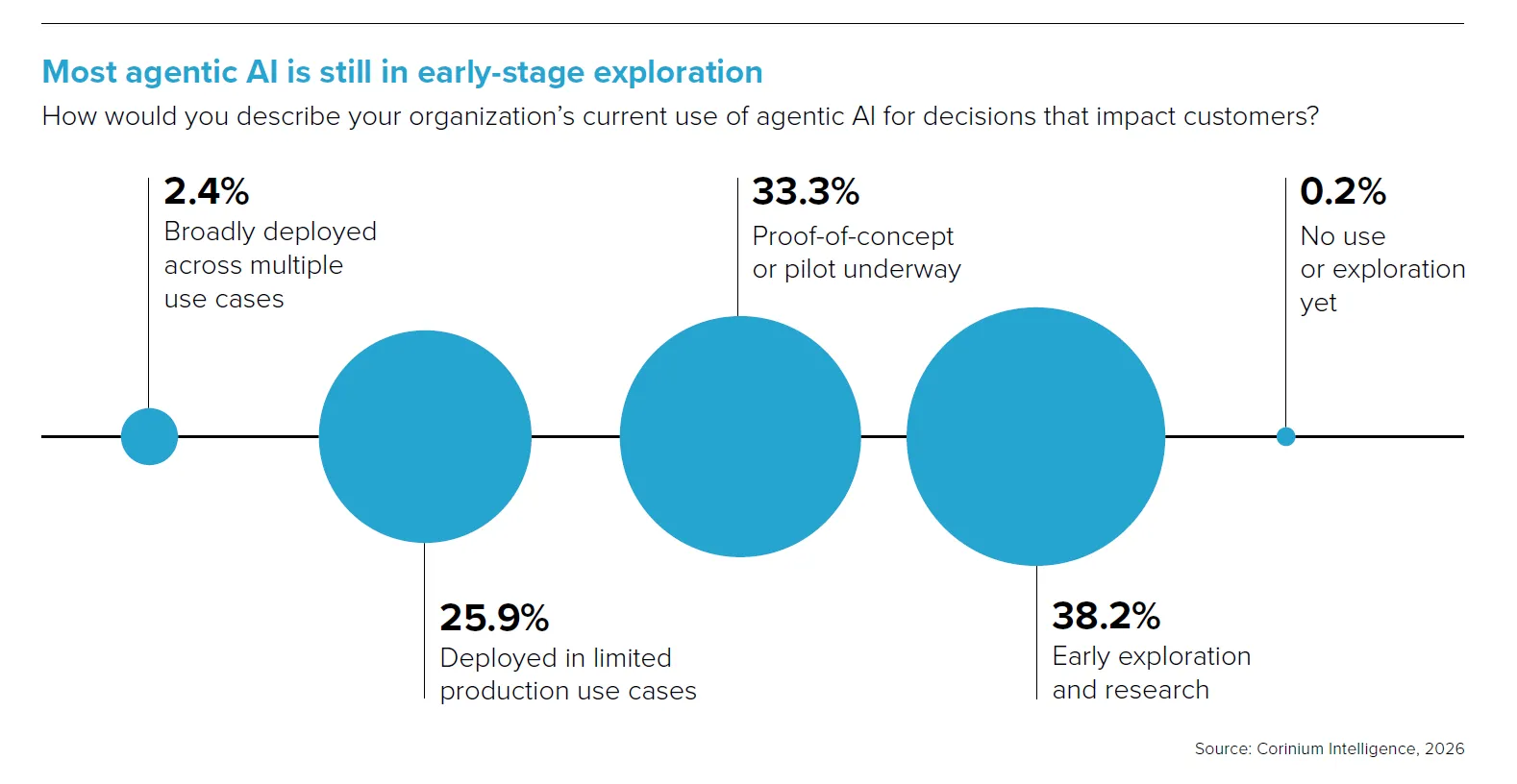
FICO's State of Responsible AI 2026 report, built on a Corinium Intelligence survey of 1,004 senior data, analytics and AI leaders, puts numbers on that gap. Of the organizations surveyed, 71.5% are still in early exploration or pilot. Just 2.4% have deployed agents broadly across multiple customer-impacting use cases.
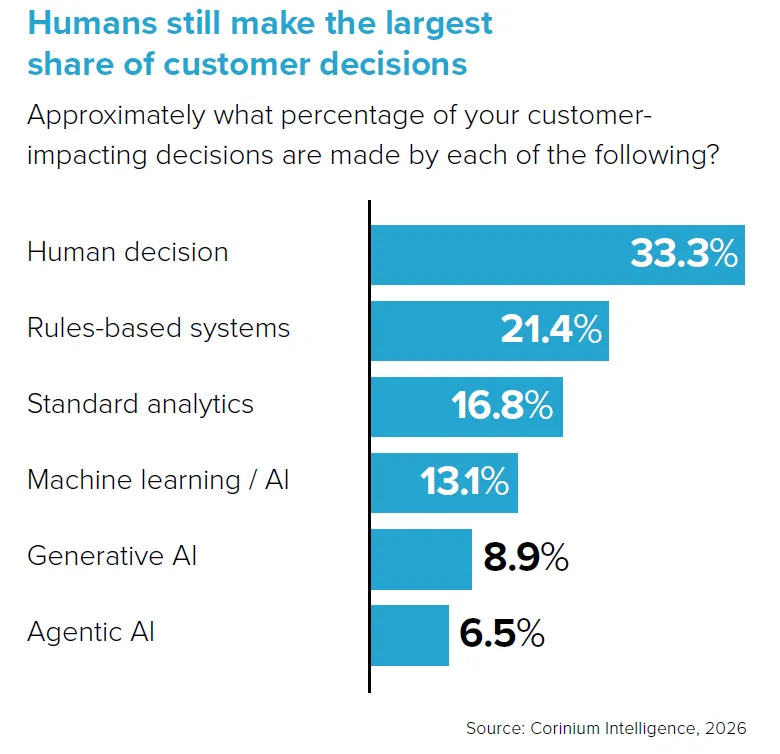
The stall may seem surprising given some 85.1% of leaders say AI has met or exceeded their initial ROI expectations. Yet as FICO Chief Analytics Officer Scott Zoldi noted in his post, AI makes only 28.5% of the decisions that reach customers today, and agents account for 6.5%. Humans, rules-based systems and standard analytics with human oversight still handle the rest.
Key Highlights
- Agentic AI is still stuck in pilot. 71.5% of organizations are in early exploration or pilot, and just 2.4% have deployed agents broadly across customer-impacting use cases.
- Leaders treat the barriers as an engineering backlog. Security concerns (40.1%) and data integration and quality (38.3%) top the list, while lack of trust or predictability comes last at 5.6%.
- Skills and culture matter as much as architecture. Workforce skills falling behind is the top five-year risk (63.2%), and resistance to change (61.4%) leads the barriers to organizational alignment.
- Financial services is the most cautious sector. 46.8% of banking and financial services leaders remain in early exploration, and only 1.1% report broad deployment.
- Conditional autonomy is the preferred model. 82.2% of leaders favor agents operating within defined limits with humans owning high-stakes cases, while just 3.0% are comfortable with full autonomy.
- A shared platform is the clearest route to returns. 96.4% of leaders expect additional ROI from a shared deployment platform, yet only 8.2% have one fully in place.
What Is Blocking Agentic AI Success Today?
Leaders name security concerns (40.1%) and data integration and quality (38.3%) as the top barriers to agentic ROI. Lack of trust or predictability comes last, at 5.6%. For a CIO, that list reads like an engineering backlog: secure the access paths, fix the data, build the monitoring.
Leaders are also tempering near-term expectations. Only 27.5% put agentic AI among the technologies likely to drive the greatest ROI over the next 18 months, second to last on the list. Domain-specific language models (49.5%), generative AI (48.7%) and interpretable model architectures (46.6%) lead.
Skills and culture matter as much as architecture
The top five-year risk is workforce skills falling behind the pace of adoption, cited by 63.2% of leaders. Resistance to change (61.4%) and a lack of shared understanding of AI (58.4%) top the list of barriers to organizational alignment around autonomous systems.
Haroon Abbu, SVP, Digital Technology, AI & Data Analytics at Bell and Howell, a major US business process automation company, ties this to leadership fundamentals rather than technology. “It comes down to people, process, and technology,” he says. “In isolation, technology is not a sufficient solution. It really comes down to change management and leadership transparency.”
Explainability still lags
While results show that trust in AI is the smallest barrier reported (5.6%), only 5.2% of respondents are very confident they could actually explain an AI decision to a regulator. Explainable AI is thus critical to further adoption, particularly for customer decisions. For more on how to address this, see Scott Zoldi’s post Responsible AI ROI Has Arrived — Here’s How Organizations Can Accelerate Its Growth.
What Should We Expect from Agentic AI in Financial Services?
Financial services show the stall in its sharpest form. In banking and financial services, 46.8% of leaders remain in early exploration. Only 1.1% of financial services firms report broad deployment.
That caution is rational. A fraud or credit decision made by an ungoverned agent carries direct financial and regulatory consequences. Leaders in the sector are asking whether an agent's actions can be constrained, monitored and defended before they ask how fast it can act. Across all respondents, 82.2% favor conditional autonomy, where agents operate freely within defined limits and humans keep responsibility for high-stakes cases.
The same instinct shows up in what the sector values. Among financial services leaders, interpretable model architectures as a leading source of future AI ROI jumped from 16% in our 2025 survey to 46.0% in 2026. Explainability has moved from compliance cost to return driver.
What Could Improve the Adoption of Agentic AI?
Nearly all respondents (96.4%) expect additional ROI if AI and technology leaders collaborate on a shared deployment platform. However, only 8.2% have such a platform fully in place today. Another 71.2% have one partially built. The ambition is there, and the infrastructure is unfinished.
Two changes can help organizations move from pilots to production.
Build collaboration into the platform
The same two barriers to organizational alignment, resistance to change and a lack of shared understanding, mean a platform should make collaboration easier and building it should model that. At FICO, engineering and product teams used to build for six months before handing the work to security, privacy, legal and cyber teams for approval, and the pushback was predictable. Now those disciplines join at the start. They are invested from day one, so resistance is much lower.
What sets an AI platform apart from any other shared workspace is trust. When AI is a full participant in the work, everyone involved needs to see why it made a decision. They need to see audit logs showing what was decided, how, and what informed it, and these should be visible to everyone reviewing the same decision. Every reviewer works from the same record: a glass box, not a black box.
While this kind of platform can unite the AI team and the IT team, it can also enable greater collaboration between disparate groups with goals that can often be in competition, such as marketing and risk. Each department sets its own KPIs, driven by OKRs, so a shared platform can show marketing the limits risk sets, and show risk what marketing is trying to achieve, before either plan is final.
This is what we designed FICO® Platform to do. As I discussed in my post following FICO World 26, FICO Platform is designed not only to further collaboration but to activate agents that handle decision management tasks.
Manage agents the way you manage people
Moving from generative AI to agentic AI that acts requires a framework to build, manage and govern those agents: policy, guardrails, evaluations and monitoring, so that what we ask agents to do and what they do match.
At FICO, we approach it by mirroring how people are trained. For our fraud agents, we load the policies and instructions a new fraud investigator would receive on their first day. We build the guardrails by running through thousands of exercises to see how the agents perform, and then we go back and edit the guardrails as needed. These tests are the manager's review of each mock investigation, and monitoring is ongoing performance management. If evaluation or monitoring reveals behavior you don't like, you return to the guardrails and go around again. Without that loop, you shouldn't be surprised when an agent goes off the rails.
Where Will Agentic AI Adoption Be in Three Years?
Today, respondents say AI agents handle just 6.5% of customer-impacting decisions, against 13.1% for traditional machine learning and 8.9% for generative AI, which together account for 22.0%. I expect agents to start closing that distance as institutions finish the unglamorous groundwork: defined permissions, escalation thresholds, security hardening and cleaner data. Before an agent goes live, leaders need to specify which decisions it can make alone, which get escalated, and what confidence threshold moves a case from one bucket to the other. Without that catalog, "human in the loop" only means someone eventually notices a problem.
Explainability will need to be addressed as part of this transition. This means it will need to be designed into the model lifecycle, with documented requirements, independent verification and named accountability.
Our Chief Analytics Officer, Dr. Scott Zoldi, describes the standard he advocates: "No model gets released unless every one of those requirements has been developed, tested, and then verified by an independent verifier, with literal names of people who have signed off on that work."
The State of Responsible AI report shows how far businesses have come in AI adoption, and how far they still must go. FICO's commitment is to help clients move agents from pilot to production with decisions they can explain, govern and defend. FICO's decisioning leadership is reflected in recent Leader positions in analyst evaluations from Gartner and IDC. That record gives teams a powerful foundation for AI adoption.
Learn More about Harnessing Responsible AI
- Download the State of Responsible AI 2026 report
- Read the Future of Agentic AI whitepaper: How to close the AI operationalization gap
- Read my blog post on Your Customer’s AI Agents Are Coming – Are You Ready?

Popular Posts

Average U.S. FICO® Score at 716, Indicating Improvement in Consumer Credit Behaviors Despite Pandemic
The FICO Score is a broad-based, independent standard measure of credit risk
Read more
The GSE Data Is Public. Here's What It Shows About Credit Score Modernization.
Independent Milliman analysis of GSE historical data confirms what anyone can now verify directly: FICO® Score 10T is the most predictive score.
Read more
FICO® Score High Achievers: Is Age the Only Factor?
We've refreshed our study on the credit behavioural profiles of consumers with higher FICO Scores, with a strong focus on younger consumers.
Read moreTake the next step
Connect with FICO for answers to all your product and solution questions. Interested in becoming a business partner? Contact us to learn more. We look forward to hearing from you.