AI in Banking Transformation: The Real Gap Isn’t Technology, It’s Trust at Scale
The $4.4 trillion in added AI productivity growth potential will go to institutions that build the right infrastructure

Every major bank in the world is investing in AI. Budgets are growing, pilots are multiplying, and the pressure to show results has never been higher. Yet only 25% of AI initiatives deliver anything close to their expected return on investment.
The gap isn’t technological. The tools exist. The data exists. What most institutions are still grappling with is how to move from experimentation to production — how to turn intelligence into decisions that run at scale, in real time, with full accountability to regulators and customers alike. That is the defining challenge of AI transformation in banking and financial services heading into 2027. The $4.4 trillion productivity opportunity in AI transformation will go to institutions that build this infrastructure, not to those simply running the most pilots.
Key Takeaways
- Only 25% of AI initiatives in banking deliver their expected ROI. The challenge is moving from pilot to a production system that runs at scale, in real time, with full accountability to regulators and customers.
- That ROI gap is widening under three converging pressures: AI adoption is hard in its own right. Customer loyalty is eroding as switching hits a ten-year high, and regulatory scrutiny is intensifying, with banking penalties up 522% in two years. Agentic AI makes the loyalty problem worse by removing the friction that used to keep customers in place.
- Governance is becoming a source of competitive advantage rather than a constraint. The real question for banks is no longer whether AI decisions need human oversight, but which specific decisions can be safely delegated and which still require judgment. Institutions that can prove their AI is fair and explainable, decision by decision, will earn trust that competitors can't match on brand alone.
- The results of successful AI transformation in banking are already visible. TD Bank, Nationwide, Absa, and Banco Santa Cruz have each used FICO Platform to turn AI strategy into measurable gains, faster risk decisions, stronger fraud containment, and lower delinquency.
The Three Forces Reshaping Banking Are Converging at Once
Banking is being reshaped by three simultaneous pressures, none of which can be addressed in isolation.
- AI adoption itself remains the hardest problem. The opportunity is real. Getting from a promising pilot to a production system that runs reliably and explainably — that's the hard part and where most of the projects stall out.
- Customer loyalty is eroding faster than most institutions have priced in or budgeted for. Switching is at a ten-year high, and nearly three-quarters of banking customers already hold accounts with a competitor. $11 trillion in household wealth is at risk of moving in the US alone. Agentic AI accelerates this instability: when an AI agent removes the friction from switching, loyalty built on inertia disappears quickly.
- Regulatory complexity is compounding both. In 2024, banking penalties surged 522% in just 24 months. The question regulators are asking has shifted — it is no longer what can you do with AI, but what can you prove.
The Relationship Between Banks and Their Customers Is Changing Shape
Within the next few years, a meaningful share of banking interactions won’t originate from a human customer at all. They’ll originate from that customer’s AI agent — an autonomous system optimizing for rate, speed, and trust, with no loyalty to your brand and no patience for friction.
The future will feature agents on both sides of the banking relationship, making transactions at machine speed, inside governance frameworks that humans define and continue to own.
Governance Is Becoming the Differentiator, Not the Brake
For years, human-in-the-loop was the default answer to every AI governance question in regulated industries. Now the question is which decisions warrant human oversight and which can be safely delegated. Fraud detection already runs largely autonomously at major banks, and regulators accept this because the risk is quantifiable, contained, and owned by the institution.
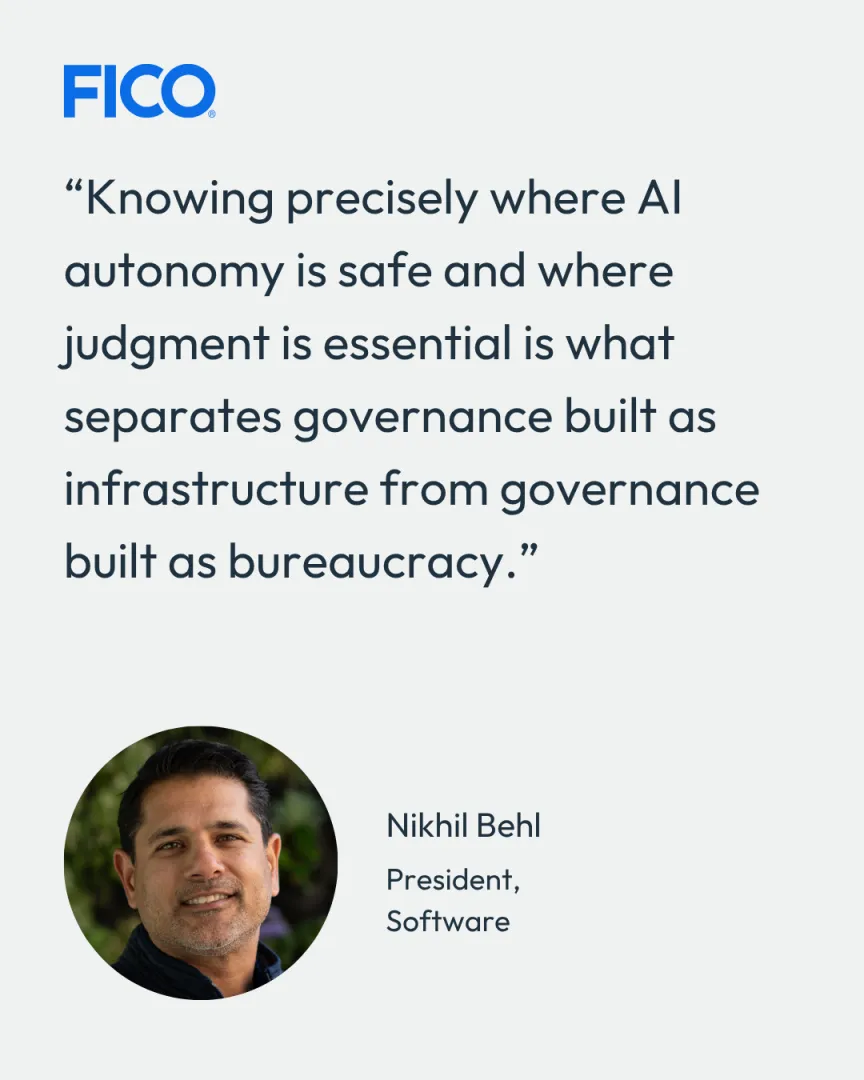
That clarity — knowing precisely where autonomy is safe and where judgment is essential — is what separates governance built as infrastructure from governance built as bureaucracy. And it matters commercially, not just legally: only 26% of consumers trust organizations to use AI responsibly. Institutions that can prove their AI is fair and explainable, decision by decision, will win trust that brand alone can't buy.
The Opportunity for AI Transformation Is Large and Unevenly Distributed
Up to $4.4 trillion in added productivity growth potential is on the table globally. It won’t go to the institutions running the most pilots. It will go to those who have built the foundation to operationalize what they learn, to take a model from sandbox to production, govern its outputs in real time, and explain its decisions to any regulator on demand.
At FICO, we’ve been building toward that foundation for seven decades. Not because we anticipated every twist in AI’s development, but because we understood early that better decisions require better infrastructure — and that in financial services, infrastructure you can’t trust isn’t infrastructure at all.
From Experimentation to Scale: How FICO Turns AI Strategy Into Production Decisions
The average human blink takes 200 to 400 milliseconds. FICO Platform coordinates fraud detection, risk assessment, customer profiling, and offers personalization in a fraction of that window.
Itaú Unibanco is one of the largest banking institutions in Brazil and Latin America. A third of the country’s daily transaction volume flows through its systems, and as a result, Itaú must determine whether a transaction is fraudulent in under 100 milliseconds. The speed, accuracy, and auditability of Itaú Unibanco requires a platform built specifically for financial services. It requires a platform with a unified data layer that ingests and enriches signals in real time, orchestration that coordinates fraud, risk, growth, and retention at once, and governance that traces every decision back to the model, data, and agent behind it.
One customer profile, not a dozen product silos
Banks are typically organized around products, not customers, which is why personalization has stayed aspirational at most institutions for over a decade. FICO Platform’s always-on dynamic profiling aggregates signals across originations, fraud, collections, customer management, and marketing into a single, continuously updated view of each customer, so every decisioning workflow draws from the same intelligence rather than stitching together siloed insights.
Built for AI agents, not retrofitted for them
As agentic AI becomes a bigger share of banking interactions on both the consumer and institutional side, platforms need to be natively agentic, not adapted after the fact. Every capability in FICO Platform is self-describing, constrained, and discoverable, so agents can find what they need, chain capabilities together, and act only within boundaries institutions define.
Governance as structure, not paperwork
FICO builds governance into the platform architecture itself rather than adding it as a compliance layer afterward:
- Immutability so decisions and configurations can’t be silently altered
- Full auditability from data ingestion through to outcome
- Jurisdiction-native data residency so institutions can deploy globally and comply locally without a separate security workstream for every release
AI Banking Transformation in Practice: Results from Institutions Already Using FICO to Run at Scale
TD Bank completed its fraud platform migration to FICO after a modernization journey that began in 2023, replacing legacy infrastructure that wasn’t built for the speed or sophistication of modern fraud. As Tarundeep Dhot, Head of Fraud at TD Bank, said: “We are not just a loss reduction function. We are a business enablement function. One dollar prevented in fraud is three dollars to revenue.”
Nationwide Building Society, one of the UK’s leading mortgage lenders, serving roughly 23 million people, has used FICO Platform to deploy new risk strategies 50% faster than five years ago. Andrew Lawrie, tech lead for credit risk at Nationwide Building Society said, “With FICO Platform, we’ve moved from a fragmented legacy system to a unified, scalable decisioning framework. This transition has empowered our teams to implement changes faster, minimize risks, and provide customers with faster, more personalized experiences.”
Absa Bank, one of South Africa's five largest banks, became the first of its peers to launch WhatsApp as a fraud communication channel using FICO Customer Communication Services. Fraud containment rates improved by 29% in card fraud and 33% in digital fraud, and customer promises to pay more than doubled after the channel launched.
Banco Santa Cruz, the largest and fastest-growing bank in the Dominican Republic, cut its policy change cycle from 90 days to 2 days, a 4,400% improvement, alongside a projected 65% drop in delinquency rates. Its CRO, Maribel Concepcion, described the shift plainly: “We are not making something just technological. We are changing our way to make things.”
Purpose-built decision intelligence vs. general-purpose AI: the choice institutions are actually making
General-purpose AI platforms offer breadth but limited financial services depth. Specialist vendors go deep in one domain, fraud or credit, but don’t cover the full customer lifecycle. Homegrown solutions offer control, but demand sustained engineering investment that few institutions can maintain at market pace. FICO’s position is defined by breadth, depth, and structural governance across the full customer lifecycle, built on decades of financial services domain expertise.
The distance between an AI pilot and a production decisioning system isn’t closed by better models alone. It’s closed by infrastructure built for the constraints banking actually operates under: real-time decisions, full explainability, and zero tolerance for decisions no one can account for.
FICO Platform is the only decision intelligence platform to have been recognized as a leader by Gartner, Forrester, and IDC simultaneously, for three years running. That recognition reflects not just capability, but the sustained execution required to deliver at scale in a highly regulated, rapidly evolving market.
See How FICO Supports Digital Transformation for Financial Services
- Watch Dr. Scott Zoldi’s keynote presentation at FICO World 2026 to learn more about the FICO innovations GenAI that tackle banking challenges
- Read the results of our State of Responsible AI in Financial Services survey to understand how AI initiatives and unified platforms are enabling financial services firms to reduce risk, accelerate innovation, and deliver measurable returns.
- Read the Executive-to-executive guide to successful digital transformation to see how hundreds of top financial services executives approach digital transformation and what it means for your organization
- Learn more about the FICO® Platform and how it revolutionizes the way financial services make decisions
Frequently Asked Questions
AI transformation is the strategic process an organization undergoes to adopt and integrate AI into its operations to drive innovation, efficiency, and growth. In banking, it means businesses are implementing a system where AI makes intelligent decisions across the full customer lifecycle, (including originations, fraud detection, collections, and customer management), using machine learning, predictive analytics, decision intelligence platforms, and agentic AI systems that act autonomously on behalf of consumers and institutions.
Decision intelligence technology connects existing data, predictive models, and business rules into repeatable, automated decision flows that can be deployed consistently across an organization. This helps digital transformation efforts succeed by closing the common gap between generating insight and acting on it at scale: routine decisions can be automated so staff focus on exceptions, decisioning stays consistent as processes move between departments, and built-in monitoring and simulation tools let teams test and refine strategies before rolling out changes, shortening the time between spotting a problem and fixing it.
FICO Platform gives financial institutions a unified, real-time view of the customer across every stage of the lifecycle, from acquisition and onboarding through servicing, retention, and collections, by connecting data and systems that traditionally sat in separate silos. This allows institutions to move from generic, stage-by-stage handling to more personalized and proactive engagement, such as tailoring offers at onboarding based on predicted needs, catching early warning signs of attrition or credit risk before they escalate, and adjusting servicing or collections strategies in response to a customer's changing circumstances. The result is a more consistent and responsive experience for the customer, along with better visibility for the institution into how decisions made at one stage of the lifecycle affect outcomes at the next.
An enterprise-wide AI decision platform replaces siloed, department-by-department automation with a shared foundation of data, models, and decisioning logic that every business unit can build on. This accelerates transformation since new initiatives can reuse existing infrastructure, improves consistency in decisions across the customer lifecycle, and gives leadership clearer visibility into performance, all while making it faster and less risky to adapt strategy than reworking automation embedded separately across many individual systems.

Popular Posts

Average U.S. FICO® Score at 716, Indicating Improvement in Consumer Credit Behaviors Despite Pandemic
The FICO Score is a broad-based, independent standard measure of credit risk
Read more
The GSE Data Is Public. Here's What It Shows About Credit Score Modernization.
Independent Milliman analysis of GSE historical data confirms what anyone can now verify directly: FICO® Score 10T is the most predictive score.
Read more
FICO® Score High Achievers: Is Age the Only Factor?
<p>FICO’s latest research on <a href="http://www.fico.com/en/blogs/risk-compliance/us-credit-quality-rising-the-beat-goes-on/" target="_blank">national FICO® Score distribution</a> shows that US credit quality continues to trend upwards, with an increasing number of consumers scoring in the highest scores ranges. Given that, we decided it was time to refresh our study on “<a href="http://www.fico.com/en/blogs/risk-compliance/infographic-what-does-a-high-credit-scorer-look-like/" target="_blank">FICO® Score high achievers</a>,” where we examine the credit behavioural profiles of consumers with higher credit scores.</p> <p>As expected, our latest study showed that older people generally have higher scores, as has been the case in our <a href="http://www.fico.com/en/blogs/risk-compliance/age-before-beauty-credit-worthiness-before-youth/" target="_blank">past research</a>. This is largely because they have trade lines that have been open longer, which leads to higher scores (assuming the trade lines are in good standing and all other things equal). The most credit savvy among you will remember that length of credit history accounts for roughly 15% of the overall <a href="http://www.myfico.com/CreditEducation/WhatsInYourScore.aspx" target="_blank">FICO® Score calculation</a>.</p> <p>But for younger consumers, it isn’t too helpful to say, “just wait until you are 50 years old, and that will fix things!” Thus, I decided to dive deeper with our analysis, including looking at the credit behavioural characteristics of younger consumers with high FICO® Scores.</p> <p>In this analysis, I looked at credit characteristics for the two highest score bands, 750-799 and 800-850, which have about 16% and 23% of the population, respectively. I further broke this down by looking at the characteristics of the youngest 15% in each group, which occurs at age 29 for the 750-799 group and 43 for the 800-850. We used FICO<strong>®</strong> Score 9 for our analysis, and examined typical variables of the categories that go into the make-up of the score.</p> <p><a href="http://www.fico.com/en/blogs/wp-content/uploads/2016/10/FICO-Score-High-Achiever-table.png"><img class="alignnone size-full wp-image-29367" src="http://www.fico.com/en/blogs/wp-content/uploads/2016/10/FICO-Score-High-Achiever-table.png" alt="fico-score-high-achiever-table" width="715" height="747" /></a></p> <p>Since there’s a lot to dissect in this chart, I’ll highlight a few findings that struck me: <ul> <li><strong>Credit history.</strong> Higher scores are undoubtedly associated with a longer time on file. What’s striking is the higher average time on file for the 800+ group, both overall and for revolving accounts (the most common trade line). Clearly, it helps to start credit use early in life – but that’s not the sole determining factor for high scoring. The younger cohorts in both the 800+ and 750-799 groups have time on file medians significantly less than their older counterparts.</li> <li><strong>New credit.</strong> High credit scorers do, in fact, pursue new credit. We see little variation in months since last trade line opening and last inquiry among all groups observed.</li> <li><strong>Pay on time.</strong> As you might expect, the further in the past the delinquency, the higher the score – and that’s <u>if</u> a delinquency ever happened. 95% of the 800+ people and 72% of the 750-799 group have never been delinquent, which is a striking contrast to the 57% for the total population. The percentages for the younger groups are even higher, especially so for the 750-799ers. Collection items are also scarce for these high scorers. While 23% of the national population have collection items greater than $99, the figures are only 0.5% for the 800+ group and 3% for the 750-799 group. It is clear that, in conjunction with starting a credit file early, paying on time is a key trait of the FICO® Score high achiever.</li> <li><strong>Balance and utilization.</strong> Finally, we look at how credit is being used, focusing on revolving product use. (Since most people only have one mortgage or one auto loan, variation in instalment product figures is minimal and driven by payment history, which is near perfect for high scorers, as we’ve seen.) FICO® Score high achievers tend to have more open revolving accounts. While the % active trades and utilization are generally lower, by no means do high scorers avoid the use of credit products. What drives the difference here is the amount of <u>available</u> revolving credit utilized. The 800+ group is roughly 1/4 of the national median, both in total and on their highest utilized card; they also have lower balances and more cards<em>. </em>The 750-799 group is more active and higher utilized, but still only at 2/3 of the national figures. The young 750-799 group compensate with lower revolving balances and, as a result, lower utilization, which is in line with what we see for the 800+ group.</li> <li><strong>Benchmarks.</strong> I’d like to point out that while this study provides good benchmarks of the typical credit traits of the FICO® Score high achiever, individual credit profiles will vary widely. And keep in mind that when we sort groups of consumers as a whole by different behaviours, some results may look superficially odd. For example, the 800+ band has a longer median average open account time (128 months) than average revolving months on file (140 months).</li> </ul> So, what do we conclude? A huge takeaway is that high scorers don’t have too much in the way of serious delinquencies and negative public record data.</p> <p>In most respects, the young 800+ people are like their peer group. They really only differ markedly in their shorter credit history and higher non-mortgage balance, both of which are a function of life stage. Our results show that you don’t have to be a credit product hermit; these high scorers have more credit cards. The takeaway is to start credit activity early and maintain well-managed and moderate usage.</p> <p>In many ways, the young 750-799 people are more interesting because their age profile is much younger. Their credit characteristics differ more from their peer group, particularly in terms of length of credit history. They compensate by having almost pristine credit records and lower balances.</p> <p>Ultimately, 39% of US consumers are FICO® Score high achievers, which they accomplish by following common-sense credit practices. It ain’t rocket science!</p>
Read moreTake the next step
Connect with FICO for answers to all your product and solution questions. Interested in becoming a business partner? Contact us to learn more. We look forward to hearing from you.