Overlimit Authorizations: Enhancing Credit Card Portfolio Revenue by Managing Insufficient Funds Declines
Overlimit events with credit cards can be a growth signal – here’s how to structure an overlimit strategy to improve retention, customer experience and revenues

Why Revisit Overlimit Now
In my previous post, 4 Key Ways to Drive Profitability With Overlimit Authorizations, I stated that overlimit events are a growth signal for credit cards, not just a risk event, and that the top issuers treat every request as a real-time, risk-based and customer-centric decision. This post explores precisely how the leading players across credit card issuers and processors in several regions leverage these decisions: the data they rely on, how they structure and combine them, and how each decision is configured — allowing selected customers to transact above their current limit.
Data from the FICO® Benchmark points to a clear opportunity: addressing insufficient funds can unlock additional revenue and increase retention in the credit card portfolio.
Key Highlights
- Credit card overlimit events are a growth signal, not just a risk event. Leading issuers treat each overlimit request as a real-time, risk-based and customer-centric decision, allowing selected customers to transact above their current limit when the data supports it.
- Insufficient funds declines represent a considerable missed opportunity. Transaction declines create friction for cardholders and merchants, drive attrition, and may reject customers who could safely be approved. FICO client data shows insufficient funds consistently ranks among the top three decline reasons.
- The strongest strategies combine multiple data points. Issuers improve overlimit decisioning by using behavior risk scores, bureau scores, merchant category codes, account tenure, credit limits and recent credit line changes rather than relying on a single threshold.
- Scenario-based tolerances make overlimit strategies testable. By configuring conservative, standard and aggressive approval scenarios, issuers can tune overlimit headroom to their risk appetite while monitoring approval rates, volume and portfolio impact.
- Better overlimit decisioning improves both retention and customer experience. Approving the right transaction in real time removes friction when customers are most sensitive to it and creates an opportunity for personalized communication through the customer’s preferred channel.
- Incremental revenue can build across the customer lifecycle. Overlimit approvals can unlock additional payment volume and interchange, while also feeding into credit limit management, risk-based pricing and cross-selling opportunities.
The Problem Hiding in the Decline File
Every card transaction declined for insufficient funds is a moment of friction for the cardholder and the merchant, and a well-documented driver of attrition. The scale is easy to underestimate. Independent research from Datos Insights puts the cost of transaction declines — legitimate transactions that issuers reject — at $213 billion globally in 2025, rising to $297 billion by 2029. The same study found that 78% of financial institutions consider failed payments critically damaging to customer experience, and that a third have lost between 2% and 5% of their cardholders as a result.
FICO’s own client data points the same way. At one South American bank, “insufficient limit” was the single largest decline reason, accounting for 21.5% of declined transactions. Another issuer in the same region saw 12.7% of transactions declined for insufficient funds. Across FICO clients and partners globally, “insufficient funds” consistently ranks among the top three decline reasons.
The insight is simple: a share of these declines are not risk decisions at all — they are blunt limit checks applied to customers who could safely be approved, like recurring transactions due to subscription services (streaming services and other industries). The FICO® Benchmark Reporting Service, built on more than 20 years of industry knowledge, indicates that between 30% and 60% of transactions that would be declined for insufficient funds can be approved, depending on the issuer’s risk appetite.
What Clients Use as Data: The Data Points Behind an Overlimit Strategy
The common thread across every engagement is that the strongest overlimit strategies combine multiple data points rather than relying on a single limit rule or score. In several situations, we see clients adopting blunt rules — applying a single threshold uniformly regardless of the customer’s risk profile — not due to a lack of data, but due to a lack of technology capabilities. When issuers evaluate whether to approve an overlimit transaction or a transaction on a delinquent account (two scenarios with distinct risk profiles), they balance relationship, exposure, external data, transaction data and credit history.
Our research shows that the data points most commonly leveraged across client engagements include:
- Behavior risk score, which commonly drives whether an account receives an expansion and by how much — the lower the risk, the higher the expansion
- Credit bureau score
- Merchant category code (particularly for identifying international spend)
- Months on books (typically no expansion under six months)
- Current credit limit (used to control the percentage of expansion)
- Months since the last credit line change, with recently increased lines often blocked from further expansion
Cash transactions are frequently subject to more scrutiny given their higher risk profile.
Ongoing client engagement makes this concrete. Working with client data, the FICO Advisors team leverage FICO® Platform to develop the best data-driven strategy, setting up the variables and thresholds to segment “good” and “bad” customers. The exercise confirmed the value of data-driven segmentation: credit card declined transactions carried up to ten times the default rate of approved ones, and even approved transactions showed a lower average risk, reflecting the customer’s profile rather than operational cut-offs. This is the difference between a static limit check and a genuine, transaction-level credit decision.
Structuring the Decision: Scenario-Based Tolerances
FICO Platform not only supports clients in developing and setting up their data-driven strategy, it also allows institutions to operationalize the process — configuring a decision path that maps a customer segment to a specific overlimit tolerance, most commonly expressed in three forms:
- A percentage above the assigned limit
- A fixed amount greater than the credit limit
- The ability for a customer to spend up to a certain limit ~ tuning to the risk of each node in a decision tree.
In one client strategy, the percentage of additional limit was parameterized according to the risk level of each individual node, with the strategy set up to approve transactions between 5% and 20% above the customer’s current limit.
Issuers then frame these tolerances as risk-appetite scenarios, turning overlimit from a fixed policy into a tunable, testable strategy. The pattern is consistent across engagements: issuers model a conservative, a standard, and an aggressive scenario, each with its own approval rate and projected volume. Backed by global data, we were able to see clients setting up different levels of risk appetite according to customer risk profile, with a conservative scenario at an 18% approval rate, a standard scenario at 22%, and an aggressive scenario at 29%. Another client, with more risk appetite, runs scenarios at 30% conservative, 40% standard, and 50% aggressive.
UK Consumer Duty and Compliance
Compliance remains the anchor. For instance, the UK’s 2023 Consumer Duty regulations require firms to deliver good customer outcomes by actively avoiding foreseeable harm, demonstrated across core outcomes, like fair value, consumer understanding, and proactively providing clear consumer support and information. These all directly dictate our overlimit strategies.
As noted in the previous post, overlimit services are permitted in most major markets, provided customers are informed of terms and fees, but nuances such as fee caps and consent requirements vary by region. In the UK, overlimit fees are capped at £12. Any scenario strategy must be designed to remain explainable and auditable — a requirement FICO Platform supports through its transparent decision-tree architecture.
Retention and Customer Experience: The Real Prize
The financial upside matters, but the experience upside is what protects the franchise. Declined transactions damage both cardholder and merchant relationships and are a well-documented driver of attrition. Approving the right overlimit transaction in real time — at the supermarket, online, or at an ATM — removes friction at exactly the moment a customer is most sensitive to it.
Across clients, real-time decisions are delivered through behavior and/or transaction risk score leverage by decision trees, with the roadmap extending to omnichannel communication so the issuer can inform the customer of the event and offer solutions, deepening trust rather than eroding it.
This connects back to the customer management fundamentals: interactive, real-time communication through the customer’s preferred channel, and treatment that is personalized to their risk and relationship rather than applied bluntly. Done well, an approved overlimit transaction becomes a moment of positive surprise and a foundation for long-term loyalty.
Unlocking New Revenue Across the Customer Lifecycle
The revenue case is compelling and repeatable across markets. The table below summarizes key benchmarks from FICO client engagements:
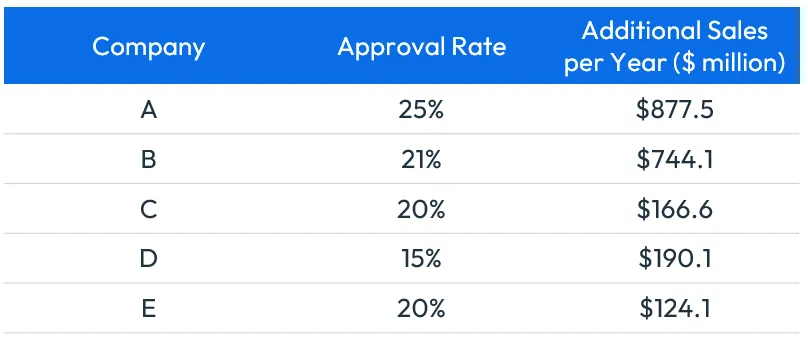
In India, a bank served by a FICO partner generated considerable additional payments volume up to $275 million and roughly $2.75 million in additional annual interchange at a 20% approval rate — while holding delinquency rates stable within predefined risk appetite thresholds. As a reminder, the data-driven strategy, with performance based on “good” behaviors, already points to the population default levels, which are by nature established by the originations process. Applying the FICO benchmark of approving around 20% of transactions declined for insufficient funds, another Indian portfolio pointed to roughly $96.2 million in additional transaction value and about $0.96 million in additional annual interchange.
In the wider Latin American region, a large-bank analysis found that 5.2 million authorizations were declined for insufficient funds in a single month, affecting 1.5 million customers and $300 million in monthly volume. Some 30% or more of these could have been approved, translating to $890 million in potential additional 12-month volume and an estimated $10.8 million in potential additional revenue. A separate regional analysis across Latin American issuers estimated 5.8 million additional approved transactions per year, $264 million in incremental payment volume, and $2.6 million in additional interchange revenue, assuming just 20% of declines were approved — a rate well supported by the FICO Benchmark Reporting Service.
Crucially, this is revenue that compounds across the lifecycle rather than a one-off. An overlimit event is a signal that the current limit may no longer fit the customer’s needs, feeding directly into credit limit management, risk-based pricing, and cross-selling. A FICO case study comparing active versus passive users of customer management tools over a 41-month period found that active users — those leveraging the broadest range of tools, including overlimit management, credit limit decisions, and targeted marketing — achieved materially higher account profitability, with limit offers and cross-selling opportunities increasing up to 20%, revenue growth annualized at 11%, and a 30% reduction in 90-plus-day delinquency, alongside up to 42% additional annual revenue and 66% higher profit per account.
Turning Insight into Action
For issuers reviewing their own approach, the evidence points to three practical moves.
First, quantify what the “insufficient funds” decline file is really costing in lost volume, interchange, and customer goodwill — the numbers are almost always larger than expected.
Second, move from a single overlimit tolerance to segmented scenarios built on multiple data points, so headroom of 5%–20% can be extended to the lowest-risk, highest-value customers while protecting the portfolio.
Third, close the loop by simulating conservative, standard, and aggressive scenarios, deploying the one that fits the stated risk appetite, and refining it on observed performance.
How FICO Can Help You Improve the Profitability of Your Card Portfolio
FICO Platform brings data, real-time decisioning, decision-tree design, simulation, and continuous-feedback capabilities needed to design, test, and refine overlimit scenario strategies for credit card issuers — reducing declines while increasing approvals for the customers who matter most.
- Explore how FICO® Platform can help you reduce losses and increase approval rates through automation, analytics, and informed customer insights
- Read the previous post: 4 Key Ways to Drive Profitability with Overlimit Authorizations
- Read the supporting study: Using More Customer Management Tools Can Generate Millions in Incremental Profit
- To explore this for your portfolio, reach out to your designated FICO Advisor or sales executive
Frequently Asked Questions
An existing account carries behavioral history that a new application does not. Rather than relying on a single bureau-based threshold, the strongest overlimit strategies combine several signals: behavior risk score, credit bureau score, transaction data, account tenure, current credit limit, and how recently the credit line was last changed. This blended approach allows issuers to differentiate between customers who present low incremental risk and those who warrant more caution, rather than applying one rule uniformly across the portfolio.
Larger than most issuers assume, and it surfaces in three places. The first is attrition: failed payments are widely recognized as critically damaging to customer experience, and a meaningful share of institutions lose cardholders directly as a result. The second is the customer journey — a decline lands at the point of transaction, the moment a customer is most sensitive to friction, and it strains the merchant relationship at the same time. The third is renounced revenue: every transaction turned away is payment volume and interchange the institution never earns, compounding across the lifecycle as the card slips down the customer's wallet.
An overlimit event can act as a signal that a customer's current limit may no longer reflect their financial situation. That insight can inform decisions elsewhere in the relationship, including credit limit management, risk-based pricing, and cross-selling. Institutions that draw on this broader set of customer management capabilities, rather than managing limits in isolation, are positioned to build more complete, responsive customer strategies over time.
Personalization and compliance are treated as complementary rather than competing goals. Regulatory frameworks such as the UK's Consumer Duty require firms to actively avoid foreseeable harm and to demonstrate good outcomes around fair value, consumer understanding, and clear support. Any tiered or scenario-based approach to overlimit decisioning should therefore remain explainable and auditable.
The signal can be track in two fronts: a cyclical refresh of behavior and bureau scores, and a real-time read of the transaction at authorization — MCC, cash versus purchase, value against normal pattern. Guardrails limit expansion inside the first six months on books and after a recent line change. Then close the loop: test conservative, standard and aggressive scenarios, deploy to appetite, and retune on observed approval and delinquency performance.

Popular Posts

Average U.S. FICO® Score at 716, Indicating Improvement in Consumer Credit Behaviors Despite Pandemic
The FICO Score is a broad-based, independent standard measure of credit risk
Read more
The GSE Data Is Public. Here's What It Shows About Credit Score Modernization.
Independent Milliman analysis of GSE historical data confirms what anyone can now verify directly: FICO® Score 10T is the most predictive score.
Read more
FICO Statement on FHFA and FHA Updates to Credit Score Modernization
FICO supports FHFA’s announcement that the long-anticipated historical data for FICO® Score 10T will be released to the mortgage market.
Read moreTake the next step
Connect with FICO for answers to all your product and solution questions. Interested in becoming a business partner? Contact us to learn more. We look forward to hearing from you.