How HSBC UK Grew Credit Card Spend 15% Without Increasing Risk, Using FICO's AI Decision Optimization
Discover how HSBC UK used FICO Enterprise Optimization to grow monthly credit card spend by 15% and share of wallet by 6%, without increasing financial risk

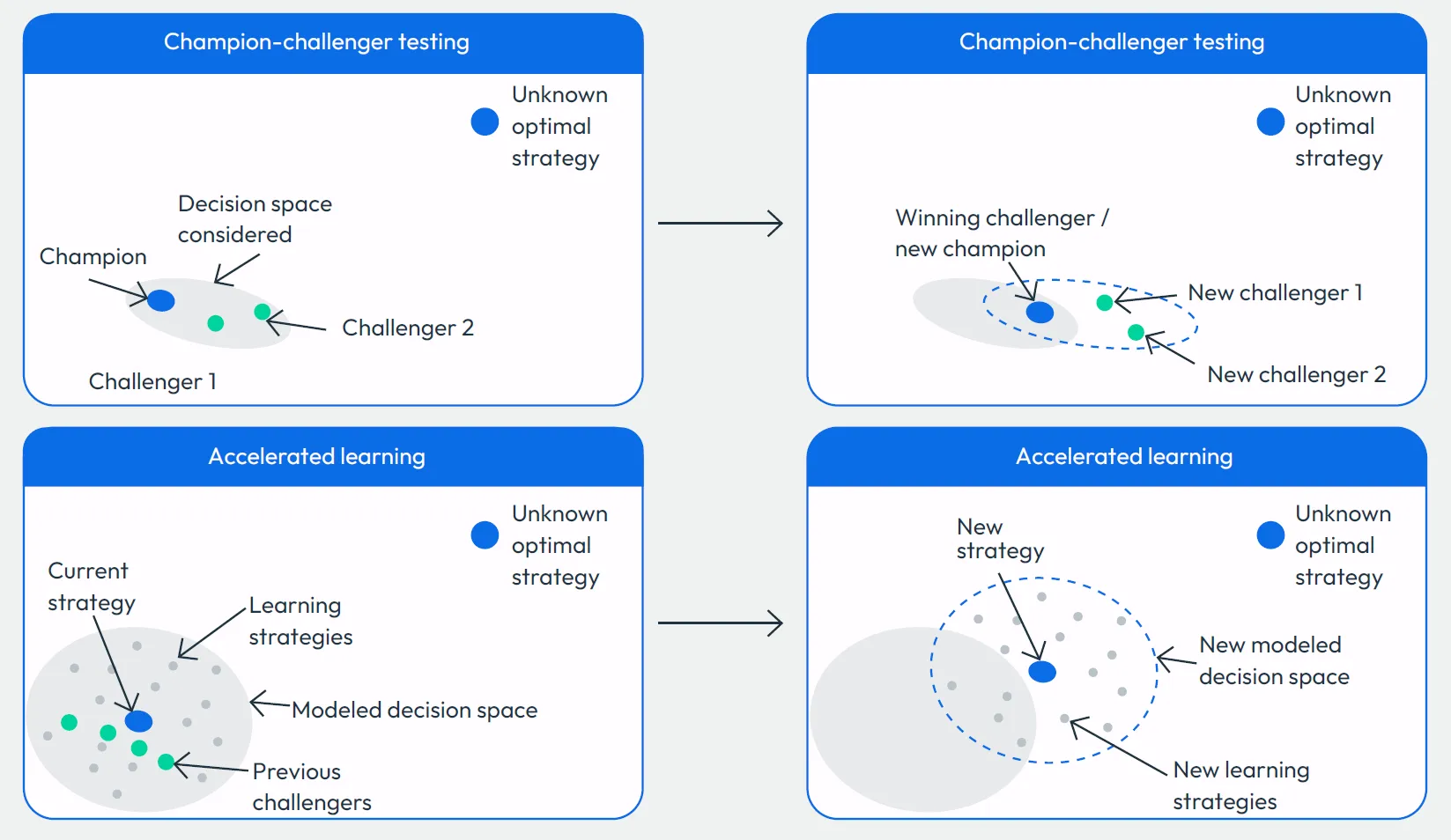
HSBC UK addressed the challenge of balancing growth, risk, and capital efficiency by partnering with FICO to apply the Enterprise Optimization Capability available on FICO Platform to its credit line increase strategy. Rather than relying on the bank's previous champion-challenger testing approach, which tested strategies sequentially and iteratively, HSBC UK adopted an accelerated learning model capable of evaluating a substantially larger decision space in parallel.
This shift enabled the bank to:
- Move beyond narrow, sequential test cycles toward simultaneous evaluation of multiple strategies, executing approximately 40 optimization scenarios to identify the most effective approach.
- Balance growth objectives against risk, profitability and customer-level behavior, using eight action-effect models to forecast customer spending, revenue and potential losses.
- Apply causal inference modeling to understand not only how customers had responded to past offers, but how their behavior would change under different offer scenarios.
Key Takeaways
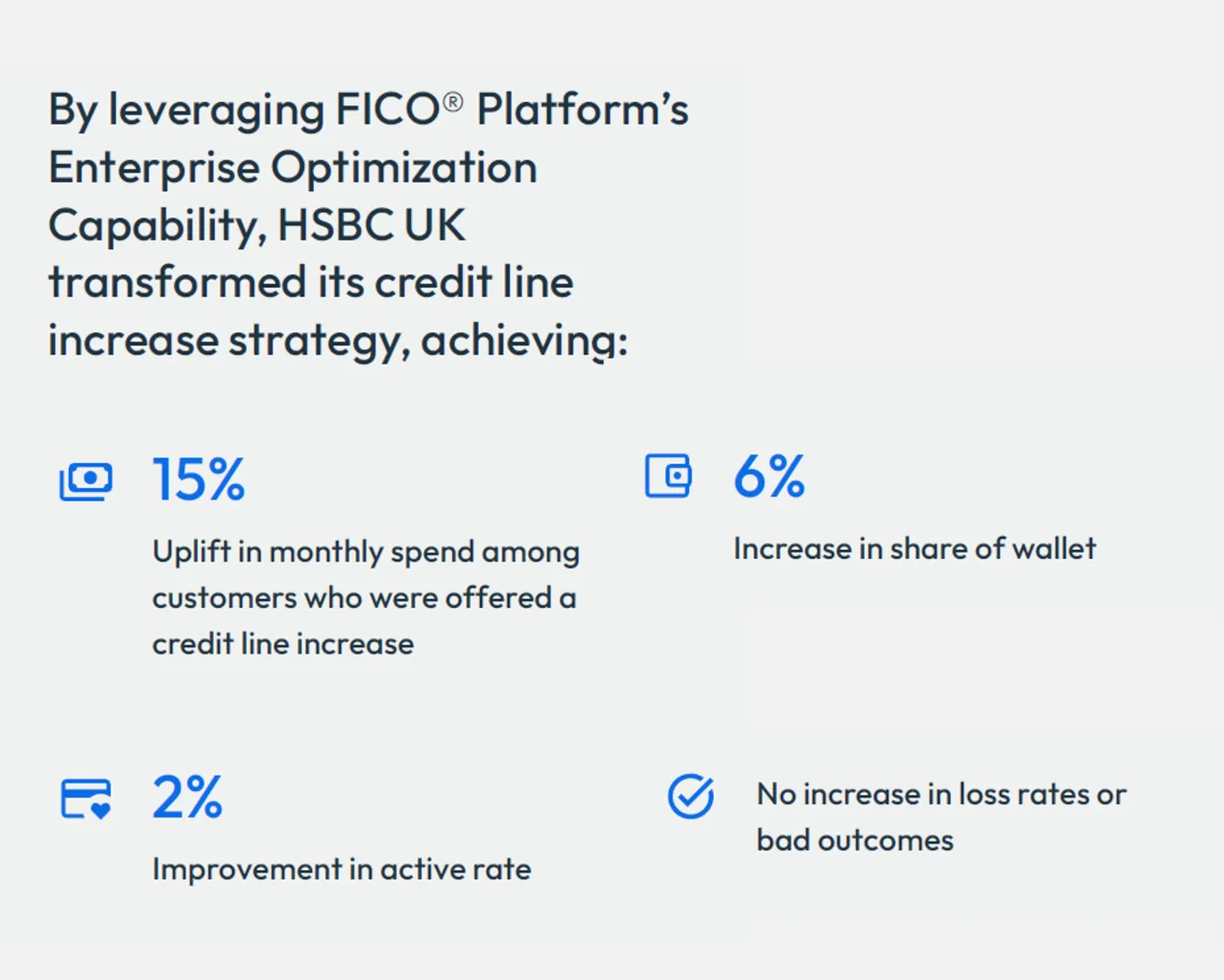
- Growth and risk management are no longer mutually exclusive. By partnering with FICO, HSBC UK achieved a 15% increase in monthly spend among customers offered a credit line increase, a 2% improvement in active rate and a 6% boost in share of wallet. Despite higher credit utilization, the proportion of customers experiencing financial difficulty remained stable or even declined, proving that growth and responsible risk management can move forward together rather than in conflict.
- Parallel optimization finds the best strategy faster than sequential testing. HSBC UK's previous champion-challenger approach tested one challenger strategy at a time in slow, iterative cycles. By adopting an accelerated learning model, the bank was able to evaluate a much larger modeled decision space simultaneously, running approximately 40 optimization scenarios to arrive at its most effective strategy far more quickly.
- Causal inference closes the gap between prediction and real decision-making. Traditional analytic modeling could only show how customers had reacted to past offers, not how they would behave under a different one. FICO Platform's Enterprise Optimization Capability used causal inference models to simulate customer responses to spending, engagement, loss rates, and profitability under different scenarios, giving HSBC UK the insight to make more targeted, effective offers.
- Turning Disruption into an Opportunity for Refinement. When COVID-19 upended the economic landscape, HSBC UK paused its credit line optimization strategy rather than pushing forward blindly. It used the pause to refine its approach, and when it relaunched in February 2022, the updated strategy proved even more effective at identifying customers who could responsibly benefit from credit.
- Regulatory change and customer-centricity reinforced each other rather than competing. When the UK Consumer Duty raised the bar from "Treating Customers Fairly" to "Delivering Good Customer Outcomes" in July 2023, HSBC UK used FICO's explainable, data-driven optimization to actively align its credit strategies with customers' financial well-being, turning a compliance requirement into a driver of better outcomes for both the bank and its customers.
About HSBC UK: What Makes It One of the World's Leading Financial Institutions?
HSBC operates as one of the world's foremost financial institutions, serving a global customer base of over 40 million. Within the UK, where the bank functions as a ring-fenced entity, HSBC UK provides an extensive suite of financial services, spanning routine financial management through to private banking and wealth advisory offerings
HSBC UK's scale reflects its position as a major player in UK retail banking, with 14.5 million active retail customers, 600,000 business customers, and a workforce of 23,800 employees
According to Mike Roberts, Head of Unsecured Retail Risk at HSBC UK, the institution's purpose centers on enabling opportunity for its customers: "At HSBC, our mission is to open up a world of opportunity, and that's what drives us every day. Whether it's credit or wealth management, we're committed to helping our customers achieve their greatest financial ambitions"
The Challenge: Balancing Growth, Risk, and Customer Experience
HSBC UK's core challenge was automating and optimizing the decision-making process for credit line increases while balancing customer needs, risk, profitability, and sustainable growth in a highly competitive market.
Ensuring Credit Offers Reached the Right Customers
The UK retail banking market is highly competitive, with customers typically managing multiple financial relationships. To build loyalty, HSBC UK needed to strengthen customer engagement, yet ensuring that credit offers reached the right individuals remained a persistent challenge. Without precise targeting, offers risked being ignored or misallocated, limiting both customer satisfaction and business impact. HSBC UK sought to refine its approach to maximize the effectiveness of its credit strategies while maintaining a responsible lending framework.
Mike Roberts, Head of Unsecured Retail Risk at HSBC UK, framed the stakes clearly: "Providing credit to our customers is a powerful tool for helping them achieve their dreams, but we have to do it responsibly. Our goal was to ensure we're offering tailored credit line increases that balance customer needs and financial health".
Growing the Credit Card Portfolio Without Compromising Risk
At the same time, HSBC UK faced the challenge of growing its credit card portfolio while managing risk and capital efficiency. Traditional decision-making processes made it difficult to pinpoint the right customers for credit line increases and to predict how they would use them. Without better insight, the bank risked extending credit where it would not drive value or, conversely, missing opportunities to support customers responsibly. This left HSBC UK needing a way to automate and optimize these decisions, ensuring growth without compromising risk management.
Roberts summarized the strategic imperative this created: "To meet our strategic priorities, we needed a solution that could streamline our decision-making process, balance profitability with responsible lending, and enhance customer engagement while supporting our digital transformation."
Adapting to Uncertainty: How Did HSBC UK Navigate the Pandemic and Regulatory Change?
HSBC UK's journey to optimize its credit line strategy was shaped by two major challenges.
Pandemic disruptions
HSBC UK's credit line optimization strategy was temporarily paused as the COVID-19 pandemic upended the economic landscape. Amid shifting financial behaviors and declining credit demand, the bank used this period to refine its approach rather than proceeding without adjustment. Upon relaunch in February 2022, the updated strategy proved even more effective in identifying customers who could benefit from credit, reinforcing HSBC UK's commitment to responsible growth.
Evolving regulatory standards
The introduction of the UK Consumer Duty in July 2023 raised compliance expectations across the industry, shifting the regulatory focus from "Treating Customers Fairly" to "Delivering Good Customer Outcomes." This required HSBC to move beyond transparency alone and actively align its credit strategies with customers' financial well-being.
The Solution: How FICO's Enterprise Optimization Capability Changed the Equation
HSBC UK partnered with FICO to leverage its Enterprise Optimization Capability, which uses advanced mathematical optimization solvers paired with user-friendly modeling and analysis tools to solve complex decision-making problems
Bridging the Predictive Gap in Traditional Modeling
Traditional analytic modeling techniques could predict how customers had reacted to previous credit limit offers, but they lacked the ability to understand how those reactions would change if a different offer were made. FICO Platform's Enterprise Optimization Capability closed this gap by leveraging causal inference models to understand these trade-offs, enabling HSBC UK to rapidly test and identify the most effective strategies. This allowed the bank to define specific goals and constraints, and to execute multiple scenarios in parallel, resulting in an improved decision strategy ready for deployment.
Strategic Gains from the Optimization-Driven Approach
This shift in methodology allowed HSBC UK to move to a more data-driven segmentation of customers, grounded in lending needs, risk, and growth potential. It also allowed the bank to refine its credit line increase offers, identifying customers who would generate meaningful balance growth and revenue while reducing offers to those with minimal impact, including extending offers to customers who had previously been excluded from the strategy. Profitability was further strengthened by aligning credit line increase strategies with customers' actual behaviors and financial outcomes
Developing the Analytical Framework Behind the Strategy
Together, HSBC UK and FICO developed a decision-influence process tailored specifically to the credit line increase strategy. This involved creating eight action-effect models to forecast customer spending, revenue, and potential losses. These models, combined with HSBC UK's internal profit calculations, powered approximately 40 optimization scenarios, helping the bank fine-tune its strategy to balance growth, risk, and customer satisfaction.
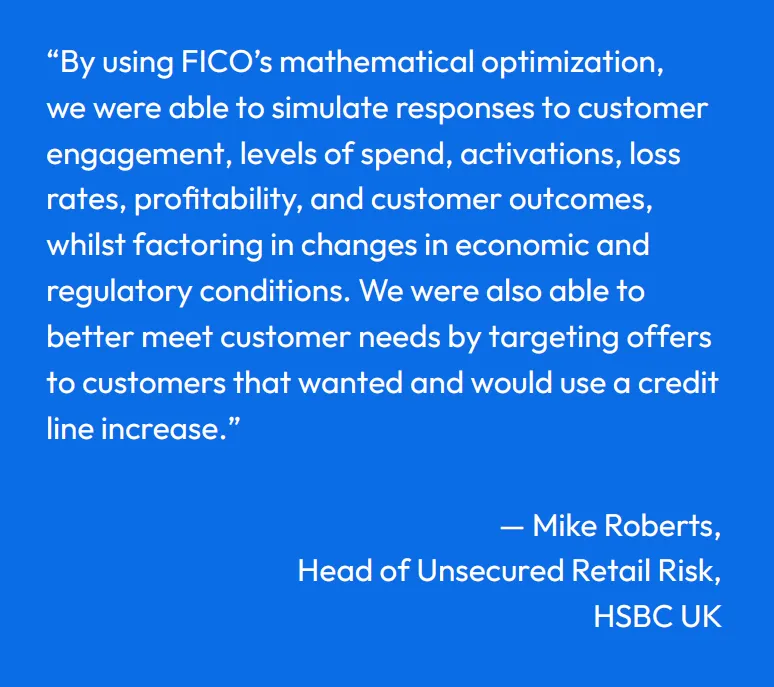
As Mike Roberts, Head of Unsecured Retail Risk at HSBC UK, explained: "By using FICO's mathematical optimization, we were able to simulate responses to customer engagement, levels of spend, activations, loss rates, profitability, and customer outcomes, whilst factoring in changes in economic and regulatory conditions. We were also able to better meet customer needs by targeting offers to customers that wanted and would use a credit line increase."
The Results: Measurable Impact Without Added Risk
HSBC UK's use of decision optimization transformed its credit line increase strategy into a data-driven, performance-enhancing model. The bank's ability to scientifically target the right customers, reallocating offers from underperforming segments to high-potential ones, led to significant improvements in customer engagement and business performance.
Compared with its previous strategy, HSBC UK achieved:
- A 15% increase in monthly spend for customers who were offered a credit line increase
- A 2% improvement in active rate that kept more customers engaged
- A 6% boost in share of wallet that strengthened customer relationships.
Most importantly, these gains were achieved without increasing financial risk. Despite higher credit utilization, the proportion of customers experiencing financial difficulty remained stable or even declined, reinforcing HSBC UK's commitment to responsible lending.
With an accelerated learning approach now in place, HSBC UK is positioned to continuously optimize its strategies, unlocking further growth and staying ahead of the competition in the years ahead.
HSBC UK's Innovation Earned Recognition Across Financial Services
HSBC UK's work on this project has earned significant recognition across the financial services industry.
- The bank was honored with the 2025 FStech Award for Best Use of Data Analytics. Part of the FStech Awards, which celebrate outstanding achievement and innovation in financial services across the UK and EMEA regions, this accolade recognized FICO and HSBC's excellence in leveraging data analytics to drive meaningful advancements in the industry.
- HSBC was also named a finalist for "Best Use of Technology" at the 2024 Credit Awards, hosted by Credit Strategy, a leading influencer in financial services across EMEA, highlighting the bank's commitment to advancing technological solutions that drive innovation and best practices in the sector.
- HSBC received the 2024 FICO Decisions Award for AI, Machine Learning, and Optimization. Awarded by an independent panel of industry judges, this award emphasized the bank's excellence in leveraging cutting-edge technologies to optimize decision-making processes and deliver enhanced financial services.
Explore More on Decision Optimization
- Read the full case study to learn more about how FICO Platform’s Enterprise Optimization Capability enabled HSBC UK to move beyond slower, iterative champion-challenger testing toward an accelerated learning approach, allowing the bank to identify its optimal credit line strategy with greater speed and precision
- HSBC UK's results are just one example of what's possible when optimization meets applied intelligence. Discover how FICO Platform can help organizations transform decisioning across the entire customer lifecycle, from acquisition to retention, and turn AI-driven insight into measurable business outcomes.
- Discover the power of action-effect modeling and mathematical optimization in action. Explore How Akbank Increased Profit by 129% to see how data-driven decisioning reshaped a major bank's lending strategy
- By transitioning from manual forecasting to data-driven optimization, Avis Europe transformed fleet allocation, pricing strategy, and the overall customer experience, unlocking $19 million in annual value in the process. Discover how a data-driven approach could deliver comparable results for your organization in Optimization Drives $19 Million Gains at Avis.
Frequently Asked Questions
Action-effect modeling is an analytical methodology that projects how a particular action, such as the extension of a credit line increase, will affect a specified outcome, including customer spending, revenue, or losses. Rather than evaluating customer behavior in isolation, these models are constructed to isolate the effect directly attributable to the decision itself. This capability holds considerable value in credit line decision-making, as it allows an institution to determine the incremental impact of a given offer.
Traditional predictive modeling reveals how customers have behaved in the past, but it cannot indicate how they would respond under different conditions. Causal inference addresses this limitation by estimating outcomes under alternative scenarios, such as the likely effect of offering a larger credit line than a customer previously received. This enables institutions to anticipate the impact of a decision before it is made, supporting more precise and forward-looking strategies.
The same principles that transformed HSBC UK's credit line strategy apply across the entire customer lifecycle. Organizations are applying decision optimization to customer acquisition, pricing, collections and recoveries, marketing offer allocation, fraud strategy, and retention. In practice, any decision that requires balancing competing objectives against real-world constraints is a strong candidate for optimization, which means the opportunity to drive measurable value rarely stops at a single use case. Wherever complex trade-offs exist, optimization can help turn them into a source of competitive advantage.
Enterprise optimization supports regulatory compliance by making decision-making transparent, explainable, and explicitly aligned with defined objectives and constraints, including customer well-being. Because the approach models outcomes such as financial difficulty alongside profitability, it enables an institution to demonstrate that its strategies are designed to deliver good customer outcomes rather than simply to maximize revenue.

Popular Posts

Average U.S. FICO® Score at 716, Indicating Improvement in Consumer Credit Behaviors Despite Pandemic
The FICO Score is a broad-based, independent standard measure of credit risk
Read more
The GSE Data Is Public. Here's What It Shows About Credit Score Modernization.
Independent Milliman analysis of GSE historical data confirms what anyone can now verify directly: FICO® Score 10T is the most predictive score.
Read more
FICO® Score High Achievers: Is Age the Only Factor?
<p>FICO’s latest research on <a href="http://www.fico.com/en/blogs/risk-compliance/us-credit-quality-rising-the-beat-goes-on/" target="_blank">national FICO® Score distribution</a> shows that US credit quality continues to trend upwards, with an increasing number of consumers scoring in the highest scores ranges. Given that, we decided it was time to refresh our study on “<a href="http://www.fico.com/en/blogs/risk-compliance/infographic-what-does-a-high-credit-scorer-look-like/" target="_blank">FICO® Score high achievers</a>,” where we examine the credit behavioural profiles of consumers with higher credit scores.</p> <p>As expected, our latest study showed that older people generally have higher scores, as has been the case in our <a href="http://www.fico.com/en/blogs/risk-compliance/age-before-beauty-credit-worthiness-before-youth/" target="_blank">past research</a>. This is largely because they have trade lines that have been open longer, which leads to higher scores (assuming the trade lines are in good standing and all other things equal). The most credit savvy among you will remember that length of credit history accounts for roughly 15% of the overall <a href="http://www.myfico.com/CreditEducation/WhatsInYourScore.aspx" target="_blank">FICO® Score calculation</a>.</p> <p>But for younger consumers, it isn’t too helpful to say, “just wait until you are 50 years old, and that will fix things!” Thus, I decided to dive deeper with our analysis, including looking at the credit behavioural characteristics of younger consumers with high FICO® Scores.</p> <p>In this analysis, I looked at credit characteristics for the two highest score bands, 750-799 and 800-850, which have about 16% and 23% of the population, respectively. I further broke this down by looking at the characteristics of the youngest 15% in each group, which occurs at age 29 for the 750-799 group and 43 for the 800-850. We used FICO<strong>®</strong> Score 9 for our analysis, and examined typical variables of the categories that go into the make-up of the score.</p> <p><a href="http://www.fico.com/en/blogs/wp-content/uploads/2016/10/FICO-Score-High-Achiever-table.png"><img class="alignnone size-full wp-image-29367" src="http://www.fico.com/en/blogs/wp-content/uploads/2016/10/FICO-Score-High-Achiever-table.png" alt="fico-score-high-achiever-table" width="715" height="747" /></a></p> <p>Since there’s a lot to dissect in this chart, I’ll highlight a few findings that struck me: <ul> <li><strong>Credit history.</strong> Higher scores are undoubtedly associated with a longer time on file. What’s striking is the higher average time on file for the 800+ group, both overall and for revolving accounts (the most common trade line). Clearly, it helps to start credit use early in life – but that’s not the sole determining factor for high scoring. The younger cohorts in both the 800+ and 750-799 groups have time on file medians significantly less than their older counterparts.</li> <li><strong>New credit.</strong> High credit scorers do, in fact, pursue new credit. We see little variation in months since last trade line opening and last inquiry among all groups observed.</li> <li><strong>Pay on time.</strong> As you might expect, the further in the past the delinquency, the higher the score – and that’s <u>if</u> a delinquency ever happened. 95% of the 800+ people and 72% of the 750-799 group have never been delinquent, which is a striking contrast to the 57% for the total population. The percentages for the younger groups are even higher, especially so for the 750-799ers. Collection items are also scarce for these high scorers. While 23% of the national population have collection items greater than $99, the figures are only 0.5% for the 800+ group and 3% for the 750-799 group. It is clear that, in conjunction with starting a credit file early, paying on time is a key trait of the FICO® Score high achiever.</li> <li><strong>Balance and utilization.</strong> Finally, we look at how credit is being used, focusing on revolving product use. (Since most people only have one mortgage or one auto loan, variation in instalment product figures is minimal and driven by payment history, which is near perfect for high scorers, as we’ve seen.) FICO® Score high achievers tend to have more open revolving accounts. While the % active trades and utilization are generally lower, by no means do high scorers avoid the use of credit products. What drives the difference here is the amount of <u>available</u> revolving credit utilized. The 800+ group is roughly 1/4 of the national median, both in total and on their highest utilized card; they also have lower balances and more cards<em>. </em>The 750-799 group is more active and higher utilized, but still only at 2/3 of the national figures. The young 750-799 group compensate with lower revolving balances and, as a result, lower utilization, which is in line with what we see for the 800+ group.</li> <li><strong>Benchmarks.</strong> I’d like to point out that while this study provides good benchmarks of the typical credit traits of the FICO® Score high achiever, individual credit profiles will vary widely. And keep in mind that when we sort groups of consumers as a whole by different behaviours, some results may look superficially odd. For example, the 800+ band has a longer median average open account time (128 months) than average revolving months on file (140 months).</li> </ul> So, what do we conclude? A huge takeaway is that high scorers don’t have too much in the way of serious delinquencies and negative public record data.</p> <p>In most respects, the young 800+ people are like their peer group. They really only differ markedly in their shorter credit history and higher non-mortgage balance, both of which are a function of life stage. Our results show that you don’t have to be a credit product hermit; these high scorers have more credit cards. The takeaway is to start credit activity early and maintain well-managed and moderate usage.</p> <p>In many ways, the young 750-799 people are more interesting because their age profile is much younger. Their credit characteristics differ more from their peer group, particularly in terms of length of credit history. They compensate by having almost pristine credit records and lower balances.</p> <p>Ultimately, 39% of US consumers are FICO® Score high achievers, which they accomplish by following common-sense credit practices. It ain’t rocket science!</p>
Read moreTake the next step
Connect with FICO for answers to all your product and solution questions. Interested in becoming a business partner? Contact us to learn more. We look forward to hearing from you.