Preventing Application Fraud with Machine Learning and AI
When it comes to application fraud, machine learning analytics must be a critical part of a financial institution’s control strategy.


In 1997, the IBM supercomputer Deep Blue beat chess grandmaster Garry Kasparov. This defeat skyrocketed artificial intelligence (AI) into the headlines. Twenty years on, AI has transformed our daily lives: from the medical field to voice controlled devices that will order your favorite pizza to self-driving autonomous vehicles. But how can it best be used to fight application fraud?
It was not much before Deep Blue, in 1992, that FICO pioneered the use of artificial intelligence and machine learning to fight credit card fraud. Fraud losses on US credit cards were reduced by over 70% since the introduction of FICO’s real-time anti-fraud analytics. This is perhaps one of the earliest use cases of using AI moving past academia to solve a real-world business problem.
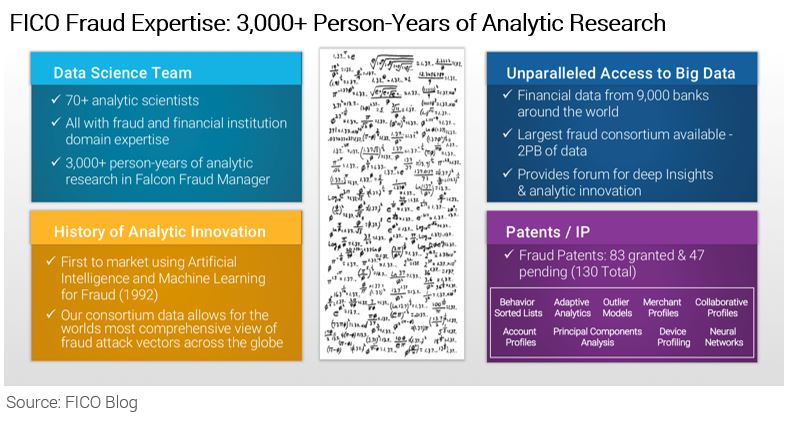
FICO didn’t stop there. We continue to innovate with a dedicated team of 70+ data scientists in our R&D arm fighting against fraud cross-product and cross-channel across the enterprise. With over 9,000 financial institutions continually contributing data to the FICO Falcon consortium, we have petabytes of data to learn from.
Now we are tackling an exponentially growing type of fraud — application fraud – and we recognize that machine learning analytics must be a critical part of a financial institution’s control strategy. With everyone talking about machine learning and artificial intelligence, it’s important to level what these terms actually mean and to understand how we can operationalize these analytic innovations in a way that makes sense in a highly regulated lending environment.
How Is AI Different from Machine Learning?
Artificial intelligence uses computers to mimic the human brain and perform tasks that require intelligence and learning. While machine learning and artificial intelligence are often used interchangeably, machine learning is a subset of artificial intelligence that uses algorithms to exhibit intelligent behaviors. Machine learning algorithms do what humans cannot: siphon through massive amounts of data and produce scores that, for example, rank-order transactions from highest to lowest likelihood of fraud.Scores add precision to the broad-brush approach of rules-based detection. Instead of coding up and alerting on known patterns of how fraud operates, machine learning analytics are sensitive to the complex, multi-variate attributes that predict fraud – whether it’s payments fraud, application fraud, account takeover, mass card compromise, or more.
Generally speaking, machine learning analytics fall into two broad categories: supervised and unsupervised.
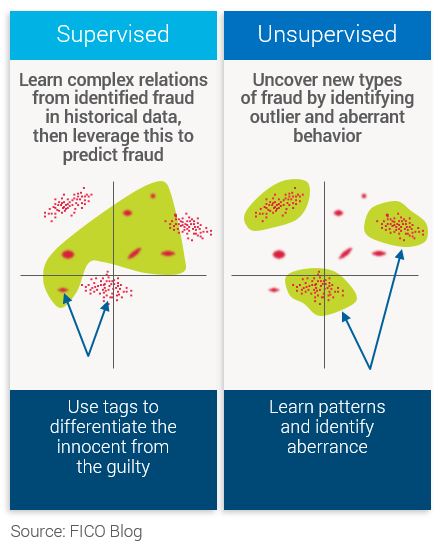
A supervised model is a model that is trained on a rich set of properly tagged or labeled (e.g., fraud and non-fraud) examples. Although typically more accurate, supervised models do require frequent retraining to keep up with evolving fraud modus operandi.
Unsupervised models, on the other hand, do not require previous tags and rely on outlier detection to find aberrant behavior that is indicative of fraud. This starts with understanding the archetype or peer grouping of a transaction to detect where this transaction is acting differently than expected.
For example, if an applicant for an auto loan is sub-prime, the vehicle is an economy compact vehicle, and the stated salary is $35,000, this application is likely in a very different peer group than an applicant with an 800 FICO Score borrowing money for a Mercedes G-Series. If we understand who we should be comparing each applicant to, the inherent assumption is that higher the aberrance to expected behavior, the higher the likelihood of fraud.
Unsupervised models are handy in situations where there is a lack of fraud exemplars, for example if a new type of product or channel is launched. And although these models do not offer complete protection against all fraud attacks, they do provide an important line of defense against new attacks and alongside supervised models can provide enhanced prediction.
Self-Learning Scores
Whether supervised or unsupervised techniques are used, self-learning models provide an added layer of resiliency and longevity to the robustness of a score. Also known as adaptive analytics, self-learning techniques mean that models can continuously learn about new behavior patterns by using the actual outcomes and feedback that fraud analysts provide on worked cases. These scores fine-tune attribute weights, automatically refresh algorithms, and adjust final scores predictions accordingly.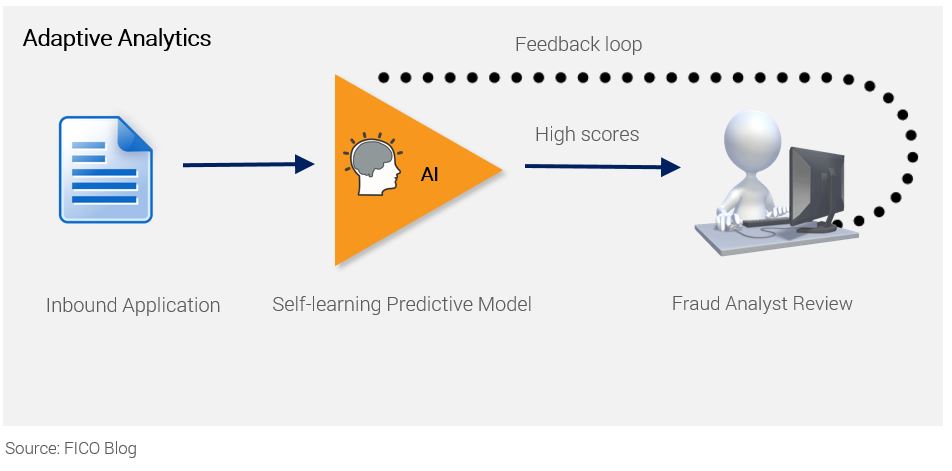
Machine Learning to Fight Application Fraud
As with most good things, there is a catch: Operationalizing machine learning, particularly in highly regulated environments such as lending, requires significant consideration. Many machine learning algorithms are considered “black box” models that do not give fraud analysts, consumers, or regulators the appropriate insights into decisioning logic, e.g., “Why am I being declined for credit?”This is why explainable artificial intelligence is so important: to impart the necessary transparency to pass regulatory muster, while maintaining accuracy of prediction.
FICO are very cognizant of the impact of regulations to our business and for our clients. In fact, we pride ourselves in leveraging mathematical innovation to solve problems in the real world. In the area of account originations, our credit risk and fraud scores are designed to be a tool to assist lenders with compliance to applicable fair lending laws such as the Fair Credit Reporting Act, Regulation B, and the Equal Credit Opportunity Act (ECOA).
Stay tuned because our plan is to dive even deeper into machine learning for application fraud with our next few posts. In the meanwhile, check out our previous posts on application fraud, including:
- Trends in Application Fraud – From Identity Theft to First-Party Fraud
- Best Practices in Establishing Your Fraud Risk Appetite
- ELI5: How Does the Dark Web Work?
- What Data Do I Need to Fight Application Fraud?
- Best Practices in Fraud Management: Q & A with Bob Shiflet
Learn More at FICO World 2018
Want to learn more about AI? Join us at FICO World, April 16-19 in Miami Beach. In addition to presentations from our chief analytics officer, Dr. Scott Zoldi, and others on AI and its applications in fraud, we’re excited to have keynote speaker Garry Kasparov share with us what really happened with Deep Blue.
Popular Posts

Average U.S. FICO® Score at 716, Indicating Improvement in Consumer Credit Behaviors Despite Pandemic
The FICO Score is a broad-based, independent standard measure of credit risk
Read more
The GSE Data Is Public. Here's What It Shows About Credit Score Modernization.
Independent Milliman analysis of GSE historical data confirms what anyone can now verify directly: FICO® Score 10T is the most predictive score.
Read more
FICO® Score High Achievers: Is Age the Only Factor?
<p>FICO’s latest research on <a href="http://www.fico.com/en/blogs/risk-compliance/us-credit-quality-rising-the-beat-goes-on/" target="_blank">national FICO® Score distribution</a> shows that US credit quality continues to trend upwards, with an increasing number of consumers scoring in the highest scores ranges. Given that, we decided it was time to refresh our study on “<a href="http://www.fico.com/en/blogs/risk-compliance/infographic-what-does-a-high-credit-scorer-look-like/" target="_blank">FICO® Score high achievers</a>,” where we examine the credit behavioural profiles of consumers with higher credit scores.</p> <p>As expected, our latest study showed that older people generally have higher scores, as has been the case in our <a href="http://www.fico.com/en/blogs/risk-compliance/age-before-beauty-credit-worthiness-before-youth/" target="_blank">past research</a>. This is largely because they have trade lines that have been open longer, which leads to higher scores (assuming the trade lines are in good standing and all other things equal). The most credit savvy among you will remember that length of credit history accounts for roughly 15% of the overall <a href="http://www.myfico.com/CreditEducation/WhatsInYourScore.aspx" target="_blank">FICO® Score calculation</a>.</p> <p>But for younger consumers, it isn’t too helpful to say, “just wait until you are 50 years old, and that will fix things!” Thus, I decided to dive deeper with our analysis, including looking at the credit behavioural characteristics of younger consumers with high FICO® Scores.</p> <p>In this analysis, I looked at credit characteristics for the two highest score bands, 750-799 and 800-850, which have about 16% and 23% of the population, respectively. I further broke this down by looking at the characteristics of the youngest 15% in each group, which occurs at age 29 for the 750-799 group and 43 for the 800-850. We used FICO<strong>®</strong> Score 9 for our analysis, and examined typical variables of the categories that go into the make-up of the score.</p> <p><a href="http://www.fico.com/en/blogs/wp-content/uploads/2016/10/FICO-Score-High-Achiever-table.png"><img class="alignnone size-full wp-image-29367" src="http://www.fico.com/en/blogs/wp-content/uploads/2016/10/FICO-Score-High-Achiever-table.png" alt="fico-score-high-achiever-table" width="715" height="747" /></a></p> <p>Since there’s a lot to dissect in this chart, I’ll highlight a few findings that struck me: <ul> <li><strong>Credit history.</strong> Higher scores are undoubtedly associated with a longer time on file. What’s striking is the higher average time on file for the 800+ group, both overall and for revolving accounts (the most common trade line). Clearly, it helps to start credit use early in life – but that’s not the sole determining factor for high scoring. The younger cohorts in both the 800+ and 750-799 groups have time on file medians significantly less than their older counterparts.</li> <li><strong>New credit.</strong> High credit scorers do, in fact, pursue new credit. We see little variation in months since last trade line opening and last inquiry among all groups observed.</li> <li><strong>Pay on time.</strong> As you might expect, the further in the past the delinquency, the higher the score – and that’s <u>if</u> a delinquency ever happened. 95% of the 800+ people and 72% of the 750-799 group have never been delinquent, which is a striking contrast to the 57% for the total population. The percentages for the younger groups are even higher, especially so for the 750-799ers. Collection items are also scarce for these high scorers. While 23% of the national population have collection items greater than $99, the figures are only 0.5% for the 800+ group and 3% for the 750-799 group. It is clear that, in conjunction with starting a credit file early, paying on time is a key trait of the FICO® Score high achiever.</li> <li><strong>Balance and utilization.</strong> Finally, we look at how credit is being used, focusing on revolving product use. (Since most people only have one mortgage or one auto loan, variation in instalment product figures is minimal and driven by payment history, which is near perfect for high scorers, as we’ve seen.) FICO® Score high achievers tend to have more open revolving accounts. While the % active trades and utilization are generally lower, by no means do high scorers avoid the use of credit products. What drives the difference here is the amount of <u>available</u> revolving credit utilized. The 800+ group is roughly 1/4 of the national median, both in total and on their highest utilized card; they also have lower balances and more cards<em>. </em>The 750-799 group is more active and higher utilized, but still only at 2/3 of the national figures. The young 750-799 group compensate with lower revolving balances and, as a result, lower utilization, which is in line with what we see for the 800+ group.</li> <li><strong>Benchmarks.</strong> I’d like to point out that while this study provides good benchmarks of the typical credit traits of the FICO® Score high achiever, individual credit profiles will vary widely. And keep in mind that when we sort groups of consumers as a whole by different behaviours, some results may look superficially odd. For example, the 800+ band has a longer median average open account time (128 months) than average revolving months on file (140 months).</li> </ul> So, what do we conclude? A huge takeaway is that high scorers don’t have too much in the way of serious delinquencies and negative public record data.</p> <p>In most respects, the young 800+ people are like their peer group. They really only differ markedly in their shorter credit history and higher non-mortgage balance, both of which are a function of life stage. Our results show that you don’t have to be a credit product hermit; these high scorers have more credit cards. The takeaway is to start credit activity early and maintain well-managed and moderate usage.</p> <p>In many ways, the young 750-799 people are more interesting because their age profile is much younger. Their credit characteristics differ more from their peer group, particularly in terms of length of credit history. They compensate by having almost pristine credit records and lower balances.</p> <p>Ultimately, 39% of US consumers are FICO® Score high achievers, which they accomplish by following common-sense credit practices. It ain’t rocket science!</p>
Read moreTake the next step
Connect with FICO for answers to all your product and solution questions. Interested in becoming a business partner? Contact us to learn more. We look forward to hearing from you.