Real-Time Payments Fraud Is Growing - Here's How to Prevent It
As real-time payments take off and begin to dominate ecommerce growth, banks must address real-time payments fraud with sensible friction and personalized notifications

As I sat down recently to try out a new streaming series recommended to me by a friend, I found myself multi-tasking. I was ready to buy something I’d been surfing for with my phone, but my new wallet-free lifestyle meant that I didn’t have any of my physical payment cards ready at hand to complete my purchase.
But right there on the checkout page was the option to complete my purchase using my preferred digital payment option, Apple Pay (the site also offered Google Pay, PayPal, and Stripe). Since I frequently use that payment option, I had my new purchase complete before the title of my new favorite show was off the screen.
It occurred to me right then that the speed and convenience of using one’s phone as a payment tool was having a profound impact on my individual behavior, and consumer behavior in general. It also reinforced why digital wallets and payments have gone from a niche use case to widespread norm in very little time.
Digital Payments: A Customer Experience Must-Have
The integrated digital payment option has become a game changer for ecommerce sites. When I can’t one-click buy on a site the way I can on sites like Amazon or eBay, it’s become a reason not to buy. Sites that don’t prioritize multiple payment options, including digital real-time payments (RTP), can create a negative customer experience that results in lost sales.
While it seems like we’ve waited for years for easy one-click buying, we have crossed a threshold where customers gravitate to this convenience and expect it to make things super easy for them. Worldwide data backs this up — consumers are changing their purchasing behavior because of the unbeatable convenience of real-time payments.
The US Department of Commerce says the global value of ecommerce transactions will grow from $5.9 trillion to nearly $6.4 trillion between 2023 and 2024 alone. It reports ecommerce transactions have grown since 2020 from 18% of all retail commerce to 22% in 2024.
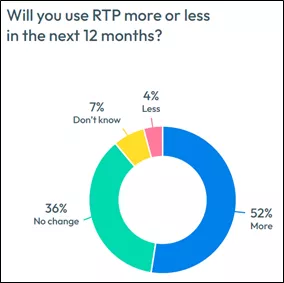
At the same time, global real-time payments are expected to grow more than 30% per year by 2030. FICO’s own research indicates that globally, 88% of consumers plan to maintain or increase individual use of RTP. It’s a sea change in the payments landscape that is not going away, and if my career in fraud management has taught me anything, it’s that fraudsters will follow the money. So what can we do to help detect and prevent fraud in these growing payments methods?
Payment Fraud Management Must Be Up to the Task
As consumers and merchants both embrace digital RTP, banks need to make sure their fraud prevention capabilities for real-time payments can operate at the same level of proficiency they have achieved for their credit and debit card transactions – and do it while the RTP transactions multiply fast. Let’s examine some of the key management steps banks can take in this rapidly changing landscape to ensure best-in-class fraud detection and prevention:
Establish the New Baselines for Detection
The first step is recognizing that customers are using different types of payment channels to move funds in and out of their accounts. We know fraudsters are already onto this change; scams grew 30% between 2021 and 2022 in the US and more than 40% of all fraud loss in the UK came from real-time payments fraud in 2022.
For banks, it’s crucial to monitor and measure these behaviors and establish new behavioral baselines very quickly. Given the growing transaction volumes, there should be plenty of live data. With continued monitoring, a bank can flag anything that looks abnormal and determine if it signals fraud.
Add Sensible Friction
Fraudsters have been early adopters of RTP because they can get funds quickly and irrevocably from unsuspecting consumers. FICO research shows that globally, 68% of consumers have gotten some sort of outreach they thought was part of a scam, which illustrates just how pervasive the problem has become.
Because consumers, not banks, represent the primary target for scams, the next key step is to add more sensible friction into payment processes. Because RTP methods allow for immediate transfers of life-changing sums of money, putting any small amount of friction into the process can potentially help prevent scam losses. Adding an “Are you sure?” screen with a clear scam warning can help customers think a bit before sending cash to a thief.
Enable Personalized Notifications
The next key step to prevent fraud in digital payments and RTP is to enable customers to customize notifications at any and every step in the process. Banks can also allow customers to receive communications to their preferred channel — email, mobile, social, bank app, or messenger app.
This way, a fraud attempt or fraudulent payment cannot happen without the customer being notified that something has transacted against any of their accounts, cards, or loans. When a bank provides this level of personal communication, it gives customers the tools they need to expand their trusted relationship and protect themselves from emerging scams or other forms of fraud.
Balancing RTP Growth and Fraud Management
Consumers will continue to embrace the convenience and speed of digital and real-time payments. This will in turn raise the customer experience and fraud management demands on financial institutions. Banks will have to recognize these new payments channels are simply additive and will not completely replace the risks and fraud schemes of established payments methods like checks or credit and debit cards.
In fact, RTP will just add new twists to enterprise fraud management. As a result, financial institutions need to continue to understand who their customers are, establish what their evolving behavioral baselines look like, define what actions to take when abnormalities happen, and know how the customer prefers to be contacted when necessary.
The root solution to defending customers and all their payment channels comes back to the same concepts — knowing what normal looks like, acting when something happens that isn’t normal, and communicating as much as possible though sensible friction and personalized notifications and alerts.
How FICO Helps Detect and Prevent Payments Fraud
- Explore FICO’s innovative fraud protection technology
- Learn how real-time customer communications can help stop fraud
- Read about FICO’s award winning, machine learning-powered retail banking model with scam detection score
- Download the FICO 2023 Scams Impact Survey
For more of my latest thoughts on the evolution of payments, fraud, and FICO’s entire family of software solutions, follow me on LinkedIn.

Popular Posts

Average U.S. FICO® Score at 716, Indicating Improvement in Consumer Credit Behaviors Despite Pandemic
The FICO Score is a broad-based, independent standard measure of credit risk
Read more
The GSE Data Is Public. Here's What It Shows About Credit Score Modernization.
Independent Milliman analysis of GSE historical data confirms what anyone can now verify directly: FICO® Score 10T is the most predictive score.
Read more
FICO® Score High Achievers: Is Age the Only Factor?
<p>FICO’s latest research on <a href="http://www.fico.com/en/blogs/risk-compliance/us-credit-quality-rising-the-beat-goes-on/" target="_blank">national FICO® Score distribution</a> shows that US credit quality continues to trend upwards, with an increasing number of consumers scoring in the highest scores ranges. Given that, we decided it was time to refresh our study on “<a href="http://www.fico.com/en/blogs/risk-compliance/infographic-what-does-a-high-credit-scorer-look-like/" target="_blank">FICO® Score high achievers</a>,” where we examine the credit behavioural profiles of consumers with higher credit scores.</p> <p>As expected, our latest study showed that older people generally have higher scores, as has been the case in our <a href="http://www.fico.com/en/blogs/risk-compliance/age-before-beauty-credit-worthiness-before-youth/" target="_blank">past research</a>. This is largely because they have trade lines that have been open longer, which leads to higher scores (assuming the trade lines are in good standing and all other things equal). The most credit savvy among you will remember that length of credit history accounts for roughly 15% of the overall <a href="http://www.myfico.com/CreditEducation/WhatsInYourScore.aspx" target="_blank">FICO® Score calculation</a>.</p> <p>But for younger consumers, it isn’t too helpful to say, “just wait until you are 50 years old, and that will fix things!” Thus, I decided to dive deeper with our analysis, including looking at the credit behavioural characteristics of younger consumers with high FICO® Scores.</p> <p>In this analysis, I looked at credit characteristics for the two highest score bands, 750-799 and 800-850, which have about 16% and 23% of the population, respectively. I further broke this down by looking at the characteristics of the youngest 15% in each group, which occurs at age 29 for the 750-799 group and 43 for the 800-850. We used FICO<strong>®</strong> Score 9 for our analysis, and examined typical variables of the categories that go into the make-up of the score.</p> <p><a href="http://www.fico.com/en/blogs/wp-content/uploads/2016/10/FICO-Score-High-Achiever-table.png"><img class="alignnone size-full wp-image-29367" src="http://www.fico.com/en/blogs/wp-content/uploads/2016/10/FICO-Score-High-Achiever-table.png" alt="fico-score-high-achiever-table" width="715" height="747" /></a></p> <p>Since there’s a lot to dissect in this chart, I’ll highlight a few findings that struck me: <ul> <li><strong>Credit history.</strong> Higher scores are undoubtedly associated with a longer time on file. What’s striking is the higher average time on file for the 800+ group, both overall and for revolving accounts (the most common trade line). Clearly, it helps to start credit use early in life – but that’s not the sole determining factor for high scoring. The younger cohorts in both the 800+ and 750-799 groups have time on file medians significantly less than their older counterparts.</li> <li><strong>New credit.</strong> High credit scorers do, in fact, pursue new credit. We see little variation in months since last trade line opening and last inquiry among all groups observed.</li> <li><strong>Pay on time.</strong> As you might expect, the further in the past the delinquency, the higher the score – and that’s <u>if</u> a delinquency ever happened. 95% of the 800+ people and 72% of the 750-799 group have never been delinquent, which is a striking contrast to the 57% for the total population. The percentages for the younger groups are even higher, especially so for the 750-799ers. Collection items are also scarce for these high scorers. While 23% of the national population have collection items greater than $99, the figures are only 0.5% for the 800+ group and 3% for the 750-799 group. It is clear that, in conjunction with starting a credit file early, paying on time is a key trait of the FICO® Score high achiever.</li> <li><strong>Balance and utilization.</strong> Finally, we look at how credit is being used, focusing on revolving product use. (Since most people only have one mortgage or one auto loan, variation in instalment product figures is minimal and driven by payment history, which is near perfect for high scorers, as we’ve seen.) FICO® Score high achievers tend to have more open revolving accounts. While the % active trades and utilization are generally lower, by no means do high scorers avoid the use of credit products. What drives the difference here is the amount of <u>available</u> revolving credit utilized. The 800+ group is roughly 1/4 of the national median, both in total and on their highest utilized card; they also have lower balances and more cards<em>. </em>The 750-799 group is more active and higher utilized, but still only at 2/3 of the national figures. The young 750-799 group compensate with lower revolving balances and, as a result, lower utilization, which is in line with what we see for the 800+ group.</li> <li><strong>Benchmarks.</strong> I’d like to point out that while this study provides good benchmarks of the typical credit traits of the FICO® Score high achiever, individual credit profiles will vary widely. And keep in mind that when we sort groups of consumers as a whole by different behaviours, some results may look superficially odd. For example, the 800+ band has a longer median average open account time (128 months) than average revolving months on file (140 months).</li> </ul> So, what do we conclude? A huge takeaway is that high scorers don’t have too much in the way of serious delinquencies and negative public record data.</p> <p>In most respects, the young 800+ people are like their peer group. They really only differ markedly in their shorter credit history and higher non-mortgage balance, both of which are a function of life stage. Our results show that you don’t have to be a credit product hermit; these high scorers have more credit cards. The takeaway is to start credit activity early and maintain well-managed and moderate usage.</p> <p>In many ways, the young 750-799 people are more interesting because their age profile is much younger. Their credit characteristics differ more from their peer group, particularly in terms of length of credit history. They compensate by having almost pristine credit records and lower balances.</p> <p>Ultimately, 39% of US consumers are FICO® Score high achievers, which they accomplish by following common-sense credit practices. It ain’t rocket science!</p>
Read moreTake the next step
Connect with FICO for answers to all your product and solution questions. Interested in becoming a business partner? Contact us to learn more. We look forward to hearing from you.