Application Fraud: The Role of AI and Machine Learning
I spoke with one of FICO’s principal scientists, Derek Dempsey, who shared how AI and machine learning are solving problems in application fraud.


In a recent blog post we explored the underlying concepts behind machine learning and its tremendous benefits in fighting application fraud. Since then, I had the opportunity to speak with one of FICO’s principal scientists, Derek Dempsey, who shared how AI and machine learning are solving problems in application fraud.

Derek has worked in machine learning and advanced analytics for 20+ years, and he is a specialist in the development and application of predictive analytics for application fraud detection. As a man of many talents, when he is not busy fighting crime through intelligent computing, Derek dazzles the London stage as an actor.
What do you see as the biggest challenges for machine learning to fight application fraud
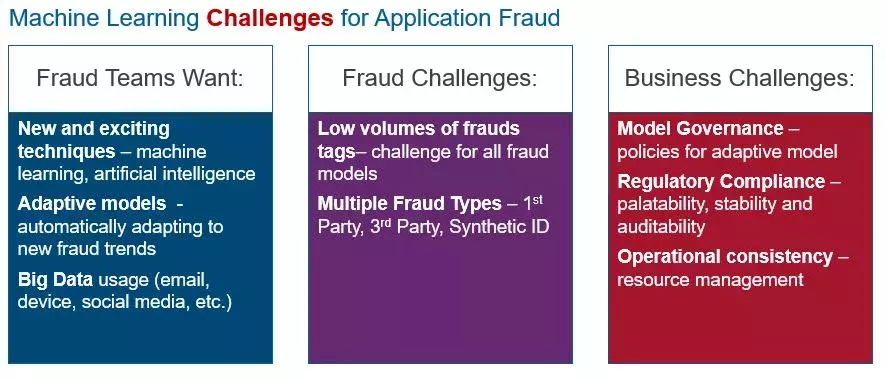
I think the biggest challenge will be governance and regulation rather than analytical challenges. Building machine learning models will require a deep understanding of how financial institutions work, how fraud is detected, and how fraud is controlled and managed — it’s not just about pointing algorithms at the data.
Broadly speaking, here’s how I see the big challenges in the application of machine learning to fight application fraud:
Can you explain what adaptive analytics are, and do you think self-learning models have a place in application fraud?
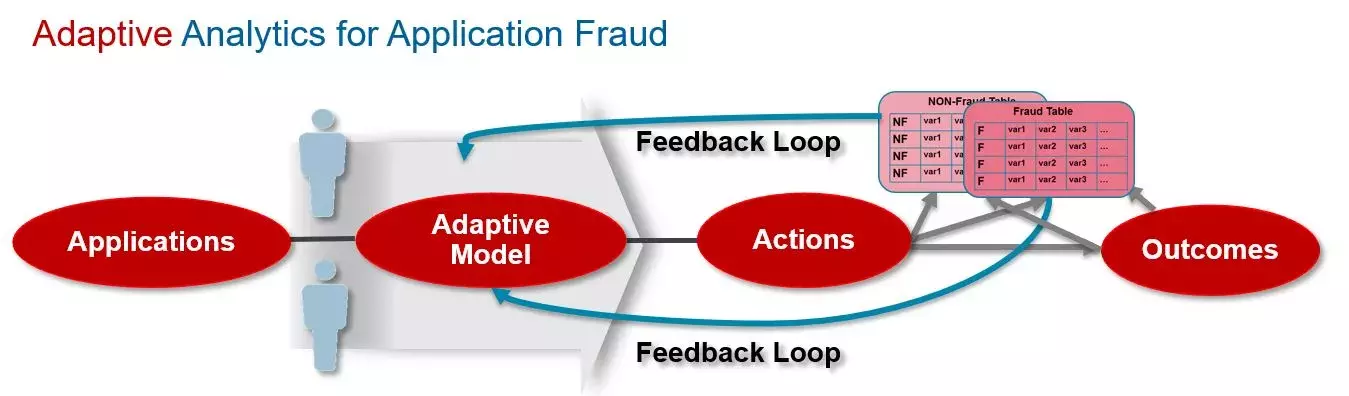
There are several flavors of adaptive analytics. For example, there are adaptive elements such as real-time adaptive profiles that maintain recursively updated feature detectors applied to individuals or to groups of entities. We also use self-calibrating analytics where the models derive data-driven groupings and distributions that are constantly updated and re-calculated.
Another type of adaptive analytics uses confirmed fraud and non-fraud dispositions from the analysts working cases to adapt model weights so that when new fraud and non-fraud patterns are discovered this information is fed back to improve the model performance. This methodology is very successfully leveraged today in FICO's Falcon Fraud Manager Platform to detect enterprise payments fraud, and is currently under development for application fraud within FICO Application Fraud Manager. We expect this to have a major impact on improving application fraud detection.
Feature generation is something we discussed in our most recent blog as an important part of generating a predictive model. Can you tell us more about the feature generation techniques that provide the most uplift for predictability?
Feature generation is the key to unlocking the value in data. In time series data, we want to look at velocities of activity, for example, time-clustered transactions that are indicative of fraud. In application fraud, two main areas of focus are the generation of features that highlight the risk associated with the applicant and application and network analytics that identifies relationships between applications.
Much of the data available at application is categorical, such as employment status, occupation, and residential status. Handling these categorical risk variables through risk tables and generation of indicators is critical for effective analytics. However, we need to enhance these features through the development of velocity variables and network variables to extract maximum information from the data and detect different types of fraud attack.
In application fraud, another area where we see significant uplift is through fuzzy matching, for example, against previous applications. We see that fraudsters often make several attempts to commit application fraud using slightly varying details to gain access to credit products, e.g. changing address, name, occupation or salary details, etc. The ability to fuzzy match against previous applications – and other data sources - and identify possible matches is important. This information can also be included within the models as additional features. Brute force and botnet attacks can also be quickly identified using this method.
This signal and feature generation process can be further bolstered through social network analytics (SNA) to uncover links between fraudsters and their clever tactics to uncover fraud faster. FICO SNA provides this powerful capability as discussed in a recent FICO webinar: http://www.fico.com/en/latest-thinking/on-demand-webinar/layered-defenses-in-the-fight-against-application-fraud
When operationalizing machine learning models for application fraud in an originations environment, what considerations should be undertaken?
One critical factor is to ensure that the operational data environment is aligned to the model data specification. Another key factor is to ensure that the end-users, the business team, understand the detection rates and false positive rates associated with the model. This must be explicit in the model report so that the operational teams can define appropriate thresholds to manage the fraud cases and prioritize queues.
The 'interpretability' of the model is also of critical importance, as results must be explainable not only to the fraud analyst but also as part of the broader regulatory regime. The fraud analyst needs to understand why the model has scored this application high to understand quickly the possible fraud type and the additional checks required. FICO provides model reason codes that indicate the main features contributing to the model score. More broadly, while fraud checks are excluded from much regulation, the model governance teams need to be able to confirm that bias is not being introduced into the originations process. See Scott Zoldi's post on explainable AI.
Lastly, the production environment and business requirements around score generation need to be accounted for in the model design. All environments are dynamic: OS upgrades happen, system upgrades, security patches and so on. Models become part of this ecosystem and, as such, need to be robust and maintainable. The recent move to cloud-based solutions removes most of these dependencies, however, and this move to cloud has been a core element of FICO strategy in recent years.
What kind of uplift can a financial institution anticipate from using an analytic approach for application fraud, over and above a rules-based approach?
We typically estimate uplift in the order of 30% - 40% in terms of fraud detection but this is dependent on many factors and can be much higher.
As with all types of fraud detection, layered controls are critical. A rule makes sense when you have a well-defined knock-out (KO) criterion — for example, this ID is on our negative list as a fraudster so exclude them. This doesn't need a sophisticated model - it's a simple KO rule. Where analytic gains are most significant is by combining “soft” rules and indicators into a sophisticated algorithmic calculation that will utilize multiple features and result in much greater accuracy.
As I mentioned earlier, feature generation creates a much richer data representation that allows the algorithms to outperform rules significantly.
I know FICO scientists are working currently on a consortium model for application fraud — why should clients be excited?
A consortium model uses data from multiple organizations, and this rich data set can provide a huge gain in power. We build consortium models for payments fraud using the Falcon Intelligence Network, and you can read more about this approach in this post from FICO’s TJ Horan. . Using this kind of consortium allows a standardization of data requirements, tools and techniques and this in turn facilitates research into new machine learning techniques applied to produce increasingly powerful models. The consortium data is used for model development and innovation, but is not shared between contributors — for example, negative file lists are not shared as part of this approach.
We expect to see big benefits from a consortium solution in application fraud by utilizing the feature generation methods and advanced machine learning techniques such as multi-layer self-calibrating models, collaborative profiles and Adaptive Analytics. Adaptive Analytics utilizes both the fraud and non-fraud dispositions from the fraud analysts to re-optimize model weights and enable a rapid response to new fraud trends as well as reducing false positives.
A fraud consortium like the one we’re building is much more than just sharing data. It is about transforming fraud prevention with data-driven methodologies and continuous model improvement to find fraud an individual lender has not seen before.
Thanks, Derek, for your time, it was a pleasure meeting and learning from you!
Want to learn more? Check out our previous posts on application fraud:
- Trends in Application Fraud – From Identity Theft to First-Party Fraud
- Best Practices in Establishing Your Fraud Risk Appetite
- ELI5: What does the Dark Web have to do with Application Fraud
- Data, data, data: Application Fraud and the elephant in the room
- Preventing Application Fraud with Machine Learning and AI
- 4 Success Factors for Machine Learning in Fraud Detection
Popular Posts

Average U.S. FICO® Score at 716, Indicating Improvement in Consumer Credit Behaviors Despite Pandemic
The FICO Score is a broad-based, independent standard measure of credit risk
Read more
The GSE Data Is Public. Here's What It Shows About Credit Score Modernization.
Independent Milliman analysis of GSE historical data confirms what anyone can now verify directly: FICO® Score 10T is the most predictive score.
Read more
FICO® Score High Achievers: Is Age the Only Factor?
<p>FICO’s latest research on <a href="http://www.fico.com/en/blogs/risk-compliance/us-credit-quality-rising-the-beat-goes-on/" target="_blank">national FICO® Score distribution</a> shows that US credit quality continues to trend upwards, with an increasing number of consumers scoring in the highest scores ranges. Given that, we decided it was time to refresh our study on “<a href="http://www.fico.com/en/blogs/risk-compliance/infographic-what-does-a-high-credit-scorer-look-like/" target="_blank">FICO® Score high achievers</a>,” where we examine the credit behavioural profiles of consumers with higher credit scores.</p> <p>As expected, our latest study showed that older people generally have higher scores, as has been the case in our <a href="http://www.fico.com/en/blogs/risk-compliance/age-before-beauty-credit-worthiness-before-youth/" target="_blank">past research</a>. This is largely because they have trade lines that have been open longer, which leads to higher scores (assuming the trade lines are in good standing and all other things equal). The most credit savvy among you will remember that length of credit history accounts for roughly 15% of the overall <a href="http://www.myfico.com/CreditEducation/WhatsInYourScore.aspx" target="_blank">FICO® Score calculation</a>.</p> <p>But for younger consumers, it isn’t too helpful to say, “just wait until you are 50 years old, and that will fix things!” Thus, I decided to dive deeper with our analysis, including looking at the credit behavioural characteristics of younger consumers with high FICO® Scores.</p> <p>In this analysis, I looked at credit characteristics for the two highest score bands, 750-799 and 800-850, which have about 16% and 23% of the population, respectively. I further broke this down by looking at the characteristics of the youngest 15% in each group, which occurs at age 29 for the 750-799 group and 43 for the 800-850. We used FICO<strong>®</strong> Score 9 for our analysis, and examined typical variables of the categories that go into the make-up of the score.</p> <p><a href="http://www.fico.com/en/blogs/wp-content/uploads/2016/10/FICO-Score-High-Achiever-table.png"><img class="alignnone size-full wp-image-29367" src="http://www.fico.com/en/blogs/wp-content/uploads/2016/10/FICO-Score-High-Achiever-table.png" alt="fico-score-high-achiever-table" width="715" height="747" /></a></p> <p>Since there’s a lot to dissect in this chart, I’ll highlight a few findings that struck me: <ul> <li><strong>Credit history.</strong> Higher scores are undoubtedly associated with a longer time on file. What’s striking is the higher average time on file for the 800+ group, both overall and for revolving accounts (the most common trade line). Clearly, it helps to start credit use early in life – but that’s not the sole determining factor for high scoring. The younger cohorts in both the 800+ and 750-799 groups have time on file medians significantly less than their older counterparts.</li> <li><strong>New credit.</strong> High credit scorers do, in fact, pursue new credit. We see little variation in months since last trade line opening and last inquiry among all groups observed.</li> <li><strong>Pay on time.</strong> As you might expect, the further in the past the delinquency, the higher the score – and that’s <u>if</u> a delinquency ever happened. 95% of the 800+ people and 72% of the 750-799 group have never been delinquent, which is a striking contrast to the 57% for the total population. The percentages for the younger groups are even higher, especially so for the 750-799ers. Collection items are also scarce for these high scorers. While 23% of the national population have collection items greater than $99, the figures are only 0.5% for the 800+ group and 3% for the 750-799 group. It is clear that, in conjunction with starting a credit file early, paying on time is a key trait of the FICO® Score high achiever.</li> <li><strong>Balance and utilization.</strong> Finally, we look at how credit is being used, focusing on revolving product use. (Since most people only have one mortgage or one auto loan, variation in instalment product figures is minimal and driven by payment history, which is near perfect for high scorers, as we’ve seen.) FICO® Score high achievers tend to have more open revolving accounts. While the % active trades and utilization are generally lower, by no means do high scorers avoid the use of credit products. What drives the difference here is the amount of <u>available</u> revolving credit utilized. The 800+ group is roughly 1/4 of the national median, both in total and on their highest utilized card; they also have lower balances and more cards<em>. </em>The 750-799 group is more active and higher utilized, but still only at 2/3 of the national figures. The young 750-799 group compensate with lower revolving balances and, as a result, lower utilization, which is in line with what we see for the 800+ group.</li> <li><strong>Benchmarks.</strong> I’d like to point out that while this study provides good benchmarks of the typical credit traits of the FICO® Score high achiever, individual credit profiles will vary widely. And keep in mind that when we sort groups of consumers as a whole by different behaviours, some results may look superficially odd. For example, the 800+ band has a longer median average open account time (128 months) than average revolving months on file (140 months).</li> </ul> So, what do we conclude? A huge takeaway is that high scorers don’t have too much in the way of serious delinquencies and negative public record data.</p> <p>In most respects, the young 800+ people are like their peer group. They really only differ markedly in their shorter credit history and higher non-mortgage balance, both of which are a function of life stage. Our results show that you don’t have to be a credit product hermit; these high scorers have more credit cards. The takeaway is to start credit activity early and maintain well-managed and moderate usage.</p> <p>In many ways, the young 750-799 people are more interesting because their age profile is much younger. Their credit characteristics differ more from their peer group, particularly in terms of length of credit history. They compensate by having almost pristine credit records and lower balances.</p> <p>Ultimately, 39% of US consumers are FICO® Score high achievers, which they accomplish by following common-sense credit practices. It ain’t rocket science!</p>
Read moreTake the next step
Connect with FICO for answers to all your product and solution questions. Interested in becoming a business partner? Contact us to learn more. We look forward to hearing from you.