Black Friday Fraud: Latest Advice for Shoppers and Financial Institutions
From fake stores to scam delivery texts, here is how shoppers can protect themselves this year, and what bank fraud teams should have in place

Black Friday falls on 27 November this year, with Cyber Monday on 30 November. For most of us it marks the real start of Christmas shopping: presents to buy, deals to catch, and far more card payments than usual. In the US alone, shoppers spent a record $14.25 billion online on Cyber Monday last year, and $44.2 billion across the five days of Cyber Week, according to Adobe.
Criminals plan for this period as carefully as retailers do. More spending means more cover. A fraudulent payment is easier to hide among thousands of unusual but genuine ones, and a fake shop is easier to believe when every real shop is shouting about 50% off.
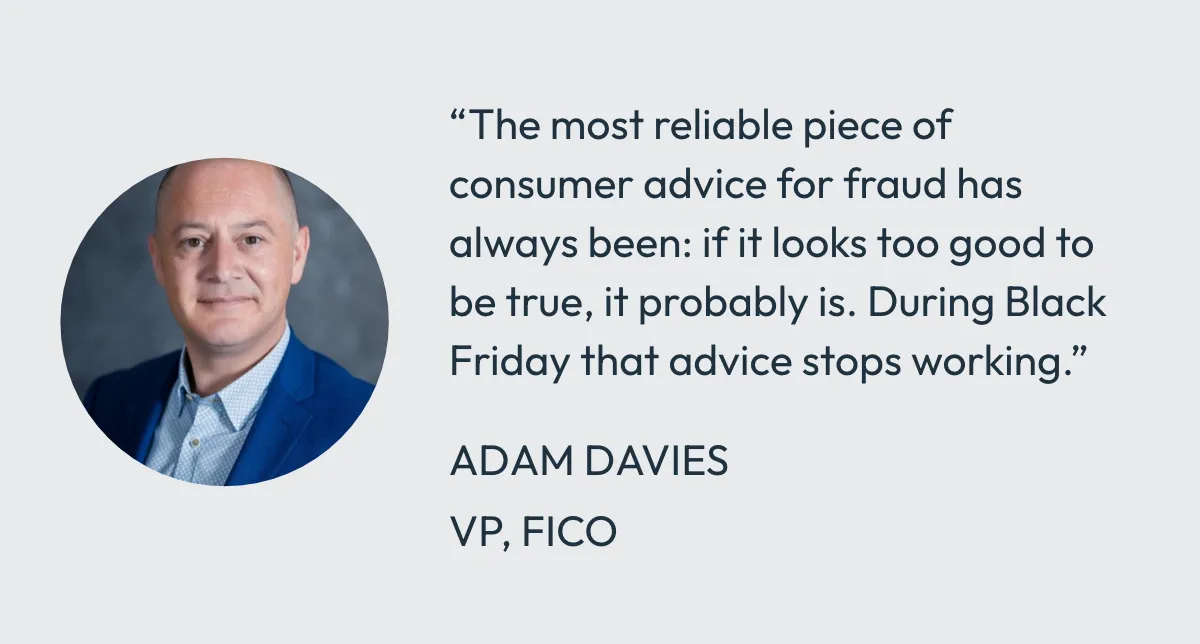
I have worked in fraud for more than 30 years, and the most reliable piece of consumer advice has always been the same: if it looks too good to be true, it probably is. During Black Friday that advice stops working, because the genuine deals look too good to be true as well. So this year, look harder at who you are buying from, not just at the price.
How to Protect Yourself this Black Friday
Watch Out for the More Convincing Fake Shop
Not long ago you could often spot a fake shop just by looking at it: clumsy design, poor spelling, product photos that didn't match, a checkout that felt wrong. Plenty of people quite rightly wouldn't buy from a site that didn't look trustworthy, because they didn't believe the goods would ever turn up.
Generative AI has removed most of those clues. A criminal can now produce a polished store, a full catalogue of product pages, convincing reviews, a returns policy and an "about us" story in an afternoon. The result can look as professional as the best retailers on the internet.
Scamwise, a consumer scam-checking service, says its users flagged a new fake store roughly every three minutes this year. AI-generated content appeared on 74% of the scam stores it analyzed, at least one in five traced back to an advert on a major social or search platform, and 85% had disappeared within two weeks.
“The shop that takes your money on Black Friday may not exist yet today, and it may be gone before you realize your parcel isn't coming.”
Many of these sites aren't really trying to sell you anything. They exist to capture your name, address and card details. By the time you start wondering where your order is, your card may already have been used somewhere else.
Before You Buy
- Check the shop, not just the deal. Search the store's name with "reviews" or "scam" on an independent site. Find out how long the website has existed. A site that appeared a few weeks ago and is selling at deep discounts is a warning sign.
- Be wary of ads. Being advertised on social media does not mean a shop has been checked. If a deal appears in your feed, type the retailer's address into your browser yourself instead of tapping the ad.
- Compare with the brand's own site. A genuine 30% off is common this week. 80% off this year's games console or a designer coat is not.
- If an AI assistant finds you a deal, check where it sends you. Fake stores are already turning up in AI shopping results, and a polished site can fool an assistant just as easily as a person.
At Checkout
- Turn your card off when you're not using it. Most banking apps let you freeze or lock a card instantly and unfreeze it in seconds when you want to buy something. Many also let you block online payments, set spending limits or create a virtual card number for a single shop or purchase. If your details are stolen on a fake site, a frozen card is a far less useful prize.
- Use one card for online shopping. Ideally a virtual or low-limit card, so your main card isn't exposed to every site you try.
- Pay by credit card where you can. In many countries credit cards give stronger rights to get your money back than debit cards, and the money in dispute isn't missing from your current account while it's investigated.
- Never pay a shop by bank transfer, gift card or cryptocurrency. If a seller asks you to, especially in exchange for an extra discount, walk away. These payments are very hard to recover.
- Don't save your card details on a site you haven't used before.
After Checkout
- Watch for the follow-up scams. Fake delivery texts ("we missed you, pay a redelivery fee"), fake order confirmations and refund scams all spike after big shopping days. Track parcels through the retailer's own website or app, never through a link in a message.
- Check your banking app for weeks afterwards. Small, unfamiliar payments can be criminals testing your card before they use it properly.
- If something feels wrong, act fast. Freeze the card in your app and call your bank on the number on the back of your card. The sooner you report it, the better the chance of stopping further fraud and recovering your money.
What Bank Fraud Teams Should Prepare For
For fraud teams, the holiday period tests everything at once: models, rules, operations and customer experience. The problem that catches consumers catches us too. When genuine behavior shifts this sharply, "unusual" stops meaning "suspicious", and the cost of a wrong decision rises on both sides. Decline a genuine Christmas purchase and the customer moves your card to the back of the wallet, sometimes for good. Miss the fraud and the losses arrive in January.
So treat it as a season, not a day. Card testing builds in the weeks before Black Friday. Fake-store domains multiply through October and November: Netcraft saw new Black Friday-themed domains rise from around 54 a day in mid-October last year to more than 300 a day by early November. Disputes and scam claims then peak in January. Plan for all three phases.
Before the Peak
Agree your risk appetite in advance
Set an explicit false-positive budget with the business: how many genuine customers you are prepared to inconvenience for each dollar, pound or euro of fraud prevented. Making that call in a war room on Black Friday morning rarely ends well.
Prepare models for seasonal drift
Make sure adaptive models are calibrated with last year's peak in mind, and resist bolting on static rules that will still be firing in February. Give every temporary rule an owner and an expiry date.
Build merchant-risk intelligence
Fake stores often run on legitimate e-commerce platforms and payment providers, so the transactions look authorized and genuine, because the cardholder really did make them. The signal is in the merchant: new merchant IDs or descriptors, a sudden rush of first-time cardholders, high-value orders in electronics, toys and fashion, and very fast growth from nothing. Look at these patterns across your whole portfolio rather than one transaction at a time, and share what you find with schemes, acquirers and consortium partners.
Push card controls to customers
Freeze and unfreeze, online-payment toggles, spending limits and virtual cards are some of the best defenses customers have. Promote them in-app before Black Friday, not after the first wave of claims. Customers who use them also give your models cleaner signals.
During the Peak
Find common points of purchase in near real time
When cards start being misused, find the merchant they share quickly. If it is a fake store harvesting details, you can block it, flag every card that transacted there, and reissue or monitor those cards before the second wave of fraud, not months later.
Watch for card testing
Bursts of low-value authorizations, sequential card numbers and high decline rates from one merchant or device are classic signs that harvested details are being validated before use.
Replace declines with conversations
A real-time "Is this you?" push notification, or step-up authentication in the app, keeps genuine spending flowing and still stops fraud. Every hard decline on a good customer during the busiest week of the year is expensive.
Don't forget purchase scams on faster payments
Many shopping scams on social media and online marketplaces are paid by bank transfer, not card. Put clear, specific warnings at the point of payment, and use behavioral and payee-risk signals to decide when to interrupt. In markets where reimbursement rules now share the cost of scams with banks, the case for this is even stronger.
Monitor score distributions daily
Seasonal shifts can quietly push models outside the conditions they were trained on. Daily checks on score distributions, alert volumes and hit rates will show drift before it shows up in losses.
Staff for the surge
Fraud operations, contact centers and disputes teams all see spikes. Have escalation paths, extra capacity and updated scripts in place before the volume arrives.
After the Peak
Expect the January wave
Non-delivery disputes, chargebacks and scam claims on fake stores arrive weeks after the purchase. Resource dispute teams for it, and feed confirmed fraud back into your models quickly, so this year's attacks strengthen next year's defenses.
Follow the money, not just the payment
Money from purchase scams has to land somewhere. Monitoring inbound payments for mule activity, such as new accounts suddenly receiving many small payments from strangers, can stop the funds and help expose the network behind them.
The Next Thing to Prepare for: AI Agents that Shop
This may be the first holiday season in which a meaningful share of purchases is made by AI agents acting for customers. The card networks have built frameworks for it, including Mastercard Agent Pay and Visa Intelligent Commerce, which use agent-specific tokens and verification. The risk picture is still forming. In September, six banks including NatWest, Bank of America, ING, Capital One and Commonwealth Bank of Australia published principles for trusted agentic commerce, warning about fraud, scams, agent impersonation and unclear liability.
Fraud teams should be asking now:
- Can we tell when a transaction was started by an agent rather than a person?
- Do our models mistake an agent's fast, precise, consistent behavior for a bot attack?
- How will we handle a dispute where the customer says "my agent bought it, not me"?
- What happens when an agent is fooled by the same polished fake store that would fool a person?
Blocking agents outright isn't the answer. Recognizing them, verifying them and scoring them as a channel in their own right is.
Black Friday Advice Matters at Christmas Too - and Beyond
Black Friday will always be a peak for fraud, because it is a peak for everything else. What has changed is the quality of the deception. AI lets criminals look as professional as the best retailers on the internet, at almost no cost.
For shoppers, that means trusting your eyes a little less and your bank's tools a little more. For fraud teams, it means seeing patterns across transactions instead of judging each one alone, and getting the balance right between stopping fraud and letting genuine customers enjoy the season.
Learn More About How FICO Can Help You Manage Fraud Enterprise-Wide
- Read Beyond Point Solutions: Orchestrating the Future of Fraud Prevention, the analyst report from Datos Insights to help financial institutions better understand the fraud orchestration market and develop a centralized fraud management strategy that works best for them.
- Download Chartis Vendor Spotlight: Enterprise and Payment Fraud Solutions, 2026 to learn where FICO excels, and how we can help fight enterprise and payments fraud.
- Read The 6 "E"s of Enterprise Fraud Management to understand how to navigate the complexities of enterprise fraud management with seamless orchestration, real-time detection, and scalable prevention and intervention strategies.
- Download the Scam Signal solution sheet to read more about how FICO can mitigate APP scams with real-time detection and intervention.
- Download the FICO Focused Foundation Model Executive Brief to see how purpose-built GenAI strengthens fraud detection without sacrificing auditability.

Popular Posts

The GSE Data Is Public. Here's What It Shows About Credit Score Modernization.
Independent Milliman analysis of GSE historical data confirms what anyone can now verify directly: FICO® Score 10T is the most predictive score.
Read more
Average U.S. FICO® Score at 716, Indicating Improvement in Consumer Credit Behaviors Despite Pandemic
The FICO Score is a broad-based, independent standard measure of credit risk
Read more
FICO® Score High Achievers: Is Age the Only Factor?
We've refreshed our study on the credit behavioural profiles of consumers with higher FICO Scores, with a strong focus on younger consumers.
Read moreTake the next step
Connect with FICO for answers to all your product and solution questions. Interested in becoming a business partner? Contact us to learn more. We look forward to hearing from you.