How Fraud Defences Must Evolve to Protect Agentic Commerce
Predictive AI and traditional transactional fraud models were not designed to flag agent-based activities - the new way customers shop will require new approaches to fraud

AI has quickly moved from answering questions to taking action. Consumers are transitioning from asking for advice on what to buy, and are now employing AI-based agents to find the best deal and complete the purchase for them. This is not a small change, and the implications are significant. Agentic commerce has entered the financial landscape, bringing with it a plethora of new challenges and unforeseen behavioral patterns. Many fraud solutions on the market today were not originally designed to cater for such a level of payment and technological innovation; for banks, this means that a rethinking of approach is needed in order to minimize fraud exposure for this emerging reality.
Key Takeaways
- Predictive AI wasn't built to see agents. It has been the backbone of fraud detection for three decades, built on real-time transaction monitoring and pattern recognition at scale. That foundation isn't going away, but it was built to catch human behavior, not agent behavior.
- Generative AI and AI agents add a new layer of reasoning. They sit on top of the predictive foundation, able to understand natural language, reason through a task, and carry out multi-step actions with a person checking in where it matters most.
- Agentic commerce is set to become a trillion-dollar shift. It's projected to reach $1.7 trillion by 2030, potentially culminating to a point where more agents are transacting than humans.
- Fraud losses tied to generative AI are climbing fast. Potential fraud losses are projected to exceed $58.3 billion by 2030, driven largely by fraudsters using generative AI themselves to facilitate various attack vectors.
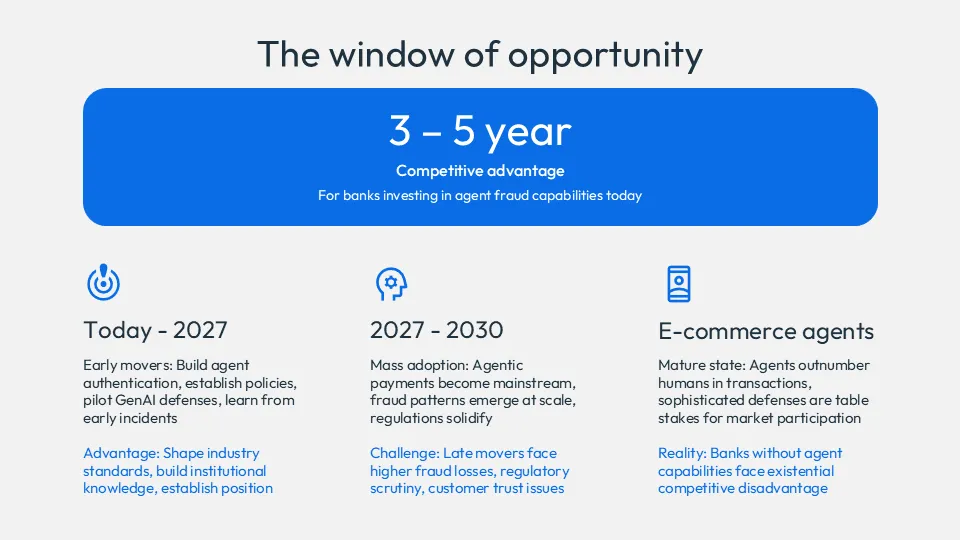
- Early movers stand to gain the most. Banks investing in agentic fraud capabilities today have an estimated three-to-five-year competitive advantage, but many institutions currently have no strategy in place to authenticate or monitor agentic transactions.
A Foundation Built for Humans, Not Agents
For three decades, predictive AI has monitored transactions in real time, recognized patterns across thousands of transactions per second, and blended rule-based logic with machine learning to flag anomalies. It remains a proven backbone.
But it was built on one assumption: that a human is on the other end of the transaction. Behavioral biometrics only exist when a person is physically interacting with a device. As consumers adopt AI-based agents for purchases and transact through an API instead, those signals simply aren't there anymore. Predictive AI and traditional transactional fraud models were not designed to flag agent-based activities.
Generative AI and Agents Bring Something Predictive AI Never Had
Generative AI can understand prompts and questions, and respond in natural language, and reason through tasks step by step. AI agents take this further and execute multi-step actions on their own, whether fully automated or with individual consumer oversight.
Predictive AI is fast, accurate, and built for scale, excellent at spotting statistical outliers. Agents bring something different, such as the ability to reason through context and explain why a decision was made.
When the Shopper Is an Agent, Not a Person
For the first time, AI agents, not just humans, are being given real authority to spend money on someone's behalf. Agentic commerce is projected to reach $1.7 trillion by 2030, with agents potentially outnumbering humans as the ones initiating transactions.
This is already showing up in ordinary ways. A smart fridge reordering groceries, a car paying for its own parking, an e-commerce agent managing subscriptions or handling holiday shopping. Each of these individually may seem minor, but combined they represent a huge shift in where monetary transactions originate – which raises the thorny issue of legitimacy for banks monitoring for fraud.
The Same AI Making Shopping Easier Is Making Fraud Easier Too
Natural language reasoning, automation, and unparalleled scale makes agentic commerce convenient for consumers. Those same qualities make it easy for fraudsters to exploit detection systems that were never built to verify a non-human actor in the first place. Fraudsters have been using generative AI to scale their own operations for several years, with fraud losses continually increasing; in fact, potential US fraud losses are expected to exceed $40 billion by 2027 as a direct result of the increasing sophistication of fraud and scam attack vectors.
GenAI is accelerating fraud across a broad spectrum: individually curated scams lie at one end, and at the other sits tools such as WormGPT, an AI tool built specifically for malicious use and sold on dark web forums, it strips out the guardrails found in commercial models and lets attackers run phishing campaigns at scale, roughly ten times faster than traditional methods.
Fighting Agentic Fraud Requires Agentic Defence
The same qualities that make agentic commerce fast and scalable are the same qualities that break legacy detection methods. Velocity has typically been an indicator of risk, since a human can't physically initiate and execute hundreds of transactions in a matter of seconds. But an authorized agent can, legitimately. That kills velocity as a signal. Detection windows are compressing from hours to milliseconds, faster than a manual review cycle can keep up. This challenge is compounded by the fact that there is not yet any baseline for “normal” agent behavior; banks must wait to see how the payments landscape evolves as consumer adoption of agentic commerce increases. The datasets used to train models in use today don't include agentic customer data for the models to analyze.
Not only can agentic commerce be executed much more rapidly than traditional methods of payment, but the entire chain of events that leads to a purchase decision gets messier with more than one agent involved. A human may give their agent an instruction, but that agent can then ask another to act on its behalf, which asks a third and so on. What looks like a single purchase is really a chain of hand-offs, each a step removed from the person who said, "Go ahead”. If something in that chain breaks, or is manipulated, identifying who authorized what, and how the resultant action has deviated from the original intent, can be nearly impossible. Investigators have spent 30 years tracing transactions back to one person; tracing a relay of agents is a skill the industry hasn't built yet.
That's why GenAI or an agentic workflow isn't a nice-to-have. Fraud's core question has always been "who is this customer?" With agents, it's "which agent is acting, on whose authority, with what intent?" Answering that at machine speed, across chains of agents rather than single transactions, means fraud prevention must operate the way the threat does, by matching its tempo and structure to keep protection intact when autonomy exists at both the human and machine levels.
Predictive AI absolutely still has a place in transactional fraud detection, However, if banks are to also leverage generative AI and agentic capabilities, these types of AI together can cover more ground than one could alone. With this in mind, a hybrid approach should be the goal for fraud prevention – something that fraud teams are being asked to build toward now.
What Banks Gain by Moving Before Competitors Do
Banks investing in agentic fraud management capabilities today will have a distinct competitive advantage over those who wait. Early movers have the opportunity to help shape industry standards and build institutional knowledge before consumers (and fraudsters) adopt agentic payments en-masse.
Unfortunately, many institutions are facing an uphill battle for agentic fraud management. Few have a defined strategy for authenticating or monitoring agent transactions, and do not have systems that can tell a human apart from an agent. Technology and the market are both moving quickly, and robust fraud management and implementation strategies will need to keep up.
The Next Move for Fraud Teams
None of this means throwing away thirty years of fraud detection work. It means evolving that foundation to recognize a new kind of actor it was never designed to see. Generative AI and agentic AI are quickly becoming necessary just to keep pace with both the scale of agentic commerce and the fraudsters already exploiting it. The institutions that treat this as something to solve now, rather than a problem to revisit later, are the ones who'll be ready before agentic commerce becomes the default rather than the exception.
How FICO Can Help Financial Institutions Address Agentic Commerce Fraud
FICO® Platform brings predictive AI, generative AI, and agentic capabilities together in a composable, intelligent foundation that enterprises can use to detect and manage agent-driven transactions before losses compound.
Most fraud systems still cannot distinguish legitimate transactions from fraudulent ones when they’re initiated by an agent. FICO® Platform can help close the gap with a single, continually learning view of risk across every channel, so institutions can extend detection to agent-driven activity without rebuilding from scratch.
Agent chains that pass through several steps are hard to trace, and there's currently no baseline for what "normal" agent behavior even looks like. FICO® Focused Sequence Model learns each entity's own pattern directly from the full, ordered sequence of its activity, so it doesn't need the industry to agree on what "normal" agent behavior looks like before it can spot what isn't. It can also connect an early step in a sequence to a much later one, even when several legitimate-looking hops sit in between.
FICO Customer Communication Services for Fraud helps confirm there's a real person on the other end with low-friction, high-security two-way checks, including caller ID authentication and anti-spoofing defenses, all without adding headcount.
Banks that act now have a significant head start. Those who wait are likely to face higher losses, closer regulatory attention, and a harder time earning back customer trust once mass adoption hits.
Explore FICO's approach to agentic fraud readiness to see how these capabilities work together.
- Explore FICO Platform
- Read about FICO® Focused Foundation Model for Financial Services Provides Superior Accuracy in Decisioning and Trust When Deploying GenAI
- Explore Customer Communications for Fraud | FICO
- Download the 2025 State of Responsible AI in Financial Services survey results to understand where organizations are falling short on their AI implementation and what opportunities are shaping the next phase of AI maturity in financial services
- Read the GenAI in the Past, Present, and Future whitepaper to learn more about FICO's perspective on leveraging GenAI for scalable, impactful customer experiences

Popular Posts

Average U.S. FICO® Score at 716, Indicating Improvement in Consumer Credit Behaviors Despite Pandemic
The FICO Score is a broad-based, independent standard measure of credit risk
Read more
The GSE Data Is Public. Here's What It Shows About Credit Score Modernization.
Independent Milliman analysis of GSE historical data confirms what anyone can now verify directly: FICO® Score 10T is the most predictive score.
Read more
FICO Statement on FHFA and FHA Updates to Credit Score Modernization
FICO supports FHFA’s announcement that the long-anticipated historical data for FICO® Score 10T will be released to the mortgage market.
Read moreTake the next step
Connect with FICO for answers to all your product and solution questions. Interested in becoming a business partner? Contact us to learn more. We look forward to hearing from you.