Debit Card Compromises Nearly Doubled in 2023 - FICO Data
Debit card skimming grew 96% year over year in 2023, with new geographies taking some of the top spots for points of compromise

In August of 2023, I posted about the growth we’ve seen in different fraud types, including card skimming. Now that we’ve reviewed data from the entire year, we are seeing the alarming trend continue.
For 2023, we saw a significant increase in compromised cards resulting from skimming activity. Total compromised debit cards were up 96% from 2022, with more than 315,000 impacted cards identified. More than 3,500 unique financial institutions (FIs) were impacted, and we saw a significant increase in bank ATM compromises – up 90% from 2022.
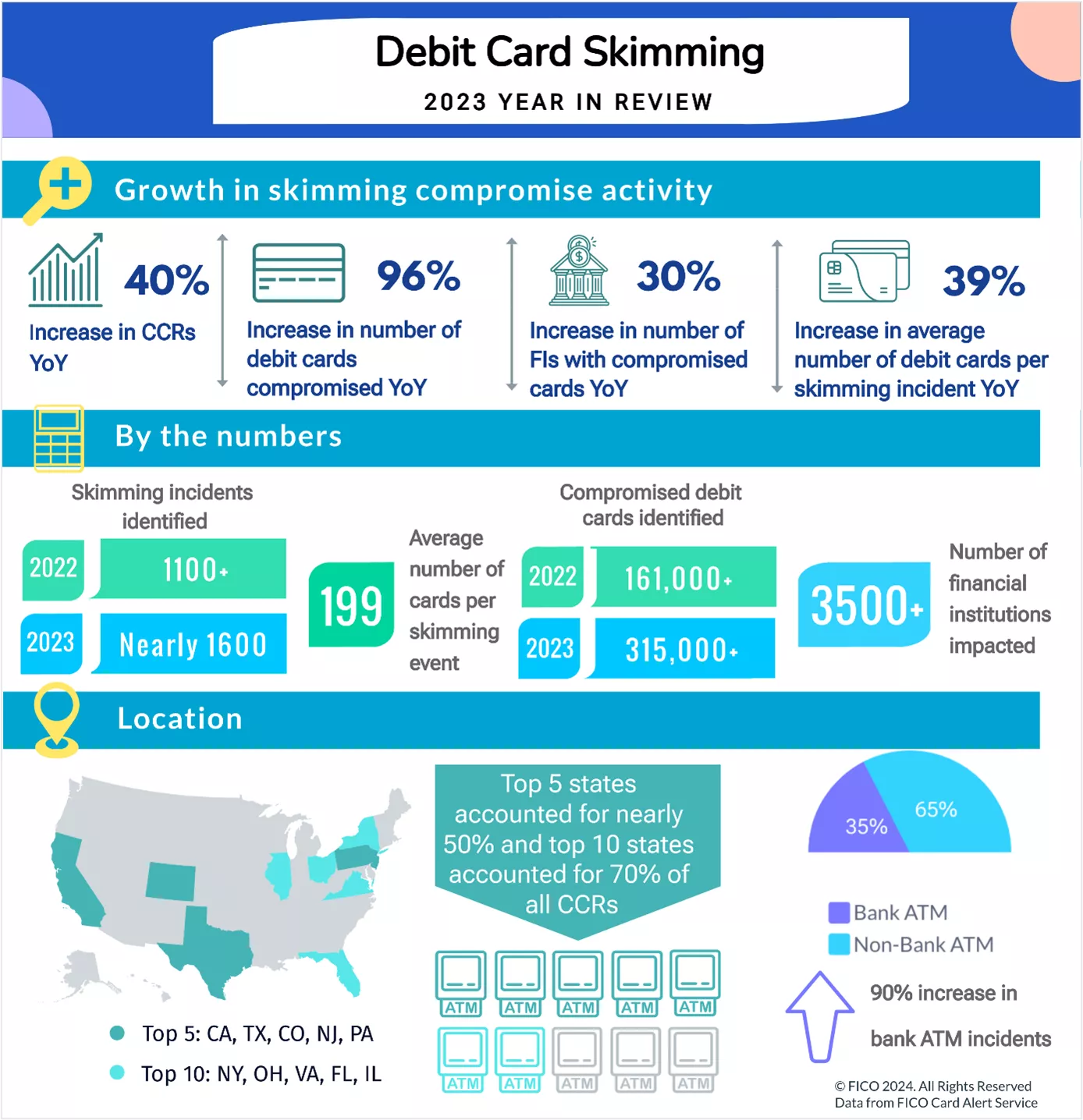

This growth trend is a continuation from what we saw in 2022 and represents a significant threat for both banks and consumers. Unfortunately, the trend shows no sign of slowing down. With January already showing an increase year-over-year, I expect to see continued increases in skimming points of compromise (POCs) and compromised cards for 2024.
Changing Locations, Points of Compromise
One interesting data point that leaps out from this graphic is the dramatic increase in POCs at bank ATMs. While the majority of compromises still occur at non-bank ATMs – like free-standing terminals in convenience stores – criminals appear to be going right to the source more frequently when it comes to ATM locations. In 2022, bank ATM compromises were less than 20% of overall incidents compared to 35% in 2023, a 90% increase year-over-year. When you combine bank ATM compromise growth with a 39% increase in the average number of cards compromised per skimming event (nearly 200 per event in 2023), debit card users should carefully assess the situation when using any ATM, point of sale terminal, or other location where a card skimmer could be lurking.
Across the US, the geographic hot spots for skimming activities have shifted from 2022 to 2023. California retained the unenviable title of top state for skimming event locations, boasting over 20% of all incidents for 2023, more than double any other state. Texas and Colorado both moved into the top five states for skimming activity, while New Jersey and Pennsylvania rounded out the main offending states. These five states accounted for nearly 50% of all the skimming activity.
New to the top ten states this year were Ohio, Florida, and Illinois, complemented by New York and Virginia. These top ten accounted for 70% of all the Compromised Card Reports that FICO delivered to banks and financial institutions last year.
Consumers: Pay Attention to Detail
Given the ever-growing rate of skimming fraud, I would recommend specific actions for both consumers and FIs to mitigate impacts from a compromise. I’ve mentioned some of these in previous posts, but they bear repeating.
- Pay close attention to PIN pads and payment terminals. Anything that catches your attention when you use a credit or debit card, like mushy keys on the keypad, a tap reader that isn’t working, or a broken seal on a gas pump card reader should be a red flag to head to another location.
- Utilize tap-to-pay technology. With this payment method, commonly known as “contactless payment”, tokenization encrypts the card details. Rather than exposing all the card information that is contained in a magnetic strip, the tap-to-pay hides all the card details and replaces them with a token that is nearly impossible to decrypt, preventing criminals from capturing sensitive card information.
- If tap-to-pay isn’t available, utilize chip and PIN. While these transactions are more secure than swiping, consumers are still advised to cover the PIN pad while entering their number to prevent a fraudulently installed spy camera from capturing their information.
- Avoid swiping a magnetic stripe if at all possible. This is the least secure payment method, as it exposes all the card information. If a payment terminal has been compromised, it will often only allow swiping. If you experience problems using tap-to-pay or chip and PIN methods, find another place to complete your transaction.
Banks Can Take Proactive Steps to Protect Against Compromise
For banks and other FIs, knowing that bank-owned ATMs are increasing as points of compromise is critical. With this knowledge, institutions can step up protection and monitoring of their ATM locations, employing video surveillance where possible. Regular inspection of ATMs for signs of tampering, as well as coordination with law enforcement, can help ensure ATMs remain safe for consumers.
Equally important is knowing where the bulk of skimming and POC activity is happening. By employing fraud checks and using advanced analytics to identify and flag risky transactions, banks can help prevent potentially compromised cards from being used to commit fraud.
FICO® Card Alert Service provides reports to issuers with valuable data that enables them to act immediately to address known compromised cards. Banks can block/reissue a compromised card or monitor cards for signs of fraud, depending on their unique risk management strategies.
Being proactive with customer outreach is another way to help prevent fraud on a compromised card. Engaging customers in real-time, in the channel of choice (whether text, email, phone, or in-app messages) and providing the option to have two-way conversations can enable FIs to confirm whether a specific transaction is legitimate or fraudulent.
While skimming is one of the vectors that fraudsters use to separate victims from their hard-earned money, criminals will also continue phishing, smishing, and other tactics to obtain any data they can use to commit fraud across all channels. The right technology, including AI- and ML powered fraud detection models, can help banks fend off fraudsters while helping deliver the experiences that customers expect.
How FICO Fights Card Skimming Fraud
- Explore how FICO helps fight fraud, regardless of channel or portfolio.
- Review the first half 2023 card skimming results from Card Alert Service.
- Get more details on FICO® Card Alert Service and how it helps protect US consumers
- Learn how Customer Communications Services for Fraud engages customers in real time to fight scams and skimming.
Follow me on LinkedIn for more insights about FICO’s innovative fraud fighting efforts.

Popular Posts

Average U.S. FICO® Score at 716, Indicating Improvement in Consumer Credit Behaviors Despite Pandemic
The FICO Score is a broad-based, independent standard measure of credit risk
Read more
The GSE Data Is Public. Here's What It Shows About Credit Score Modernization.
Independent Milliman analysis of GSE historical data confirms what anyone can now verify directly: FICO® Score 10T is the most predictive score.
Read more
FICO® Score High Achievers: Is Age the Only Factor?
<p>FICO’s latest research on <a href="http://www.fico.com/en/blogs/risk-compliance/us-credit-quality-rising-the-beat-goes-on/" target="_blank">national FICO® Score distribution</a> shows that US credit quality continues to trend upwards, with an increasing number of consumers scoring in the highest scores ranges. Given that, we decided it was time to refresh our study on “<a href="http://www.fico.com/en/blogs/risk-compliance/infographic-what-does-a-high-credit-scorer-look-like/" target="_blank">FICO® Score high achievers</a>,” where we examine the credit behavioural profiles of consumers with higher credit scores.</p> <p>As expected, our latest study showed that older people generally have higher scores, as has been the case in our <a href="http://www.fico.com/en/blogs/risk-compliance/age-before-beauty-credit-worthiness-before-youth/" target="_blank">past research</a>. This is largely because they have trade lines that have been open longer, which leads to higher scores (assuming the trade lines are in good standing and all other things equal). The most credit savvy among you will remember that length of credit history accounts for roughly 15% of the overall <a href="http://www.myfico.com/CreditEducation/WhatsInYourScore.aspx" target="_blank">FICO® Score calculation</a>.</p> <p>But for younger consumers, it isn’t too helpful to say, “just wait until you are 50 years old, and that will fix things!” Thus, I decided to dive deeper with our analysis, including looking at the credit behavioural characteristics of younger consumers with high FICO® Scores.</p> <p>In this analysis, I looked at credit characteristics for the two highest score bands, 750-799 and 800-850, which have about 16% and 23% of the population, respectively. I further broke this down by looking at the characteristics of the youngest 15% in each group, which occurs at age 29 for the 750-799 group and 43 for the 800-850. We used FICO<strong>®</strong> Score 9 for our analysis, and examined typical variables of the categories that go into the make-up of the score.</p> <p><a href="http://www.fico.com/en/blogs/wp-content/uploads/2016/10/FICO-Score-High-Achiever-table.png"><img class="alignnone size-full wp-image-29367" src="http://www.fico.com/en/blogs/wp-content/uploads/2016/10/FICO-Score-High-Achiever-table.png" alt="fico-score-high-achiever-table" width="715" height="747" /></a></p> <p>Since there’s a lot to dissect in this chart, I’ll highlight a few findings that struck me: <ul> <li><strong>Credit history.</strong> Higher scores are undoubtedly associated with a longer time on file. What’s striking is the higher average time on file for the 800+ group, both overall and for revolving accounts (the most common trade line). Clearly, it helps to start credit use early in life – but that’s not the sole determining factor for high scoring. The younger cohorts in both the 800+ and 750-799 groups have time on file medians significantly less than their older counterparts.</li> <li><strong>New credit.</strong> High credit scorers do, in fact, pursue new credit. We see little variation in months since last trade line opening and last inquiry among all groups observed.</li> <li><strong>Pay on time.</strong> As you might expect, the further in the past the delinquency, the higher the score – and that’s <u>if</u> a delinquency ever happened. 95% of the 800+ people and 72% of the 750-799 group have never been delinquent, which is a striking contrast to the 57% for the total population. The percentages for the younger groups are even higher, especially so for the 750-799ers. Collection items are also scarce for these high scorers. While 23% of the national population have collection items greater than $99, the figures are only 0.5% for the 800+ group and 3% for the 750-799 group. It is clear that, in conjunction with starting a credit file early, paying on time is a key trait of the FICO® Score high achiever.</li> <li><strong>Balance and utilization.</strong> Finally, we look at how credit is being used, focusing on revolving product use. (Since most people only have one mortgage or one auto loan, variation in instalment product figures is minimal and driven by payment history, which is near perfect for high scorers, as we’ve seen.) FICO® Score high achievers tend to have more open revolving accounts. While the % active trades and utilization are generally lower, by no means do high scorers avoid the use of credit products. What drives the difference here is the amount of <u>available</u> revolving credit utilized. The 800+ group is roughly 1/4 of the national median, both in total and on their highest utilized card; they also have lower balances and more cards<em>. </em>The 750-799 group is more active and higher utilized, but still only at 2/3 of the national figures. The young 750-799 group compensate with lower revolving balances and, as a result, lower utilization, which is in line with what we see for the 800+ group.</li> <li><strong>Benchmarks.</strong> I’d like to point out that while this study provides good benchmarks of the typical credit traits of the FICO® Score high achiever, individual credit profiles will vary widely. And keep in mind that when we sort groups of consumers as a whole by different behaviours, some results may look superficially odd. For example, the 800+ band has a longer median average open account time (128 months) than average revolving months on file (140 months).</li> </ul> So, what do we conclude? A huge takeaway is that high scorers don’t have too much in the way of serious delinquencies and negative public record data.</p> <p>In most respects, the young 800+ people are like their peer group. They really only differ markedly in their shorter credit history and higher non-mortgage balance, both of which are a function of life stage. Our results show that you don’t have to be a credit product hermit; these high scorers have more credit cards. The takeaway is to start credit activity early and maintain well-managed and moderate usage.</p> <p>In many ways, the young 750-799 people are more interesting because their age profile is much younger. Their credit characteristics differ more from their peer group, particularly in terms of length of credit history. They compensate by having almost pristine credit records and lower balances.</p> <p>Ultimately, 39% of US consumers are FICO® Score high achievers, which they accomplish by following common-sense credit practices. It ain’t rocket science!</p>
Read moreTake the next step
Connect with FICO for answers to all your product and solution questions. Interested in becoming a business partner? Contact us to learn more. We look forward to hearing from you.