Decision Optimization: 5 Reasons You Need It More than Ever
In an uncertain environment, decision optimization gives you what you need most - speed and control

The marketplace is now completely different from where it was before the start of the global pandemic — and it’s evolving fast. Are your decision strategies evolving as fast? Are your offers and your options still relevant to your customers? And, crucially, are they agile enough to track and meet quickly emerging business expectations, while maintaining the ability to pivot and make course corrections if conditions change again?
They say technologies have their moment of need, and this is the moment when businesses need decision strategy optimization. Here are five ways it can help you win today.
1. Get started fast
Within four months, organizations can be benefitting from a solution that gives them the ability to create optimized strategies.
It’s not a one-off win either, but the creation of an ongoing ability to continually check and quickly assess whether objectives are being met—and to immediately react and adapt when needed.
Combining world-class software with specialist industry consulting and analytics know-how offers an unrivalled level of expertise when it comes to configuring solutions that match precise commercial needs. In fact, market-leading consultants are a mix of the best analytic talent as well as advisers who have real-world commercial experience in organizations that are very similar in nature to those of FICO clients. These types of multi-disciplinary teams know the challenges businesses face—as well as the pitfalls to avoid when it comes to making the most of data, modelling and enterprise software.
2. Build self-reliance in your team
Approaches that combine know-how and software, which result in a solution that clients’ teams can both leverage, further develop and manage going forward, are critical. Knowledge transfer must be comprehensive, so the client fully owns the solution, can maintain and manage it to ensure ongoing benefits.
Further down the line, training teams to build their own applications and create their own “Centres of Decision Modelling and Optimization Excellence” helps future-proof the business.
The best operating models also offer complete flexibility. From our experience some clients like to become self-sufficient as soon as they can, while others favour keeping us on standby and available to help on an ongoing basis as their business needs change or evolve. It’s all part of ensuring they continue to generate ongoing value from their solutions.
A hybrid model of self-sufficiency combining software and targeted advisory consulting services can ensure that clients benefit from global best practice and incorporate these within their business. It can also be a fail-safe against the risk of staff attrition.
3. Make your business more resilient
The pandemic has clearly driven massive digital disruption, rapidly shaped customer expectations around experience and empowerment.
But it was a trend that was already well underway.
In fact, in some markets, ongoing regulatory scrutiny around managing financially vulnerable consumers is driving a commercial environment that demands results are achieved at speed and scale. It also means the luxury of adopting multiple testing cycles to arrive at a perceived optimal strategy no longer exists. Digital disruptors, lean, agile, new-to-market competitors and fin-techs will simply win market share. Optimal strategies should be adopted from the outset to compete more effectively, otherwise a business will always be behind the curve and simply obliged to follow the market rather than leading it, consequently always underperforming and underachieving.
4. Replace guesswork with science
Success essentially hinges on the ability to automate and analyse millions of strategy permutations in somewhere close to real time.
The optimization engine identifies the best potential strategies from an analytical standpoint, alongside detailed reporting and visualization tools, to provide a deep understanding of what is achievable within the constraints and commercial appetite of the business.
Constraints, both at the account and portfolio level, can be directly applied. These may include a lender’s selected risk appetite, ensuring that the final scenario is within the bounds of their acceptable limits.
Lenders also select and set all other objectives and constraints, so a multitude of possible options can be considered. By making modest adjustments, the impact, and trade-offs between a host of simulated factors can be assessed against KPIs and those metrics that are key to your business.
Typically, it’s an iterative process starting with a deep understanding of the business-as-usual strategy, what could be achieved and then comparing multiple what-if simulations and optimizations — all with various applied or flexed constraints.
5. React and respond faster
Reacting to the right insights and having the confidence to be able to pivot and adapt to meet the demands of changing market conditions at speed is critical. Knowing how well strategies will perform, under any number of possible stressed scenarios, allows lenders to make informed decisions as to whether to maintain the current strategy or refine it further.
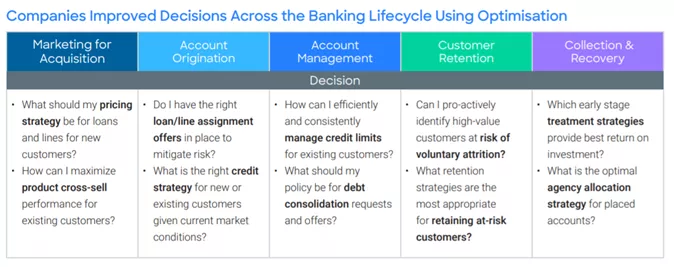
In all likelihood, the impact of the pandemic will be felt for a long time to come. As a result, strategies must continue to be as flexible as possible from here on. Optimization combined with consulting can allow businesses to move fast and react quickly to new, evolving market conditions and changing customer circumstances.
At FICO, optimization is championed among our clients across the globe. It quickly becomes the decision-making cornerstone of an organization. The development of a centre of excellence of decision modelling and optimization can then manage, maintain and drive the creation of continually improving solutions across numerous business applications, right across the customer lifecycle. Consulting, when delivered as a standalone service, rarely leaves a tool set or detailed knowledge transfer. But when combined with optimization, it delivers a legacy that enables the lender to continually benefit from optimization. To find out more, read this Q&A on the power of optimization combined with consulting.

Popular Posts

Average U.S. FICO® Score at 716, Indicating Improvement in Consumer Credit Behaviors Despite Pandemic
The FICO Score is a broad-based, independent standard measure of credit risk
Read more
The GSE Data Is Public. Here's What It Shows About Credit Score Modernization.
Independent Milliman analysis of GSE historical data confirms what anyone can now verify directly: FICO® Score 10T is the most predictive score.
Read more
FICO® Score High Achievers: Is Age the Only Factor?
<p>FICO’s latest research on <a href="http://www.fico.com/en/blogs/risk-compliance/us-credit-quality-rising-the-beat-goes-on/" target="_blank">national FICO® Score distribution</a> shows that US credit quality continues to trend upwards, with an increasing number of consumers scoring in the highest scores ranges. Given that, we decided it was time to refresh our study on “<a href="http://www.fico.com/en/blogs/risk-compliance/infographic-what-does-a-high-credit-scorer-look-like/" target="_blank">FICO® Score high achievers</a>,” where we examine the credit behavioural profiles of consumers with higher credit scores.</p> <p>As expected, our latest study showed that older people generally have higher scores, as has been the case in our <a href="http://www.fico.com/en/blogs/risk-compliance/age-before-beauty-credit-worthiness-before-youth/" target="_blank">past research</a>. This is largely because they have trade lines that have been open longer, which leads to higher scores (assuming the trade lines are in good standing and all other things equal). The most credit savvy among you will remember that length of credit history accounts for roughly 15% of the overall <a href="http://www.myfico.com/CreditEducation/WhatsInYourScore.aspx" target="_blank">FICO® Score calculation</a>.</p> <p>But for younger consumers, it isn’t too helpful to say, “just wait until you are 50 years old, and that will fix things!” Thus, I decided to dive deeper with our analysis, including looking at the credit behavioural characteristics of younger consumers with high FICO® Scores.</p> <p>In this analysis, I looked at credit characteristics for the two highest score bands, 750-799 and 800-850, which have about 16% and 23% of the population, respectively. I further broke this down by looking at the characteristics of the youngest 15% in each group, which occurs at age 29 for the 750-799 group and 43 for the 800-850. We used FICO<strong>®</strong> Score 9 for our analysis, and examined typical variables of the categories that go into the make-up of the score.</p> <p><a href="http://www.fico.com/en/blogs/wp-content/uploads/2016/10/FICO-Score-High-Achiever-table.png"><img class="alignnone size-full wp-image-29367" src="http://www.fico.com/en/blogs/wp-content/uploads/2016/10/FICO-Score-High-Achiever-table.png" alt="fico-score-high-achiever-table" width="715" height="747" /></a></p> <p>Since there’s a lot to dissect in this chart, I’ll highlight a few findings that struck me: <ul> <li><strong>Credit history.</strong> Higher scores are undoubtedly associated with a longer time on file. What’s striking is the higher average time on file for the 800+ group, both overall and for revolving accounts (the most common trade line). Clearly, it helps to start credit use early in life – but that’s not the sole determining factor for high scoring. The younger cohorts in both the 800+ and 750-799 groups have time on file medians significantly less than their older counterparts.</li> <li><strong>New credit.</strong> High credit scorers do, in fact, pursue new credit. We see little variation in months since last trade line opening and last inquiry among all groups observed.</li> <li><strong>Pay on time.</strong> As you might expect, the further in the past the delinquency, the higher the score – and that’s <u>if</u> a delinquency ever happened. 95% of the 800+ people and 72% of the 750-799 group have never been delinquent, which is a striking contrast to the 57% for the total population. The percentages for the younger groups are even higher, especially so for the 750-799ers. Collection items are also scarce for these high scorers. While 23% of the national population have collection items greater than $99, the figures are only 0.5% for the 800+ group and 3% for the 750-799 group. It is clear that, in conjunction with starting a credit file early, paying on time is a key trait of the FICO® Score high achiever.</li> <li><strong>Balance and utilization.</strong> Finally, we look at how credit is being used, focusing on revolving product use. (Since most people only have one mortgage or one auto loan, variation in instalment product figures is minimal and driven by payment history, which is near perfect for high scorers, as we’ve seen.) FICO® Score high achievers tend to have more open revolving accounts. While the % active trades and utilization are generally lower, by no means do high scorers avoid the use of credit products. What drives the difference here is the amount of <u>available</u> revolving credit utilized. The 800+ group is roughly 1/4 of the national median, both in total and on their highest utilized card; they also have lower balances and more cards<em>. </em>The 750-799 group is more active and higher utilized, but still only at 2/3 of the national figures. The young 750-799 group compensate with lower revolving balances and, as a result, lower utilization, which is in line with what we see for the 800+ group.</li> <li><strong>Benchmarks.</strong> I’d like to point out that while this study provides good benchmarks of the typical credit traits of the FICO® Score high achiever, individual credit profiles will vary widely. And keep in mind that when we sort groups of consumers as a whole by different behaviours, some results may look superficially odd. For example, the 800+ band has a longer median average open account time (128 months) than average revolving months on file (140 months).</li> </ul> So, what do we conclude? A huge takeaway is that high scorers don’t have too much in the way of serious delinquencies and negative public record data.</p> <p>In most respects, the young 800+ people are like their peer group. They really only differ markedly in their shorter credit history and higher non-mortgage balance, both of which are a function of life stage. Our results show that you don’t have to be a credit product hermit; these high scorers have more credit cards. The takeaway is to start credit activity early and maintain well-managed and moderate usage.</p> <p>In many ways, the young 750-799 people are more interesting because their age profile is much younger. Their credit characteristics differ more from their peer group, particularly in terms of length of credit history. They compensate by having almost pristine credit records and lower balances.</p> <p>Ultimately, 39% of US consumers are FICO® Score high achievers, which they accomplish by following common-sense credit practices. It ain’t rocket science!</p>
Read moreTake the next step
Connect with FICO for answers to all your product and solution questions. Interested in becoming a business partner? Contact us to learn more. We look forward to hearing from you.