Southwest Airlines Accelerates Crew Planning Optimization with FICO® Xpress on NVIDIA GPUs
Southwest Airlines cut the time to a first crew planning solution by 90% after switching to a hybrid GPU/CPU approach in FICO® Xpress

Every month, Southwest Airlines publishes a crew schedule for more than 33,000 pilots and flight attendants, covering up to 4,600 flights a day during peak travel seasons across 122 airports and 12 countries. And the planning never stops.
Southwest has been using FICO® Xpress to solve this problem since 2004. For 22 years, every schedule that reached a crew member came from models built, tuned, and solved by the airline’s own operations research team using native CPU execution.
In 2026, Southwest shifted to a hybrid GPU/CPU architecture within FICO Xpress, running part of the solve on NVIDIA GPUs and cutting the time to a first integer-feasible solution by 90%. The shift also dropped Southwest’s memory requirement by 50%, lowering cloud compute costs. The crew planning model built in FICO Xpress didn’t change; the underlying compute architecture did. Live in a production environment since July 2026, this hybrid approach is accelerating the monthly planning cycle that staffs every Southwest flight.
Key Takeaways
- Crew planning is one of aviation’s hardest problems. Every flight must be covered by exactly one crew and is required to satisfy all federal regulations and union contracts, drawn from quintillions of possibilities across Southwest’s point-to-point network of up to 4,600 flights a day.
- Southwest has been optimizing with FICO Xpress for over two decades. Since 2004, successive releases have compounded performance gains, including roughly ten times faster bidline generation after the 2014 parallel dual simplex and a 6.65x MIP speedup on instances taking longer than 1,000 seconds since 2020.
- GPU acceleration went from test to production in under five months. Southwest began testing the GPU-accelerated hybrid gradient algorithm in FICO Xpress 9.8 in March 2026 and had it running in production on FICO Xpress 9.9 by July 2026.
- A hybrid GPU/CPU split focuses each part of the solve on where it runs best. The hybrid gradient (PDHG) algorithm runs on NVIDIA GPUs where uniform execution is rewarded, and the FICO Xpress MIP solver stays on the CPU where the search can be parallelized across cores as independent threads.
- The hybrid approach cut the time to a first integer-feasible solution by 90%. On an NVIDIA L40S GPU, one of the largest monthly pairing generation problems fell from 6.5 hours to 17 minutes, and on a weekly problem, from just over an hour to under 3 minutes, while Southwest’s AWS memory requirement dropped by 50%.
- Faster planning gives crews and operations more room to improve schedules. Crew planners can run more scenarios and get results back sooner, and more rounds of feedback with Network Planning help shape a more crew-friendly flight schedule before it is published.
Why Crew Planning Is One of Aviation’s Hardest Problems
Most passengers never consider how or why a particular crew is assigned to a flight. Even fewer recognize how complex this problem is to solve and operationalize at scale. But crew assignments aren’t arbitrary. Those decisions were determined weeks earlier from quintillions of possibilities by optimization experts who specialize in turning complex problems into routine business operations.
To understand the complexity of a crew planning problem, start with coverage. Every flight in the published schedule needs a crew, and each flight has to be covered exactly once — no gaps, no duplicates. And crews don't normally fly single legs; they work sequences that can run over several days and must begin and end at the base the crew is assigned to. Assembling those sequences from a network of thousands of daily flights produces more combinations than anyone could enumerate.
How large that space gets depends in part on how the network is designed. In a hub-and-spoke network, crews fly out from a base and then return to it, with the real decisions concentrated at the base itself. Southwest operates point-to-point: crews continue on to new destinations, where multiple connecting flights are typically available. Those choices compound at every stop, for every crew, across every flight Southwest operates each day, leading to a much larger space of possibilities.
Legality is where the complexity intensifies. Federal regulations govern how long a crew can be on duty, how much rest is required between assignments, and how many hours are allowed to accumulate over a week, a month, and a year. Union contracts layer on rules that are frequently stricter — minimum monthly pay guarantees, required days off, limits on how a month of work can be built, and so on. A sequence that satisfies every federal rule can still be contractually impossible.
Aircraft assignment adds another dependency. The number of flight attendants on each flight depends on the size of the aircraft, so crew requirements aren't fully settled until the aircraft plan is — and aircraft plans change.
Then there's the question of what makes a schedule effective, not just operationally feasible. This requires balancing multiple considerations at once. Crew costs are among the largest line items on an airline's income statement. But the same schedule that minimizes cost could impact crew satisfaction and operational resilience. Planned aircraft changes that run late can propagate delays to other aircraft. Delayed flights can cause the crew to time out and be replaced with reserves.
A crew schedule that follows all the rules is not the same as a schedule worth flying. The goal is to generate the best possible one — legal, cost-efficient, and preferable for the crew — fast enough to be operationally useful.
Over Two Decades of Optimization at Southwest
Crew planning is one of the foundational problems Southwest's operations research team was created to solve, and since 2004 they have formulated, solved, and continually enhanced the model in FICO Xpress. The team has since developed models to optimize trip construction, gate assignments, bidline generation, training and vacation scheduling, and day-of-operation recovery — the often-invisible but mission-critical machinery that continuously staffs America's largest domestic airline by originating passengers.
And over time, with each new version release of FICO Xpress, the performance gains have compounded. After FICO Xpress shipped the first commercial implementation of a parallel dual simplex algorithm in 2014, bidline generation at Southwest ran roughly ten times faster. In a separate release, updates to indicator constraint handling improved runtimes by 20% on certain recovery problems, and Southwest eventually replaced its custom heuristics entirely with FICO Xpress's own built-in primal heuristics. Since 2020 alone, FICO Xpress's mixed integer programming (MIP) solver has delivered a 6.65x speedup on instances taking longer than 1,000 seconds to solve.
"FICO Xpress Optimization is certainly enabling more growth at Southwest," said Rusty Burlingame, Principal Operations Research Advisor at Southwest Airlines. "Year after year, FICO improves the performance of the software and each release is consistently better than the last."
“For more than two decades, Southwest’s operations research team has been turning advances in FICO Xpress into a sharper edge for crew planning, and GPU acceleration is the latest leap in a long run of them,” said Horia Tipi, Vice President of Platform Management at FICO. “This is a team that doesn’t wait for the future of optimization to arrive. They grab it, put it to work on one of the largest planning problems in aviation, and make it count. Congratulations to Rusty Burlingame and the entire Crew Planning team. We can’t wait to see where they take Xpress next.”
Twenty-two years in, Southwest has never treated the work as finished. They evaluate each new FICO Xpress release and take what helps — the free gains that come with the upgrade, and the new features that earn their way in. The question has never been whether to keep improving. It's how.
In 2026, for the first time, the answer wasn't found on the CPU.
From Test to Production in Five Months
Since 1983, when Xpress released its first linear programming (LP) solver, every performance gain across its entire suite of commercial optimization solvers, whether from better mathematics or better use of the hardware, came on CPU-native execution.
That includes the hybrid gradient algorithm, released in April 2024 as part of FICO Xpress 9.4. As a first-order linear programming method, it doesn’t require factorization, relying instead on elementary matrix and vector operations repeated many times over, a structure CPUs can only partially exploit at scale.
That changed in October 2025, when FICO Xpress 9.8 introduced a GPU-accelerated implementation of the hybrid gradient algorithm.
Southwest began testing the GPU-accelerated hybrid gradient algorithm on FICO Xpress 9.8 in March 2026.
By July 2026, the hybrid GPU/CPU architecture behind Southwest’s crew planning problem was running in production on FICO Xpress 9.9 — less than five months from first testing it and less than ten months after it was first released in 9.8.
Inside Southwest’s Hybrid GPU/CPU Approach in FICO Xpress
Solving a crew planning problem at this scale doesn’t begin with a standard root relaxation and branching from it. There are far too many possible pairings to enumerate, so problems of this type are commonly solved by building up a pool of candidates in a loop. Each pass solves two linear programs: a pairing generation problem, whose solution drives which pairings to create next, and a pairing solution problem, which selects pairings to be part of the crew plan. Both grow as pairings accumulate, and the loop repeats until the integer solve begins — close to 100 linear programs in total.
At Southwest, that loop — not the integer solve — is where the runtime concentrates.
Until FICO Xpress 9.9, Southwest had been solving these linear programs exclusively with the barrier method, a second-order interior point algorithm that forms and factorizes a matrix at every iteration. Factoring a sparse matrix typically produces a Cholesky factor with far more nonzeros than the matrix it originated from, and all of it has to be computed and held in memory.
Two flights pick up a nonzero in that matrix whenever a single pairing covers both, so as pairings accumulate, the factorization fills in toward dense even though the model itself stays sparse. And while a factorization can be parallelized, it still has to be formed and stored.
Across every LP solve in the loop, that overhead compounds.
The first-order hybrid gradient algorithm forms no factorization at all — nothing to compute, nothing to store. Memory scales with the problem data itself instead of a factor that outgrows it.
But replacing a second-order method with a first-order one comes with a tradeoff: the cost of accuracy. Barrier converges faster as it nears the solution, making the final digits relatively cheap. First-order methods behave the opposite way: quick to modest accuracy, slow to tighten beyond it.
Nothing about how the algorithms function prevents targeting the same tolerance. What differs is the cost of tightening. This tradeoff is inherent to first-order methods, not to any specific implementation.
A second consideration is precision, which bounds what any tolerance can achieve. The GPU implementation of the hybrid gradient algorithm runs in single precision by default, where barrier runs in double. Single precision is cheaper to compute, and it is also why a tighter tolerance alone wouldn’t produce a more accurate solution. Unlike the hybrid gradient algorithm’s convergence, precision is a setting that can be changed. For Southwest, leaving it at the default was the natural place to start testing, even though it meant accepting a looser tolerance.
One question Southwest had to answer empirically was whether the resulting accuracy gap between barrier and hybrid gradient made any practical difference to the quality of the final crew schedule.
"We were concerned that precision could be a problem. Luckily for us, it wasn’t an issue in the largest LPs we solve for pairing generation. The speed helps us solve faster, and we’ve found we generate even more pairings than before because the solution has been more fractional. When it’s time for accuracy in the last of the LPs, we switch back to barrier," said Burlingame.
That left Southwest with another question: whether moving most of the LP solves onto GPUs would deliver enough runtime and memory savings to justify the swap.
Elementary matrix and vector operations at enormous scale are precisely what NVIDIA GPUs are built for, and the hybrid gradient algorithm is composed of little else. GPUs can run thousands of those operations in parallel and have the memory bandwidth to keep every core supplied. Those are the two things a CPU struggles to offer at this scale.
Branch and cut is the opposite kind of work — irregular and different at every node. It stays with FICO Xpress's MIP solver on the CPU, where the search can be parallelized across cores as independent threads rather than in the uniform execution a GPU rewards.
The scale of Southwest's crew planning problem is what made the split worth trying. The question was never how it would perform on a single solve — it was what the entire loop would add up to.
The Results
Southwest compared the hybrid GPU/CPU approach against the CPU-native path it had been running for years — the same crew planning model solving the same problem, with most of the LP solves moved from barrier on CPU to hybrid gradient on an NVIDIA L40S GPU with 48GB memory.
The comparison covered four representative problems: two from pairing generation and two from pairing solution.
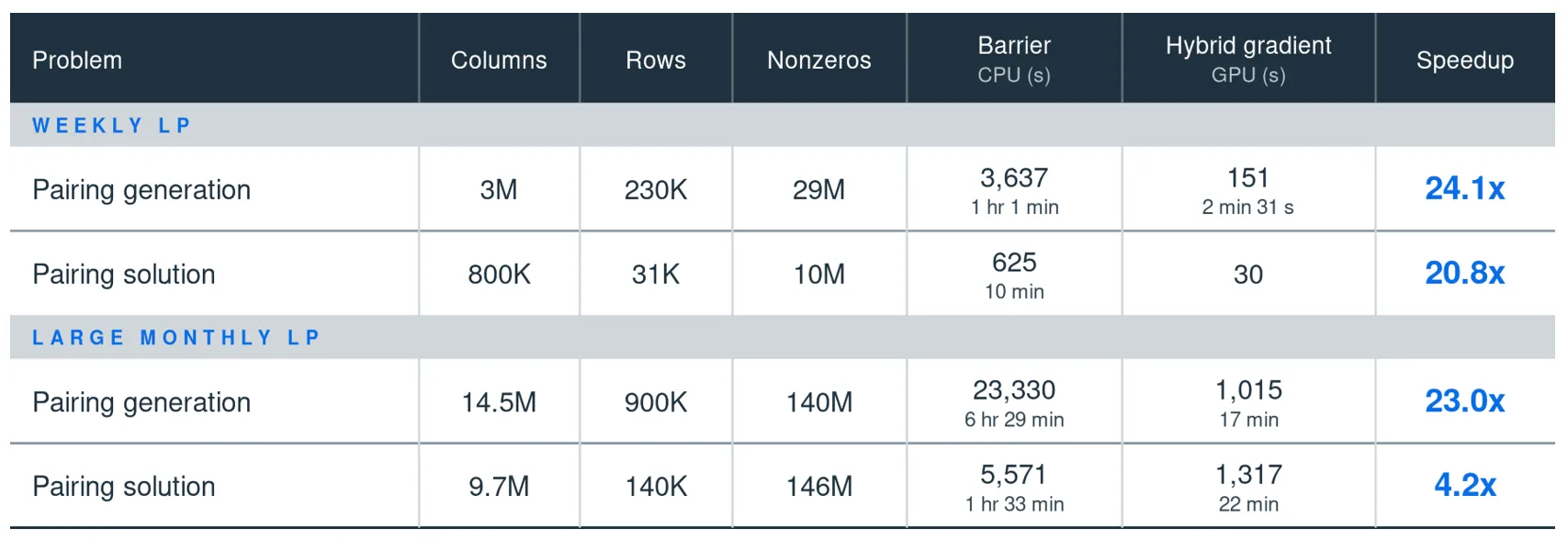
On the large monthly pairing generation problem, with 14.5 million columns and 140 million nonzeros, the solve dropped from 6.5 hours to 17 minutes, a 23x speedup.
The weekly pairing generation problem, with 3 million columns and 29 million nonzeros, dropped from just over an hour to under 3 minutes, a similar speedup of 24x.
Even further speedups are likely with more recent NVIDIA hardware released such as Blackwell GPUs.
“The results have been astounding,” said Burlingame. “Crew Planning insisted on making the switch permanent as soon as they saw initial results. While we’ve had to work through some issues with calibration, AWS availability, and parameter setting for some outliers, we’re getting solutions that are 90% faster from start to first solution.”
Southwest has reinvested some of that recovered time into the problem itself, generating even more pairings and increasing some problem sizes. That 90% is measured from the start of a scenario run to when the first integer-feasible solution is found. For many test scenarios, that’s effectively the end of the run — the first integer feasible solution answers the question that prompted it. Production runs continue, with improvement algorithms refining it until the deadline.
Southwest found the memory advantage held up in production as well, cutting its AWS memory requirement by 50%. This lowered cloud compute costs and widened the range of machines the work can run on.
”GPU acceleration is expanding what aviation can plan within a fixed window. Southwest’s deployment combines FICO’s optimization expertise with NVIDIA acceleration to tackle one of the most complex airline scheduling challenges,” said Alex Fender, Director of Decision Intelligence at NVIDIA. “24x faster planning enables teams to respond faster to disruptions, plan better for peak seasons by exploring more scenarios, and mobilize dispatch, ground operations and tech operations more effectively.”
Ultimately, the value of a faster, lighter solve is measured only by what it changes — across the entire operation, and for the crews who depend on the schedules it sets.
What Faster Planning Means for Crews and Operations
Crew Planning at Southwest works three plans at once: a near-term plan being finalized for publication one to two months out, a mid-term plan under review by Crew and Operations at three to six months out, and a long-term plan still taking shape at six to twelve months out — where the flight schedule itself is still open to change.
For the long-term plan, Crew Planning works alongside Network Planning, and faster solves mean more rounds of feedback before a flight schedule is published. Rather than only staffing the flight schedule once it is set, Southwest can help shape it to fit its crews and its passengers. The expected outcome is a more crew-friendly flight schedule.
“In Crew Planning, we work on the schedule until we run out of time. Running FICO Xpress on NVIDIA GPUs has vastly improved our run times and allowed us to increase the number of scenarios under consideration. This has allowed us to respond quickly to schedule and staffing changes and produce a crew plan that is more aligned to the true operating environment,” said Mark Sutcliffe, Vice President of Crew Planning at Southwest Airlines.
Crew Planners can now run more scenarios, and get them back faster. This buys more opportunities to find improvements against the same deadlines, and more time to focus on what’s needed to make the best decisions.
The best schedules deliver on several fronts at once — disciplined on cost, easier for crews to work, and more resilient when something goes wrong. Those goals never change, and neither do the deadlines. The lever Southwest has always relied on is better modeling and better technology — and that’s what pushes their Crew Planning team to keep improving every day.
Next month, Southwest will publish another schedule for its more than 33,000 crew members. And the month after that, another one. What changed in 2026 wasn’t the model, the problem, the planning window, or even the operations research team that builds it — it was where the longest part of the solve now runs.
Learn More About FICO Xpress Optimization
- Learn what's new in Xpress 10.0
- Read GPU-Powered Optimization: FICO's Experience with NVIDIA cuOpt
- Read GPU Acceleration of the Hybrid Gradient Algorithm in FICO Xpress
- Visit the new FICO Xpress website
- Learn how PepsiCo uses FICO Xpress to execute 400-500 large-scale optimization models daily
- Request a free trial license and test the hybrid GPU/CPU approach on your own models
- Learn how DoorDash uses FICO Xpress to make complex deliveries up to 100x faster

Popular Posts

Average U.S. FICO® Score at 716, Indicating Improvement in Consumer Credit Behaviors Despite Pandemic
The FICO Score is a broad-based, independent standard measure of credit risk
Read more
The GSE Data Is Public. Here's What It Shows About Credit Score Modernization.
Independent Milliman analysis of GSE historical data confirms what anyone can now verify directly: FICO® Score 10T is the most predictive score.
Read more
FICO® Score High Achievers: Is Age the Only Factor?
We've refreshed our study on the credit behavioural profiles of consumers with higher FICO Scores, with a strong focus on younger consumers.
Read moreTake the next step
Connect with FICO for answers to all your product and solution questions. Interested in becoming a business partner? Contact us to learn more. We look forward to hearing from you.