Top 5 Fraud & Security Posts 2018: AI and Machine Learning
The tremendous interest in AI and machine learning drove the readership on the Fraud & Security blog in 2018. Here are the five posts with the most views.
The tremendous interest in AI and machine learning drove the readership on the Fraud & Security blog in 2018. Here are the five posts with the most views.
Author TJ Horan, FICO vice president for fraud solutions, wrote a five-part series on the keys to using AI and machine learning in fraud detection. In the first post, TJ discussed the use of supervised and unsupervised models.
Because organized crime schemes are so sophisticated and quick to adapt, defense strategies based on any single, one-size-fits-all analytic technique will produce sub-par results. Each use case should be supported by expertly crafted anomaly detection techniques that are optimal for the problem at hand. As a result, both supervised and unsupervised models play important roles in fraud detection and must be woven into comprehensive, next- generation fraud strategies.
A supervised model, the most common form of machine learning across all disciplines, is a model that is trained on a rich set of properly “tagged” transactions. Each transaction is tagged as either fraud or non-fraud. The models are trained by ingesting massive amounts of tagged transaction details in order to learn patterns that best reflect legitimate behaviors. When developing a supervised model, the amount of clean, relevant training data is directly correlated with model accuracy.
Unsupervised models are designed to spot anomalous behavior in cases where tagged transaction data is relatively thin or non-existent. In these cases, a form of self-learning must be employed to surface patterns in the data that are invisible to other forms of analytics.
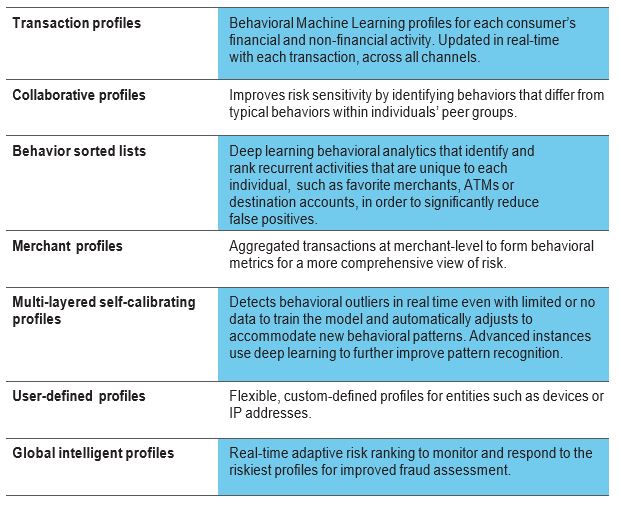
In this post, TJ Horan described the kinds of behavioral analytics used to understand and anticipate behaviors. A critical part of this, he noted, is behavioral profiles:
Given the sophistication and speed of organized fraud rings, behavioral profiles must be updated with each transaction. This is a key component of helping financial institutions anticipate individual behaviors and execute fraud detection strategies, at scale, which distinguish both legitimate and illicit behavior changes. A sample of specific profile categories that are critical for effective fraud detection includes:
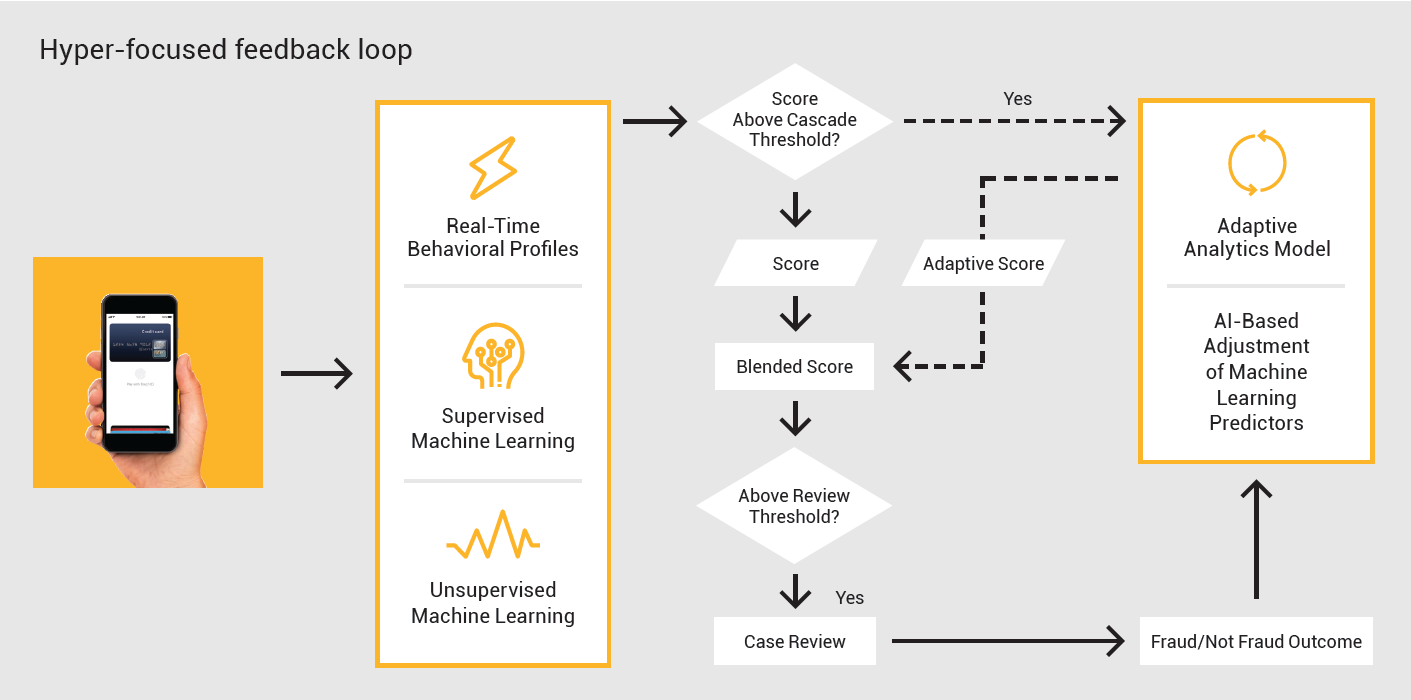
In the third of his posts to crack the top five for last year, TJ Horan explained how adaptive analytics improve sensitivity to shifting fraud patterns.
Adaptive analytics technologies automatically adapt to recent confirmed case disposition, resulting in a more precise separation between frauds and non-frauds. When an analyst investigates a transaction, the outcome — whether the transaction is confirmed as legitimate or fraudulent — is fed back into the system to accurately reflect the fraud environment that analysts are facing, including new tactics and subtle fraud patterns that have been dormant for some time. This adaptive modeling technique automatically modifies the weights of predictive features within the underlying fraud models. It is a powerful tool that improves fraud detection performance on the margins and stops new types of fraud attacks.
In a preview of her FICO World presentation, Liz Lasher discussed how adaptive analytics, supervised and unsupervised models, and other AI and machine learning techniques are being applied to catch application fraud. In this realm, she argued, explainable AI is critical:
Many machine learning algorithms are considered “black box” models that do not give fraud analysts, consumers, or regulators the appropriate insights into decisioning logic, e.g., “Why am I being declined for credit?
This is why explainable artificial intelligenceis so important: to impart the necessary transparency to pass regulatory muster, while maintaining accuracy of prediction.
FICO are very cognizant of the impact of regulations to our business and for our clients. In fact, we pride ourselves in leveraging mathematical innovation to solve problems in the real world. In the area of account originations, our credit risk and fraud scores are designed to be a tool to assist lenders with compliance to applicable fair lending laws such as the Fair Credit Reporting Act, Regulation B, and the Equal Credit Opportunity Act (ECOA).
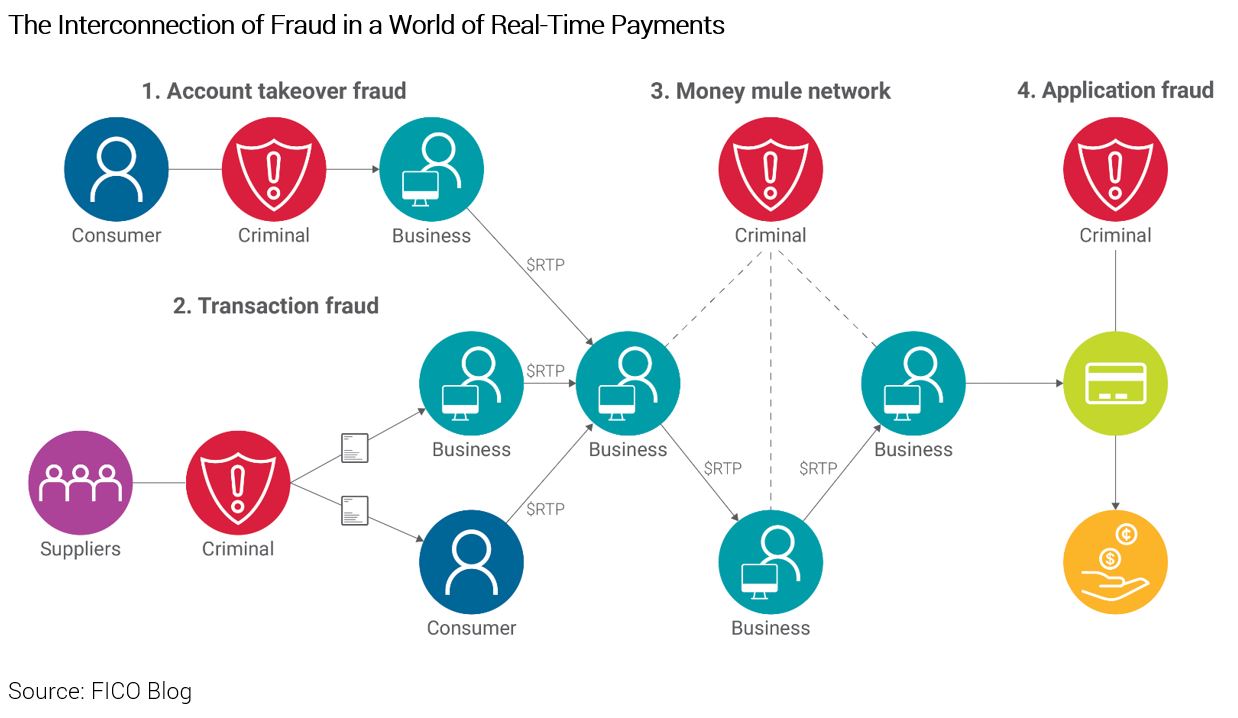
Real-time payments are opening up new avenues for fraud, wrote Sarah Rutherford. The speed of these payments makes it more difficult to trace the proceeds of crime, while also making it easier for criminals to move and extract funds. She noted three areas of concern as examples:
Account takeover fraud: A criminal can take over an account and use it to ‘hop’ money through, thereby making it more difficult for the authorities to follow the money. In some instances, the legitimate account holder may not even spot it’s happening, particularly if its an account that they don’t regularly access themselves.
Use of money mules: People who are otherwise upstanding citizens can be persuaded to allow criminals to use their accounts to transfer money through. Again, this helps criminals to hide the source of their funds, and with real-time payments the money can be moved across multiple accounts extremely quickly. In some cases, people allow their accounts to be used as mules for altruistic reasons (they’ve been conned into thinking they are helping someone in genuine need), but in other cases the mule account holder receives a payment. In the UK the widespread use of real-time payments has seen certain groups targeted by criminal gangs to act as money mules – students are often recruited.
Application fraud: Another way criminals can gain access to an account is to open one using a stolen or synthetic identity. With such an account the criminal cannot only move money through it but extract it. As discussed earlier, in the case of authorized push payment fraud, the payee’s bank may not be held liable for losses from the fraud. However, in cases where the fraudulent payment has been sent to an account opened using a stolen or synthetic identity, the receiving bank has been pushed to make restitution to the victims for having opened an account for a fraudster.
Follow this blog for our 2019 insights into fraud, financial crime, cybersecurity and AI and machine learning.
FICO
FICO (NYSE: FICO) powers decisions that help people and businesses around the world prosper. Founded in 1956, the company is a pioneer in the use of predictive analytics and data science to improve operational decisions. FICO holds more than 200 US and foreign patents on technologies that increase profitability, customer satisfaction and growth for businesses in financial services, insurance, telecommunications, health care, retail and many other industries. Using FICO solutions, businesses in more than 80 countries do everything from protecting 4 billion payment cards from fraud, to improving financial inclusion, to increasing supply chain resiliency. The FICO® Score, used by 90% of top US lenders, is the standard measure of consumer credit risk in the US and has been made available in over 40 other countries, improving risk management, credit access and transparency.
FICO® Score High Achievers: Is Age the Only Factor?
<p>FICO’s latest research on <a href="http://www.fico.com/en/blogs/risk-compliance/us-credit-quality-rising-the-beat-goes-on/" target="_blank">national FICO® Score distribution</a> shows that US credit quality continues to trend upwards, with an increasing number of consumers scoring in the highest scores ranges. Given that, we decided it was time to refresh our study on “<a href="http://www.fico.com/en/blogs/risk-compliance/infographic-what-does-a-high-credit-scorer-look-like/" target="_blank">FICO® Score high achievers</a>,” where we examine the credit behavioural profiles of consumers with higher credit scores.</p>
<p>As expected, our latest study showed that older people generally have higher scores, as has been the case in our <a href="http://www.fico.com/en/blogs/risk-compliance/age-before-beauty-credit-worthiness-before-youth/" target="_blank">past research</a>. This is largely because they have trade lines that have been open longer, which leads to higher scores (assuming the trade lines are in good standing and all other things equal). The most credit savvy among you will remember that length of credit history accounts for roughly 15% of the overall <a href="http://www.myfico.com/CreditEducation/WhatsInYourScore.aspx" target="_blank">FICO® Score calculation</a>.</p>
<p>But for younger consumers, it isn’t too helpful to say, “just wait until you are 50 years old, and that will fix things!” Thus, I decided to dive deeper with our analysis, including looking at the credit behavioural characteristics of younger consumers with high FICO® Scores.</p>
<p>In this analysis, I looked at credit characteristics for the two highest score bands, 750-799 and 800-850, which have about 16% and 23% of the population, respectively. I further broke this down by looking at the characteristics of the youngest 15% in each group, which occurs at age 29 for the 750-799 group and 43 for the 800-850. We used FICO<strong>®</strong> Score 9 for our analysis, and examined typical variables of the categories that go into the make-up of the score.</p>
<p><a href="http://www.fico.com/en/blogs/wp-content/uploads/2016/10/FICO-Score-High-Achiever-table.png"><img class="alignnone size-full wp-image-29367" src="http://www.fico.com/en/blogs/wp-content/uploads/2016/10/FICO-Score-High-Achiever-table.png" alt="fico-score-high-achiever-table" width="715" height="747" /></a></p>
<p>Since there’s a lot to dissect in this chart, I’ll highlight a few findings that struck me:
<ul>
<li><strong>Credit history.</strong> Higher scores are undoubtedly associated with a longer time on file. What’s striking is the higher average time on file for the 800+ group, both overall and for revolving accounts (the most common trade line). Clearly, it helps to start credit use early in life – but that’s not the sole determining factor for high scoring. The younger cohorts in both the 800+ and 750-799 groups have time on file medians significantly less than their older counterparts.</li>
<li><strong>New credit.</strong> High credit scorers do, in fact, pursue new credit. We see little variation in months since last trade line opening and last inquiry among all groups observed.</li>
<li><strong>Pay on time.</strong> As you might expect, the further in the past the delinquency, the higher the score – and that’s <u>if</u> a delinquency ever happened. 95% of the 800+ people and 72% of the 750-799 group have never been delinquent, which is a striking contrast to the 57% for the total population. The percentages for the younger groups are even higher, especially so for the 750-799ers. Collection items are also scarce for these high scorers. While 23% of the national population have collection items greater than $99, the figures are only 0.5% for the 800+ group and 3% for the 750-799 group. It is clear that, in conjunction with starting a credit file early, paying on time is a key trait of the FICO® Score high achiever.</li>
<li><strong>Balance and utilization.</strong> Finally, we look at how credit is being used, focusing on revolving product use. (Since most people only have one mortgage or one auto loan, variation in instalment product figures is minimal and driven by payment history, which is near perfect for high scorers, as we’ve seen.) FICO® Score high achievers tend to have more open revolving accounts. While the % active trades and utilization are generally lower, by no means do high scorers avoid the use of credit products. What drives the difference here is the amount of <u>available</u> revolving credit utilized. The 800+ group is roughly 1/4 of the national median, both in total and on their highest utilized card; they also have lower balances and more cards<em>. </em>The 750-799 group is more active and higher utilized, but still only at 2/3 of the national figures. The young 750-799 group compensate with lower revolving balances and, as a result, lower utilization, which is in line with what we see for the 800+ group.</li>
<li><strong>Benchmarks.</strong> I’d like to point out that while this study provides good benchmarks of the typical credit traits of the FICO® Score high achiever, individual credit profiles will vary widely. And keep in mind that when we sort groups of consumers as a whole by different behaviours, some results may look superficially odd. For example, the 800+ band has a longer median average open account time (128 months) than average revolving months on file (140 months).</li>
</ul>
So, what do we conclude? A huge takeaway is that high scorers don’t have too much in the way of serious delinquencies and negative public record data.</p>
<p>In most respects, the young 800+ people are like their peer group. They really only differ markedly in their shorter credit history and higher non-mortgage balance, both of which are a function of life stage. Our results show that you don’t have to be a credit product hermit; these high scorers have more credit cards. The takeaway is to start credit activity early and maintain well-managed and moderate usage.</p>
<p>In many ways, the young 750-799 people are more interesting because their age profile is much younger. Their credit characteristics differ more from their peer group, particularly in terms of length of credit history. They compensate by having almost pristine credit records and lower balances.</p>
<p>Ultimately, 39% of US consumers are FICO® Score high achievers, which they accomplish by following common-sense credit practices. It ain’t rocket science!</p>
Connect with FICO for answers to all your product and solution questions. Interested in becoming a business partner? Contact us to learn more. We look forward to hearing from you.