The Hidden Costs of Friction: What 18,000 Consumers Revealed About Identity Verification and Account Origination
Our comprehensive survey uncovered striking regional differences in consumer priorities and behaviors, challenging conventional wisdom about what drives account selection

In today's digital-first financial landscape, the balance between security and customer experience has never been more critical—or more delicate. A new FICO global consumer survey reveals surprising insights about how identity verification processes can create expensive customer churn, costing financial institutions both revenue and relationships in ways many organizations may not fully recognize.
The Global Consumer Perspective: Security vs. Simplicity
Our comprehensive study surveyed approximately 18,000 consumers across 18 countries spanning APAC, EMEA, Latin America, and North America, uncovering striking regional differences in consumer priorities and behaviors. The findings challenge conventional wisdom about what drives account selection and reveal concerning trends about customer abandonment.
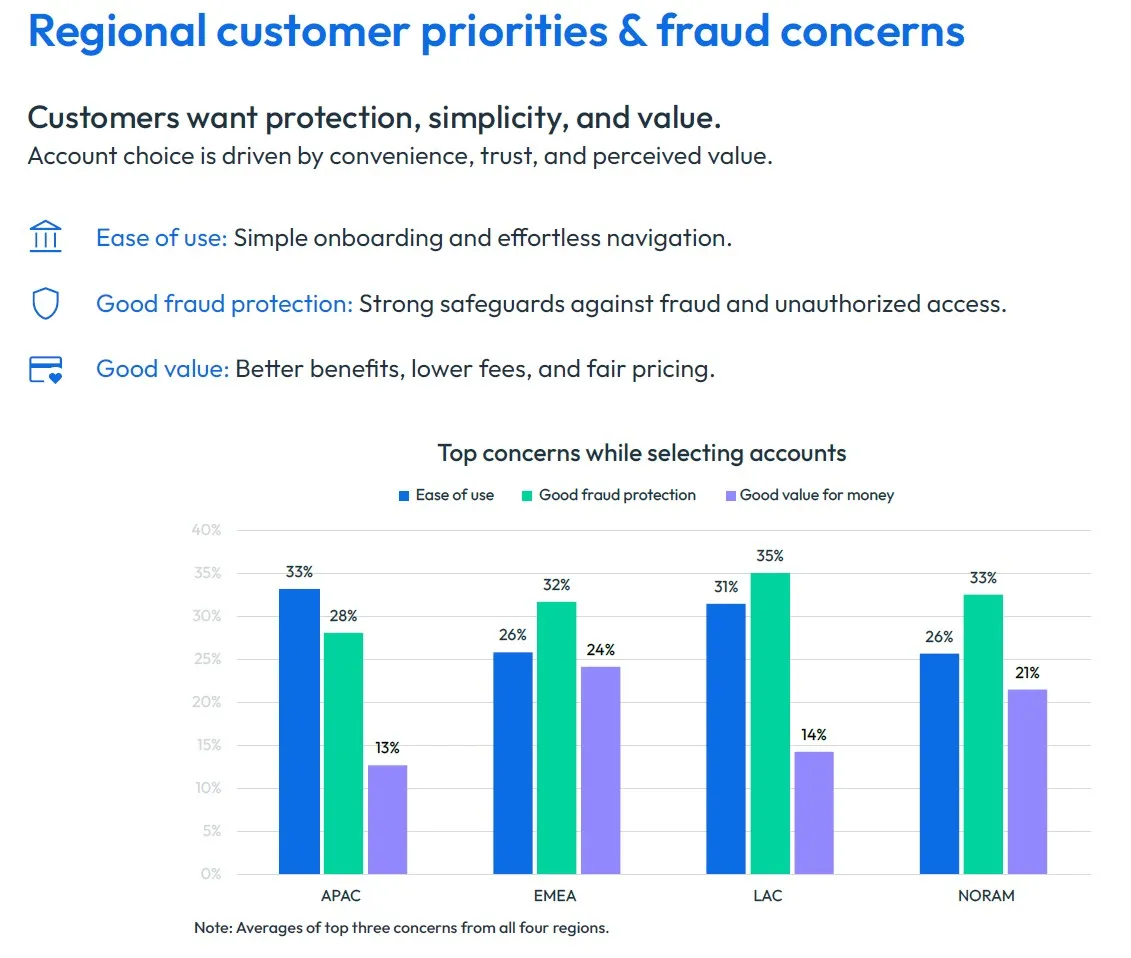
When choosing financial accounts, consumers consistently prioritize three key factors: convenience, protection, and perceived value. However, the weight given to each varies dramatically by region. While customers in APAC prioritize ease of use above all else, consumers in other regions place stronger emphasis on fraud protection as their primary deciding factor. This regional disparity has profound implications for how financial institutions should tailor their onboarding strategies.
Customers want protection, simplicity, and value led by:
- Ease of use: simple onboarding and effortless navigation
- Good fraud protection: strong safeguards against fraud and unauthorized access
Good value: better benefits, lower fees, and fair pricing
The Account Opening Opportunity Hiding in Plain Sight
Perhaps most intriguing is what our research reveals about customer abandonment during the account opening process. The data shows that complex identity verification procedures are creating significant friction at the worst possible moment—when potential customers are deciding whether to trust an institution with their financial relationship.
The abandonment rates vary considerably across different types of accounts and regions, with some account types experiencing particularly high drop-off rates. Personal bank accounts, representing the foundation of most customer relationships, show concerning abandonment patterns that should give every financial services executive pause.
But the problem doesn't end at account opening. Our research uncovered an equally troubling trend: customers who successfully navigate initial identity checks may later reduce or completely stop using their accounts if they perceive ongoing verification processes as too burdensome. There is tremendous opportunity for forward-thinking banks to win, retain, and protect customers with streamlined, safe, and intuitive account opening.
Financial Crime Fears Drive Contradictory Behaviors
Consumer attitudes toward financial crime reveal a complex psychology that institutions must navigate carefully. Customers fear financial crimes that can strike suddenly and cause direct financial loss that's difficult to reverse. Yet their concerns vary significantly by region.
Scams top the worry list in APAC at 33%, while identity fraud dominates concerns in LAC at 37%. Meanwhile, card misuse ranks highest among North American consumers at 23%. These regional differences suggest that one-size-fits-all approaches to security messaging and verification processes may be missing the mark.
Adding another layer of complexity, our research reveals that 7% of all global respondents believe their identity has definitely been used to open a financial account fraudulently, with the highest percentage occurring in North America at 9%. This statistic underscores why consumers demand robust protection—even as they simultaneously abandon accounts due to verification friction.
Application Fraud: Where Friction and Risk Collide
The consumer behaviors uncovered in our research play out against a backdrop of increasingly sophisticated application fraud. When individuals misrepresent their identity, inflate their income, or use stolen credentials to open accounts, they exploit the very same onboarding processes that frustrate legitimate customers. The irony is sharp: the friction that drives good customers away often fails to stop determined fraudsters.
Application fraud is multifaceted. Third-party fraud uses stolen or synthetic identities and is the variety most consumers picture when they think about identity theft. But our survey findings on income exaggeration hint at a murkier reality — first-party fraud, where applicants deliberately falsify their own information, is deeply intertwined with the "situational flexibility" attitudes our respondents revealed. And mule accounts, opened to move illicit funds, can slip through onboarding checks that prioritize speed over scrutiny.
Layering on more verification may catch more fraud, but our data shows it also pushes legitimate customers toward abandonment. Streamlining without intelligent risk assessment simply opens the door wider for bad actors. The institutions getting this right are moving toward orchestrated and adaptive approaches that calibrate friction to risk in real time — lighter-touch verification for low-risk applicants, escalated scrutiny where signals warrant it. Done well, this strengthens fraud prevention and customer experience simultaneously.
The Biometric Authentication Puzzle
Consumer attitudes toward biometric authentication present another fascinating paradox. While these technologies promise to reduce friction while maintaining security, our research reveals significant gaps between user preference and perceived protection across different biometric methods.
The data shows that consumer acceptance varies not just by technology type, but also by region, suggesting that deployment strategies for biometric authentication need to consider local preferences and cultural attitudes toward privacy and technology adoption.
The Trust vs. Convenience Dilemma
Perhaps most intriguingly, our survey uncovered attitudes toward income exaggeration that reveal the complex relationship between consumer behavior and institutional risk management. The findings show that consumer tolerance for "situational flexibility" varies dramatically across different types of applications and regional contexts.
These insights have profound implications for first-party fraud prevention, regulatory compliance, and the design of application processes that accurately assess consumer ability to repay while maintaining reasonable friction levels.
What This Means for Financial Institutions
The research reveals a fundamental challenge: consumers want both bulletproof security and frictionless experiences, but current approaches often force an either-or choice. The institutions that will thrive are those that can thread this needle—delivering robust fraud protection through intelligent, adaptive processes that feel seamless to legitimate customers.
The regional variations in consumer behavior and preferences also suggest that global financial institutions need more nuanced, localized approaches to identity verification and fraud prevention. What works in North America may drive abandonment in APAC, and vice versa.
The Path Forward
The full implications of these findings extend far beyond simple customer satisfaction metrics. They touch on fundamental questions of revenue optimization, risk management, regulatory compliance, and competitive positioning in an increasingly digital marketplace.
The complete research reveals specific strategies and technologies that can help institutions navigate these challenges while providing detailed benchmarks for understanding how your organization's performance compares to regional and global standards.
The future of financial services belongs to institutions that can master the art of invisible security—protection so intelligent and seamless that customers feel both safe and unencumbered. The question is: will your organization be among them?
Dive Deeper Into the Data
Download the full consumer insights infographic to explore detailed findings across APAC, EMEA, LAC, and NORAM, including specific metrics, regional comparisons, and strategic recommendations for balancing security with customer experience.
How FICO Can Help You Stop Fraud
- Understand more about modern approaches to enterprise fraud with the six E’s of enterprise fraud
- Explore our fraud solutions
- Explore our origination solutions

Popular Posts

Average U.S. FICO® Score at 716, Indicating Improvement in Consumer Credit Behaviors Despite Pandemic
The FICO Score is a broad-based, independent standard measure of credit risk
Read more
The GSE Data Is Public. Here's What It Shows About Credit Score Modernization.
Independent Milliman analysis of GSE historical data confirms what anyone can now verify directly: FICO® Score 10T is the most predictive score.
Read more
FICO® Score High Achievers: Is Age the Only Factor?
<p>FICO’s latest research on <a href="http://www.fico.com/en/blogs/risk-compliance/us-credit-quality-rising-the-beat-goes-on/" target="_blank">national FICO® Score distribution</a> shows that US credit quality continues to trend upwards, with an increasing number of consumers scoring in the highest scores ranges. Given that, we decided it was time to refresh our study on “<a href="http://www.fico.com/en/blogs/risk-compliance/infographic-what-does-a-high-credit-scorer-look-like/" target="_blank">FICO® Score high achievers</a>,” where we examine the credit behavioural profiles of consumers with higher credit scores.</p> <p>As expected, our latest study showed that older people generally have higher scores, as has been the case in our <a href="http://www.fico.com/en/blogs/risk-compliance/age-before-beauty-credit-worthiness-before-youth/" target="_blank">past research</a>. This is largely because they have trade lines that have been open longer, which leads to higher scores (assuming the trade lines are in good standing and all other things equal). The most credit savvy among you will remember that length of credit history accounts for roughly 15% of the overall <a href="http://www.myfico.com/CreditEducation/WhatsInYourScore.aspx" target="_blank">FICO® Score calculation</a>.</p> <p>But for younger consumers, it isn’t too helpful to say, “just wait until you are 50 years old, and that will fix things!” Thus, I decided to dive deeper with our analysis, including looking at the credit behavioural characteristics of younger consumers with high FICO® Scores.</p> <p>In this analysis, I looked at credit characteristics for the two highest score bands, 750-799 and 800-850, which have about 16% and 23% of the population, respectively. I further broke this down by looking at the characteristics of the youngest 15% in each group, which occurs at age 29 for the 750-799 group and 43 for the 800-850. We used FICO<strong>®</strong> Score 9 for our analysis, and examined typical variables of the categories that go into the make-up of the score.</p> <p><a href="http://www.fico.com/en/blogs/wp-content/uploads/2016/10/FICO-Score-High-Achiever-table.png"><img class="alignnone size-full wp-image-29367" src="http://www.fico.com/en/blogs/wp-content/uploads/2016/10/FICO-Score-High-Achiever-table.png" alt="fico-score-high-achiever-table" width="715" height="747" /></a></p> <p>Since there’s a lot to dissect in this chart, I’ll highlight a few findings that struck me: <ul> <li><strong>Credit history.</strong> Higher scores are undoubtedly associated with a longer time on file. What’s striking is the higher average time on file for the 800+ group, both overall and for revolving accounts (the most common trade line). Clearly, it helps to start credit use early in life – but that’s not the sole determining factor for high scoring. The younger cohorts in both the 800+ and 750-799 groups have time on file medians significantly less than their older counterparts.</li> <li><strong>New credit.</strong> High credit scorers do, in fact, pursue new credit. We see little variation in months since last trade line opening and last inquiry among all groups observed.</li> <li><strong>Pay on time.</strong> As you might expect, the further in the past the delinquency, the higher the score – and that’s <u>if</u> a delinquency ever happened. 95% of the 800+ people and 72% of the 750-799 group have never been delinquent, which is a striking contrast to the 57% for the total population. The percentages for the younger groups are even higher, especially so for the 750-799ers. Collection items are also scarce for these high scorers. While 23% of the national population have collection items greater than $99, the figures are only 0.5% for the 800+ group and 3% for the 750-799 group. It is clear that, in conjunction with starting a credit file early, paying on time is a key trait of the FICO® Score high achiever.</li> <li><strong>Balance and utilization.</strong> Finally, we look at how credit is being used, focusing on revolving product use. (Since most people only have one mortgage or one auto loan, variation in instalment product figures is minimal and driven by payment history, which is near perfect for high scorers, as we’ve seen.) FICO® Score high achievers tend to have more open revolving accounts. While the % active trades and utilization are generally lower, by no means do high scorers avoid the use of credit products. What drives the difference here is the amount of <u>available</u> revolving credit utilized. The 800+ group is roughly 1/4 of the national median, both in total and on their highest utilized card; they also have lower balances and more cards<em>. </em>The 750-799 group is more active and higher utilized, but still only at 2/3 of the national figures. The young 750-799 group compensate with lower revolving balances and, as a result, lower utilization, which is in line with what we see for the 800+ group.</li> <li><strong>Benchmarks.</strong> I’d like to point out that while this study provides good benchmarks of the typical credit traits of the FICO® Score high achiever, individual credit profiles will vary widely. And keep in mind that when we sort groups of consumers as a whole by different behaviours, some results may look superficially odd. For example, the 800+ band has a longer median average open account time (128 months) than average revolving months on file (140 months).</li> </ul> So, what do we conclude? A huge takeaway is that high scorers don’t have too much in the way of serious delinquencies and negative public record data.</p> <p>In most respects, the young 800+ people are like their peer group. They really only differ markedly in their shorter credit history and higher non-mortgage balance, both of which are a function of life stage. Our results show that you don’t have to be a credit product hermit; these high scorers have more credit cards. The takeaway is to start credit activity early and maintain well-managed and moderate usage.</p> <p>In many ways, the young 750-799 people are more interesting because their age profile is much younger. Their credit characteristics differ more from their peer group, particularly in terms of length of credit history. They compensate by having almost pristine credit records and lower balances.</p> <p>Ultimately, 39% of US consumers are FICO® Score high achievers, which they accomplish by following common-sense credit practices. It ain’t rocket science!</p>
Read moreTake the next step
Connect with FICO for answers to all your product and solution questions. Interested in becoming a business partner? Contact us to learn more. We look forward to hearing from you.