Loan Origination Strategy: A 7-Step Framework for Lenders
When 80% of portfolio risk is decided at originations, it’s critical to get speed, trust and explainability right - here are the factors that matter

Originating a new account is one of the highest-stakes moments in the credit lifecycle. According to FICO research, the origination decision accounts for up to 80% of the measurable risk a lender carries over the life of an account— more than any limit increase, repricing or collections action that follows. Originations sit at the intersection of marketing, which brings the applicant to the door, fraud prevention, which confirms the applicant is who they claim to be, and customer management, which grows the relationship afterwards. It is where a lender decides whether to open that relationship at all, and on what terms.
The decision is getting harder. The OECD’s September 2026 Interim Economic Outlook projects global growth of 2.9% in 2026 and 3.0% in 2027, even as an energy supply shock keeps G20 headline inflation at 4.1% this year, easing to 3.6% in 2027. Lending demand has not gone away: the Federal Reserve’s consumer credit data shows total consumer credit is expanding at a 2.6% annualised rate in Q2 2026. TransUnion’s Q2 2026 Credit Industry Insights Report tells a similar story, with mortgage originations up 26%, personal loan originations up 19.5%, and bankcard originations up 11.8%. The New York Fed’s Q2 2026 Household Debt and Credit Report adds the balance-side confirmation: credit card and auto loan balances are both higher than the quarter before. In the UK, the Institute for Fiscal Studies expects real earnings to fall in both 2026 and 2027, with Bank Rate already at a restrictive 3.75%. The margin for error on each decision has narrowed, so growth and caution need to be designed together.
Lenders pulling ahead are not the ones originating less. They are the ones getting better at answering three questions for every applicant: can this person actually afford what they are asking for, what is the most accurate picture of their finances, and is this person a fraudster? Affordability assessment and alternative data have been discussed as the answer for years, but both were historically hard to operationalise at scale. Affordability checks leaned on self-reported income and a static bureau snapshot, and cash-flow data meant bespoke integrations too costly to run. Open banking infrastructure and data-aggregator connections have changed those economics: a verified income and cash-flow picture can now be pulled into a decision in seconds.
Key Takeaways
- Origination is where most credit risk is decided. FICO research attributes up to 80% of the measurable risk a lender carries over an account’s life to the origination decision, more than any later limit, pricing or collections action.
- Growth and caution have to be designed together. Delinquency is rising fastest where origination volume is growing fastest, so lenders cannot add risk discipline after the event.
- A modular seven-pillar framework brings structure. Some components, such as hard declines, stay stable for long periods, while others, such as decision criteria and monitoring, need continuous recalibration.
- Speed, trust, and explainability are the new bar. Borrowers expect short, low-friction applications and welcome AI only with disclosure, while regulators in the UK, EU and US expect lenders to show their work.
- Better decisioning pays off on both sides of the P&L. Lenders report lower cost to originate and more approved volume at the same risk, as the Freddie Mac and Lloyds Banking Group examples show.
What Are the Trends in Credit Originations?
A recent Credit Industry Insights Report shows record origination volumes across the major lending products in its U.S. Consumer Credit Database, with growth concentrated at the edges of the risk spectrum rather than the middle. Bankcard originations rose 11.8% year-over-year; unsecured personal loans grew 19.5% to a new high, led by subprime (+29%) and super-prime (+9%). Auto originations rose a more modest 1.3% as demand shifted toward used vehicles. Mortgage originations jumped 26.0%, driven mostly by refinancing as rates eased. Delinquency rose across all four products: card 90+ day delinquency reached 2.26% (from 2.17%), personal loan 60+ day delinquency reached 3.81% (from 3.37%), auto edged up 2 basis points to 1.33%, and mortgage climbed 29 basis points to 1.56%, the largest relative increase at +23%.
Two implications follow. First, growth in cards and personal loans is concentrated towards subprime and super-prime simultaneously, with the prime middle comparatively flat — a sign that origination strategies increasingly need to differentiate within a risk tier, not just across them. Second, delinquency is rising fastest where volume is growing fastest. Mortgage posted both the strongest origination growth and the largest year-over-year increase in delinquency. Lenders need to design growth and risk discipline together, not one after the other.
What Are the 7 Pillars of the Originations Decision Framework?
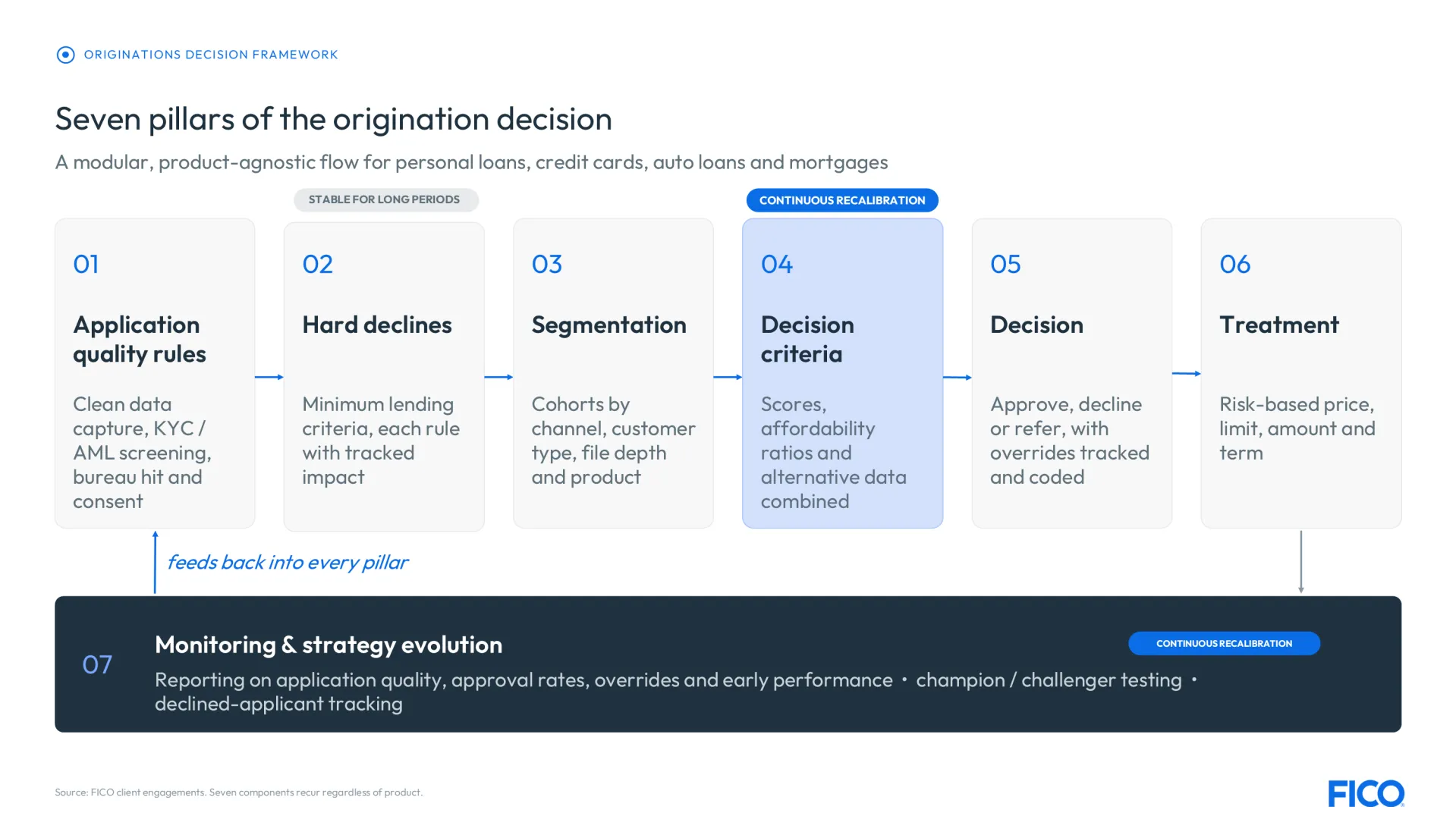
This piece sets out a practical, product-agnostic framework for the origination decision across personal loans, credit cards, auto loans and mortgages, and for meeting the regulation that now surrounds it. A well-run origination process is modular: some components stay stable for prolonged periods, while others need continuous recalibration. Seven components recur across FICO client engagements, regardless of product.
- Application quality rules. Poor data hygiene at the point of capture creates problems that surface everywhere downstream. This is where legal age, identity (KYC), and screening for anti-money laundering and politically exposed persons happen, alongside the credit bureau “hit” that pulls the right report and score. Standardised inputs — fixed date formats, controlled lists rather than free text — measurably improve downstream decision quality, and this is also the point to capture consent for future bureau updates and marketing, provided the extra fields don't tip the application into the friction that drives abandonment.
- Hard declines. A completed application is screened against minimum lending requirements — age, region, income level, employment type, prior insolvency, presence on a fraud or watch list — often using a short-form bureau file rather than the full report, for cost and speed. The discipline here is measurement: every knock-out rule should carry a tracked volume impact, because a rule written for yesterday's fraud pattern can silently cut off a large share of good applicants today.
- Segmentation. Applicants are grouped into cohorts — by channel, by new-versus-existing customer, by thin-versus-thick bureau file, by product type — so the decision criteria that follow can be targeted rather than generic. Pre-approved offers to existing customers typically run a simplified “fast-track” flow, since creditworthiness was already assessed at the point the offer was made.
- Decision criteria. This is the heart of credit decisioning, where the richest data comes in: application and internal data, affordability assessment measures (debt-to-income, payment-to-income, gross and total debt-service ratios), and predictive scores layered together — a bureau credit risk score, such as FICO® Score 10T, a bankruptcy score, an application or behaviour score, and increasingly a fraud score built on consortium and internal data. A credit-risk-by-bankruptcy-score matrix remains one of the most widely used ways to combine two predictive views into a single decision grid. Alternative and open banking data — cash-flow patterns, rental and utility payment history, aggregated postcode-level data — are the fastest-growing additions to this layer, specifically because they extend coverage to thin-file and credit-invisible applicants without abandoning bureau-based risk discipline: in a 2024 industry survey, 90% of lenders said broader access to alternative data would help them reach new markets, citing younger consumers and other thin-file segments by name. The UltraFICO® Score applies that logic to the score itself, combining a FICO® Score with consumer-permissioned cash flow data to help lenders assess consumers with limited credit histories.
- Decision. Approve, decline, or refer for manual review when information is incomplete or inconsistent. Overrides — a human approving an application the rules declined, or vice versa — should be tracked and coded, both to catch systematic gaps in the automated strategy and to build the evidence base regulators increasingly expect.
- Treatment. The last step sets price, limit or loan amount and term, calibrated to risk-reward, and personalized rather than one-size-fits-all action. A low-risk applicant should receive better terms than a high-risk one approved on the same product, with pricing strategies reflecting enough headroom to support future up-sell and cross-sell without eroding the lender's margin target. Where an applicant falls just short, alternatives to an outright decline — a more suitable product, a lower limit or a shorter term — can keep a good customer while controlling risk.
- Monitoring and strategy evolution. No strategy stays optimal for long. Regular reporting on application quality, approval rates, overrides and early performance shows when cut-offs drift or a rule's efficiency decreases. Strategy evolution ranges from recalibrating scores and cut-offs to running a fully optimised challenger against the current champion. This is also the step that generates the outcome evidence regulators require. Tracking how declined applicants perform elsewhere, using bureau data, against the accounts that were approved also helps lenders validate their cut-offs and risk appetite.
What Impact Do Origination Strategies Have on the Customer Lifecycle?
Every change made at the point of acquisition shapes the rest of the customer journey, so the framework works more effectively when teams across the lifecycle are connected to it.
If risk cut-offs are lowered to capture growth at the edges of the risk spectrum, more higher-risk customers come onto the book, and collections volumes will follow, typically a few months later. Collections teams need advance warning to plan capacity and treatment strategies. The same customers are often more credit-hungry. Expect more requests for credit limit increases and more attempts to spend over limit, so customer management strategies for limit management, authorisations and over-limit tolerance should be ready before the new vintages mature, not after. Teams responsible for impairment and Expected Credit Loss (ECL) need the same visibility, because a shift in the risk mix at origination flows straight into ECL provisioning. The most effective lenders treat this as a closed feedback loop: the originations team shares what has changed and why, while customer management, collections and impairment teams report back on how those accounts actually perform. That evidence then informs the next round of cut-off management and strategy decisions.
Speed, Trust and Explainability: the New Bar at Origination
Two forces are reshaping what “good” looks like at origination: borrowers who now benchmark a loan application against the best digital experience they have had anywhere, and AI that is finally fast enough to meet that bar. Increasingly, they complement each other.
Friction is product-specific. FICO's 2025 consumer survey found that nearly half of borrowers will not tolerate more than ten questions on an application. Most expect the entire process, from application to decision, to take under an hour, and many expect a decision in 30 minutes or less; for personal loans, some set the bar at ten minutes. Up to one in five applicants who start in good faith abandon the application because the process feels too complex, and identity and fraud checks are a specific flashpoint: 20% of personal loan applicants and 16% of auto loan applicants abandon when verification feels too cumbersome.
Tolerance also rises with the size of the decision. FICO research on digital originations found that around half of mortgage applicants are willing to answer twenty or more questions. Only around a third currently prefer a fully digital channel, because consumers still expect — and tolerate — more rigor for the largest financial decision of their lives. PwC’s 2026 Consumer Lending Radar shows the same split for AI: borrowers are more comfortable with AI approving an auto loan (49%) than a home loan (37%). The acceptable amount of friction is product-specific, not universal.
AI is welcomed, but only with disclosure. A study from 2025 found that mortgage borrowers feel comfortable with AI in the originations process — 54% “completely comfortable” and a further 31% “partially comfortable” — but only on condition of transparency: 71% say it is “very important” that their lender discloses when AI is being used. That is the customer-experience case for explainability, where FICO’s 2026 State of Responsible AI report explores how organisations are closing the gap in explaining AI-influenced decisions to regulators and customers.
Accuracy means explainable, not just correct. The direction of travel is the same across major markets: lenders must be able to show their work. In the UK, the FCA's Consumer Duty, in force since July 2023, requires firms to deliver good outcomes and actively avoid foreseeable harm across the origination journey. Similarly, the EU AI Act classifies creditworthiness assessment as a high-risk use. Lenders using AI to score applicants must assign trained human oversight, keep decision logs, tell applicants that AI is involved and complete a fundamental rights impact assessment, and applicants gain a right to “clear and meaningful explanations” of the decision. In the US, the Equal Credit Opportunity Act and Regulation B already require lenders to give declined applicants the specific principal reasons for an adverse decision, whatever model sits behind it.
A decision built on transparent, documented criteria — a decision tree or scorecard whose logic can be read back to a regulator or a declined applicant — meets the customer expectation and the compliance requirement at the same time. That moves explainability from an audit-time exercise to a design requirement.
What Are the Benefits of Getting the Originations Framework Right?
The business case for getting origination right is no longer just a customer satisfaction story. Lenders that have put better decisioning and AI into the process are reporting gains on both sides of the P&L at once — lower cost to originate, and more approved volume at the same risk.
Lower cost per loan. Freddie Mac's May 2025 machine-learning update to its automated underwriting engine put the ceiling at up to $1,500 saved per loan, with lenders who fully adopt automation saving as much as 40% on processing costs. Freddie Mac's own measured — not modelled — Cost to Originate research found that lenders with higher digital-adoption rates run $2,200 cheaper per loan than lower-adoption peers, with production cycles five days shorter and margins a full percentage point higher.
Higher approval volume at the same risk. Lloyds Banking Group, a 2025 FICO® Decisions Award winner for Cloud Deployment, moved its lending decision infrastructure to FICO® Platform. Real-time bureau data drove a 2.5% uplift in credit card approvals and doubled new-to-bank consumer loan customers, and more than £7 billion in annual lending is now powered by the platform. A bureau data upgrade that once took months was completed in weeks.
Three Tips for Increasing Value from Originations
For lenders reviewing their origination strategy against the framework above, three moves recur across engagements.
- Measure friction as a risk metric, not just a conversion metric. Every knock-out rule, verification step and data request in the application quality and hard decline stages should carry a tracked abandonment cost, because the applicants lost to friction are disproportionately the low-risk ones a faster competitor will happily take.
- Extend decision criteria with alternative data specifically where bureau coverage is thinnest. Apply it where it closes a named gap — younger consumers, recent immigrants, thin-file segments — rather than uniformly, so the gain in reach does not come at the cost of discipline on applicants the bureau already scores well.
- Build explainability into the decision architecture itself. Retrofitting it at audit time is slower and less reliable than designing for it from the start. A scorecard or decision tree that reads back in plain language meets borrowers’ demand for disclosure and the explanation duties emerging in the UK, US and EU, and whatever comes next.
The common thread across all three: a decision built on transparent, documented criteria is no longer simply good practice or a compliance checkbox. It is the architecture that lets a lender move at the speed its customers now expect, without losing the ability to show its work.
How FICO Can Help You Improve Originations
- Explore FICO® Originations Solution, Powered by FICO® Platform — a configurable, analytics-driven decisioning environment built for faster approvals, higher automated approval rates and lower abandonment across every consumer lending product.
- Read the related blog post: Loan Origination Automation: Faster Approvals, Reduced Risk
- Learn about FICO® Score 10T and how it incorporates trended credit data and, when available, rental payment history, into credit risk assessment.
- To explore this for your portfolio, reach out to your designated FICO® Advisor or sales executive.

Popular Posts

Average U.S. FICO® Score at 716, Indicating Improvement in Consumer Credit Behaviors Despite Pandemic
The FICO Score is a broad-based, independent standard measure of credit risk
Read more
The GSE Data Is Public. Here's What It Shows About Credit Score Modernization.
Independent Milliman analysis of GSE historical data confirms what anyone can now verify directly: FICO® Score 10T is the most predictive score.
Read more
FICO® Score High Achievers: Is Age the Only Factor?
We've refreshed our study on the credit behavioural profiles of consumers with higher FICO Scores, with a strong focus on younger consumers.
Read moreTake the next step
Connect with FICO for answers to all your product and solution questions. Interested in becoming a business partner? Contact us to learn more. We look forward to hearing from you.