Predictions 2024: You Need to Calm Down: AI Predictions and Prescriptions
Where will we land in 2024? Will we enter into a new, calmer era of AI?

Like Sam Altman himself, I was quite surprised by the recent whirlwind speed of OpenAI’s revolving door: He’s out! He’s trying to get in! He’s at Microsoft! He’s back at OpenAI! This collective corporate behavior can only be described as dysfunctional and destabilizing, qualities that OpenAI’s Generative AI (GenAI) tool, ChatGPT, also earned a reputation as being. It’s pretty impossible to depend on anything that acts erratically, but that is exactly what has happened in 2023, with the world (including Microsoft) quickly becoming dependent on ChatGPT. Therefore, my artificial intelligence (AI) predictions for 2024 are also prescriptive: we––the tech industry, business world, cheating college students and the world in general––need to take another piece of advice from TIME Magazine’s Person of the Year, Taylor Swift. Instead of acting on Generative AI with truly blind faith, we need to calm down from the AI hoopla of 2023 and retrain our focus on practical artificial intelligence. Here are four ways I believe that will happen:
1. Auditable AI will make accountability cool
The last few weeks of 2023 showed us how organizational dysfunction at AI firms can translate into a disturbing opacity about how AI tools work. In 2024 I expect to see a backlash against opacity, and a resulting surge in market demand for AI model transparency. Auditable AI will become mandatory for artificial intelligence models; with so much riding on AI decisioning and Generative AI outputs, understanding how models operate will no longer be a nice-to-have. Auditability requirements will catalyze AI governance structures so much that, in 2024, accountability will be cool.
Blockchain technology makes Auditable AI readily attainable. Blockchain has matured and been applied in extremely useful ways beyond cryptocurrency, such as for AI model management governance. Blockchain will be a key component of Auditable AI strategies, through immutable chains of AI model requirements met, tested and accepted. This will help to reduce the risk of negative AI outcomes.
In 2024, I anticipate immutable blockchain technology to become more ingrained in the data science ecosystem. Auditability and transparency will be part of the conversation much earlier as part of demonstrable Responsible AI practices. As more organizations adopt auditability into their workstreams, there will be an appreciable improvement in model auditability and adherence to model development standards.
If 2023 has taught the world anything, it’s that rushing AI models and products into production is flat-out dangerous. Organizations that want their AI systems to be trusted will need to adopt Auditable AI.
2. Small will be beautiful
Large AI models, including large language models (LLMs) like ChatGPT, Google Bard AI, et. al., are incredibly unwieldy, difficult and expensive to build and operate. Furthermore, they are not easily retrained without cannibalistic entropy.
I have long held an unorthodox belief in “explainability first, predictive power second,” a core tenet of Responsible AI. In 2024, small, highly explainable AI models will be accepted and embraced as being more effective than outsized large models, as organizations focus on practical, reliable, net-positive business outcomes.
3. Humans will reassert themselves
As 2023 saw humans giddily outsourcing much thinking to Gen AI. In 2024 we will realize that we have a responsibility to be the overlords of this new technology, not the other way around. Why? Because in outsourcing one’s critical thinking to a chatbot, with every prompt we cede a bit of our soul and creativity. Critical thinking atrophies.
I believe that in 2024 humans will move past Gen AI’s ‘wow’ factor and focus on getting practical. People need to critically understand, trust and validate the AI tools they leverage, and in the coming year will prioritize finding new ways to work together using artificial intelligence as a tool instead of a magic wand. Doing so will produce far better, ethical and more responsible outcomes.
4. Gen AI will become less dramatic, more pragmatic
It’s hard to imagine Generative AI ever falling far from top-of-mind. But that is what happens with all technologies as they move, with almost clockwork reliability, through their hype cycle.
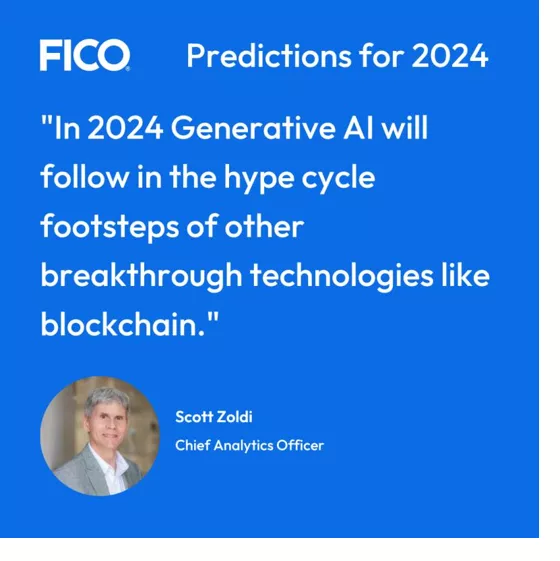
While its impact has been unprecedented, in 2024 Generative AI will follow in the hype cycle footsteps of other breakthrough technologies like blockchain. At their outset, both technologies appeared to be powerful novelties with great but unknown potential. As blockchain has matured and been applied in extremely useful ways beyond cryptocurrency – such as for model management governance – Gen AI will find similar tributary applications that will be less dramatic, but far more pragmatic.
Where will we land in 2024? Will we enter into a new, calmer era of AI? I sure hope so. Follow me on LinkedIn and on X @ScottZoldi to keep up with my latest thoughts on Auditable AI, AI innovation and Responsible AI.
To learn more about FICO’s work with AI:

Popular Posts

Average U.S. FICO® Score at 716, Indicating Improvement in Consumer Credit Behaviors Despite Pandemic
The FICO Score is a broad-based, independent standard measure of credit risk
Read more
The GSE Data Is Public. Here's What It Shows About Credit Score Modernization.
Independent Milliman analysis of GSE historical data confirms what anyone can now verify directly: FICO® Score 10T is the most predictive score.
Read more
FICO® Score High Achievers: Is Age the Only Factor?
<p>FICO’s latest research on <a href="http://www.fico.com/en/blogs/risk-compliance/us-credit-quality-rising-the-beat-goes-on/" target="_blank">national FICO® Score distribution</a> shows that US credit quality continues to trend upwards, with an increasing number of consumers scoring in the highest scores ranges. Given that, we decided it was time to refresh our study on “<a href="http://www.fico.com/en/blogs/risk-compliance/infographic-what-does-a-high-credit-scorer-look-like/" target="_blank">FICO® Score high achievers</a>,” where we examine the credit behavioural profiles of consumers with higher credit scores.</p> <p>As expected, our latest study showed that older people generally have higher scores, as has been the case in our <a href="http://www.fico.com/en/blogs/risk-compliance/age-before-beauty-credit-worthiness-before-youth/" target="_blank">past research</a>. This is largely because they have trade lines that have been open longer, which leads to higher scores (assuming the trade lines are in good standing and all other things equal). The most credit savvy among you will remember that length of credit history accounts for roughly 15% of the overall <a href="http://www.myfico.com/CreditEducation/WhatsInYourScore.aspx" target="_blank">FICO® Score calculation</a>.</p> <p>But for younger consumers, it isn’t too helpful to say, “just wait until you are 50 years old, and that will fix things!” Thus, I decided to dive deeper with our analysis, including looking at the credit behavioural characteristics of younger consumers with high FICO® Scores.</p> <p>In this analysis, I looked at credit characteristics for the two highest score bands, 750-799 and 800-850, which have about 16% and 23% of the population, respectively. I further broke this down by looking at the characteristics of the youngest 15% in each group, which occurs at age 29 for the 750-799 group and 43 for the 800-850. We used FICO<strong>®</strong> Score 9 for our analysis, and examined typical variables of the categories that go into the make-up of the score.</p> <p><a href="http://www.fico.com/en/blogs/wp-content/uploads/2016/10/FICO-Score-High-Achiever-table.png"><img class="alignnone size-full wp-image-29367" src="http://www.fico.com/en/blogs/wp-content/uploads/2016/10/FICO-Score-High-Achiever-table.png" alt="fico-score-high-achiever-table" width="715" height="747" /></a></p> <p>Since there’s a lot to dissect in this chart, I’ll highlight a few findings that struck me: <ul> <li><strong>Credit history.</strong> Higher scores are undoubtedly associated with a longer time on file. What’s striking is the higher average time on file for the 800+ group, both overall and for revolving accounts (the most common trade line). Clearly, it helps to start credit use early in life – but that’s not the sole determining factor for high scoring. The younger cohorts in both the 800+ and 750-799 groups have time on file medians significantly less than their older counterparts.</li> <li><strong>New credit.</strong> High credit scorers do, in fact, pursue new credit. We see little variation in months since last trade line opening and last inquiry among all groups observed.</li> <li><strong>Pay on time.</strong> As you might expect, the further in the past the delinquency, the higher the score – and that’s <u>if</u> a delinquency ever happened. 95% of the 800+ people and 72% of the 750-799 group have never been delinquent, which is a striking contrast to the 57% for the total population. The percentages for the younger groups are even higher, especially so for the 750-799ers. Collection items are also scarce for these high scorers. While 23% of the national population have collection items greater than $99, the figures are only 0.5% for the 800+ group and 3% for the 750-799 group. It is clear that, in conjunction with starting a credit file early, paying on time is a key trait of the FICO® Score high achiever.</li> <li><strong>Balance and utilization.</strong> Finally, we look at how credit is being used, focusing on revolving product use. (Since most people only have one mortgage or one auto loan, variation in instalment product figures is minimal and driven by payment history, which is near perfect for high scorers, as we’ve seen.) FICO® Score high achievers tend to have more open revolving accounts. While the % active trades and utilization are generally lower, by no means do high scorers avoid the use of credit products. What drives the difference here is the amount of <u>available</u> revolving credit utilized. The 800+ group is roughly 1/4 of the national median, both in total and on their highest utilized card; they also have lower balances and more cards<em>. </em>The 750-799 group is more active and higher utilized, but still only at 2/3 of the national figures. The young 750-799 group compensate with lower revolving balances and, as a result, lower utilization, which is in line with what we see for the 800+ group.</li> <li><strong>Benchmarks.</strong> I’d like to point out that while this study provides good benchmarks of the typical credit traits of the FICO® Score high achiever, individual credit profiles will vary widely. And keep in mind that when we sort groups of consumers as a whole by different behaviours, some results may look superficially odd. For example, the 800+ band has a longer median average open account time (128 months) than average revolving months on file (140 months).</li> </ul> So, what do we conclude? A huge takeaway is that high scorers don’t have too much in the way of serious delinquencies and negative public record data.</p> <p>In most respects, the young 800+ people are like their peer group. They really only differ markedly in their shorter credit history and higher non-mortgage balance, both of which are a function of life stage. Our results show that you don’t have to be a credit product hermit; these high scorers have more credit cards. The takeaway is to start credit activity early and maintain well-managed and moderate usage.</p> <p>In many ways, the young 750-799 people are more interesting because their age profile is much younger. Their credit characteristics differ more from their peer group, particularly in terms of length of credit history. They compensate by having almost pristine credit records and lower balances.</p> <p>Ultimately, 39% of US consumers are FICO® Score high achievers, which they accomplish by following common-sense credit practices. It ain’t rocket science!</p>
Read moreTake the next step
Connect with FICO for answers to all your product and solution questions. Interested in becoming a business partner? Contact us to learn more. We look forward to hearing from you.