Understanding Fraud Detection to Safeguard Financial Services in an Ever-Changing Threat Landscape
This comprehensive guide explores the multifaceted domain of fraud detection, including specific AI fraud detection techniques and their implementation

The scope and scale of modern fraud is staggering. Criminals are inflicting huge financial losses on both customers and institutions, while siloed processes and lack of advanced detection can erode customer trust and compromise institutional reputations. In the regulated world of financial services, the integrity of every transaction and the security of every customer account are paramount. For fraud management practitioners and buyers, a deep, nuanced understanding of fraud detection - from foundational principles to cutting-edge applications - is critical.
This comprehensive guide explores the multifaceted domain of fraud detection, including specific techniques and their practical implementation. We will also explore how FICO uses advanced analytics, machine learning, and a holistic, end-to-end approach to fraud management to combat emerging threats through AI fraud detection and neutralize them before significant damage occurs.
Key Takeaways
- AI-driven fraud detection significantly outperforms rules-based systems, with DBS Bank seeing a 60% improvement in detection accuracy and a 90% reduction in false positives after adopting AI monitoring, per The Payments Association.
- Generative AI is escalating the threat: Deloitte projects U.S. fraud losses could jump from $12.3 billion in 2023 to $40 billion by 2027 as deepfakes, voice cloning, and AI-generated identity documents lower the barrier for fraudsters.
- There's a major AI adoption gap in financial services: Signicat found 42.5% of detected fraud attempts are already AI-driven, but only 22% of institutions have deployed AI-based prevention in response.
- Effective fraud detection depends on five core principles: accuracy, real-time speed, adaptability, explainability and scalability, and a system weak in any one area creates risk.
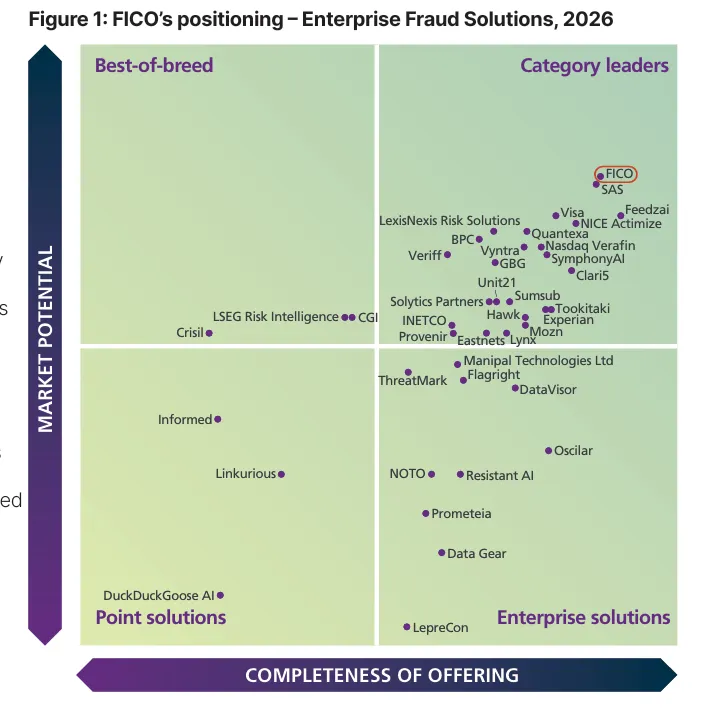
- Enterprise fraud management (centralized, cross-channel detection) is replacing siloed point solutions, a shift recognized in the 2026 Chartis Vendor Spotlight report naming FICO's positioning in the space.
What is Fraud Detection? Core Concepts and Principles for Financial Services
At its core, fraud detection is the process of identifying and preventing deceptive practices designed to obtain financial or other gains through illicit means. It encompasses a wide range of activities, from monitoring individual transactions to analyzing broad behavioral patterns, to uncovering suspicious activities or malicious actors before they cause significant harm. For financial institutions, fraud management means safeguarding customer accounts, preventing unauthorized transactions, identifying and intervening in transactions that may be associated with criminal activity, and protecting the institution’s assets and reputation.
Consider credit card fraud . A customer makes a purchase online. A strong fraud detection system immediately analyzes this transaction against a wealth of historical data, including the customer's typical spending habits, geographical location, transaction size, merchant type, and device used. If the system detects out-of-pattern spending, the transaction originates from an unusual location, or use of a device not previously associated with the account, it flags the transaction as potentially fraudulent. This flag triggers further investigation or an immediate hold on the transaction, protecting the customer and the institution.
The primary objectives of a fraud detection framework are to accurately identify genuine fraud and to minimize false positives, when legitimate transactions are incorrectly flagged as fraudulent. A fraud detection system that errs too often on the side of caution can frustrate customers and lead to lost business, while a system that misses too much fraud exposes the institution to unacceptable risks and losses.
What Is the Typical Fraud Detection Process?
- Data Collection: Gathering vast amounts of data from various sources, including transaction histories, customer profiles, behavioral data, device information, and third-party risk intelligence.
- Anomaly Detection Modeling: Applying analytical techniques, such as machine learning algorithms, to identify patterns indicative of fraud by pinpointing deviations from established norms or expected behavior. These anomalies are the initial signals of potential suspicious activities.
- Analysis and Decisioning: Developing risk-based strategies leveraging the anomaly detection modeling and other data to determine whether to approve, deny, or further review a transaction.
- Alert Generation: When the analysis and decisioning identify potential fraud, the system generates an alert, notifying human analysts or triggering automated actions such as contacting the customer or blocking a transaction.
- Investigation: Fraud analysts review the priority alerts, gather additional context, and contact the customer to determine whether the activity is indeed fraudulent. Based on their findings, a decision is made to block or unblock the account, reissue a card, or other actions.
- Feedback Loop: The outcomes of investigations are fed back into the system to refine rules and retrain machine learning models, ensuring continuous improvement and adaptation to new fraud patterns.
What are the Key Principles of Fraud Detection in Banking?
- Accuracy: The ability to correctly identify transactions as fraudulent or legitimate, minimizing both false positives and false negatives.
- Speed (Real-Time): The ability to process and analyze massive volumes of transactions in milliseconds is vital to preventing fraud during the authorization process.
- Adaptability: The capacity of the system to evolve and learn from new data, direct feedback, and detect emerging fraud schemes.
- Explainability: Understanding why a particular transaction was flagged as suspicious is crucial for regulatory compliance and effective investigation.
- Scalability: The system must be able to handle ever-increasing volumes of data and transactional volume without degradation in performance.
Why Fraud Detection Is Imperative for Financial Services
The financial services industry is a prime target for malicious actors. Because banks and other financial service providers deal with vast sums of money and sensitive customer data, they face an unrelenting barrage of criminals attempting to exploit vulnerabilities. The need for holistic enterprise fraud management systems has never been greater, and continues to be driven by escalating fraud volumes, increasing fraudster sophistication, and changing regulatory requirements.
Fraud losses are substantial and multifaceted. Beyond the direct theft of funds, institutions incur significant costs associated with investigations, chargebacks, operational overhead, and potential regulatory fines, which can impact the bottom line and strain resources. In addition, a single high-profile fraud incident can severely tarnish an institution's reputation, leading to a loss of customer trust and market share. Customers expect their financial providers to safeguard their assets and data; any breach of this trust can result in a mass exodus and a prolonged struggle to rebuild credibility.
Regulatory bodies worldwide impose strict requirements on financial institutions to implement effective controls to mitigate financial crime risks. Failure to comply can result in hefty fines, legal penalties, and severe operational restrictions, which means an institution's investment in enterprise fraud detection and management is both a good business decision and a regulatory obligation.
Fundamentally, fraud detection is the strategic defense mechanism that protects an institution's financial health, safeguards its customers, and upholds its standing in the market. Fraud detection is not reactive, but a proactive, real-time shield, constantly working to identify and intervene against criminal activities before they develop into significant losses.
Fraud is Constantly Evolving – Detection Systems Must Keep Up
Fraud is in a state of perpetual evolution. Fraudsters are agile, constantly adapting their methods to circumvent existing security measures and exploit new technologies like generative AI. What was effective fraud management yesterday may be obsolete tomorrow, which means organizations need dynamic fraud detection capabilities that can learn, adapt, predict, and identify new fraud patterns. Let's examine some of the different types of established and emerging frauds and the role of AI in fraud detection.
How AI is Changing the Fraud Landscape
Generative AI has handed fraudsters tools that were once available only to well-resourced criminal organizations. Voice cloning, deepfake video, and AI-generated identity documents now let a single bad actor run convincing, personalized scams at a scale that used to require an entire team.
The scale of this shift is significant. Deloitte's Center for Financial Services projects that generative AI could push fraud losses in the United States from $12.3 billion in 2023 to as much as $40 billion by 2027.
This shift cuts both ways. The same technology fueling new attack types can also strengthen the institutions defending against them, but only if their detection systems evolve just as fast as the threats. A system built to catch yesterday's phishing email or synthetic application has no mechanism for recognizing a deepfake voice call or an AI-generated identity document, because it was never designed to look for those signals. This is what makes a deliberate AI fraud detection strategy essential for institutions.
Payment Fraud
Payment fraud represents a significant portion of all fraudulent transactions and typically involves unauthorized access or manipulation of payment instruments.
- Card-Not-Present (CNP) Fraud: This occurs when fraudsters use stolen card information (obtained via data breaches, phishing, malware, and other means) to make purchases without having the physical card.
- Account Takeover (ATO): With account takeover fraud, a fraudster gains unauthorized access to an existing account, often through phishing, credential stuffing, or malware. Once in control, they can take actions like changing contact information or making unauthorized purchases. Behavioral analytics play a crucial role, particularly non-monetary transaction analysis such as detecting logins from new devices or locations or changes in personal details.
- Authorized Push Payment Fraud (APP): Authorized push payment fraud, commonly known as scams, happens when victims are tricked into authorizing payments or initiating wire transfers to fraudsters. This tactic has continued to grow globally: the FBI’s annual IC3 report tallied an average of 836,000 fraud complaints per year since 2020, or more than 4 million total, totaling $50.5 billion in losses. The latest report from the Global Anti-Scam Alliance estimates 2024 losses globally at $1 trillion.
- Digital Wallet Fraud: Digital wallet fraud occurs when digital wallets are compromised through phishing, malware or social engineering, to allow fraudsters to load stolen credentials for spending.
- Account Compromise: Fraudsters use deceptive communications (email, SMS, voice calls) to phish/smish/vish customers accordingly into revealing login credentials or other sensitive information. Once credentials are stolen, they gain unauthorized access to online accounts or make fraudulent purchases.
- Malware-Driven Fraud (Trojans, Ransomware): Malicious software installed on a user's device can intercept banking credentials, manipulate transactions, or even take control of the device to perform unauthorized actions.
Application Fraud
Application fraud occurs when individuals provide false information to obtain financial products, often leading to financial losses for institutions.
- Synthetic Identity Fraud: This sophisticated scheme involves creating a new identity using a mix of real and fabricated personal information (e.g., a real Social Security number combined with a fake name and date of birth). These synthetic identities are then used to open accounts, build credit history, and eventually "bust out" by maxing out lines of credit and disappearing. Synthetic identities are challenging to detect because the identity has sufficient legitimate information to pass traditional checks. Detection often requires advanced network analytics to identify connections between synthetic identities and shared fraudulent attributes, as well as behavioral analysis that flags fraud signals like rapid credit seeking.
- First-Party Fraud (Bust-Out Schemes): This is where legitimate customers intentionally defraud financial institutions. They open accounts, use them normally to build trust, and then maximize the credit lines with no intention of repayment, effectively "busting out" with the borrowed funds. Detecting first-party fraud involves analyzing the complete lifecycle of an account, looking for patterns of rapid credit utilization after a period of normal behavior, changes in financial habits, or attempts to obtain multiple credit products simultaneously before the bust-out.
- Third-Party Fraud: Third-party fraud occurs when an unknown or unauthorized entity commits identity fraud against individuals. Fraudsters use personally identifiable information obtained through data breaches or social engineering to bypass fraud defenses and open fraudulent accounts or secure credit in another individual’s name.
What is the Role of AI in Fraud Detection?
The imbalance is stark. Signicat's 2024 Battle Against AI-Driven Identity Fraud report found that AI-driven fraud already accounts for 42.5% of detected fraud attempts in financial services, while only 22% of institutions had deployed AI-driven identity fraud measures in response. Closing that gap starts with understanding what AI actually contributes to modern fraud detection.
In practice, AI plays several distinct roles across the fraud detection lifecycle:
Onboarding and identity verification
- Deepfake and liveness detection: AI screens ID document uploads and video selfies for face swaps, injection attacks, and synthetic document artifacts.
- Synthetic identity screening at application: ML models flag credit/loan applications with fabricated or fabricated identities before an account is even opened, rather than only after transactions begin.
- Counter-generative-AI detection: Media forensics tools built specifically to catch AI-generated voice, video, and text artifacts.
Authentication and access verification
- Adaptive step-up authentication: Risk scores from behavioral and device signals trigger additional verification (OTP, biometric recheck) only when needed, reducing friction for legitimate users.
- Bot and credential-stuffing detection: AI distinguishes automated login attacks from genuine users at the authentication layer, separate from post-login behavioral biometrics.
- Behavioral biometrics: Patterns in typing speed, device handling, and navigation are analyzed to catch account takeover attempts even when the correct login credentials are used.
- Voice and language analysis: Natural language processing and voice biometrics help identify the subtle artifacts of AI-generated speech and text used in vishing calls and phishing messages.
Transaction monitoring
- Cross-channel/omnichannel correlation: AI links signals across card, wire, ACH, and P2P rails to catch fraud that moves between channels rather than staying in one.
- Real-time anomaly detection: Machine learning models score each transaction against a customer's historical behavior in milliseconds, flagging deviations a static rule would never catch.
- Real-time payments fraud scoring: Because instant payment rails have no chargeback window, AI-driven pre-transaction scoring and insights matter more here than in card networks.
Investigation and case management
- Alert prioritization and triage: AI ranks and clusters alerts by risk so investigators spend time on the highest-value cases instead of working a flat queue.
- Explainable AI outputs: Models generate reason codes for flagged transactions, supporting compliance and adverse-action requirements, since regulators are increasingly scrutinizing black-box fraud models
- Network and graph analytics: By mapping relationships between accounts, devices, and identities, AI can surface synthetic identity rings that share fabricated attributes across dozens of seemingly unrelated applications.
None of these functions operate in isolation. The institutions closing the adoption gap are the ones treating AI as an orchestrated layer across decisioning and case management, not a bolt-on feature applied to a single channel or fraud type.
FICO's Ongoing Commitment to Fraud Detection
FICO has more than 30 years of fraud-fighting experience and is deeply committed to fraud detection. FICO offers advanced AI/ML-driven enterprise fraud management solutions that protect billions of accounts and transactions globally. Some 4 billion of the world’s payment card accounts are protected by FICO, which has developed 100+ fraud detection patents.
Behavioral Analytics
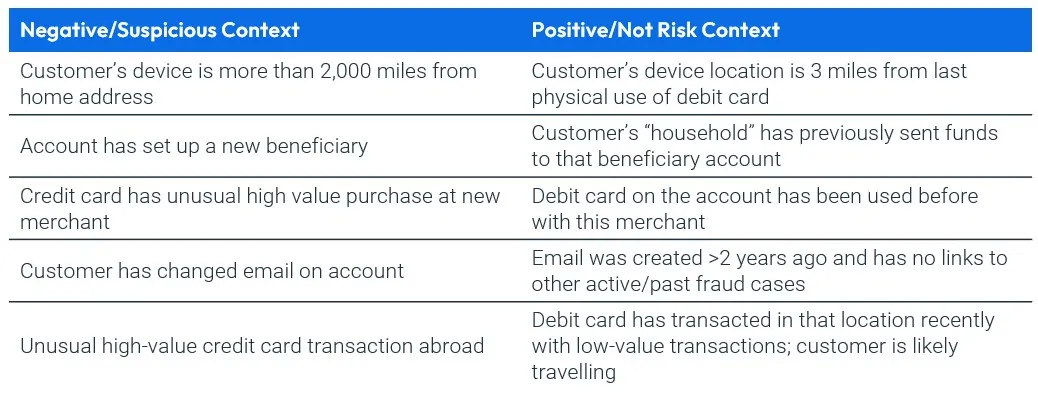
Behavioral analytics use AI and machine learning to understand and anticipate behaviors across each aspect of a transaction. The information is tracked in profiles that represent the behaviors of each individual, merchant, account, or device. These behavioral profiles are updated with each transaction in real time to create analytic characteristics that predict future behavior. FICO’s robust enterprise fraud management capabilities combine analytic models and behavioral profiles to deliver insights about evolving transaction patterns in real time.
Authorized Push Payment Fraud
FICO helps financial institutions detect and prevent APP fraud thanks to an award-winning scam detection score. The model uses AI and machine learning to evaluate customer-specific archetypes based on their payment history to determine if the payment has a high propensity to be a normal transaction or an abnormal, potential scam payment. Additional insights from the award-winning FICO® Scam Signal can help institutions use real-time telephony signals to further refine decisions about specific transactions and whether they are potentially associated with a scam payment.
Enterprise Fraud Management
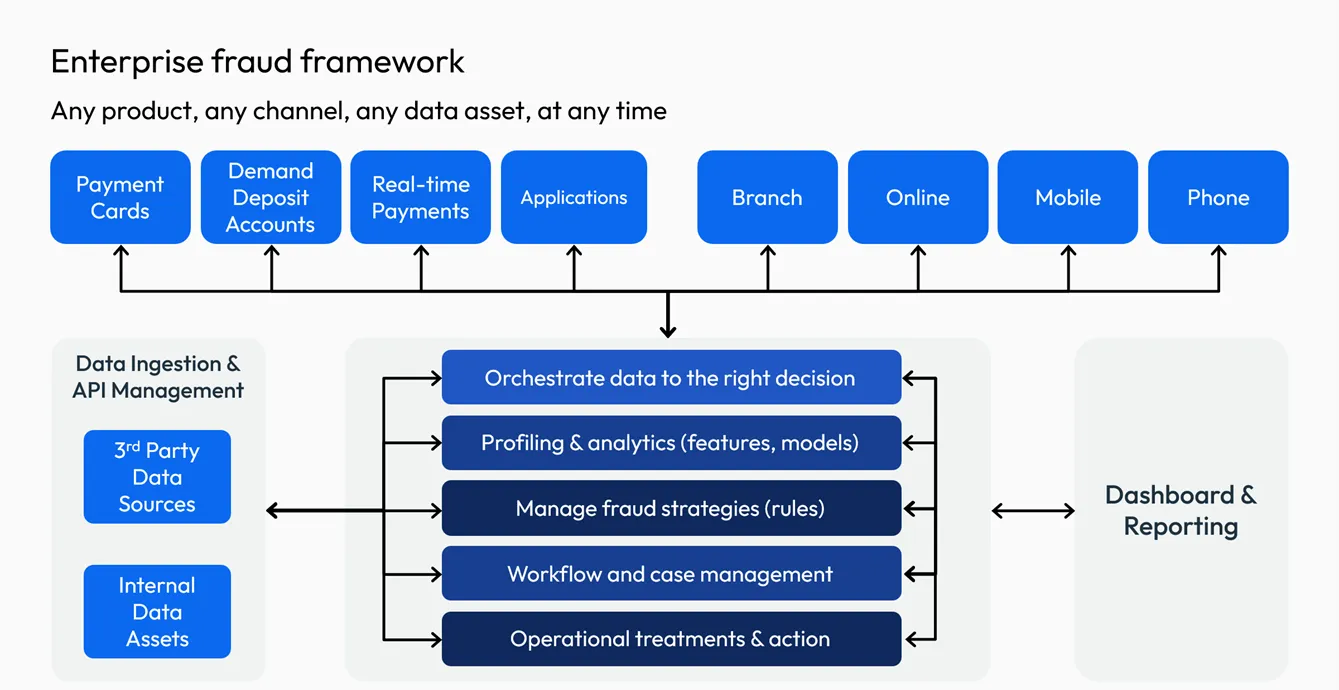
Enterprise fraud management reflects FICO's philosophy of centralized fraud management. Enterprise fraud management helps break down silos so that fraud can be identified wherever it happens in the customer lifecycle. FICO's approach is transforming fraud-fighting efforts by eliminating siloed, disconnected systems and giving institutions a centralized, coordinated, holistic system that protects both the organization and its customers, as recognized by the 2026 Chartis analyst report.
A Continuous Pursuit of Financial Security
Fraud detection in financial services requires adaptive, multi-layered defenses against sophisticated threats. Effective fraud prevention relies on people, processes, policy, and technology. Advanced AI and machine learning supported by FICO’s AI and Analytics platform enable real-time transaction monitoring and accurate risk scoring, but implementing these systems involves choosing the right technology, building skilled teams, and meeting regulatory and privacy requirements. The time invested in choosing and deploying the right fraud detection solution is worth it, as it will result in reduced losses, greater trust, and improved efficiency.
How FICO Can Help You Build and Strengthen Your Enterprise Fraud Management
- Read Beyond Point Solutions: Orchestrating the Future of Fraud Prevention, the analyst report from Datos Insights to help financial institutions better understand the fraud orchestration market and develop a centralized fraud management strategy that works best for them.
- Download Chartis Vendor Spotlight: Enterprise and Payment Fraud Solutions, 2026 to learn where FICO excels, and how we can help fight enterprise and payments fraud.
- Read The 6 "E"s of Enterprise Fraud Management to understand how to navigate the complexities of enterprise fraud management with seamless orchestration, real-time detection, and scalable prevention and intervention strategies.
- Download the Scam Signal solution sheet to read more about how FICO can mitigate APP scams with real-time detection and intervention.
- Download the FICO Focused Foundation Model Executive Brief to see how purpose-built GenAI strengthens fraud detection without sacrificing auditability.
Note: This is an update of a post from 2025.
Frequently Asked Questions
Explainability refers to the ability to understand why a specific transaction was flagged as suspicious, and it matters for two practical reasons. Regulators require financial institutions to justify decisions that affect customer accounts, so a model that cannot produce a clear rationale creates compliance risk. Fraud analysts also depend on explainability to investigate alerts efficiently, since an opaque flag with no supporting reasoning slows down case resolution and increases the chance of an incorrect outcome. Alongside accuracy, speed, adaptability, and scalability, explainability is one of the core principles that determines whether a fraud detection system holds up under scrutiny.
Overly aggressive fraud controls frustrate legitimate customers and drive them toward competitors, while controls that are too lax expose the institution to losses. The balance point depends on minimizing false positives without sacrificing detection accuracy, which is why behavioral profiling and real-time scoring matter more than static thresholds. A 2025 FICO consumer survey found customers will switch banks if fraud prevention expectations go unmet, underscoring that customer experience and fraud prevention are not competing priorities but interdependent outcomes of the same detection strategy.
Selecting a vendor starts with evaluating how it performs across the principles of accuracy, speed, adaptability, explainability, and scalability, since a solution weak in any one area introduces risk elsewhere. Institutions should also assess whether a vendor offers enterprise fraud management, meaning detection across the full customer lifecycle rather than a single channel or fraud type. Track record matters too: analyst evaluations such as the Chartis Vendor Spotlight offer an independent view of how platforms compare on capability and market positioning before a contract is signed.
The business case rests on comparing the cost of a platform against the losses, operational overhead, and reputational damage a weaker system allows through. Reduced false positives alone lower investigation costs by freeing analysts from manually reviewing legitimate transactions, while improved detection accuracy limits direct fraud losses and the regulatory penalties tied to compliance failures. Institutions evaluating this tradeoff often reference independent analyst reports, such as Datos Insights and FICO's fraud orchestration report, to benchmark expected returns against current-state costs before committing budget.

Popular Posts

Average U.S. FICO® Score at 716, Indicating Improvement in Consumer Credit Behaviors Despite Pandemic
The FICO Score is a broad-based, independent standard measure of credit risk
Read more
The GSE Data Is Public. Here's What It Shows About Credit Score Modernization.
Independent Milliman analysis of GSE historical data confirms what anyone can now verify directly: FICO® Score 10T is the most predictive score.
Read more
FICO Statement on FHFA and FHA Updates to Credit Score Modernization
FICO supports FHFA’s announcement that the long-anticipated historical data for FICO® Score 10T will be released to the mortgage market.
Read moreTake the next step
Connect with FICO for answers to all your product and solution questions. Interested in becoming a business partner? Contact us to learn more. We look forward to hearing from you.